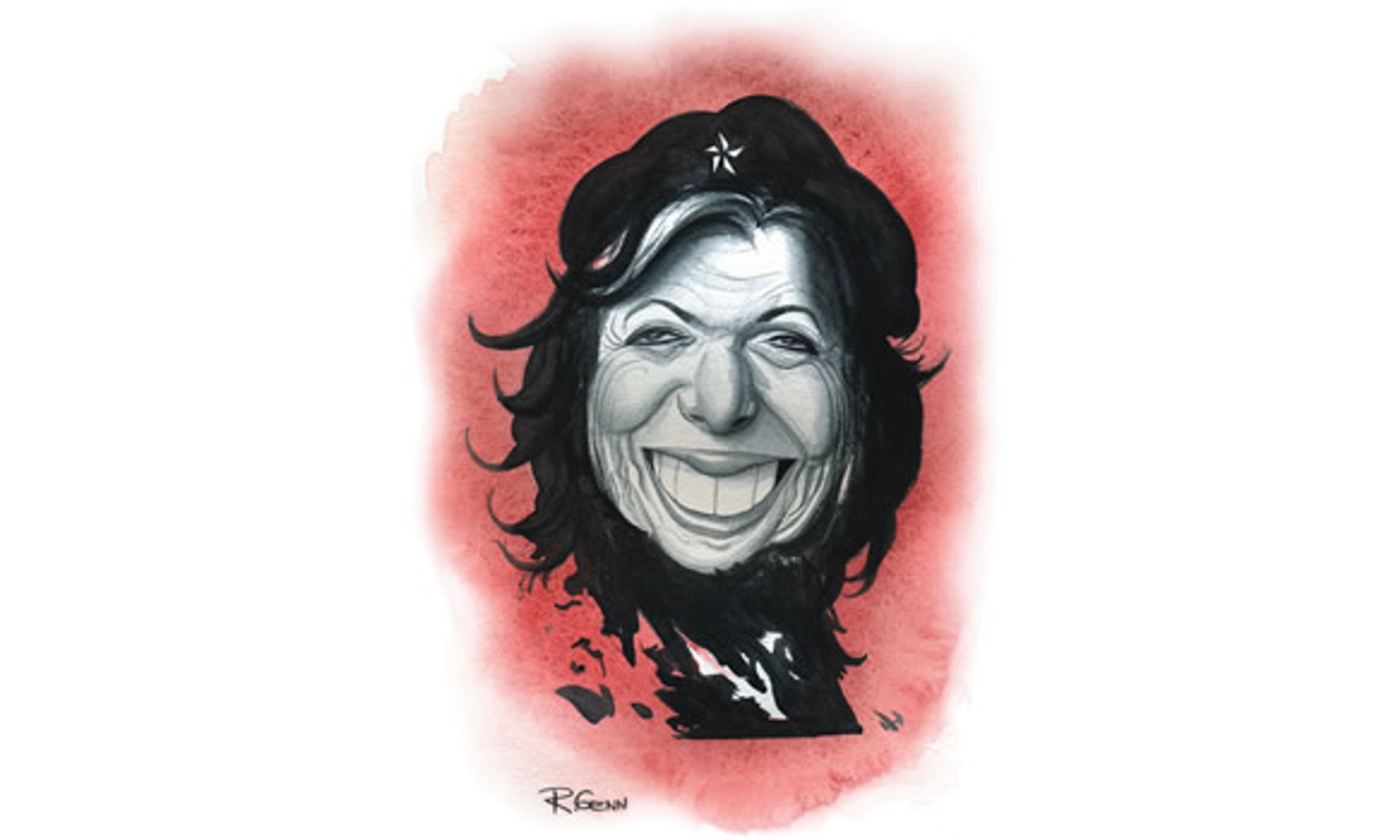
This is a wacky year, politically, and it bids to be wackily wonderful, for Republicans. High on their wish list is the defeat of Barbara Boxer, the longtime senator from California. She is being challenged by a Republican newcomer: Carly Fiorina, a lifelong businesswoman. Boxer is the favorite in the race. But if strange things happen on Election Day, a Boxer defeat could be one of them — and Republicans will be dancing in the streets.
She is possibly the leftmost member of the Senate, Boxer is. And she is maybe the most partisan in style. (It’s been 15 years since Howard Metzenbaum served.) Boxer can be strident, shrill, and other things you must never call a woman. She is quite unlike the other senator from California, Dianne Feinstein. DiFi’s a liberal Democrat, all right: but she occasionally departs from liberal orthodoxy, and you can work with her. Boxer does not mingle much with Republicans. And, ideologically, she’s true-blue, or true-something. Boxer has a good deal in common with Speaker Nancy Pelosi: Both women grew up in the East, Boxer in Brooklyn, Pelosi in Baltimore; and both went west to San Francisco, to become scrappy heroines of the Left.
Boxer was born in 1940, and made it to the Marin County Board of Supervisors in 1976. Six years later, she made it to the U.S. House. While there, she was known for her fierce opposition to the Gulf War, and for her perhaps fiercer opposition to Clarence Thomas. As a House member, she could not vote on that Supreme Court nominee: but she marched, literally, in favor of his accuser, Anita Hill. “Believe the woman” was an article of Democratic faith in those days; with the rise of Bill Clinton, that would go out the window.
In 1992, Boxer ran for the Senate, beating two other experienced Democrats in a primary. She then beat Bruce Herschensohn in the general: when it was revealed, at the last minute, that he had been to a strip club (with his girlfriend and another couple). Who knew that the California electorate was so square? Several other women were elected to the Senate at the same time, which is why 1992 was dubbed “the Year of the Woman.” Boxer has had two races since, both of them relative cakewalks for her.
How left-wing has she been in the Senate? Consider a single fact: She was the only senator to vote against accepting the Ohio results in the 2004 presidential election, Bush versus Kerry. Conspiracy types claimed that the Republicans had rigged things in Ohio; Boxer wanted a debate. Mainly, she has been known for her staunch, total support of abortion, and that includes partial-birth abortion, of course. In one infamous, creepy exchange with Sen. Rick Santorum in 1999, she had trouble saying that a baby had a right to life even if it made it out of its mother’s womb.
More notoriety came her way in June 2009, when an Army general, Michael Walsh, was testifying before her. In the military fashion, he called her “ma’am.” She interrupted him, saying, “You know, do me a favor. Could you say ‘senator’ instead of ‘ma’am’? It’s just a thing. I worked so hard to get that title.” The general meekly complied.
Out in California, Fiorina has made hay out of this episode. She’ll tell an audience that, if they elect her, “you may call me ‘ma’am.’ You may call me ‘senator.’ You may call me ‘Carly.’ You may call me, ‘Hey you: Remember, you work for me.’” Her first TV ad of the general election featured a clip of Boxer upbraiding General Walsh. Then Fiorina looked into the camera and promised to “end the arrogance in Washington.”
Born in 1954, she climbed her way up the business ladder, eventually reaching the top rung: CEO of Hewlett-Packard. That was in 1999; she got the boot in 2005. Opinion on her tenure at HP is sharply divided: Her supporters say she made some tough, modernizing decisions, leaving the company new and stronger; her critics say she undermined something long-established and good. In any case, she quickly became a political figure, post-HP. She was an ally of John McCain, and was even a wild card to be his vice-presidential nominee. Another wild card got that nod: Alaska’s governor, Sarah Palin.
Who, incidentally, endorsed Fiorina in the 2010 Senate primary, saying this ex-CEO was “the conservative who has the potential to beat” Boxer. Fiorina won the nomination over two capable Republicans, Tom Campbell and Chuck DeVore. And she ran a quite conservative campaign: against abortion, for the Arizona immigration law, for gun rights, for free markets — the whole nine yards. Republicans have their own Year of the Woman going in California (as elsewhere, actually): The gubernatorial nominee is Meg Whitman, who, like Fiorina, is a political newcomer and an ex-CEO (eBay). Her opponent is state Democratic legend Jerry Brown.
A funny thing happened after the Senate primary: Fiorina kept running as a conservative. She did not “pivot to the center,” as a Republican nominee in California is expected to do. She is continuing to talk to “tea parties,” unblushingly. Days ago, she told the press, “Tea parties have been a tremendous help to my campaign.” Aides to Fiorina kind of shrug their shoulders: “They say we’re running a conservative campaign. The truth is, we’re running a conservative candidate. She is what she is.” What can you do?
Her basic line is that Boxer is a career politician, sorely in need of retirement. She points out that, when Boxer entered politics, the No. 1 song in the country was “The Way We Were.” (She adds that Boxer’s career ought to be confined to “memories,” ha, ha, ha.) She, on the other hand, is a can-do businesswoman who can shake up politics, when a shaking up is needed. The California Senate race is like the one in Wisconsin: where a businessman and tea-party upstart, Ron Johnson, is challenging Sen. Russ Feingold, a smart, skillful, liberal political lifer.
California, like the rest of the country, is on hard times: Unemployment is 12.4 percent. Boxer is not used to running in such unfavorable conditions. And, as a seasoned observer points out, she is not used to being a “jobs” politician: She is used to being a flaming radical on the environment and abortion. (The senator herself, curiously enough, would not put it this way.) But she is a very good campaigner, and she works extremely hard. You heard what she told General Walsh: “I worked so hard to get that title.”
And she has some fundamentals going for her. As a Republican politico puts it, “The state numbers just stink — and they’re getting worse every year.” What does he mean? Democrats have a huge lead in registration, and the Latino vote is burgeoning. The Democrats have won seven Senate elections in a row: a discouraging datum for Republicans. Also, Boxer has a big lead in money: something like eleven times what Fiorina has. Longtime incumbency has its advantages, and Boxer’s friends at the plaintiff’s bar are rich and generous. But Republicans have intensity this year. And Fiorina will have adequate, though not equal, money.
Where Boxer is killing her is over her tenure at HP: where Fiorina had the unenviable task of laying off workers and outsourcing jobs. Boxer put up a harsh, nearly diabolical, ad, portraying Fiorina as some combination of Marie Antoinette and Ebenezer Scrooge. The narrator said, darkly, “Fiorina shipped jobs to China. And while Californians lost their jobs, Fiorina tripled her salary. Bought a million-dollar yacht. And five corporate jets. Carly Fiorina: Outsourcing jobs. Out for herself.” After seeing that ad, a Republican politico in the state — not the one quoted above — concluded that Fiorina would not win. Her jibes about “ma’am” were no match for this jobs business.
How does Fiorina reply to Boxer? Like an economically literate adult, which may not do her much good in the campaign. She explains that, on her watch, jobs at HP increased. She also explains that globalization is a fact of life: “Any job can go anywhere.” Furthermore, she says that, if California is uncompetitive, it’s thanks to politicians such as Boxer: who make the state far less attractive to employers than Nevada, Texas, and North Carolina, not to mention China and other foreign countries. Boxer has no clue about a modern economy, Fiorina says: “This is a woman who went into politics before Microsoft was formed.”
Then there’s abortion: another killer issue for Boxer. A prominent Democratic politico in California, Garry South, wrote, “The issue of abortion alone is sufficient to sink Fiorina.” Being against abortion in California, he said, is like being against oil in Texas. Fiorina notes that, while most Californians aren’t pro-life, as she is, they are not way out where Boxer is: supporting partial-birth abortion and public financing of abortion; opposing parental notification.
If Fiorina makes it to the Senate, she’ll be a big star — a big Republican national star. She is bright, personable, articulate, and different. She is a connector with crowds and individuals. But don’t bet the ranch on her making it. Some people who wish her well, and wish Boxer ill, are cross with her. They say, “Here was a once-in-a-lifetime chance to oust Barbara Boxer, this Sandinista of the Senate, and what does Carly do? She goes and runs a flat-out conservative campaign in the general, as though it were a primary. Thanks a lot — she’s blown it.” Others say, “Not so fast. First, she’s running honestly. Second, she’s right in there: an underdog in a competitive race.”
Moreover, a competitive race in a most unusual year: a year favorable to upstart Republicans and dangerous for incumbent Democrats. Even to Barbara Boxer, in determinedly liberal California? Yes. She could go down — to a frank Reagan conservative — and, oh, would Republicans party.











Comments