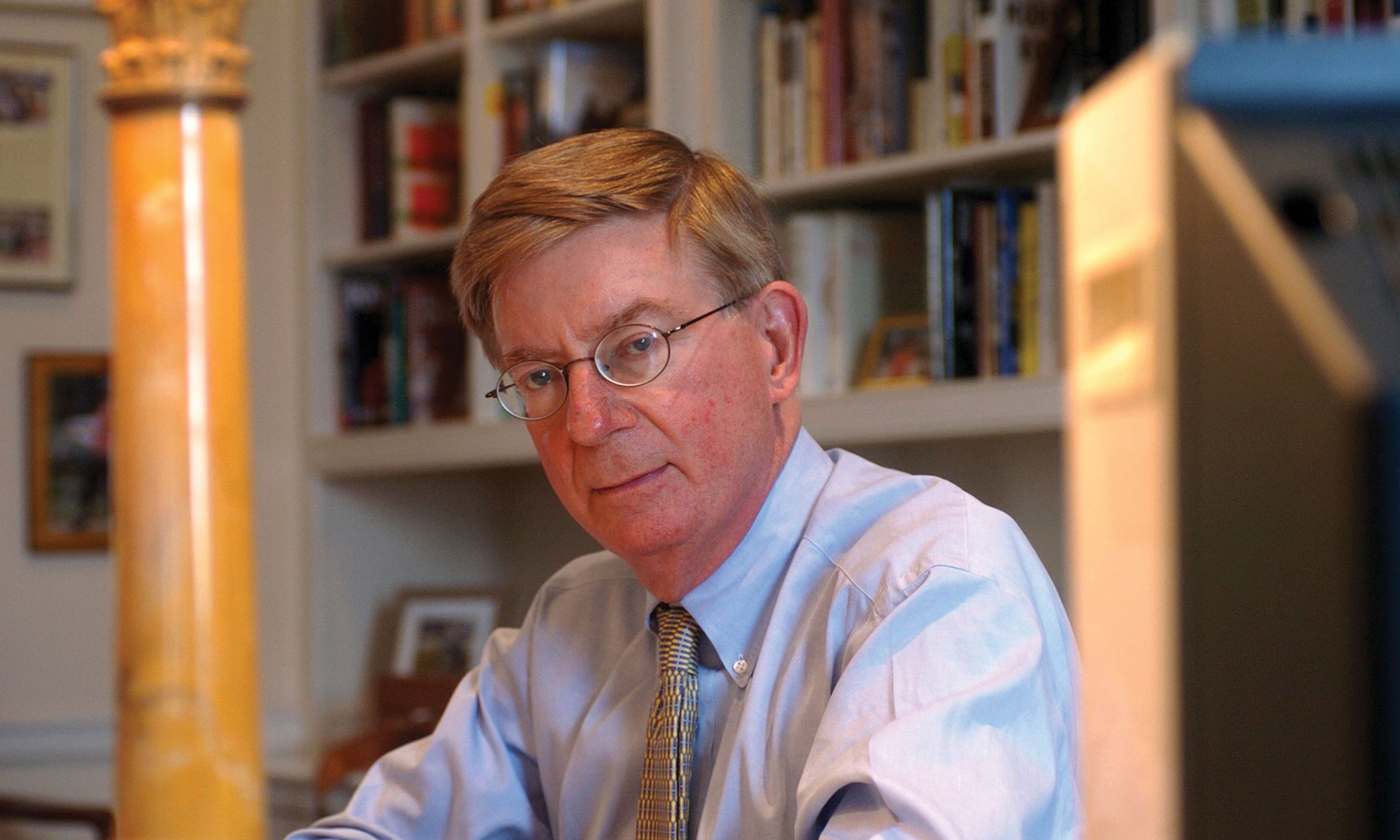
Last May, George F. Will published a column that was learned, sparkling, and wise. In other words, typical. It was also shocking. Why? Because, in it, Will disclosed that he had just turned 80. “To be 80 years old in this republic,” he wrote, “is to have lived through almost exactly one-third of its life.”
And his concluding sentence: “To live a long life braided with the life of a nation conceived in liberty and dedicated to an imperishable proposition is simply delightful.”
Yeah, yeah, nice about the braiding and all that, but — 80? George Will is 80? How is that possible? He looks the same as he always did, more or less. He writes and talks the same too: with verve, precision, and élan. He is not autumnal (except when the occasion calls for it). He motors along, timelessly.
He began writing columns for National Review and the Washington Post in 1973. Nixon was beginning his second term (which would be a short one). Will won the Pulitzer Prize for commentary just about as soon as you can — in 1977. Jimmy Carter was in his first year as president.
In October of ’77, the Yankees beat the Dodgers in the World Series. Billy Martin managed the Yankees, Tommy Lasorda the Dodgers. Catfish Hunter was on the Yankees’ pitching staff, Don Sutton on the Dodgers’. One of the umpires was Nestor Chylak. Providing color commentary in the booth was Howard Cosell.
All of this is meaningful, and orienting, to baseball people. George Will is such a person — and how. All politics and no play makes Jack a dull boy. William F. Buckley Jr. had sailing and music; Will has baseball. He does not have much use for football. That game, he says, combines two of the worst elements of American life: violence and committee meetings (in the form of huddles).
In 1990, Will wrote one of the best-selling sports books of all time: Men at Work: The Craft of Baseball.
Will is a craftsman himself — producing those columns at 750 words a crack. When he wrote his magnum opus, The Conservative Sensibility, two years ago, I asked him whether he had labored over it, poured his sweat into it. Not really, he said: He enjoyed having the room. (The book is more than 600 pages.) Columns, you have to sweat over, fitting them into that column-size frame.
I well understand. Once, when I had written something in a very tight space, I got a nice compliment from an editor (John Podhoretz): “You’re a haiku-ist.”
But back to George Will’s longevity, his stamina, his perpetual brio: How? I think the answer lies in the pleasure he takes from his immersion in the torrent. I had better explain that.
Will has published a new collection of columns, American Happiness and Discontents: The Unruly Torrent, 2008–2020. He opens his introduction with a statement by Ortega y Gasset about “the unruly torrent of life.” Will then observes that a journalist’s job is to “chronicle and comment on” this torrent. For a half century now, Will has arrived at his office each morning “impatient to get on with the pleasure of immersion in the torrent.”
How do you feel about the torrent? Sometimes, I must confess, I envy people who barely know who’s president. I myself seem drawn to the torrent, day after day.
George F. Will was born in 1941, named after George Sabine, a professor of philosophy at Cornell. Mr. Sabine had been the dissertation adviser of Will’s father, Frederick L. Will, a professor of philosophy at the University of Illinois. George Will grew up in Lincoln country. He was, as he once put it to me, “marinated in the spirit and reality of Abraham Lincoln.” I’m not sure there is a keener student of Lincoln than Will. I’m not sure there is a greater admirer.
In one of our podcasts together, Will told me that, in his estimation, Lincoln had “the greatest career in the history of world politics.”
Will had lots of education — at Trinity College, in Hartford, Conn.; at Magdalen College, Oxford; and at Princeton, where he earned a Ph.D. in politics. He was a professor for a while. In his columns, he sometimes seems a Supreme Court justice manqué. He is a legal beagle, without J.D. But his calling, no doubt, was to be a writer.
In the introduction to his new collection, he writes of visiting New York City in his freshman year of college. “Arriving in the splendor of Grand Central Terminal, I plunked down a nickel for a New York tabloid in order to see what was going on in Gotham. This purchase of a New York Post was a life-changing event because in it I found a column by Murray Kempton.”
A first encounter between a mind and spirit like George Will and a Murray Kempton column must have been explosive.
“I do not remember what his subject was that day,” Will continues, “but his subjects generally were of secondary importance to his style, which reflected his refined mind and his penchant for understated passion, mordantly expressed.”
That is exactly what Bill Buckley used to say: that Kempton’s subjects, and even his views, were of secondary importance to his style. Here in NR, WFB published Kempton at every opportunity — no matter what Kempton wanted to say. This did not sit well with people of a more ideological orientation; but it certainly sat well with WFB — a writer admiring a fellow craftsman, a fellow artist.
(When Kempton died in 1997, Bill wrote a long appreciation of him, ending, “He was a great artist, and a great friend.”)
WFB admired George Will, too — a philosophical and political kinsman, in addition to a fellow craftsman and artist. At our 50th-anniversary party, in 2005, WFB greeted Will with the words “My leader.”
For all these years, GFW has meant a lot to many of us. Will is the reason that Jonathan V. Last, my old friend and one-time co-worker, became a writer. He is the reason that JVL uses his middle initial — Will did, so why shouldn’t he, too? In fact, Last sometimes refers to Will, with earthy reverence, as “George Effin’ Will.”
Will had an influence on me, and I think of two issues, in particular — big ones: Israel and abortion. He was for the first, against the latter. So am I. In a podcast with me, he said, “Is it possible that abortion will look 70 years from now the way segregated buses look today? I think it’s possible.”
Looking back, I think of lighter columns, as well as heavier. There was the time George was taken to a Bruce Springsteen concert and wore earplugs (1984). There was the time he pronounced Ferris Bueller’s Day Off the greatest movie — movie, now, as distinct from film — ever made (1986).
And he was a steady presence on television — speaking in the same crisp, smooth paragraphs that characterized his writing. With Sam Donaldson, he was a panelist on David Brinkley’s Sunday-morning show. Sam once told Johnny Carson something like this: “I used to call George ‘the smartest person I know.’ But then someone pointed out, ‘Hey, you disagree with him on everything. What does that say about you?’”
In Will’s formulation, Murray Kempton exemplified “trenchant elegance.” So does he, really. Also, Will is wry, as in that 80th-birthday column, last May: “Among the abundant pleasures of turning 80, in addition to being well beyond the danger of dying young, is . . .”
Bill Buckley would search for, and land on, the “right word.” Indeed, that’s what he titled his collection on language: The Right Word. GFW lands on the right word as well. In one of our podcasts, he described Mookie Betts, an outfielder with the Dodgers, as “superb,” sure, but also “angelic.” Yes.
Language and style aside, Will is a “honey badger” — a fearless animal, a fearless writer, who doesn’t care what the Left thinks, who doesn’t care what the Right thinks, who says what he thinks is so, trusting that he will find his readers, who value the honesty and independence.
In the new collection, there are ample columns on politics, policy, etc. You also get Frank Sinatra, on the occasion of his centennial. Will celebrates him as a craftsman — same as he does the top baseball players. He also says, “Sinatra was many things, some of them — libertine, bully, gangster groupie — regrettable. But he unquestionably was the greatest singer of American songs.”
“Unquestionably”? Is that the mot juste? I question it. (I could easily live with “arguably.”)
Will also writes about another singer — a singer-songwriter — namely Bob Dylan. In 2016, Dylan won the Nobel Prize in Literature. You want wry? “If you recognize even one-third of the 113 literature prize winners since 1901,” Will says, “you need to get out of the house more.” He also includes a political note: Dylan once called Barry Goldwater his “favorite politician.”
(In one of our podcasts, Will said, “I cast my first presidential vote for Barry Goldwater, and I’m not sure I’ve enjoyed a vote as much since.”)
I cannot pass the subject of Dylan without remembering WFB — who did not give a positive review to his singing. Dylan, said Buckley, “has enough gravel in his throat to stop Jean-Claude Killy in mid-slope.” (Bill also blasted the Beatles. He was never a bower to popular culture.)
George Will ends his collection with a moving column, even a gut-punch. It is about how families are notified when their loved ones are killed while wearing our uniform. Will’s longtime assistant, Sarah Walton, received such a notification in 2008. Her husband, Lieutenant Colonel Jim Walton — West Point Class of 1989 — had been killed in Afghanistan. Will dedicates the collection to Sarah.
In the eyes of many, Will is the paradigmatic conservative. I once asked him, “What is a conservative, exactly? Or generally?” A conservative, Will replied — an American conservative, he specified — is someone who desires to conserve our founding — our ideals, our experiment, our way of life — which is under constant attack. I believe that George Will ought to have the Medal of Freedom, from a president either R or D.
I also think of what Bill Buckley said of Jeane Kirkpatrick: “She ought to be woven into the flag as the 51st star.” (On hearing about this, Michael Kinsley quipped, “Sounds painful.”)
When I hit him with praise some time ago, in one piece or another, Will sent a typical note: “Your excessively kind words are a timely reminder, as spending surges in trillion-dollar tranches, that inflation need not be painful.” Objecting to his contention, I replied, “I am anti-inflation, in all respects.” Immerse yourself in the torrent — the salutary waters — of George Will’s writings, and you will see.



Comments