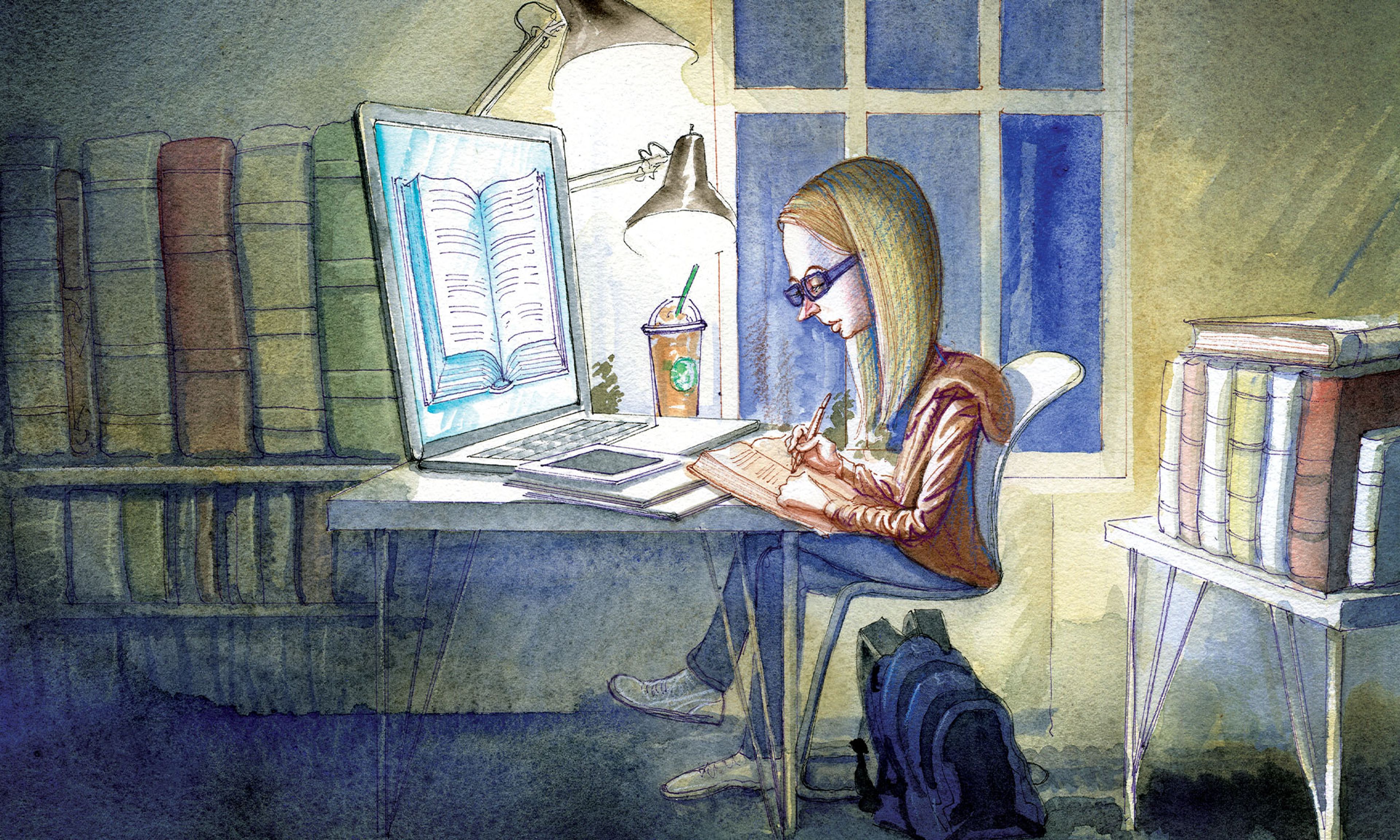
A decade ago, I was writing a book that asked why education technology so rarely delivers on its promise, even as innovative educators were urging schools to ensure that every student had a phone and bragging about student writing assignments that incorporated tweets and texts. Of course, as the grim consequences of phones in school became clear, those devotees quietly began plugging virtual reality, TikTok, AI, and other new enthusiasms.
While technology has a useful role to play in schooling (we’ll get to this momentarily), experience has offered much cause for skepticism.
The past decade of school-tech acquisition has yielded equal parts frustration with what’s going on and unbridled enthusiasm for what’s next. “While that last generation of technology disappointed, the new stuff will be a game-changer,” the spasmodic thinking goes. Stanford’s Larry Cuban nailed it two decades ago when he titled his history of education technology “Oversold and Underused.”
The pandemic unleashed a vast new wave of tech enthusiasm. An Education Week survey in 2022 found that before the pandemic, two-thirds of districts provided a device (usually a Chromebook or an iPad) to every student in middle or high school. By March 2021, that was up to 90 percent, and 84 percent in elementary schools. This was cause for much celebration from school leaders and tech aficionados.
Teachers and parents, meanwhile, have been less euphoric. Parents decried the alienating reality of online education and complained about the hassles of balky school websites and software. As for teachers? Sixty percent told Education Week that the biggest problem with technology was distracted students, and 80 percent said that more screen time led to worse student behavior. What’s more, the existing research makes clear that it’s hard to draw any clear relationship between technology and improved learning outcomes.
Yet the enthusiasm for technology continues to grow. Schools are hustling to finish spending billions in expiring federal pandemic aid, much of it on new technology, while ed-tech hucksters and TED talkers wax rhapsodic about the promise of AI, connectivity, and digital tools. This is all playing out amid an urgent push for phone-free schools and a steady drumbeat of data suggesting that phones are bad for the learning and well-being of kids.
Indeed, at schools where phones have been banned, students tell reporters and researchers that they’re thankful for the respite from the constant demands of texting and social media. The distractions produced by 24/7 access to messaging apps, social media, and games are staggering, especially when the median teen receives 237 (!) phone notifications each day.
Just a few years ago, articles in the New York Times and the Washington Post reassured parents that school closures weren’t a big deal because online learning was a satisfactory alternative. Now, these same outlets feature a spate of headlines like “Get Tech Out of the Classroom before It’s Too Late,” “When Students’ Cellphones ‘Colonize Their Minds,’ ” and “Schools Should Ban Smartphones. Parents Should Help.”
This cycle of hype and discontent is a familiar one. Over a century ago, educators discovered the miracles of film. In 1922, Thomas Edison predicted, “The motion picture is destined to revolutionize our education system.” Things didn’t quite work out that way, as it turned out that Edison’s game-changing films were neither engaging nor especially informative. Then came radio. By the early 1930s, there was a radio division in the U.S. Office of Education, and states were regularly airing educational programs. In 1932, Benjamin Darrow’s book Radio: The Assistant Teacher hailed radio as the “textbook of the air,” and experts predicted that radios would soon be “as common in the classroom as is the blackboard.” Yet it turned out that radios weren’t all that useful, given scheduling difficulties and programming that wasn’t linked to the curriculum.
Today, schools are wrestling with AI, which is rapidly becoming an optimized cheating machine, a font of fake information, and a soft touch for Orwellian manipulation. The extravagant promises of tech enthusiasts and weary laments of teachers are all too familiar.
Pandemic-era remote learning and federal pandemic aid only supercharged the thirst for anything that could equal or improve in-person instruction, all of it yielding troubling instances of excess and waste. Education Week reported in April 2021 that Red River Parish, a poor, rural district in Louisiana, had two Chromebooks for each of its 1,400 students. Before the pandemic, the district already offered a Chromebook to every student — yet the superintendent bragged about spending 90 percent of Red River’s federal pandemic-relief funds on technology. Statewide, Louisiana has 880,000 devices for a K–12 system with 639,000 students. Louisiana is no anomaly. As of 2022, there were more than 1.3 devices per student in states as varied as Utah and Vermont.
Chicago Public Schools spent $308 million on technology between March 2020 and December 2022, 40 percent of it after students resumed in-person learning. (The district bought more than 40,000 devices, which were still in warehouses when 2022 ended.) New York City schools spent $269 million on 300,000 new iPads in spring 2020 alone. Denver’s schools bought almost 80,000 computers between 2021 and 2023 (most of which will “expire” in 2025, after which they’ll no longer accept updates to their operating system). Meanwhile, as the former CEO of EdTech Evidence Exchange told the Associated Press regarding the billions in pandemic aid spent on education technology, “there has never been anything close to a proper accounting of what has been spent on or how it was deployed.”
The unbridled enthusiasm for tech spending is due, in no small part, to the incentives that encourage superintendents and school leaders to chase grant dollars and present themselves as “forward thinking” innovators. By spending money to acquire cool stuff (whether it gets used or not), they earn fawning coverage and set themselves up for professional advancement.
A skeptic can’t help but ask: So, did the Luddites have it right? Nope, not really. Schools aren’t going back to chalk and slate, nor should they. And even “tech free” schools aren’t tearing computers out of the library or telling kids to write all their essays by hand. But schools do need to get vastly more serious about the uses and limits of technology. While the problems with smartphones have gotten a lot of well-deserved attention of late, what’s been overlooked is the ways in which technology can be not only unhelpful but corrosive to schooling.
Education requires concentration. Whether we’re talking about basketball, algebra, or the flute, learning calls for focus, engagement, and practice. That’s how students gain knowledge and master skills. Today’s digital devices and social-media algorithms, however, are increasingly optimized to be engines of distraction — to break up that kind of sustained attention.
Now, students have always found ways to tune out their lessons, but sticking an addictive, interactive gateway to gossip and gaming in their pockets doesn’t help. That’s what makes phones (and even Chromebooks and tablets) so much more disruptive than were classroom computers or VCRs a few decades back. Anyone who has ever taught a class sitting behind open laptops knows the sensation of wondering how many of those students are taking notes — and how many are shopping or perusing social media.
The answer is clear: Distraction tends to rule. Perhaps the most telling study on this question, published in Economics of Education Review, examined the performance of West Point sophomores across 50 sections of a core economics course. Some students were assigned to technology-free sections, others to sections where they had a tablet with restricted internet access, and still others to sections where they were free to use any available tech. Even among this disciplined, accomplished population, students in the technology-free sections substantially outperformed their peers. As Harvard economist Susan Dynarski aptly concluded in a review of the research on education technology, “For the typical lecture setting, the best evidence suggests students should lay down their laptops and pick up a pen.”
That said, technology can be good for learning. After all, any technology is a tool. And, with any tool, it’s what you do with it that matters.
In fact, schools are littered with familiar technologies, such as calculators and whiteboards, that were once somebody’s cutting-edge innovation. These tools proved useful, meaning there was no longer a need for high-schoolers to spend long hours wrestling with slide rules — or teachers to endure the daily routine of banging the dust from erasers. Of course, these new tools could also be put to work in troubling ways, as when progressive educators decided that the calculator meant elementary students no longer needed to master multiplication or long division.
There’s only one technology in schooling that has really delivered on its transformative promise: the humble book. Once upon a time, students could learn only from local teachers, and only when within earshot of them. The invention of the printing press allowed students to learn anywhere and from anyone. They could reread passages and learn even when their teacher was unskilled or uninteresting, while teachers could lecture less and explain more. Of course, the fact that teachers could do these things didn’t mean they would. Even today, five centuries after Gutenberg, it’s common to see teachers delivering tedious lectures in which they repeat the things students supposedly read the night before.
The problem is that education technology tends to be more about the technology than about the education. But it needn’t be.
For a vision of how to best use education technology, just visit that mecca of great pedagogy: the coach’s office of a powerhouse high-school football team. Not too long ago, coaches taught plays by drawing lots of Xs and Os on a chalkboard. They showed the opponent’s plays in grainy footage on the locker-room VCR. They coached blocking techniques by yelling loudly.
Now, players study plays on preloaded tablets, meaning coaches no longer need to diagram each play by hand over and over again. It saves time, and animated Xs and Os (which can be repeatedly paused or shown in slow motion) allow players to more readily visualize how plays are supposed to unfold. A coach can pull out an iPhone, film a player attempting a new technique, and immediately review the result with him. Technology is helping players and coaches communicate, which, in the process, provides feedback while the reps are fresh.
To repeat, it’s not the technology that matters — it’s what we do with it. If it’s used to connect students with mentors, to better engage families, to provide access to richer, more-rigorous instruction, and to make better use of student and teacher time, then technology can enrich schooling.
When I taught high school (back in the last century), there were basically two ways to tutor a kid: You could talk to a student through the phone mounted on your kitchen wall or drive to meet the student somewhere. The calls were rarely helpful, and the logistics of face-to-face meet-ups were trying. Today, in subjects from chemistry to Korean, students can readily access virtual face-to-face tutoring from skilled experts around the globe.
This is a terrific development. But harnessing it isn’t about joining the pell-mell race for new gadgetry or helplessly enabling the algorithm-fueled culture of distraction. Rather, it requires an unwavering commitment to learning. Whether tomorrow’s technology is beneficial for students will ultimately be far less about what Silicon Valley dreams up than whether schools can rise to the challenge.












Comments