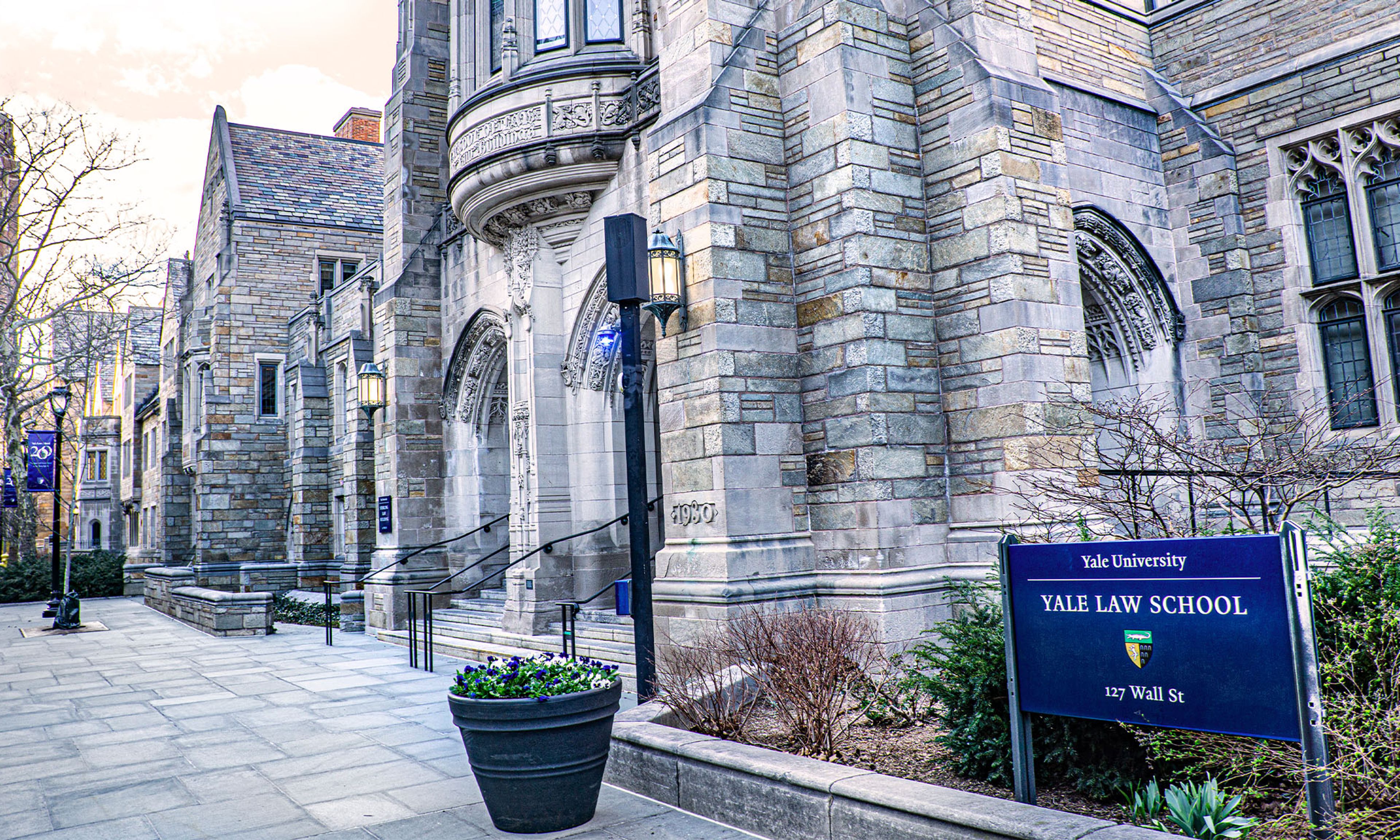
In April, Yale Law School released a statement that made few headlines but caught the attention of many in the legal academy. The school, Dean Heather Gerken announced, would be hiring a man named Garrett West as a tenure-track junior professor.
West, currently an associate at a Washington, D.C., law firm, served as a clerk to Supreme Court justice Samuel Alito during the Court’s 2021–22 term. Clerkships for federal judges — and particularly clerkships for Supreme Court justices — have traditionally been stepping stones for young lawyers seeking careers in academia, but West’s hiring turned more than a few heads because of the who and when of his clerkship.
West clerked for Justice Alito during the term in which the Supreme Court handed down its ruling in Dobbs v. Jackson Women’s Health Organization, overturning Roe v. Wade and returning the ability to regulate abortion to the people and their elected representatives. Clerks are often heavily involved in drafting and editing opinions — so it’s not far-fetched to assume, as Yale Law’s hiring committee obviously did, that West had played an important role in crafting the ruling. Suffice it to say that Yale Law must have known what they were getting with him.
What’s more, West’s hiring came several months after Gerken announced that Yale Law would be conferring a tenured professorship and endowed chair on Keith Whittington, one of the country’s preeminent legal and constitutional scholars and (full disclosure) a dear professor of mine at Princeton. By any reasonable standard, Whittington has the credentials and scholarly accomplishments to be in the top echelon of Yale Law’s faculty — so his hiring should come as no surprise.
But Whittington is also an originalist, an uncompromising defender of free speech, a friend to conservatives, and someone widely known to be right-of-center in his political commitments. Like West, he has views and CV entries that are anathema to the dogmatic leftists who have largely displaced old-school liberals in academia, especially among younger generations of scholars.
While essentially all elite institutions of higher education are more or less dominated by the Left, Yale Law in particular has not been hospitable to conservatives — or really to anyone who has dared to dissent from the doctrines of political, social, and cultural progressivism.
Under Gerken’s administration, Yale Law has seen a series of scandals that have called into serious question its commitment to freedom of speech, open inquiry, and diversity of thought — from a widely publicized 2021 incident in which law-school administrators pressured a student to publicly apologize for his use of the term “trap house” in an email, to a 2022 shout-down of a conservative speaker by more than 100 students who, despite having blatantly violated the school’s free-speech policies, were not punished. The latter incident prompted two prominent conservative federal appellate judges to lead a clerkship boycott of Yale Law, refusing to hire its students (a move likely to backfire and hurt conservatives, in my view, since leftist students would be very unlikely to seek clerkships with conservative judges anyway).
It remains to be seen whether the hiring of Whittington and West — who will be the only openly right-of-center professors at Yale Law — reflects a commitment by the law school’s faculty and leaders to improving the school’s politically tumultuous and intellectually hostile climate over the long term. The change is promising, but I view it with a moderate dose of skepticism. Gerken’s ambition to hold a prestigious university presidency has been reported, and it could be that these faculty additions are part of a short-term effort to bolster her free-speech credentials and head off further clerkship boycotts.
Ideally, of course, the hirings would reflect a conversion of heart by Yale Law’s leadership — a recognition that a uniformly liberal and progressive faculty is not sustainable, at least if the law school hopes to avoid further isolating itself from the political and cultural reality of America, where people of goodwill can and do profoundly disagree about controversial issues. Viewpoint diversity — especially among faculty — is a must if students are to have their convictions and ideas robustly challenged and a culture of intellectual freedom is to flourish.
For his part, Whittington expresses a cautious optimism about Yale Law’s future. He tells me there are “real indications that there have been problems in the culture at Yale Law School in the past” but that he is nevertheless hopeful “things are on the mend and will change,” starting with his and West’s hiring.
“It would be deeply unfortunate if they wound up looking at the recent hires and said, ‘Well, mission accomplished, we don’t need to worry about this anymore,’ ” Whittington says. “I would hope that there would be a continued openness to pursue additional faculty who are on the political right.”
Some might ask why small improvements in faculty intellectual diversity at Yale Law merit the public’s attention. Some conservatives might go so far as to celebrate it when ideologically suffocating and historically hyper-partisan institutions go off the deep end and transform themselves into out-of-touch echo chambers, viewing this as a form of self-marginalization.
But the fact is that, despite these institutions’ craziness in recent years, their enormous endowments, powerful alumni networks, unrivaled prestige (Yale Law still has the highest placement rate for Supreme Court clerkships of any law school), and ability to attract gifted students and faculty will let them retain a level of influence that less established institutions would take generations to match.
We cannot just write off Yale Law, and we should care about what happens there. The steps toward intellectual diversity that the law school has taken in recent months are notable, praiseworthy, and promising — if the school’s commitment to including once-shunned conservative perspectives proves to be enduring. Whether it does will become clearer in the coming months, and years.











Comments