Salzburg, Austria
As usual, the Salzburg Festival is loaded with concerts, recitals, and operas. Plays, too — although these play second fiddle to the music. I propose a sampler. I will touch on four performances, four events: a chamber concert, an opera, a piano recital, and an orchestra concert.
Theater critics can look after the plays.
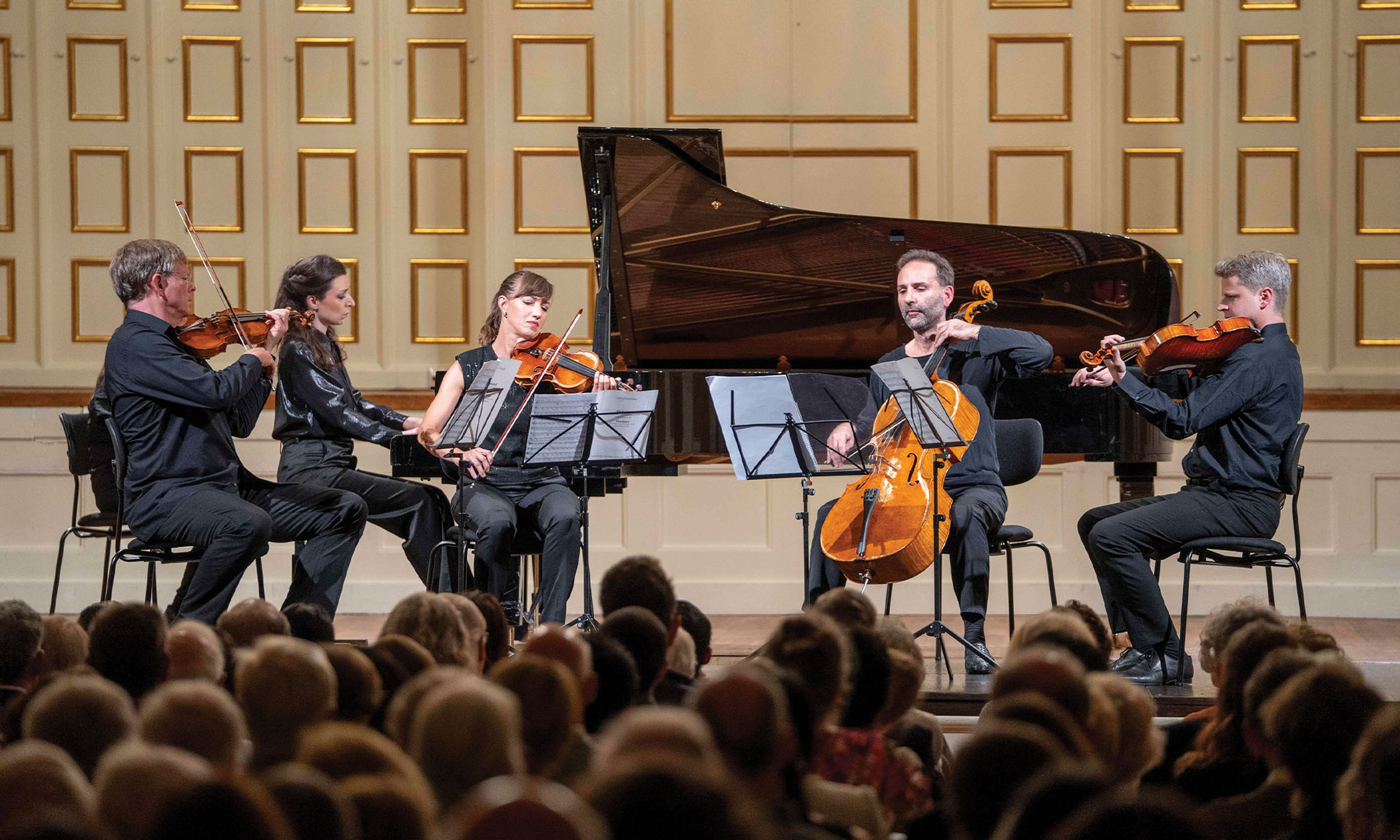
The Vienna Philharmonic is the resident orchestra here, and, every summer, a handful of its members present a chamber concert. There is an expression in music lore: “the Mighty Handful” (referring to five Russian composers of the 19th century).
This summer, the chamber concert began with a work requiring a pianist. The “outsider” — the guest of the Vienna Phil players — was Yulianna Avdeeva. And the work in question was the Piano Quintet of Alfred Schnittke (a Russian composer of the 20th century).
The opening notes of this work are on the piano and very quiet. As Avdeeva played them, a siren passed outside the hall. One of the violinists raised her eyebrows as if to say, “Gee, that’s a great start.”
But the audience was quiet as a church mouse, from first note to last. To listen to this music takes patience. It is not crowd-pleasing. It is intimate, inward, and grieving. Schnittke wrote his quintet in memory of his mother. Later, he arranged it for orchestra, giving it the title “In Memoriam . . .”
The Vienna Phil strings, plus Avdeeva, played with due sensitivity.
On the second half of the program, we heard the String Quintet of Bruckner. (An additional violist joined his colleagues.) Anton Bruckner, the symphonist? One and the same. He wrote very few chamber works, and this quintet is the main one. You can hear Bruckner the symphonist in it. Still, it has the character of a chamber work (as well as the scale). It even has some whimsicality — not a quality often associated with this master.
The ensemble handled the music with intelligence, accuracy, and heart. Also, beauty of sound. Beauty that was almost shocking. The Vienna Philharmonic has a reputation to uphold, even in a chamber concert. And a big part of that reputation is beauty of sound.
I thought of a slogan, used for years by the PGA Tour: “These guys are good.”
There is a range of operas at the festival, including several off the beaten path. But all paths lead to Mozart in this little burg. (Salzburg is the composer’s hometown.) This summer, the festival is staging two of his operas: La clemenza di Tito and Don Giovanni.
The second of these is conducted by Teodor Currentzis, often described as “iconoclastic,” “controversial,” “eccentric” — there are other words.
Born and raised in Greece, he completed his studies in Russia. In the ’90s, he was trained by the legendary Ilya Musin, who was himself in his 90s. In 2014, the Kremlin conferred Russian citizenship on Currentzis.
He is unconventional and brilliant, both on and off the podium. Several years ago, I did a public interview of him here in Salzburg. In stretches, he was spellbinding.
At home in Russia, he founded an orchestra, and an associated chorus, with a strangely rendered name: musicAeterna. In past years, he has brought these forces to Salzburg. But they are funded by VTB Bank — which is under sanction by the European Union, the United States, and others.
Which is sticky, given the war on Ukraine.
In 2022, Currentzis founded a different orchestra, utterly cosmopolitan, comprising musicians from dozens of countries. He calls it “Utopia” (the word created by Sir Thomas More, meaning “nowhere”). And Utopia is the orchestra in the pit for Don Giovanni.
On the night I attended, Currentzis was totally alive and thoroughly Mozartean. He was crisp, elegant, acute — all of it. The score was full of dance. The Catalogue Aria swung. Currentzis has a Jim Carrey physicality, which is deployed in the service of music (not merely for show).
Thinking about Currentzis, I thought of what George Szell said about Glenn Gould: “That nut’s a genius.”
The stage director for Don Giovanni is Romeo Castellucci, and the production is chock-full of symbolism. Various items descend or crash from the sky: cars, pianos, basketballs. Returning from intermission, a man sitting next to me asked, “What does it all mean?” I answered, “I think it means we should concentrate on the music.”
Overall, the cast was of high quality, starting with the baritone in the title role, Davide Luciano, from Italy. Vocally, musically, and theatrically, he was a real Giovanni. I will also single out Nadezhda Pavlova, portraying Donna Anna. A Russian soprano, she is formidable, not least in her high pianissimos.
I think I have made this comment in the past, but here I go again: Another Pavlova, the ballerina, had a dessert named after her. Maybe someone should concoct something for this soprano.
Every summer, the festival presents four pianists who were born in the Soviet Union but have lived in the West for decades: Grigory Sokolov, Arcadi Volodos, Evgeny Kissin, and Igor Levit. Let’s talk Volodos.
This summer, Volodos began his recital as he often does: with late Schubert. Does it make sense to speak of “late Schubert,” given that the composer died at 31? Well, “late” is a relative term.
Once, I had the audacity to ask Michael Hersch, the American composer, whether he had favorite music. He answered, “For me, late Schubert piano music is where it’s at.” It certainly is.
Volodos played the Sonata in A minor, D. 845. Like many another Schubert sonata, it seems private, personal, barely intended for performance. Volodos understands Schubert’s world. He communes with him, so to speak, or speaks for him. Every detail is attended to, with no fussiness.
Let me give you a sidenote — almost gossipy. At intermission, in the garden outside the hall, I saw Teodor Currentzis. Picture a white tank top; black hair, slicked back; and a cigarette. He looked like an extra in Grease. And, yes, the man is an individual.
After intermission, Volodos played Schumann’s Davidsbündlertänze, a work not often heard, for two reasons, probably: It is darn hard, technically, and it is strange. For Volodos, neither of these is a problem. He has all the technique in the world, and he understands what Schumann is after.
Volodos ended his printed program with Liszt: the Hungarian Rhapsody No. 13 in A minor, though souped up by Volodos himself. (Liszt’s rhapsodies are soupy enough on their own.) He makes a practice of this, as Horowitz and illustrious others did before him. Volodos played blizzards of notes, clearly and stylishly.
I thought of something that André Previn said about another André, Watts: “a lawn mower.” He meant it as a compliment. There are pianists who can plow through a piece like a lawn mower (an elegant one).
Volodos has go-to encores, and he played four of them on this evening. One of them was Malagueña, the oldie-but-goodie by Lecuona. Volodos, of course, has his own, souped-up version. I think Lecuona would rub his eyes and say, “I wouldn’t have thought it possible.” And, to emphasize: Volodos is as musical as he is virtuosic. The one (virtuosity) is always subordinate to the other (musicality).
He said good night with the Vivaldi-Bach Siciliano, which makes time stand still.
On a Saturday morning, the Vienna Philharmonic assembled to play Mahler’s Symphony No. 9 — the composer’s farewell to the world (one could argue). This orchestra has a constant round of guest conductors, having no permanent one. On this occasion, Andris Nelsons stood before them.
He is a Latvian, a protégé of the late Mariss Jansons. Nelsons began as a trumpeter playing in the Latvian National Opera orchestra. In an interview here, I once asked him, “What do trumpets do in opera?” He said, “Well, they announce things.” (Perfect answer.) For the last ten years, he has been the music director of the Boston Symphony Orchestra.
Needless to say, he conducted the Mahler Ninth ably. He did nothing screwy, and he exhibited maturity at every turn. Anything to object to? One might say this: The music was a little straight-ahead. Folk elements could have been earthier — more rustic. The symphony was a little clinical, a little dry-eyed. But, but, but: At least Maestro Nelsons avoided bathos or sentimentalism. The music can speak for itself, without too much conductorial “help.”
Really, the Vienna Philharmonic is a splendid machine. “These guys are good.” They could coast on their reputation, but they don’t — they justify it, year after year, decade after decade. (I have seen older players “age out”; I have seen young ones get middle-aged.)
As the audience applauded, Nelsons asked principal players to stand. Sometimes orchestra players are confused: “Does he mean me?” To specify the instrument he meant, Nelsons made gestures. Indicating the trumpet, he moved his fingers, as though pressing the valves. I thought: “He’s used to it.”
From my seat near the stage, I saw an interaction between Nelsons and the concertmaster, Rainer Honeck (brother of Manfred Honeck, the music director of the Pittsburgh Symphony Orchestra). Subtly, Honeck asked whether Nelsons wanted to remount the podium for a solo bow. Brooking no opposition, Nelsons shook his head no.
When Mahler died in 1911, his symphonies were not well established around the world. They were very far from canonical. Now they are practically as familiar, and valued, as Beethoven’s. I wish Mahler could know it. But, possibly, he would not be surprised.












Comments