There are times when this book is almost as jarring as the race it chronicles. But there are also moments when The Hardest, Longest Race elicited, in this reader at least, a wistfulness for a young nation that radiates optimism and joy.
Cars were a fairly new phenomenon in 1909, and auto races drew ardent crowds. The book’s subject, the Ocean to Ocean Automobile Endurance Contest — a race from New York City to Seattle, which that year hosted a world’s fair — was steered (pun intended) into existence by M. Robert Guggenheim. He also provided the race’s prize money. A member of an extremely wealthy family, Guggenheim was a ne’er-do-well. “An impish prankster, effortlessly charismatic but indifferent to work,” writes the journalist and author Eric Moskowitz. But he liked autos a lot: “The Ocean-to-Ocean Race became Guggenheim’s darling, promoting the prowess of the modern motor car and the possibility of an uninterrupted road” that would one day link New York to Seattle.
Though Guggenheim and various auto groups were enthralled by the prospect of a transnational competition, the idea was mostly spurned by an important constituency: About 250 American automakers refused to participate. “Behind the scenes, they feared high-profile failure, with bad publicity in a crowded market worse than no publicity at all.” Moreover, “no car had ever driven successfully between New York and Seattle.” Only three American automakers would provide cars and crews for the race: the Ford Motor Company, Shawmut, and Acme. (Also taking part was a European car, the Itala. It was “secretly bankrolled” by Guggenheim to assure that the race would be “international.”) I will say little more about Acme and the Itala because they were tangential to the events in this book. The Shawmut and Ford teams brought the action.
Shawmut turned out a good product, “unusually durable and well designed, with major components machined from Krupp nickel steel imported from Germany,” and top-quality ball bearings from a German arms manufacturer. But the linchpin of the book is the Ford Motor Company and its founder-owner-ruler, Henry Ford. The enterprise was founded in 1903. Its Model T entered the world in 1908 and “made Ford one of the biggest players in the business.” Henry’s great confidence in the Model T was rooted in vanadium steel, “the magic ingredient for achieving what he wanted in an auto, obliterating the competition when it came to strength against weight.” The Model T also featured left-hand-side steering, which would later become standardized. Henry felt that winning the race would make the Model T even more popular than it already was. “Defeating bigger, more powerful, more expensive competitors would cut through the clutter,” Moskowitz writes. Henry craved a win so badly that he entered two Model Ts in the race. But his lust to come out on top raised consequential questions.
The race began at City Hall in Manhattan on June 1, 1909. There were a measly five autos participating. Nonetheless, excitement was widespread throughout the country and in the press. Race officials were serious about thwarting cheating. Car teams had to sign in at “thirty nationwide checkpoints . . . so the crew members could prove that they were traveling with their automobiles continually and also that they weren’t shipping these cars point to point by rail.” The entrants were allowed to use written and human guides, and this is where Ford proved itself shrewder than its rivals. Ford’s network of branch managers recruited the most trusted car dealers as guides: “In a nation with few marked roads, where countryside directions were given largely around landscape features or notable buildings, good guides would be essential.”
The Ocean-to-Ocean Race would make a good video game. America in 1909 wasn’t, of course, blanketed in highways (or even local roads). The race teams, often sleepless and hungry, had to negotiate sometimes brutally difficult and dangerous terrain. And savage weather often made driving even more hazardous. Most of Moskowitz’s book is an account of the devastating obstacles that challenged the intrepid driving crews.
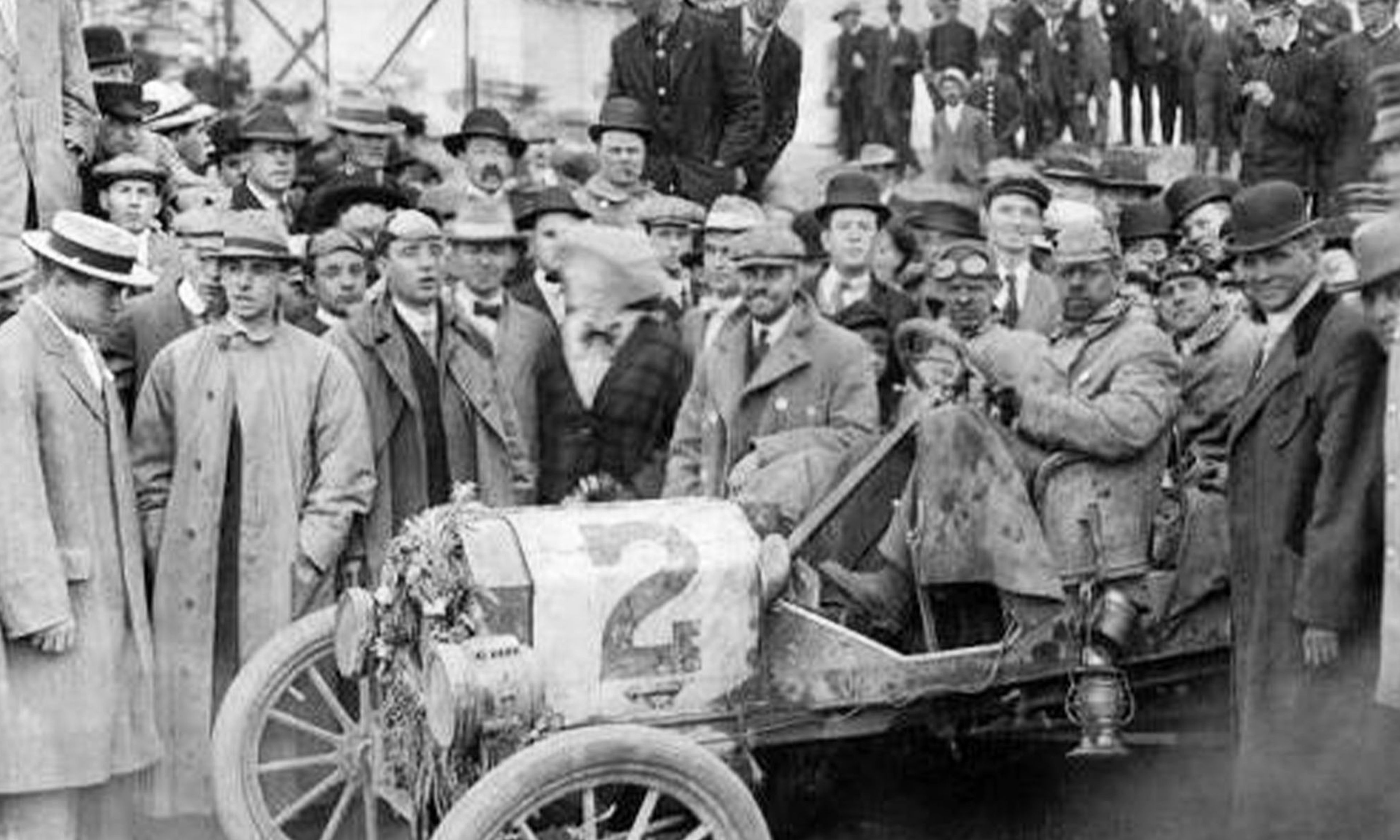
“Twenty-two days and fifty-five minutes since the opening gun,” Guggenheim declared Ford Car Number 2 the winner. (I’m not giving anything away; the copy on the book’s dust jacket reveals the victor.) The Shawmut came in second, but the firm’s officials, smelling a rat, filed a complaint to reverse the decision. And at this point it would be churlish of me to disclose the result of the appeal.
Moskowitz — a journalist formerly at the Boston Globe and a co-winner of the Pulitzer Prize for that newspaper’s coverage of the Boston Marathon bombing — is an indefatigable researcher. Perhaps too much so, if that’s possible. There are episodes in the book during which the accumulation of details rather overwhelmed me (and I was taking notes). But there are good reasons for readers to persevere. Moskowitz’s portrait of an America charging into the 20th century in autos is exciting and moving. It was a different country back then; there was much less cynicism about the future, demonstrated not just by the crowds across the nation that mustered to witness parts of the competition but also by the newspapers. And especially (on the whole) by the men who manned the racing cars.
My favorite scene: After the Acme car accidentally careened into a swamp, the Shawmut and Itala crews “did the sporting thing and pulled over, helping the Acme men get going again.” That’s quintessential American know-how and integrity!



Comments