The Cold War seems as distant as the War of the Roses, what with something called the “Islamic State” gripping the world’s attention (and cutting off heads). But everything old seems new again, where the Castro dictatorship in Cuba is concerned. After Kremlin chief Vladimir Putin visited the Castros in July, Newsweek ran a headline both amusing and apt: “Why Russia and Cuba Are Partying Like It’s 1962.” The Castros’ relations with North Korea and China, too, are newly warm.
A year before Putin traveled to Cuba — i.e., in July 2013 — a North Korean cargo ship called the “Chong Chon Gang” tried to mosey through the Panama Canal. The Panamanian authorities suspected the ship was hauling drugs. When they went to inspect, the crew put up violent resistance, and the captain attempted suicide. The Panamanians found 10,000 tons of sugar, in 250,000 sacks. Nothing to commit suicide over. The Chong Chon Gang was coming from Cuba, heading back to North Korea. Apparently, the Castros wanted to supply the starving North Koreans with something sweet.
Hidden under the sugar, however, was war matériel: two MiG-21 aircraft, components for missile systems, a variety of weapons, and so on. The Panamanian president, Ricardo Martinelli, came to see this cargo for himself. He looked bemused. He tweeted photos of the matériel with abandon.
North Korea, given its repeated nuclear provocations, is under an arms embargo by the United Nations. Cuba violated that embargo, as the U.N. reported with rare clarity and firmness in March 2014. The Cubans claimed they were not giving or selling the matériel to North Korea — they were merely sending it over there to be repaired and then returned to the Caribbean. That was funny: The Cubans had taken the trouble to paint over their national insignia on the MiGs. Those MiGs were intended to become North Korean planes.
Experts are confident that North Korean ships have traveled to Cuba and back in recent years, bearing prohibited cargo. It so happens that the Chong Chon Gang, that one day, got caught.
Cuba and North Korea have been brothers-in-arms since Fidel Castro and his gang seized power in 1959. Castro’s celebrity sidekick, Che Guevara, traveled to Pyongyang in 1960. Footage shows him bantering amiably with Kim Il-sung. Guevara gave a speech in front of huge portraits of Kim and Castro. How young they all were!
In a gesture of solidarity, Kim sent youth brigades to Cuba to help with the sugar harvest. Alongside their Cuban brethren, the North Koreans were going to cut cane. There was a problem, however: Some of the Koreans expressed “the love that dare not speak its name,” as it was once known, poetically. Castro had no tolerance for homosexuality (as Cuban gays could tell you): Those Koreans were packed back to Kim.
Many years later, in 1986, Castro himself visited Pyongyang. Footage of his arrival is somewhat amusing. Castro strides from his plane wearing what some of us used to call a “Brezhnev-style hat” — a warm winter number associated with the Soviet boss Leonid Brezhnev. Castro and Kim extend their right hands, preparing for a handshake. Then they change their minds and fling their arms open, hugging. Kim Jong-il is standing nearby. Later, he will succeed his father as dictator. He extends his hand for Castro, who, now in a hugging mood, embraces him. Castro is very tall; Kim is very not. It is an awkward hug.
Consider this: If Castro were to meet Jong-il’s son Jong-un, he might well be the only foreign leader to hug all three Kim dictators.
Cuba and North Korea are two of the remaining handful of Communist states in the world, and they do what they can to keep going. Sharing a similar predicament, they buck each other up. Cuba has a “Committee for Supporting Korea’s Reunification” (meaning the reunification of the peninsula on Communist terms). North Korea has a Committee for Solidarity with Cuba.
In 2010, a top North Korean military official, Ri Yong-ho, visited Havana. He said that his country and Cuba were “comrades-in-arms” on a “common anti-Yankee front.” North Korea and Cuba would keep fighting “in the same trenches,” he said. In 2013, another Nork military big, Kim Kyok-sik, visited the island. He, too, referred to the two countries’ fight “in the same trenches.”
After the Chong Chon Gang was seized, Fidel Castro was miffed. He is not used to being embarrassed on the international stage. He is used to applause, sympathy, and admiration. He said that prying Panamanians and others were trying to “slander our revolution.” He also revealed a historical tidbit: Kim Il-sung, that “veteran and unimpeachable combatant,” had once sent him 100,000 AK-47s, plus the ammo to put in them. And he did this all “without charging a cent.”
In the course of events, you can often discern alignments in the world by looking at votes in the United Nations. Last March, the General Assembly voted on a resolution supporting the “territorial integrity of Ukraine.” This resolution, in effect, condemned Russia for its annexation of Crimea. There were just ten votes against the resolution, other than Russia’s. Two came from former Soviet republics: Belarus and Armenia. The former is essentially a Communist dictatorship, complete with a KGB. The latter resents Ukraine for its support of Azerbaijan, Armenia’s neighbor and enemy. Three of the votes came from genocidal or quasi-genocidal states: North Korea, Sudan, and Syria. There was also Mugabe’s Zimbabwe. Finally, there were four Communist or would-be Communist states in Latin America: Cuba, Venezuela, Bolivia, and Nicaragua.
With all that support in Latin America, it made sense for Putin to undertake a Latin American tour last summer, and to begin in Havana. He met both Castros: the titular boss, Raúl, and the power behind the throne, big brother Fidel. With Raúl, Putin laid a wreath at the Monument to Soviet Internationalist Soldiers. Two delegations were present, the Russian and the Cuban. Raúl pointed out that they were all wearing business suits, in the tropical sun. “We have to change the protocol,” he said to Putin. “We don’t wear ties in this country. It’s guayaberas and sombreros, shorts and sandals.” (A guayabera is a light shirt, typical in the tropics.) “This isn’t a country for working, much less for making war,” he continued. “This is a country for relaxing.”
The Soviet Union began life 42 years before Communist Cuba, and Communist Cuba has outlived the Soviet Union by 23 years. Still, they had more than 30 years of overlap. And Russians left a deep mark on Cuba. Names such as “Vladimiro” are common. Cuban ballet dancers are good, both before and after they defect. (Where there are Russians, there is good ballet.) Children of the elite, such as Fidel Castro Jr., studied in the Soviet Union. The old man required Junior to study physics. (Where there are Russians, there is good science.)
Cuba may be a country for relaxing, not working, but Putin and the Castros inked a dozen deals while the Russian was there. These related to air travel and energy, among other things. Russia will explore for oil off Cuban coasts. Putin also forgave 90 percent of Cuba’s debts to Russia — debts to Moscow, let’s say. They are left over from the Soviet period. Putin forgave $32 billion, leaving just $3 billion and change on the books. This money is to be paid in the next ten years, and reinvested in Cuba. Raúl said, “It’s a great sign of the generosity of Russia toward Cuba.” For his part, Putin said, “We will provide support to our Cuban friends to overcome the illegal blockade of Cuba” — meaning American trade and travel sanctions.
Why was Putin in such a generous mood? A report in the Russian newspaper Kommersant may well have provided the answer: It said that Cuba had agreed to reopen Moscow’s old spy base at Lourdes, not in France, where the miracles occur, but outside Havana. This base was once the Kremlin’s largest facility abroad. It took up 28 square miles, and was just 150 miles from America. Some 3,000 people from the Soviet Union and its bloc worked at Lourdes, cocking an ear to America, gathering all the intelligence they could.
In 1991, the Soviet Union collapsed — but Russia kept the base. There was this difference, however: Where Castro hosted the base for free before, now the Russians would have to pay — $200 million a year (reportedly). In 2001, Putin decided to close the base. His government portrayed this decision as a gesture of goodwill to the United States. It is probably more relevant to say that the Russians were tired of paying the cost. What purpose did the base serve? The Cold War was over.
After the Russians left, the base went to pot. There is a computer-science university on the premises, but the buildings are decrepit, like most things in Cuba. Goats wander around, looking for food.
In the wake of the Kommersant report, Putin issued a denial. “Russia is capable of fulfilling its defense-capacity tasks without this component,” he said, meaning Lourdes. Whether Putin’s denial can be credited, it’s hard to say. The reopening of Lourdes would make sense for him. Not least, there is the matter of Russian pride, and overcoming the shame that derived from the collapse of the Soviet Union. Listen to Vyacheslav Trubnikov, a former Russian spy chief, speaking to Kommersant: “Lourdes gave the Soviet Union eyes in the whole of the Western Hemisphere.” And “for Russia, which is fighting for its lawful rights and place in the international community, it would be no less valuable than for the USSR.”
Putin himself made a telling statement in Cuba: “We are disposed to recover lost possibilities.” What he almost certainly meant was, We have played footsie and tried to make nice with the democracies, to no avail. Let’s get the old band back together. Raúl Castro made an equally telling statement, and slip of the tongue: “We support the current policy of firmness and the intelligent policies being pursued in the international arena by the Soviet Union.” Then he corrected himself. “I mean Russia.”
After Cuba, Putin went to Nicaragua to visit Daniel Ortega, an old Soviet client and proxy. Ortega said that Putin’s visit was a “ray of light.”
Like Russia, China is about the business of establishing world leadership. To this end, the Chinese boss Xi Jinping conducted his own Latin American tour, ending in Cuba, whereas Putin began there. Xi arrived in Havana ten days after Putin left. In recent decades, Cuba and China have taken somewhat different paths: China has liberalized, economically; the Castros have been pretty good about resisting reform. But China remains a one-party dictatorship with a gulag, just like Cuba. Both states torture dissenters to death. There is ample common ground.
Lighting on Cuban soil, Xi said, “I feel that as socialist countries, China and Cuba are intimately united to fight for the same missions, ideals, and goals.”
As he swung by North Korea in 1960, Che Guevara swung by China, too. Mao gave him $60 million for the Castro dictatorship, saying that it was a “loan” that “does not have to be repaid.” In those early days, Castro and his pals, including Guevara, would drop by the Chinese embassy in Havana, unannounced. They wanted to be served Chinese food by the embassy’s excellent cooks. El Jefe had a particular fondness for Peking duck.
Today, China is Cuba’s No. 2 trading partner, after Venezuela (whose leadership reveres the Castros). During his visit, Xi inked many more deals than Putin had, signing almost 30 of them. One of them was for the development of golf courses in Cuba. The young Fidel effectively banned golf, calling it a “bourgeois” pursuit. One of his sons, Antonio, not only plays golf but is said to be a champion. (When it comes to dictatorships, you can never tell these things. According to Pyongyang, Kim Jong-il had eleven holes-in-one in his very first round of golf, making him the greatest golfer, and probably the greatest athlete, ever.) Like Putin, Xi signed a deal on oil. The Chinese, as well as the Russians, will be exploring for oil off Cuban shores.
Fans of the Castros in America tend to be foes of oil. What must they think of this positively Texan enthusiasm?
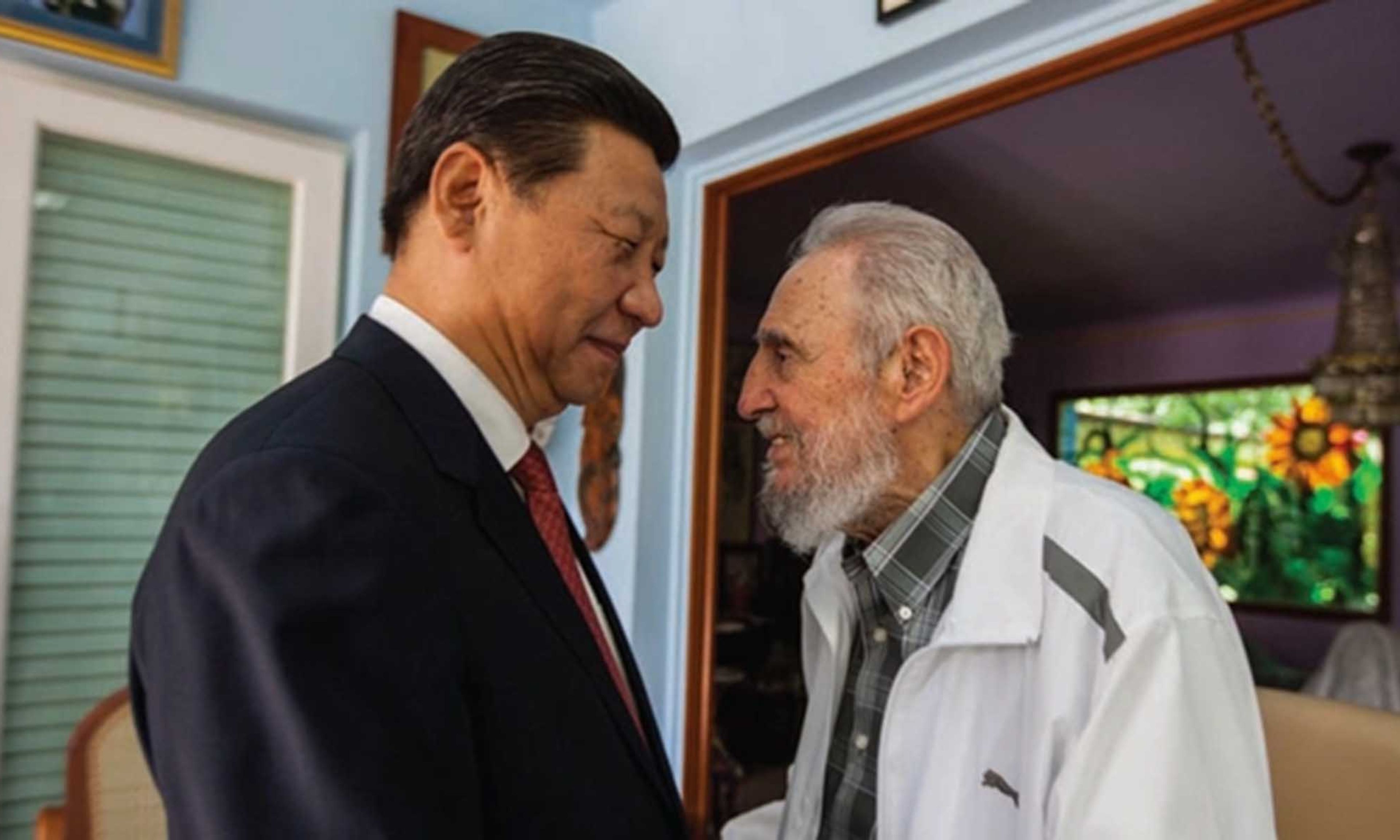
Xi went to one of Fidel’s residences, bearing a gift: a bust of El Jefe as a young man. He said to Castro, “Today, seeing you hale and vigorous, I feel very pleased. You are the founder of the cause of Cuban revolution and construction, and also the founder of the China–Cuba relationship.” Blah, blah, blah. Castro pointed out the moringa and the mulberry that had grown up on the property. They had been presented by the Chinese. Xi said he had brought more, and hoped they would “thrive and become a new manifestation of the China–Cuba friendship.”
Sizing up the world at large, Raúl said that China, Russia, and others were building “a new international order.” If it is new, it has aspects of the old. Birds of a feather are flocking together, as they tend to do at all levels of life. Way back in 1961, Senator J. William Fulbright said, “The Castro regime is a thorn in the flesh, but it is not a dagger in the heart.” That was before the Cuban Missile Crisis. Yet the statement has long applied, where American national security is concerned. Still, we have lived with this thorn for 55 years and counting, and it would be nice to pluck it out.











Comments