
In 1990, after President George H. W. Bush nominated David Souter to the Supreme Court, the president of the National Organization for Women testified that he would be the decisive fifth vote to overturn Roe v. Wade and that as a result “the underworld will flourish with back-alley abortion butchers.” This type of lurid charge has become part of the background noise of American politics. In every presidential election, in every judicial-confirmation fight over a Republican nominee, in every lawsuit that touches on abortion, the 1973 precedent is said to be hanging by a thread, and with it such weighty concerns as women’s equality and religious freedom.
Yet the Supreme Court has continued through all of these years to treat abortion as though it were a constitutional right protected from legislative regulation, and Republican appointees have been instrumental in preserving it. A Nixon appointee, Justice Harry Blackmun, wrote Roe in the first place, for a 7–2 Court. In 1992, in Casey v. Planned Parenthood, a Supreme Court including eight Republican-appointed justices reaffirmed a modified version of Roe on a 5–4 vote. Justice Souter himself voted for that decision and then became a reliable vote to nullify restrictions on abortion. In 2020, a Supreme Court with five justices appointed by pro-life Republican presidents declined, in another 5–4 vote, to narrow the abortion right.
So when the Supreme Court announced that it would hear another abortion case in its coming term, jaded observers of our rote debate treated it as more of the same. The usual interest groups sent out their five-alarm press releases, of course. But a lot of pro-lifers have refused to get their hopes up. Republican politicians and operatives, for the most part, are not paying close attention. The tenor of the press coverage is roughly the same as it has been for all the earlier abortion cases.
But this time really could be different. The new Supreme Court, for all the caution it has displayed, is the most conservative collection of justices to have sat on the bench in decades. The political timing for a reversal of the Court’s abortion precedents is much better than it was in 1992. And the case that the Court has agreed to hear is a direct challenge to those precedents and will be hard to duck.
At issue in the case is a Mississippi law that is modest, moderate, and incompatible with the Court’s rulings. It prohibits abortion after 15 weeks of gestation, with exceptions for medical emergencies and severe fetal abnormality. (It is often asserted that these exceptions cover most abortions late in pregnancy, but the available research indicates otherwise.) The most recent data from the Centers for Disease Control suggest that 5.2 percent of abortions nationally, and 0.7 percent of abortions in Mississippi, take place after that time. Most polling suggests that the public favors bans on abortion after the first three months of pregnancy. In June, the Associated Press found that 35 percent of Americans believe abortion should be illegal in all cases, and another 30 percent that it should be illegal in most cases, after three months.
One might think that a statute as limited in its application as Mississippi’s would be immune to legal challenge. We have, after all, been repeatedly assured that the Supreme Court’s abortion rulings are themselves moderate and allow many restrictions. “Plainly, the Court today rejects any claim that the Constitution requires abortion on demand,” Chief Justice Warren Burger (yet another Republican appointee) wrote in his opinion concurring in Roe.
Roe and Casey have, however, imposed policies that are much more liberal than is commonly understood. It is true that the Court has allowed some regulations of abortion. Casey let states require parental consent before minors can get an abortion, so long as the states include provisions for judges to bypass that consent. A 2007 ruling left in place a federal law banning a specific method of abortion dubbed “partial-birth abortion,” in which the unborn child is partly delivered before being killed.
But the Court has placed stringent limits on such regulations. Since 1973, it has consistently said that no state may prohibit abortion. Roe said that abortion could not be restricted in the first trimester and could be regulated before “viability” only to protect mothers’ health. It said that abortion could be prohibited after viability — and then immediately took back that concession in the companion case of Doe v. Bolton. What Doe said was that even late in pregnancy any ban had to include a health exception, with “the attending physician” exercising judgment “in the light of all factors — physical, emotional, psychological, familial, and the woman’s age — relevant to the well-being of the patient.”
Some states had liberalized their abortion laws in the years before 1973. Roe and Doe swept away the laws of all of the states, even the most liberal. Their import was that anytime an abortionist concludes that an abortion would serve a woman’s well-being, very broadly construed, he has a constitutional defense for going through with it, no matter how late in pregnancy.
None of this has any plausible grounding in the Constitution. Nothing in the text of the Constitution marks out abortion for protection from legislation, or implies anything about viability or trimesters. Roe held that bans on abortion amounted to taking away liberty without due process, which the 14th Amendment forbids states to do. But when that amendment was ratified in 1868, no informed observer understood any part of it to make abortion a right. States were, in fact, tightening their laws against abortion during this period in response to advances in embryology.
Roe’s argument has widely, and from the beginning, been treated as a laughingstock. Yale law professor John Hart Ely, who supported legal abortion, reacted by writing that the decision was nevertheless bad because it “is not constitutional law and gives almost no sense of an obligation to try to be.” In the years since, other supporters of abortion have either explicitly or implicitly conceded, by attempting to find alternative constitutional grounds for Roe, that its argument was radically deficient.
But the decision’s reputation, though poor, is still too high. Only specialists are aware that one of its main historical arguments has long been discredited and was, indeed, known to be weak even by the legal team that won Roe. Blackmun relied on the research of Cyril Means Jr., which he cited six times, to claim that state laws against abortion in the 19th century were not concerned with protecting unborn life but instead aimed only at protecting mothers from unsafe procedures. American law, he maintained, had thus never treated unborn life as deserving protection. But Means and Blackmun were wholly mistaken. Subsequent work has shown that, for example, one of the sources Means portrayed as denying the humanity of unborn children had in fact written that because “unborn embryos . . . may be supposed indeed from the time of conception, to be living animated beings, there is no doubt but that the destruction of them ought to be considered a capital crime.”
The Supreme Court itself, in Casey, demonstrated the weakness of Roe’s argument in the course of sticking with its main conclusion. Rather than attempt to argue that Roe read the Constitution correctly, the Court spent page after page explaining why it would be too costly to say that it had made a grave error. Its central point: Reversing itself, especially under pressure, would diminish the institution of the Supreme Court and therefore the rule of law and constitutional government. The Court therefore called “the contending sides of a national controversy to end their national division.” As pro-lifers bitterly observed, the justices had made themselves parties to the case and ruled in their own favor.
The Casey Court was, however, willing to fiddle with the precedent it considered so vital to the republic’s survival. The trimester scheme, previously thought central to Roe, was junked. The reworked rule continued to insist that before viability, governments could not prohibit abortion. Nor could they place on the right to abortion an “undue burden” that would effectively prohibit it. Restrictions after viability still had to include a health exception. The Court said nothing to indicate that the health exception should be construed any differently from before.
Supporters of our current abortion regime often say that abortions late in pregnancy are “rare” because the more than 10,000 abortions that take place each year after the 20th week are a small fraction of the total number. Much rarer, vanishingly rare, is the successful prosecution of anyone for performing a late-term abortion in the jurisdictions where the statute books say it’s illegal. When Hillary Clinton said in 2016 that U.S. law did not recognize any right to life for unborn children even hours before delivery, one could strongly object to her approving tone. In describing the state of the case law, however, she was spot-on, far better informed than most people.

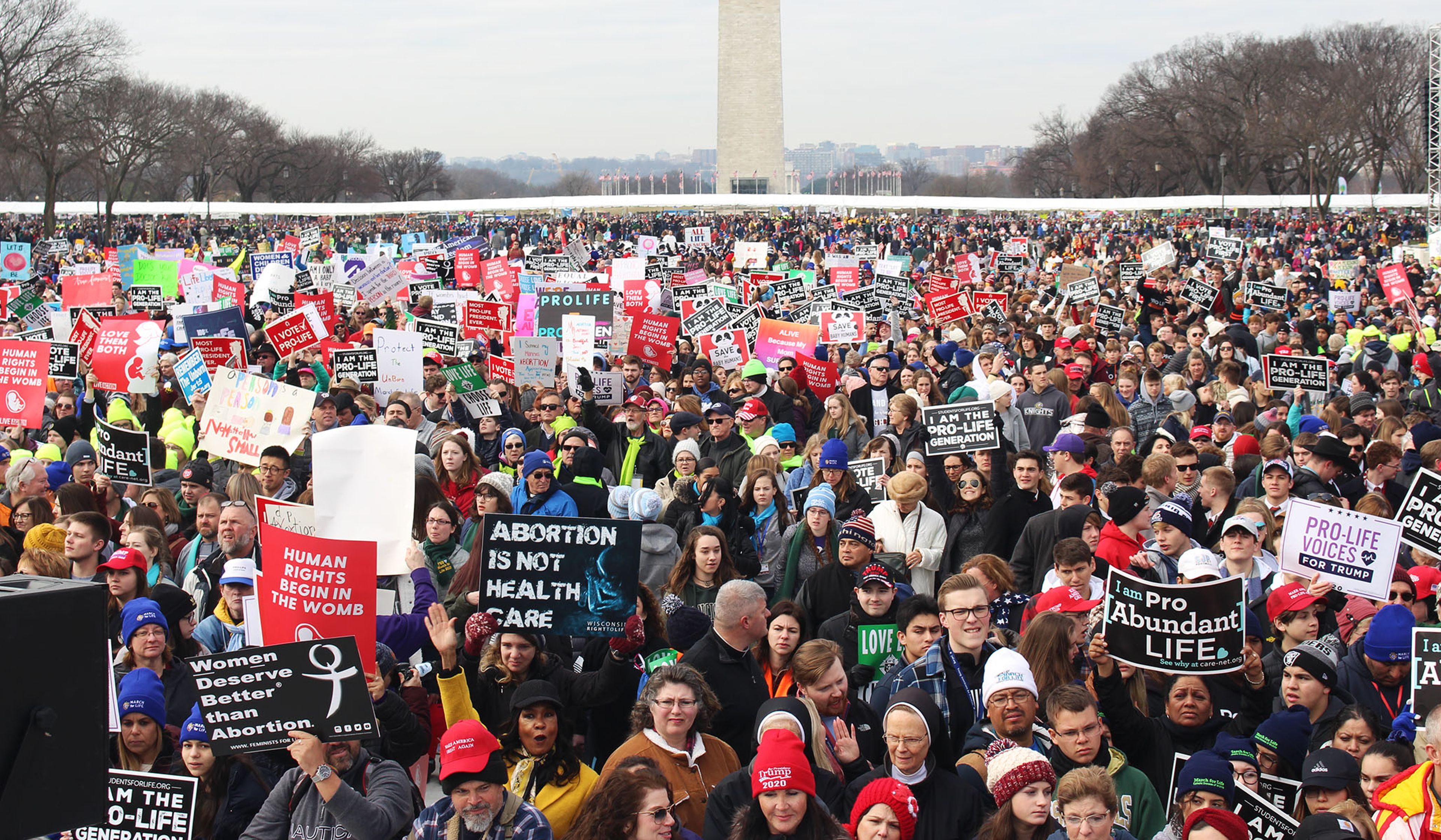





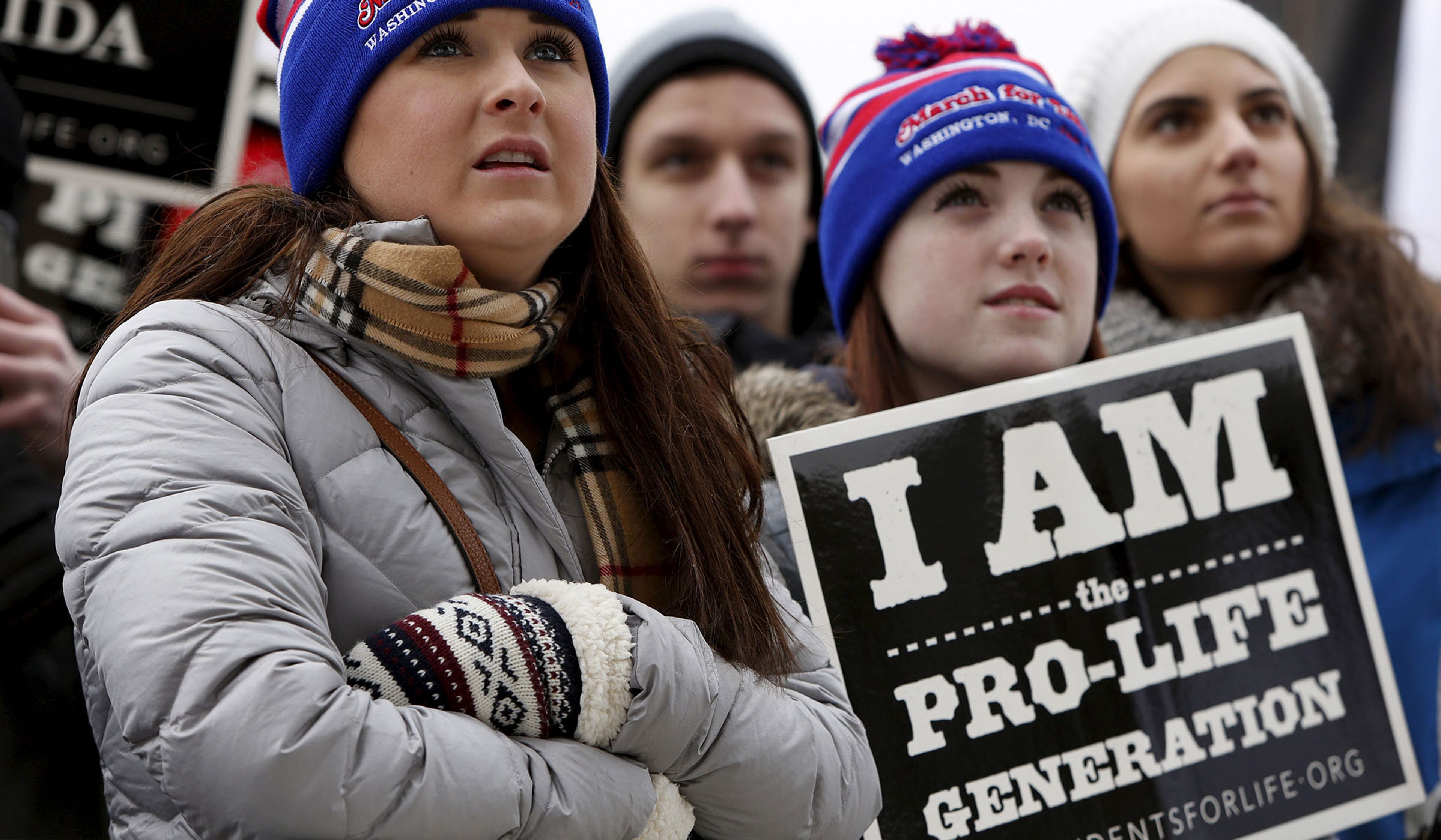
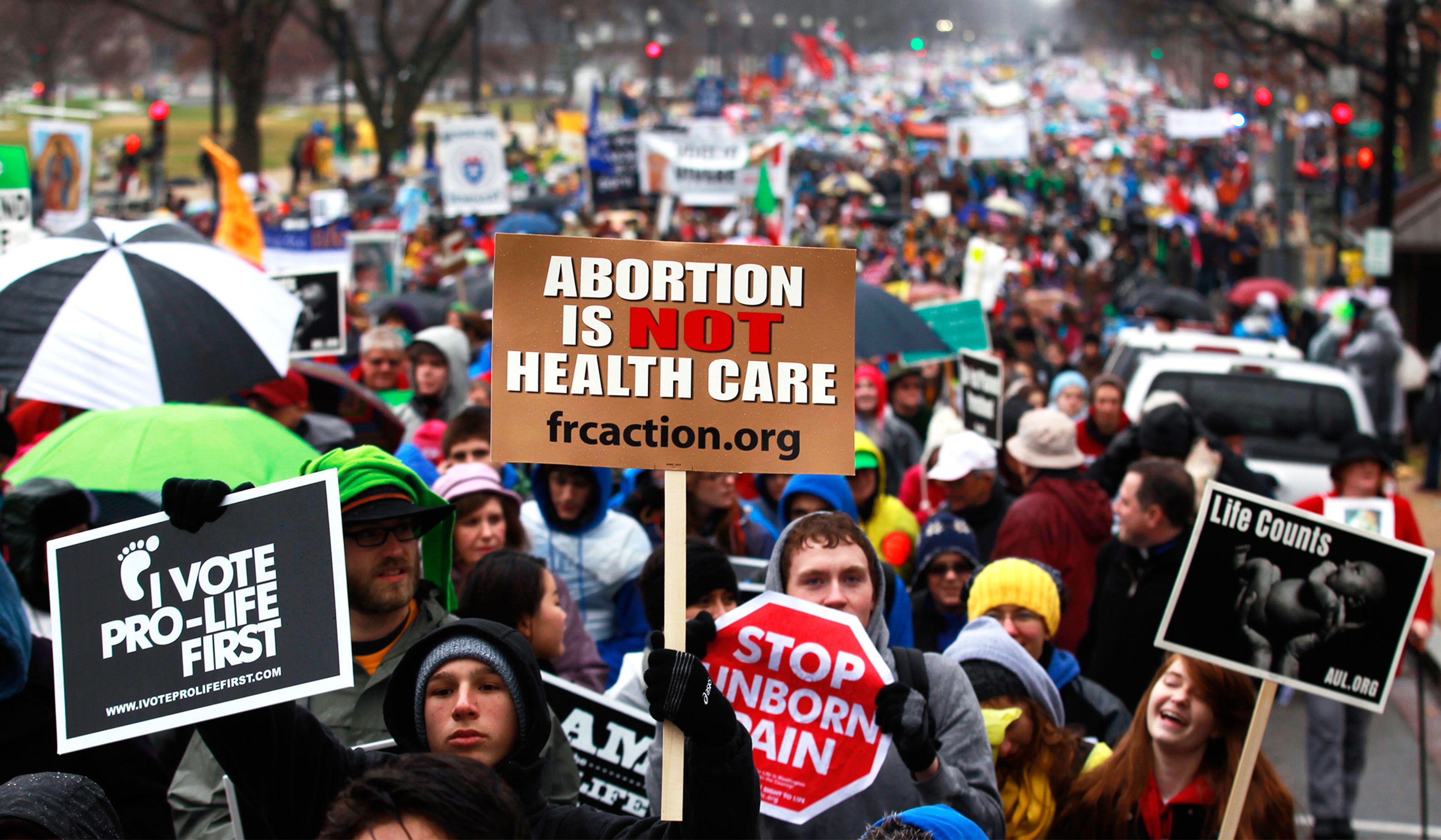
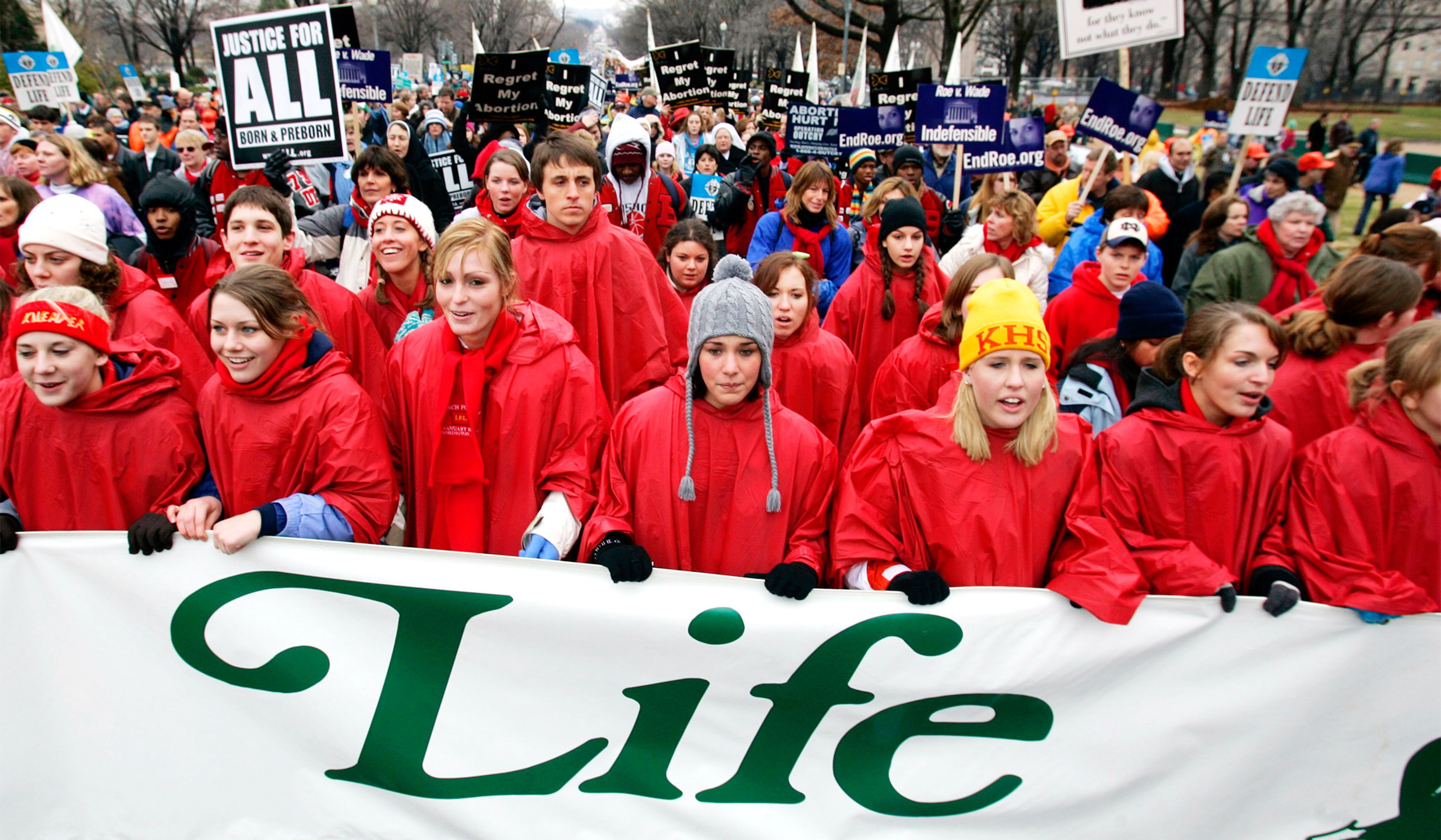
Pro-life demonstrators carry a banner during the the 47th annual March for Life in Washington, D.C., January 24, 2020.
Kevin Lamarque/Reuters
Pro-lifers have always debated among themselves how to respond to the radicalism of the Court’s abortion jurisprudence. Especially during the last three decades, the pro-life movement has generally adopted an incrementalist strategy. It has attempted to move the law and the culture little by little in a pro-life direction: cutting off taxpayer funding for abortion, requiring women seeking abortion to hear the facts about fetal development, banning kinds of abortion that shock the conscience even of some people who consider themselves “pro-choice.” The legal component of this strategy has been to chip away at the Court’s precedents until Roe and Casey could finally be obliterated.
In the current case, incrementalism would dictate trying to find a path to uphold the Mississippi law while refraining from overturning Roe and Casey or declaring that abortion law will again be the province of legislatures. The legal world abounds with speculation that some of the Republican-appointed justices would find such a path attractive. It would accord with the cautious instincts that Chief Justice John Roberts and Justice Brett Kavanaugh have shown in some cases. Justice Amy Coney Barrett recently wrote an opinion defending the religious liberty of a Catholic organization and criticizing the main precedent that limited judicial protection of that liberty, but declining to overrule the precedent itself. Liberals and conservatives alike thought her opinion could presage a split-the-difference decision in the Mississippi case.
Political considerations may also sway the justices, however improperly. Polls find that Roe v. Wade is popular and the prospect of its overruling unpopular. At the same time, as noted earlier, polling also finds public support for abortion restrictions that run afoul of the Court’s abortion decisions. Public ignorance of Roe and Casey and the consequences of reversing them surely helps to explain these results: One 2020 study suggested that two-thirds of Americans are under the mistaken impression that overturning Roe would immediately ban abortion nationwide.
Whatever the explanation, though, the polls offer any justices who take account of such things a reason to fear a public back-lash if they move decisively against Roe. Roberts appears to consider it important to protect the legitimacy of the Court. We can expect an intense pressure campaign to persuade the justices to leave Roe alone so as to avoid further efforts at Court-packing and the like. And the imperative of institutional self-preservation was, after all, what saved Roe back in 1992.
There are, of course, strong political arguments on the other side. Opposition to Roe has been the central organizing principle of both social and legal conservatism. Many conservatives would be demoralized to learn that decades of effort to reform the judiciary have proven unable to yield the correction of one of the Court’s most grievous and indefensible decisions. Many may quit politics altogether. Legal conservatism will splinter and scatter, a result that any political calculators among the Republican appointees cannot want.
Some institutional considerations also undercut the case for reaffirming Roe even in an attenuated form. Nothing has made the Court more an object of political controversy, and nothing has distorted the politics of judicial confirmation, more than the role it has arrogated to itself of setting abortion policy. Casey’s pretension to have resolved the national controversy over abortion can now incontrovertibly be judged a failure. In the long run, exiting the field could well prove in the best interests of the Court; it would certainly be in the best interests of the Court as the Constitution conceives of it. A muddled decision, by contrast, will invite further litigation.
But the chief practical difficulty of the middle option in the Mississippi case is that it may not actually exist. Sherif Girgis, a law professor at Notre Dame, has explained with crystalline clarity how the logic of the case militates against incrementalism. The law cannot plausibly be said to conform with Roe or Casey. (Or Doe: The law’s health exception is defined too concretely.) Casey repeatedly said that the state’s interest in preserving the life of an unborn child before viability is too weak to justify a prohibition, calling it, reasonably, Roe’s “central holding.” “Viability” is a standard that is notorious both for its imprecision and for moving as medicine develops, which is why it is a dubious moral or legal dividing line. But 15 weeks is inarguably before any currently plausible sense of the word. That’s why Mississippi, in its brief to the Supreme Court, argued straightforwardly for overruling Roe and Casey.
If justices instead want to find a new rule that lands some-where between “States can prohibit abortion from the moment of conception onward” and the rule it has put in place, they will have to come up with some new doctrine that isn’t in the Constitution and isn’t in the precedents either. This is bound to be an awkward maneuver at best, and is especially ill suited to a project of gradually getting rid of Roe and Casey. That project would require some justices to create a new, supposedly constitutional structure to govern abortion policy and then, in a few years, to take it down again. It is not a two-step that seems likely to make either the justices or the Court as a whole look better.
The National Right to Life Committee, one of the first pro-life organizations to arise to combat Roe and for many years the leader of the movement, is trying to stick with the incrementalist playbook. Its own brief to the Supreme Court does not ask for Roe or Casey to be overturned. But the brief can’t solve the conceptual problem of how to uphold the Mississippi law without undoing those decisions. Instead it throws up its hands. It asks the Court to come up with a new “roadmap” for abortion policy — the geography is not specified — and to tell lower courts to apply it to the law. It asks the Court, that is, to supply a clarity it cannot itself provide.
And that cannot, in the nature of things, be provided by anyone else. The Court’s abortion rulings have lacked some of the key features of stable precedents for similar reasons: The Constitution just doesn’t yield a rule that both lets the justices micromanage abortion policy and looks like law. That’s why, for example, the authors of the controlling opinion in Casey split in the first major case in which they tried to apply it: The “undue burden” test was too vague to produce a clear outcome, but it would have further strained credulity for Casey to have pretended that a more specific test could be derived from the Constitution. The pretense that trimesters have constitutional status was embarrassing enough, which is one reason the Court dropped it.
Most conservative and pro-life organizations that have submitted briefs in the case have followed Mississippi’s lead by asking the Court to overturn Roe and Casey. As the case comes into closer focus, an end to Roe is likely to become a rallying cry and a test of what the project of legal conservatism has really achieved.
An incrementalist pro-life legal strategy asks the Court to defer a final move against Roe and Casey until circumstances are more propitious. But no better time than now may come. Justice Barrett, for one thing, has not really given anyone reason to think she would flinch from erasing the abortion precedents. There are difficult questions about how the Supreme Court should protect religious liberty, questions she outlined. Abortion poses no comparable difficulties: The Constitution creates no barrier against legal protection for unborn children.
The political background is also different from 1992 in ways that cut in favor of a clean reversal. Some measures of public opinion had been moving in a pro-choice direction for nearly two decades by then; Republican politicians were split on abortion, with a large pro-choice contingent; they also had a perceived “lock” on the presidency they were scared of losing. None of this is true today. Narrow Democratic control of the White House, Senate, and House even have a silver lining for pro-lifers. If Republicans were in charge, it would be easier for abortion supporters to portray the end of Roe as the start of a theocratic revolution. If Democrats had large majorities, they might be able to codify a Roe-style abortion-on-demand regime in federal statute. Within the realm of real possibilities, we are looking at something like a best-case scenario for pro-lifers for an end to Roe.
Many things can go wrong. Some of them will go wrong. Republican politicians are not, in the main, aware that Roe really could go next year, let alone knowledgeable about what it would mean or prepared to respond. They are frequently not well versed in the law but think they are.
Ending Roe and Casey would not bring about pro-lifers’ ultimate objectives. But it would accomplish two great things. It would rectify one injustice: the treatment of unborn children in our nation’s fundamental law as un-persons who deserve no protection and, indeed, are not allowed to be protected. And it would enable that protection when, where, and to the extent that pro-lifers won the ensuing political debates.
Forty-eight years after the Supreme Court, in a simultaneous assault on justice, the rule of law, and democracy, created the abortion license, pro-lifers can have no illusions about how far we must travel before we reach the goal of an America where every unborn child is protected in law and welcomed in life. It would be a tragedy, and hard to forgive, if we failed now because we misjudged the opportunity before us.











Comments