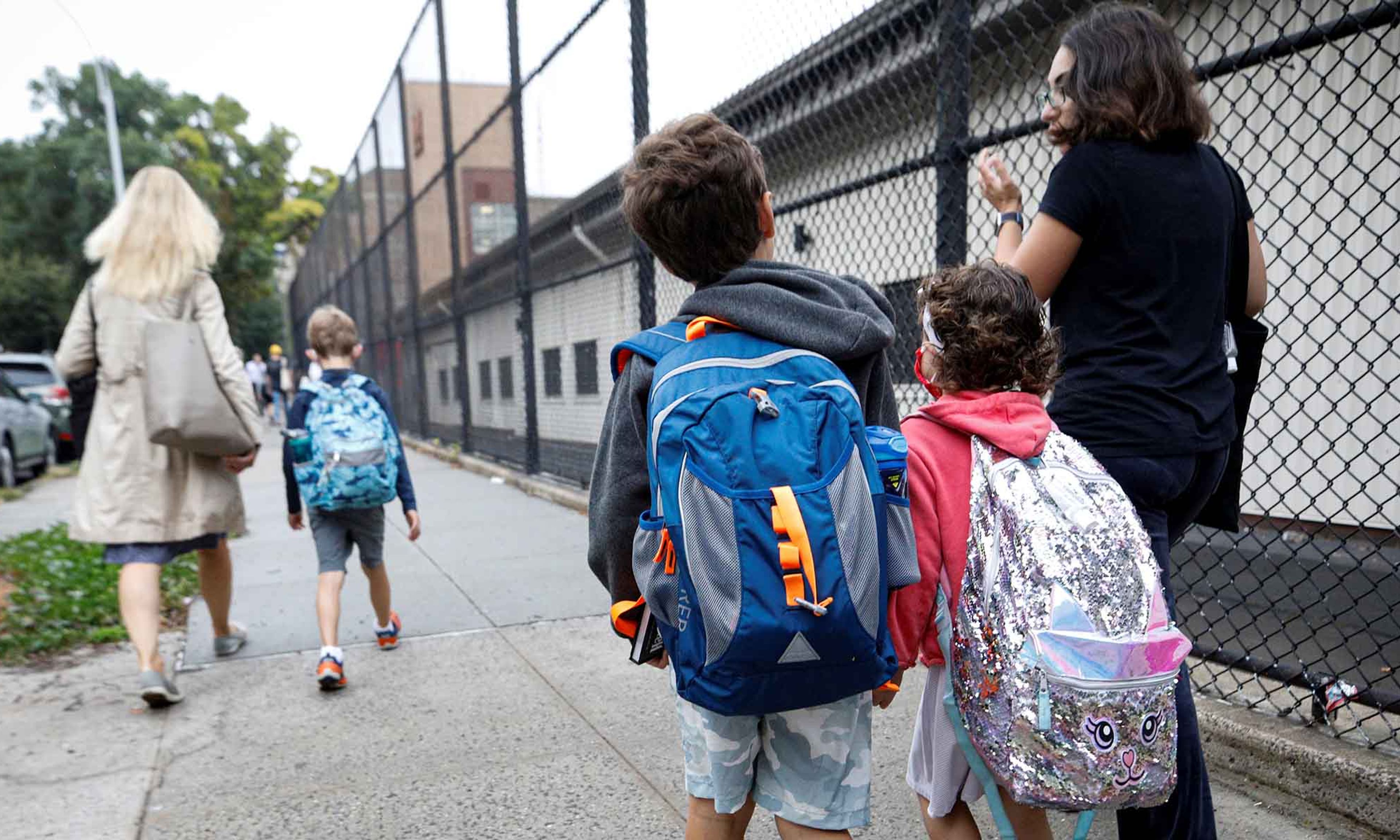
Children are back in school. After more than two years of disrupted schooling, the politics of education are changing. American parents are increasingly unsatisfied with public schooling and looking for alternatives. Capitalizing on this historic moment will require advocates and policy-makers to advance reforms that will deliver the changes that millions of American families desperately want.
Parents are right to be angry. Of all the poor government decisions that were made during the pandemic, widespread school closures during the 2020–21 school year should be at the top of the list. By the summer of 2020, we had compelling scientific evidence that schools could safely reopen, but many districts remained closed well into 2021. In some areas, public schools were closed for periods into 2022. Nationally, children attending high-poverty schools spent the most time out of the classroom.
The costs of these decisions are increasingly clear. Researchers analyzing national trends in student test scores have found that widespread school closures resulted in deep learning losses. Achievement gaps between rich and poor students have widened, particularly since the latter were more likely to be out of school longer. The U.S. Department of Education published a survey in the spring that found that 70 percent of public schools reported an increase in the percentage of students seeking mental-health services. More than 80 percent of public schools reported that parents and staff members were worried that schools were not meeting children’s academic needs.
These years of disrupted schooling also included new attention on public schools’ management and teaching practices. Debates about masking policies, curricula, and schools’ approaches to cultural issues have boosted interest in school-board politics and alternatives to traditional schooling. As a result, the politics of K–12 education are changing in ways that create opportunities for reform.
Many parents have chosen to withdraw their children from public schools. National public-school enrollments declined by 1.4 million students in 2020, according to the Department of Education. Homeschooling at least doubled during the pandemic. Many families are seeking other alternatives, including private schools, learning pods, and micro-schools.
Polling data reflect widespread dissatisfaction with traditional public education. A June Gallup poll found that just 28 percent of American adults have confidence in U.S. public schools. The survey showed an unsurprising partisan divide, with just 14 percent of Republicans expressing confidence, compared with 43 percent of Democrats. A June survey commissioned by Democrats for Education Reform found that 47 percent of likely voters in battleground districts trusted Republicans on education, compared with 43 percent who said they trust Democrats. The same poll found that likely voters thought that both parties, but particularly Democrats, are focused more on “how race and gender are taught in schools” than on “helping students get back on track.”
These changes are occurring during a period when public schools are flush with unprecedented resources. Since the start of the pandemic, Congress has provided $190 billion in emergency education aid to school districts and state education agencies. But more than $130 billion remained unspent as of June, including at least $100 billion in unspent relief funds that were included in the 2021 American Rescue Plan. The argument that additional funding is needed to fix the problems plaguing the nation’s schools is no longer credible.
Months before the midterm election, with Republicans expected to win additional seats in state legislatures and in Congress, all of this adds up to a historic opportunity for effective education reform.
In the states, conservatives have largely focused on two reform strategies. The first is to give parents more options for where and how their children learn. The second strategy attempts to exert more control over public schooling by, among other things, reforming schools’ teaching about race and culture-war topics.
Both approaches have been gaining traction. Since 2021, state policy-makers have responded to parents’ growing discontent by expanding parental choice in education. Four states created new parental-choice programs, while at least 20 other states have expanded or improved existing programs. Seventeen states have restricted the teaching of “critical race theory” or other approaches to teaching about racism and sexism. While the restrictive approach may entice many conservatives, only the former path can ensure that every child has an equal opportunity to receive a high-quality education; only expanding choice can address most parents’ primary concerns about K–12 schooling. Moreover, the attempt to legislate cultural issues only distracts attention from addressing those problems.
Arizona’s new program for education-savings accounts (ESAs), signed into law by Governor Doug Ducey in July, highlights the power of choice to improve quality and address parents’ worries. All students in the state are now eligible to receive $6,500 in funding to pay for private school, tutoring, or other instructional expenses.
Had a similar option been made available to all students in the spring of 2020, parents would have had the ability to use a share of their child’s school funding to form pandemic pods, hire tutors, or enroll in private schools that remained open when public schools were closed. Low-income families could have avoided years of unnecessary schooling disruptions that have imposed learning losses and emotional costs on a generation of children.
Even if parents in Arizona do not take advantage of the ESA program, its existence provides considerable leverage for those whose children remain in public school. Simply knowing that parents have a realistic exit option increases the school’s accountability to those who are dissatisfied with their children’s education.
On Capitol Hill, lawmakers in the 118th Congress should focus renewed attention on K–12 education. An immediate priority should be to increase oversight, including that of the billions in unspent pandemic-relief funds sent to states and school systems. Congress should document the damage that has been done by the school closures, and it should monitor how and whether states and public-school districts are using emergency funds to help students recover.
Beyond oversight, Congress should also start reforming federal education laws and programs to transfer greater power to parents, starting with the unspent federal emergency education funding. Senator Tim Scott (R., S.C.) and Representative Burgess Owens (R., Utah) recently introduced the Raising Expectations with Child Opportunity Vouchers for Educational Recovery (RECOVER) Act, which would expand how states and school districts could use unspent funding provided through the American Rescue Plan, which was one of the three Covid-emergency packages that included funds for K–12. The bill would allow states and school districts to use unspent money to award “child opportunity scholarships” to children from low- and middle-income families. The money could be used for tutoring, books, instructional materials, technology, or other outside-of-school learning costs, as well as for educational therapies for disabled children. Adding to the ways that this money can be spent to directly help students would immediately help children recover from the lockdown-driven damage.
Beyond emergency funding, lawmakers should look to reform long-standing federal education programs to give parents more control. For example, in 2021, Senator Mike Lee (R., Utah) and Senator Tommy Tuberville (R., Ala.) introduced the Children Have Opportunities in Classrooms Everywhere (CHOICE) Act. The bill would reform the Elementary and Secondary Education Act to require that states provide federal funding directly to low-income children through an expanded “529 savings account” (so called for the relevant section of the tax code) that can be set aside for college or used for private-school tuition, tutoring, or homeschooling. This bill should be a priority in the new Congress.
This approach should be applied to other key federal education programs as well. To give another example, Congress should amend the Individuals with Disabilities Education Act to strengthen parents’ right to choose their children’s educational setting. Disabled students suffered more acutely than most of their peers during the school closures. Giving the parents of children with special needs greater power to direct their children’s schooling could begin to reverse the damage and also promote equal opportunity in the future.
The federal Head Start program, which provides preschool benefits to disadvantaged children, could be transformed into a “Head Start account” program to give parents control of the more than $10,000 that is now spent per child on preschool, child care, and other services. Since it was created by President Lyndon Johnson, the Head Start program has never achieved its intended goals. A congressionally mandated national evaluation assessing the program’s long-term impact found that Head Start did not provide lasting benefits to participating children, compared with their peers who did not attend Head Start. But directly providing $10,000 to a million poor children for preschool and other education expenses would provide greater benefits.
Congress should consider other bipartisan strategies for promoting parental choice in education. Senators Maggie Hassan (D., N.H.) and Susan Collins (R., Maine) joined forces to introduce the Helping Parents Save for College Act, which expands the existing federal “saver’s credit” to allow low- and middle-income taxpayers to receive partial tax credits for contributions made to 529 savings accounts.
Since federal law now allows funds in 529 accounts to be spent on K–12 school tuition, bipartisan efforts such as the Hassan-Collins bill to encourage savings in these accounts could help parents take greater control of their children’s education while also helping disadvantaged children save for college. When the nonpartisan Government Accountability Office reviewed existing programs that help parents save for college using accounts, it found that these programs improve parents’ expectations for their children’s education. Such legislation has the potential to appeal to a broad coalition of lawmakers.
The growing national consensus that the nation’s public schools cannot be trusted to deliver the kind of education that American children deserve has made it possible for Congress and state lawmakers to provide something better. Arizona’s new universal education-savings-account program should be a model for federal and state lawmakers to give parents true control of their children’s future. Transferring power in K–12 education from teachers’ unions and school-district bureaucracies to parents has never been more necessary, or more politically feasible.










Comments