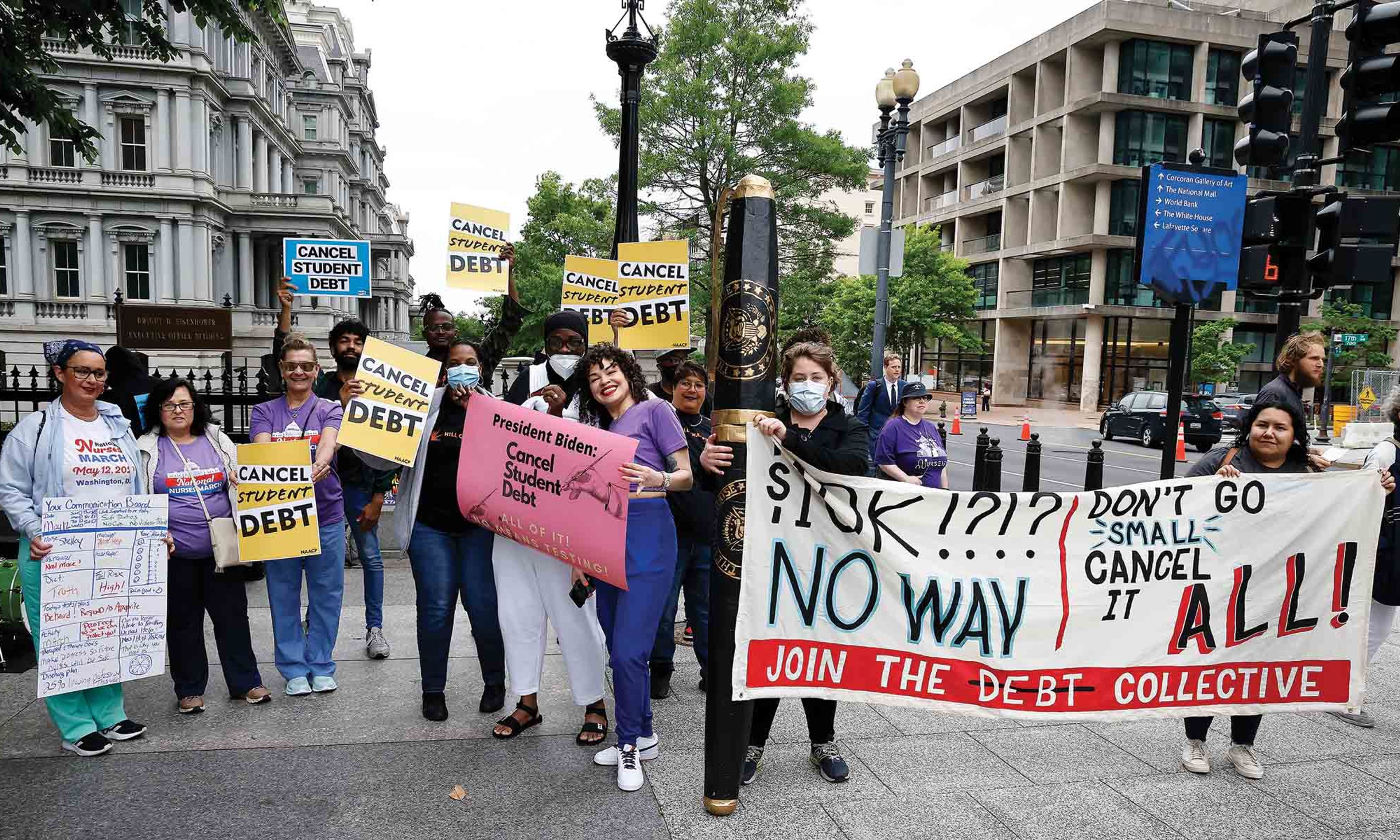
Over the past decade, higher education has grown from being a niche policy issue, followed closely only by wonks and those with a dog in the fight, to a national agenda item. Newspapers run headlines on the subject daily, showing particular fascination with student loans. And lawmakers, particularly on the left, have made their ambitions on higher education a part of their core agenda and a staple of their political rhetoric.
Notions of free college and student-loan cancellation became a serious part of the national discourse during the 2020 Democratic primary. And while Democratic majorities in the House and Senate seemed poised to reform higher-education policy to satisfy progressive values in 2020, their ambitions haven’t yielded any legislation, owing to an apparent lack of consensus within the party.
However, the White House took unilateral action and paused student-loan repayments — costing taxpayers billions of dollars through what, ironically, will prove to be a hugely regressive intervention. If Republicans win control of Congress in November, they should work quickly to pass legislation reinventing higher-education policy to better serve both students and taxpayers.
The first step should be to end the practice of issuing loans to students with little or no regard to their ability to repay them. In private credit markets, borrowers are given a loan only after the creditor assesses that it will be affordable for them to repay. In contrast, the federal student-loan program has no underwriting process, which is why students often borrow sums of money that take them decades to repay. If the private sector followed that practice, it would be considered predatory.
We should pass legislation that prevents colleges with a poor track record of student financial success from participating in federal student-aid programs. Taxpayers should not be asked to foot the bill for colleges and universities that perpetually send students into the world without the skills or credentials necessary to earn a wage that would justify the expense of their education.
The current system relies on accreditation as a gatekeeper for federal subsidies, largely ignoring post-graduation experiences and instead focusing on whether schools check certain boxes such as faculty credentials and classroom time. This system is flawed and arbitrary — instead, we should judge colleges and universities on their track record of student success. Schools and programs that consistently fail to prepare their students for opportunities to attain financial well-being should not be allowed to continue their participation in these taxpayer-funded programs.
Second, we must scrap the existing set of plans for student-loan repayment and replace them with a single universal program that delivers relief only to borrowers with unaffordable loans. If your knowledge of student-loan policy comes from the mainstream media or political rhetoric, you’re probably unaware that existing programs allow student borrowers with unaffordable loans to have them forgiven. It’s inconvenient for Democrats pushing for loan cancellation and free college to mention that the status quo isn’t so dire. These programs aren’t stingy, either. The Congressional Budget Office estimates that the existing policies will deliver over $200 billion in loan cancellation over the next ten years.
These programs are a good start, but they aren’t working well. They are confusing for borrowers to navigate and challenging for the Department of Education to administer. The result is that the neediest borrowers are probably the last to find financial relief, while financially savvy ones use the programs strategically to their advantage.
In an economy with relatively few social-welfare programs, it’s imperative that we have well-functioning mechanisms for social mobility. Higher education is potentially the single biggest driver of opportunity for young people. But sometimes it fails and students are left worse off than when they started. It is untenable for them to live under the weight of an unaffordable student loan. We should protect borrowers from unaffordable student loans, and we should refrain from encouraging students to borrow more than they can repay.
Republicans should pass legislation replacing the existing patchwork of loan-repayment programs with a single, universal loan-repayment program that allows low-income borrowers to make payments based on an affordable share of their income, with the lowest earners exempted from making any payments at all.
Last, Republicans should either eliminate the program for loans for graduate students or introduce aggressive limits on borrowing. Currently, students in graduate and professional-degree programs are able to borrow from the federal student-loan program essentially without limit. Graduate borrowing accounts for nearly all of the high-dollar loan balances that we hear about in popular media depictions of struggling borrowers, as undergraduate students are generally able to borrow only about $30,000 over the course of their degree program. About half of the more than $1 trillion in outstanding student debt is held by borrowers with graduate or professional degrees.
Scaling back or eliminating graduate-student borrowing would not leave students without the means to borrow for graduate school, as the private sector would probably step in to provide loans. In the current environment, private loans are seldom used, because the interest rates on them are not competitive with those on federal student loans. Most students would likely have to pay higher interest rates — which would drive some away from enrolling in the first place — but it’s not clear that lower enrollments in some graduate programs would be a bad thing. Allowing the private sector to take over or scale up student lending would reintroduce underwriting and reduce the likelihood that borrowers would take on loans they could not repay.
These three areas of reform would improve higher-education finance and move our system toward fiscal sustainability. If Republicans gain control of Congress next year, they’ll first need to restart student-loan repayment (which has been on hold for two and a half years), codify a restriction on the use of executive action to cancel student loans, and then move promptly to these more serious reforms. Ending student borrowing at failing colleges, shoring up the safety net for student borrowers, and limiting graduate-student borrowing would go a long way toward building a system of higher education that works better for students and taxpayers.











Comments