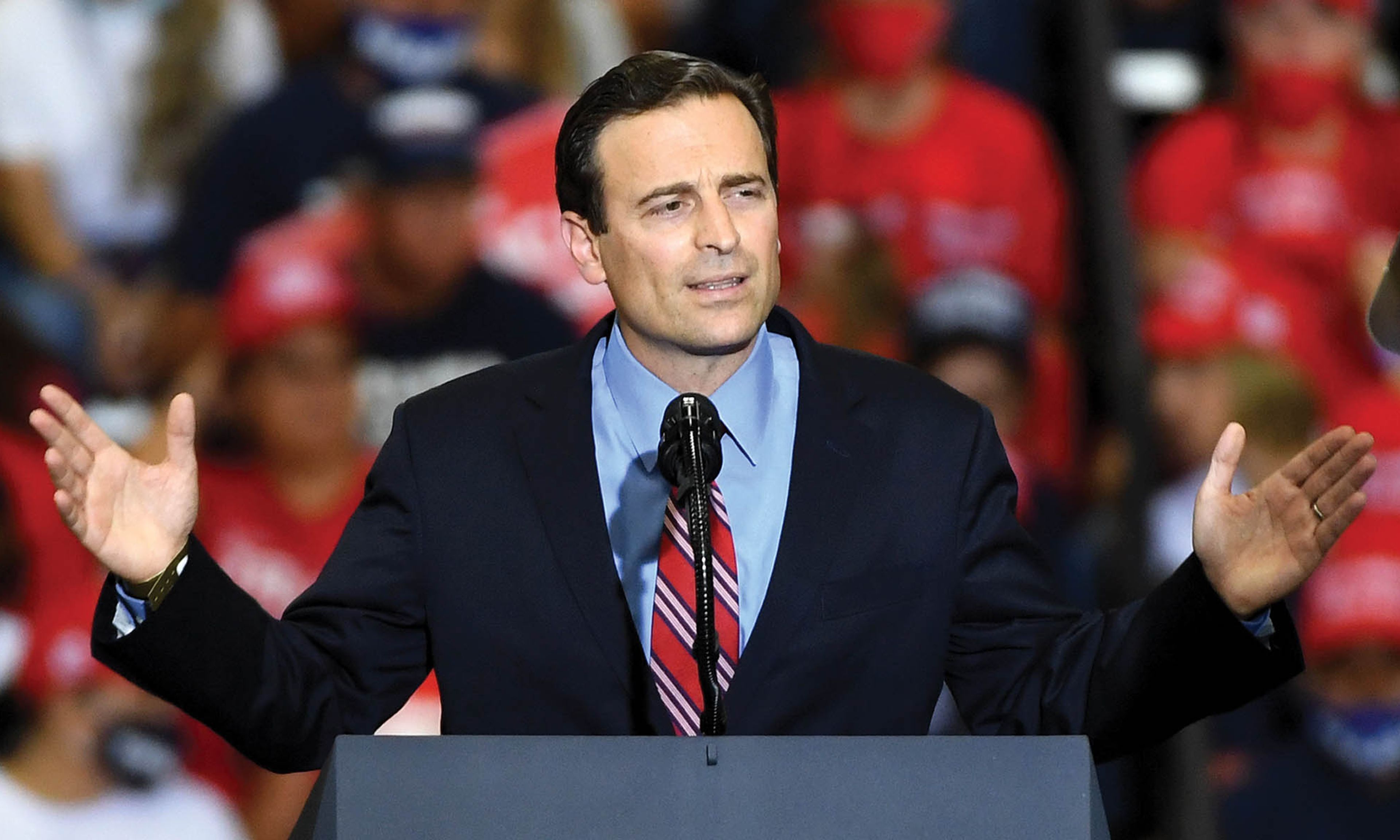
Gardnerville, Nev.
‘This race is the 51st seat,” says Adam Laxalt.
More than 1,500 other Nevada Republicans have gathered at a ranch on August 13 to hear the Senate candidate’s stump speech at the Basque Fry, an annual gathering whose name is an inside joke: Lamb fries, in the cookbook of ethnic Basques, come from a certain part of the male animal. One of the running gags of the event is to encourage newcomers to give them a try, without revealing what they really are, though in fact just about everybody knows.
“That is not a stretch,” says Laxalt. “It’s not an exaggeration. The entire U.S. Senate will hinge on this race.”
As listeners sit under the shade of big tents, Laxalt stands on a stage beneath a blue sky and the dry heat of a shining sun. Behind him in the distance rises a picture-perfect mountain of more than 10,600 feet in neighboring California. Jobs Peak seems to invoke the Old Testament text about the inscrutable ways of God, and perhaps even the uncertainties of elections, but it’s really a reference to Moses Job, an 1850s settler with a wonderful name.
“I believe fundamentally that we are a right-of-center state.”
Appearances might suggest otherwise. Nevada is one of 14 states in which Democrats control the governor’s office and both chambers of the legislature. The looming presence of Jobs Peak may even remind local conservatives of their fear that Nevada is on the verge of becoming what they call “East California.” The last time a Republican won Nevada’s electoral votes in a presidential race was almost a generation ago, in 2004. Among the state’s six-member congressional delegation, five are Democrats, including both senators. One of them is Catherine Cortez Masto, a first-termer who is Laxalt’s opponent this fall. The latest poll, taken in July of registered voters, gave her a three-point lead.
“We’re going to experience a red wave.”
Republicans nationally seem to agree that Laxalt is their best hope to flip a seat in the Senate. “Nevada is the single best pickup opportunity for Republicans in the country,” says Republican senator Ted Cruz of Texas, a few minutes before he becomes the Basque Fry’s final speaker. He puts the odds of a GOP takeover of the House of Representatives at “north of 90 percent,” but he’s more cautious about the Senate, deeming a Republican majority next year as a “60–40” proposition. Part of the problem is the map: Of the 35 seats up for election (including a pair of special elections), Republicans now hold 21, which means that they have more to lose, including a pair of vulnerable seats in Pennsylvania and Wisconsin. If they are to gain the Senate, currently in a 50–50 partisan split but under Democratic control because of the tie-breaking vote of Vice President Kamala Harris, they probably need Laxalt to prevail on November 8.
“This is going to be our year.”
Adam Paul Laxalt, who will be 44 on Election Day, is the descendant not only of Basque sheepherders who invented lamb fries, but also a famous family. Sundance Books in downtown Reno even has a shelf labeled “The Laxalt Family.” The candidate’s maternal grandfather was Paul Laxalt, a Republican senator who was so close to Ronald Reagan in the 1970s and 1980s that the New York Times once dubbed him “Reagan’s First Friend.” Then there’s Paul’s brother Robert, a well-known regional writer. Yet Adam Laxalt’s political heritage is even more striking and complicated: His father was Pete Domenici, the longtime Republican senator from New Mexico, who at the age of 46 had an extramarital affair with Adam’s 24-year-old, unwed mother. Michelle Laxalt raised Adam on her own, and the identity of Adam’s father was kept secret until 2013, when it broke in the Albuquerque Journal. “Adam had a father figure,” says Bob List, a former governor of Nevada who is close to the family. “It was his grandfather, Paul Laxalt.”
Adam was born in Reno but grew up mostly in and around Washington, D.C., where his mother worked. “I wasn’t actually raised in politics,” he says. “I never ran for student-council president.” Yet he knew his pedigree: “Since political awareness, I’ve been a Reagan conservative.” When he went to Georgetown University, he took two courses with Jeane Kirkpatrick, who had been Reagan’s ambassador to the United Nations. He also fell under the sway of George Carey, a professor of government who was, according to Laxalt, “one of the only conservative professors at Georgetown.” Laxalt remained at Georgetown for law school, where he joined the Federalist Society and became a disciple of a Supreme Court justice. “I spent law school defending Antonin Scalia,” he says. “I was one of the sole students willing to defend the Scalia side of the jurisprudence.” He also met the justice, forming a bond that years later would play an important and unexpected role in his life.
But first came the terrorist attacks of 9/11. “I felt like I needed to serve,” says Laxalt, who signed up with the Navy and began officer training while he was a law student. When he graduated in 2005, he entered a naval school in Newport, R.I., where he was assigned a roommate from Florida: Ron DeSantis, the future congressman and governor. “We just hit it off and became really close fast,” says Laxalt. “We were both super-competitive athletes. We ran together. You ally with somebody closely when you’re going through this stuff.” They remained close, too: Before either of them sought public office, they co-authored articles for National Review Online and other conservative publications on subjects such as the Obama administration’s detainee policies at Guantanamo. It was a subject Laxalt knew well: As a Judge Advocate General’s Corps (JAG) officer in Baghdad, he worked on detainee operations.
Returning from overseas, Laxalt took his final posting in uniform as an instructor at the U.S. Naval Academy in Annapolis, Md. From there, he reconnected with his old mentor, Justice Scalia. “I was complaining that I was moving around too much and didn’t have a consistent priest in my life,” says Laxalt, who then imitates Scalia’s New Jersey accent: “You need to meet my son, the best priest in America, my son, Father Paul.” Laxalt took the advice, met Father Paul Scalia, and began to attend Mass at Paul’s church, St. John the Beloved, in McLean, Va., which is about an hour’s drive from Annapolis when the traffic cooperates. Often it doesn’t, and in 2010, Laxalt ran late for the evening Mass on Holy Thursday. “I crawled over a bunch of legs. There was one seat left. It was right next to Jaime. That’s how I met my wife,” he says. “It really was miraculous.” Father Scalia married them the next year. Today they have four children.
Following the Navy, Laxalt returned to Nevada and worked at a law firm in Henderson, next to Las Vegas. Meanwhile, he admired the activities of many attorneys general in other states. “Republican AGs were almost single-handedly holding back the executive-order era of the Obama administration,” he says. Yet Nevada Republicans were somehow failing to field a candidate for their own state’s race in 2014. Laxalt decided to jump in, at the age of 35. “It’s not like I aspired to be a state attorney general, but this was a place where you could make a difference in the Obama era fighting for federalism and our constitutional system.” He beat Democrat Ross Miller, the son of a former governor, by less than a point.
As attorney general, Laxalt sued the federal government over immigration enforcement, land management, labor rules, and more. He also started a legal-assistance program for veterans, which today is a favorite talking point. His most significant achievement, however, may have involved criminal justice. “He inherited a mess: 8,000 rape-test kits that had just piled up,” says Victoria Seaman, a Republican city councilwoman in Las Vegas. “He eliminated the whole thing. That was huge.”
As the 2018 elections approached, Laxalt considered seeking a second term as attorney general, but decided instead to run for governor. “It was an open seat, and I was the strongest Republican in the state,” he says. “I felt like I was ready to lead.” Voters were less sure, and Laxalt lost to Democrat Steve Sisolak by four points. “It was a tough cycle for us,” says Laxalt. He’s right about that: Democrats fared well that year in Nevada and just about everywhere else.
“If I was the governor of the state, we would never have shut down Nevada,” says Laxalt, referring to Sisolak’s response to Covid-19. “I would have followed the DeSantis path.” He said as much in real time, too. Writing in the Nevada Business Magazine on April 18, 2020, when the pandemic lockdowns were only a month old, he called on officials to reopen the economy: “The human toll resulting from our self-imposed financial collapse is not theoretical; it can and will be every bit as tragic as that caused by a public-health threat.”
This stance possibly put Laxalt in a good position to run for governor in 2022, in a rematch of his earlier race against Sisolak, but last year he opted for the Senate. He says it came down to what he saw in the summer of 2020, as Black Lives Matter protesters took to the streets and urged the defunding of police: “No one stood up for the cops,” he says. “Between BLM and Covid and just the environment of our country turning so radically left, I really felt Iike I needed to be part of the federal solution of saving our country.”
Then came last year’s chaotic evacuation of American personnel from Afghanistan. “I think it was one of the most unmitigated foreign-policy disasters in generations,” says Laxalt, who wants the withdrawal to become a symbol of a failed leadership that only voters can correct. “It used to be in the military, when something went really, really wrong, the person in command was immediately relieved and held accountable. If a captain of a naval vessel runs aground, he’s relieved, even if there was someone else technically responsible.” That’s not what happened following the airlift from Kabul: “Nobody was relieved, nobody was held accountable.”
Now he wants voters to relieve his rival, Cortez Masto: “She has been a 100 percent reliable vote for the economic agenda of Biden.” He points to last year’s $2 trillion spending bill, passed with only Democratic votes, including Cortez Masto’s. “We all know that spending money increases inflation,” he says. Then he mentions soaring energy costs and choked supply chains — and rips into the $700 billion spending bill approved by Congress and signed by President Biden in August. “It’s not an ‘inflation reduction act.’ That’s laughable.”
Laxalt says he supports the Supreme Court’s Dobbs decision on abortion and opposes the Senate’s recent bipartisan compromise on gun control. He’s more eager to talk about the border: “It should be the No. 1 priority of the new Congress.” He brings up his visit this summer to South Texas, where he embedded with the Border Patrol and viewed a mobile morgue packed with dead migrants. “Thirty-two bodies from open-border policies,” he said in a video posted to Twitter on July 10. “This is one of the most horrific things you could ever imagine.” Laxalt cites the menaces of human-trafficking and drug-smuggling and proposes a series of reforms involving everything from detainment policies to the continued construction of a physical wall. “There’s no question this is solvable if we actually have the political will and leadership to simply come up with the solution set and go get it done.”
Conventional wisdom occasionally has claimed that Republicans who talk tough about the border risk the wrath of Hispanics. “Republicans were wrong about this,” says Laxalt. “Latino voters care about security in their communities, they care about people going through a lawful process, and they know that an open border is something that increases the likelihood of criminality and makes communities less safe. They’re incredibly fed up with it.” He makes a broader pitch for their support as well: “They are absolutely offended by this anti-American rhetoric from the Left. They believe in the American dream, and they believe in this still being a land of opportunity,” he says. “The Democrats don’t believe in that, at least Democrat leadership and left-wing politicians — they continue to say that this just doesn’t exist in the country.”
Laxalt’s candidacy will test the theory that Hispanic voters lately have drifted rightward — something that recent election results and polls have suggested, and that voter-registration numbers in Nevada may indicate as well. Writing in the Las Vegas Review-Journal on August 4, columnist Victor Joecks showed that in several legislative districts with Hispanic majorities, Democratic registrations have dropped and Republican registrations have risen, and that this trend has outpaced similar changes in areas with fewer Hispanic voters.
An added wrinkle is that his rival is Hispanic. The senator’s birth name is “Cortez,” her married name is “Masto,” and her preferred moniker is “Cortez Masto.” Laxalt routinely refers to her as “Senator Masto,” possibly in a bid to obscure the same ethnicity that she wants to highlight. Whatever the case, Laxalt thinks the race will come down to bigger questions: “People have decided that Democratic leadership has failed them.” His campaign strategists believe that Laxalt will win if he builds on the traditional strategy of Nevada Republicans, which involves running strong enough in the northern parts of the state to survive the Democratic dominance of Clark County, home of Las Vegas and about 70 percent of the state’s voters. The strategists think that if he approaches 40 percent support among Hispanics, he’ll host a victory party in November.
One of the small curiosities of the race is that although Laxalt never has run against the senator, he has replaced her previously: When he became attorney general, he succeeded Cortez Masto, who had just completed two terms. “I had to get in office and clean up after her once,” says Laxalt at the Basque Fry. The fate of the Senate may depend on whether he makes her his predecessor again.












Comments