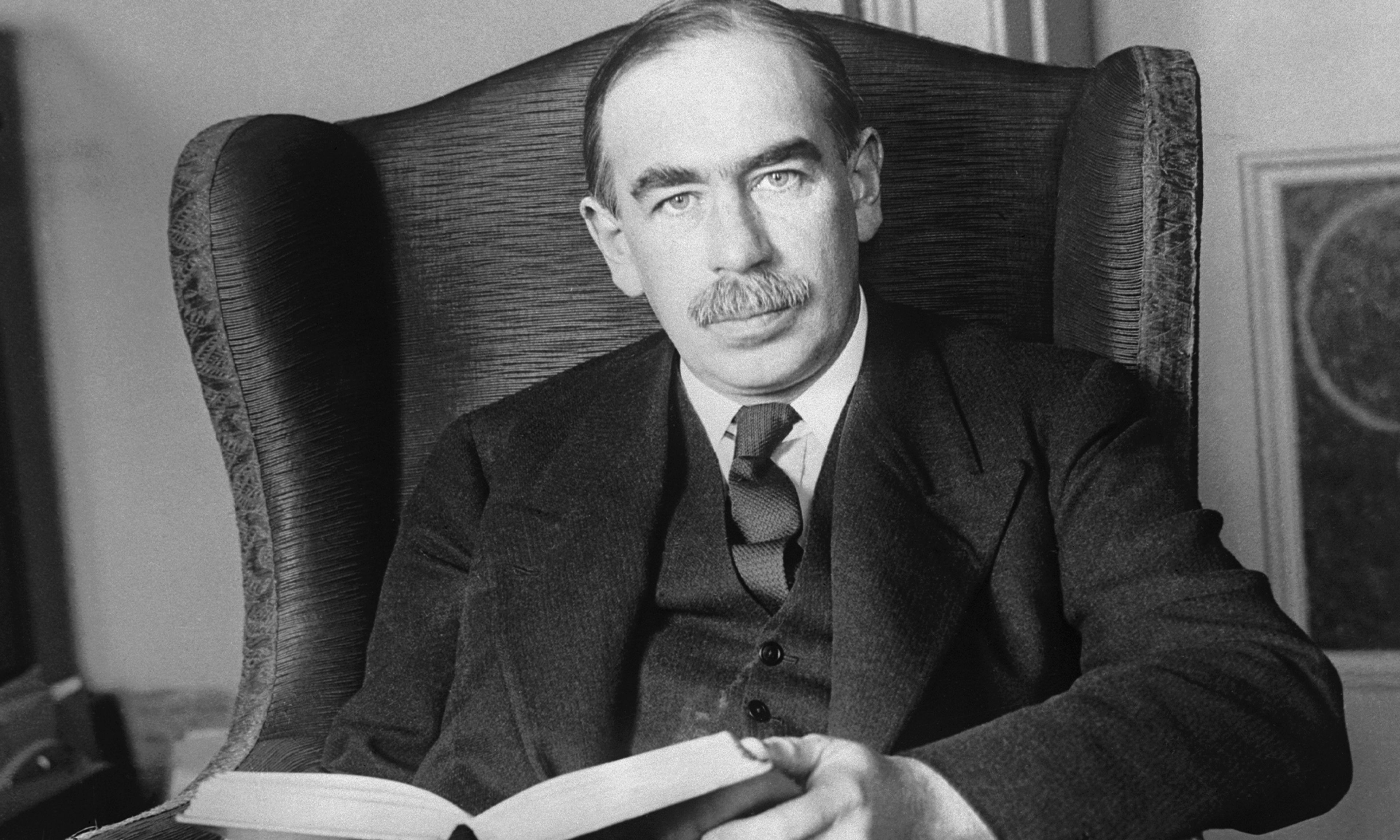
Ninety years ago, in 1936, John Maynard Keynes transformed the field of macroeconomics with a book titled The General Theory of Employment, Interest, and Money. Since its publication, there has been an ongoing debate about how best to interpret the book’s core message. What did Keynes really mean? Even today, there is no broad consensus.
In truth, Keynes did not hold a single view of macroeconomics. His views evolved as economic conditions changed. Indeed, this is a crucial issue for many of those fighting over his legacy: They underestimate the extent to which unusual circumstances shaped his thought.
Keynes wrote The General Theory at a time when much of the world was mired in depression. By 1936, he had already moved away from the views he held immediately after World War I, when inflation was the dominant international economic problem. Were Keynes alive in today’s world of inflation-targeting central banks, his approach would probably have shifted closer to what is now called New Keynesianism, which is quite different from traditional Keynesian dogma. Recall his famous (and perhaps apocryphal) quotation: “When the facts change, I change my mind — what do you do, sir?” Keynes saw his evolving views of the economy as ad hoc models in the best sense of the term — appropriate for contemporary problems.
No brief survey can cover all the ideas contained in The General Theory, so I’ll focus here on what his most astute readers viewed as its core idea. Both John Hicks and Milton Friedman suggested that the zero lower bound on interest rates was the key innovation and the assumption that motivated Keynes’s most important themes, including: (1) the paradox of thrift: the idea that an attempt by the public to increase its rate of saving might be counterproductive, pushing the economy into a slump; (2) the liquidity trap: the idea that when interest rates approach zero, any attempt to spur economic recovery by increasing the money supply might fail, as the public would hoard rather than spend the new money; and (3) the importance of fiscal policy: the view that deficit spending is necessary to escape a depression.
All three ideas are ultimately related to Keynes’s worry that monetary policy is ineffective. If the central bank alone can induce the public and businesses to spend at a desired level, much of the Keynesian model would become superfluous. There would no longer be a concern about increased saving, no worry about liquidity traps, and no need for fiscal policy to stabilize the economy.
What “effective” monetary policy means in this context is not a wise policy but merely one that can affect the level of prices or spending. In this more limited sense of the term, even the central banks of dysfunctional countries such as Zimbabwe and Venezuela are effective. After all, their central banks had no problem generating spending and inflation.
The primary problem in the 1930s was deflation. It was generally assumed — even by Keynes himself — that if a central bank could create inflation, this meant it could also spur a recovery in employment and output. But Keynes doubted it could create either inflation or an economic recovery.
Similar concerns were expressed in the early 2010s, when Keynesians like Paul Krugman argued that the Fed was unable to raise inflation up to its 2 percent target and thus that fiscal stimulus was needed. It is no coincidence that this pessimistic Keynesian view of monetary policy was revived precisely at one of those rare periods when interest rates were stuck at zero for an extended time.
In normal times, more saving can lead to lower interest rates, acting as a spur to investment in new companies and home-building. But Keynes worried that, at zero interest rates, a higher propensity to save would merely lead to less aggregate demand, as the central bank would be unable to encourage more investment by cutting interest rates further. In his view, fiscal stimulus then becomes the most effective tool for spurring a recovery.
Put simply, traditional Keynesian economics is a response to liquidity traps: sustained periods of near-zero interest rates. That’s what creates the impression that monetary policy is ineffective. It’s at such times that the Keynesian approach is most popular.
In 1923, Keynes published A Tract on Monetary Reform, which many monetarists (myself included) view as his best book on macroeconomics. The big issue of the day was post–World War I inflation, which reached double-digits in the United States and elsewhere and hyperinflationary levels in Germany. In that economic environment, you would not expect to see people worry about the ability of central banks to create inflation. Not surprisingly, Keynes employed a relatively monetarist approach in the Tract, showing how printing lots of money led to higher prices. In contrast, The General Theory reflected conditions in the 1930s, a period that saw falling prices and near-zero interest rates.
After World War II, Keynesian economics became the dominant framework for thinking about macroeconomics. If you studied economics in college, you may recall models that explained GDP in terms of movements in its major components, including consumption, investment, government output, and net exports. Those textbook models all came out of the General Theory and, unfortunately, have led to a great deal of confusion.
By the 1970s, Keynesian economics was beginning to lose its luster, partly because of an intellectual counterrevolution led by monetarist critics like Milton Friedman and partly because Keynesian economists struggled to address the increasing problem of high inflation coinciding with high unemployment. Keynesian textbooks neither offered a good explanation for what caused stagflation nor recommended good policies to counter it.
By the 1980s, a New Keynesianism emerged that combined ideas from monetarism and traditional Keynesianism. (The influence of monetarism was so strong that this hybrid theory might just as well have been called “New Monetarism.” But left-of-center types dominate academia, and they generally get to name things.) The New Keynesianism adopted both the monetarist belief that central banks could and should stabilize total spending and the Keynesian view that central banks should target interest rates rather than the money supply. It was a major improvement over the model developed in the General Theory.
In the New Keynesian era (especially between 1985 and 2008), fiscal policy was largely viewed as ineffective. The prestige of the Fed was never higher than during the late Alan Greenspan’s long tenure as chairman (1987–2006). Even Democratic administrations no longer worried about excessive saving, and the Clinton administration ended up agreeing to a fiscal policy that led to three consecutive budget surpluses.
Looking at this history reveals a pattern. Phase one: Under a gold (or silver) standard, prices rise and fall over the business cycle, and the long-run trend rate of inflation is near zero. This was the world that Keynes lived in for most of his life. It is also a world where monetary policy can do little to influence the economy.
Phase two: During and after World War I, the price level was artificially inflated as many belligerents sold gold stocks to pay for the war. This situation was fragile, however, as price levels were temporarily above their long-run equilibrium. There was a natural tendency for prices to fall back to pre-war levels, which is roughly what happened during the early 1930s.
In my view, Keynes misdiagnosed the problem of monetary policy during the 1930s. He assumed that the problem was near-zero interest rates when in fact it was the constraints imposed by the international gold standard. Indeed, studies have shown that the date on which a country began recovering from the Great Depression was highly correlated with the date on which that country left the gold standard.
Phase three: Under a fiat money regime, political pressures create an inflationary bias, and this often leads to trend rates of inflation well above zero. In addition, by the 1960s, economic policymaking was dominated by people in their 50s and 60s who had come of age during the Great Depression. That generation worried more about high unemployment than inflation.
When Keynes was alive, purely fiat money regimes were viewed as pathological cases likely to be highly inflationary, as seen in Weimar Germany. Although Keynes is widely viewed as a critic of the gold standard, he was even more strongly opposed to a completely unconstrained fiat money system; instead, he favored a hybrid system not unlike the Bretton Woods regime, in which the dollar was fixed to gold at $35 per ounce but central banks nevertheless retained greater leeway than under the classical gold standard. Like a fish that doesn’t know it is wet, Keynes was so immersed in the world of the gold standard that he failed to recognize the extent to which his worldview was shaped by a monetary system anchored by a commodity price peg.
The Depression led many countries to devalue their currency to avoid the gold standard’s constraints. In 1934, President Franklin D. Roosevelt raised the price of gold from $20.67 per ounce to $35 per ounce, allowing for a much higher price level in the long run. But even a $35 per ounce price peg eventually began to constrain the ability of monetary and fiscal policy to stimulate the economy. By the 1960s, the gold standard was viewed as what Keynes called a “barbarous relic,” and rather than tighten policy to keep the general price level consistent with the gold peg, the U.S. abandoned the peg in March 1968, when gold prices were allowed to rise in private European gold markets. This effectively put the U.S. on a 100 percent fiat money regime; the official end of gold convertibility three years later was a mere formality.
Unfortunately, Keynes’s followers failed to understand the importance of the gold standard to the original Keynesian model. Like a teenager given the keys to his father’s Ferrari, the Fed initially had trouble steering monetary policy under a pure fiat money regime. It lost control of the price level, leading to the “Great Inflation” between 1968 and 1981 — a period that saw inflation reach levels far worse than those we experienced post-Covid. Under Fed Chairman Paul Volcker, monetarist ideas finally began to be implemented in the 1980s, and inflation fell to a more moderate (but still higher than desirable) level of roughly 4 percent. The Fed adopted a 2 percent inflation target implicitly after 1990 and explicitly in the 2010s.
The early 2010s might seem to be an exception to this pattern, since that period also included zero interest rates but with no gold standard. But monetary policy remained effective during the 2010s. The U.S. economy recovered far more strongly than the eurozone, mostly because the Fed was more expansionary than the European Central Bank.
Even when rates fall to zero, central banks have plenty of other policy tools, including quantitative easing and forward guidance. No central bank in a fiat money system is ever “out of ammunition,” unless it runs out of paper and green ink. Nonetheless, zero interest rates create a false impression of monetary policy’s ineffectiveness — and thus to calls for fiscal stimulus — along with a false impression that saving is harmful to the economy.
In 2013, interest rates were stuck at zero and the traditional Keynesian model was put to the test. A round of fiscal austerity cut the budget deficit nearly in half, leading many Keynesian economists to warn of the risk of recession from too much saving and too little spending. In fact, economic growth accelerated; by the fourth quarter of 2013, twelve-month GDP growth was higher than a year earlier. If overall spending on consumption and investment is stable — as happens when monetary policy targets inflation — any increase in private or government saving cannot create a recession.
In recent decades, various schools of thought have claimed the mantle of Keynesian economics. New Keynesians are dominant in the most prestigious economics departments. More traditional Keynesians (sometimes labeled post-Keynesians) are seen as somewhat heterodox. Because Keynes’s views evolved over time, each school can find support from at least a few statements in the General Theory.
In my view, this obsession with Keynes’s actual views is a bit unhealthy, as a social science should progress over time. Traditional Keynesians probably best reflect the views expressed in the General Theory. But given everything we’ve learned since Keynes died in 1946, if he were alive today, I suspect that Keynes would be a New Keynesian.
The monetarist economist Allan Meltzer once asked why Keynes, if he was so worried about liquidity traps, didn’t advocate having the central bank simply target inflation at a high-enough positive rate to keep interest rates above zero. This would eliminate the worry that a liquidity trap could make monetary policy ineffective and therefore the perception that fiscal policy is needed. Keynes doesn’t seem ever to have addressed this issue, perhaps because a positive inflation target is impossible under a commodity money standard, where the long-run trend rate of inflation is zero.
If Keynes was not a New Keynesian economist, it was because he never envisioned that the sort of inflation-targeting monetary policy adopted by Greenspan was even possible. If he had understood that the central bank could maintain a healthy level of spending without any help from fiscal stimulus, he would have probably favored the New Keynesian approach. Indeed, if Keynes could have envisioned the next 80 years, he might also have stopped worrying about the paradox of thrift.
While I am quite skeptical of the central message of the General Theory, I would not deny that Keynes was a brilliant economist. It seems implausible that so many of our most distinguished macroeconomists would be attracted to Keynesian economics if the General Theory were simply wrong. So how do I justify my skepticism?
Keynes was correct about one big issue: The Great Depression was largely caused, at least in its initial phase, by a dramatic decline in aggregate demand, or nominal spending. He was also correct in arguing that major governments erred in not moving more aggressively to stimulate spending to boost the economy. It is possible (albeit far from certain) that gold standard constraints prevented the sort of monetary stimulus required to achieve a rapid recovery during the 1930s — but devaluation was always an option.
Unfortunately, the central ideas in the General Theory are based on a misconception about monetary-policy effectiveness, as even specialists in the field often misjudge monetary policy because of a sort of cognitive illusion. High interest rates are often considered “tight money,” i.e., contractionary policy; low rates are “easy money,” or expansionary policy. But in many cases, the exact opposite is true. When printing lots of money causes high inflation (as happened in the 1960s and 1970s), nominal interest rates rise sharply. But those high nominal interest rates are not tight money; they are the result of previous monetary stimulus. Similarly, when a reduction in the money supply leads to deflation (as in the early 1930s), interest rates often fall to zero. But those low rates are not a sign of easy money; they are the delayed reaction to a contractionary monetary environment. As a result, monetary policy has the strange property of often looking like the exact opposite of the actual policy stance.
If you try to step on the accelerator in your car and instead accidentally step on the brake, you may wrongly assume that the car is broken. Throughout history, central banks have often misjudged the economy by looking at the wrong policy indicators — with too much focus on interest rates — and as a result have wrongly concluded that monetary policy was ineffective. For instance, many Keynesian economists failed to recognize that a tight money policy pushed the economy into recession in 2008 because they focused too much on (falling) interest rates.
These cognitive illusions make Keynesian economists too pessimistic about the effectiveness of monetary policy, which then leads to pessimism more generally about free market economies. Economic crises that are caused by bad monetary policies get misdiagnosed as failures of capitalism, which then becomes viewed as an inherently unstable system. Where an economy is unstable, Keynesians tend to view central bankers as firemen who may or may not have powerful enough tools to rescue it; monetarists view central banks as arsonists who have caused the instability that they are trying to address.
The General Theory of Employment, Interest, and Money is full of insightful observations. But the core ideas in this book — the ideas that led to Keynesian economics as we know it today — are erroneous. Under a fiat money system, a central bank has an almost unlimited ability to raise prices and nominal spending. That means there is no need for deficit spending to stimulate the economy and no need to worry that more saving will somehow hurt the economy.
Keynes was right to criticize the constraints of an overly rigid gold standard. But in a fiat money world, there is no need for Keynesian economics.










Comments