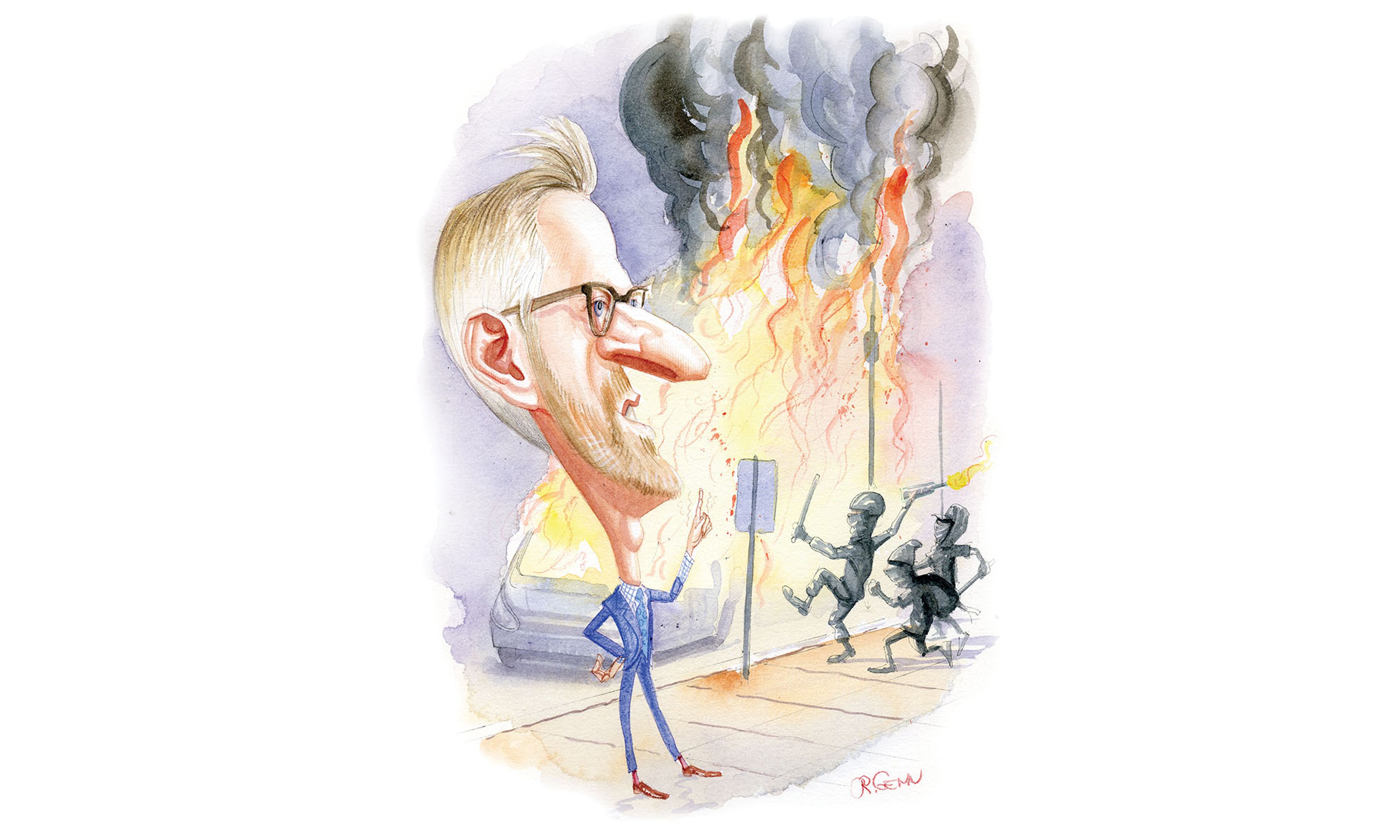
• Jerry Falwell Jr. got a $10.5 million severance from Liberty, payable in a golden calf.
• The shooting of Jacob Blake by Kenosha, Wis., police led to riots well before the key facts were known; indeed, as we go to press more than a week later, much remains unclear. The outline of what happened, though, is finally coming into view. Police were called to the scene by a woman who said Blake had taken her keys and was not supposed to be there, and they knew there was a warrant for his arrest stemming from charges of third-degree sexual assault, trespassing, and disorderly conduct in connection with domestic abuse. He resisted arrest, at one point putting an officer in a headlock; was tased twice without effect; and at some point drew a knife. In a viral video, he’s seen walking around an SUV — which evidently did not belong to him, though three of his kids were seated in the back — and opening the driver’s-side door as two officers follow him closely with their guns drawn. An officer grabs his arm, Blake bends over toward the car’s interior, and the officer shoots him seven times in the back, paralyzing him. This was a complicated, dangerous situation with many variables in play, including a lethal weapon and children, and we hope investigators fill in the missing details so that the legal system can judge whether the shooting was justified.
• Three nights after the shooting, CNN ran a chyron claiming the protests in Kenosha were “fiery but mostly peaceful,” while the channel’s gas-mask-clad correspondent explained that the lawlessness stood in “stark contrast” to the peaceful demonstrations that defined daytime hours. Fires raged amid a graveyard of destroyed vehicles in the background. There’s nothing wrong with pointing out that lawful protests preceded the chaos, but when Rome is burning, it seems beside the point to note that it was not on fire earlier that day.
• Kyle Rittenhouse, a 17-year-old from Antioch, Ill., should not have put himself into the middle of Kenosha’s civil unrest, standing guard after a curfew had gone into effect with an AR-15. In a chaotic scene captured on numerous videos, he wound up discharging that weapon at several people, killing two and injuring one; he has been charged with numerous offenses ranging from first-degree intentional homicide to bearing a dangerous weapon as a minor. It’s far from clear, however, that Rittenhouse committed murder rather than legally defended himself: A close analysis of the available footage suggests that each shooting incident began with Rittenhouse running away as protesters chased him and that he fired only when his pursuers closed in, each one apparently attacking him or trying to take his gun. It is legal to use lethal force to prevent an attacker from causing death or serious injury, and Rittenhouse’s lawyers have a case to make; but it is far better, when possible, to avoid such situations entirely.
• Shortly after the guillotine debuted in revolutionary France, it appeared in America as a political prop. One journalist described a dinner of Jeffersonians at which a pig, standing in for Louis XVI, was decapitated, “then carried around to each of the convives who, after placing the liberty cap upon [it], pronounced the word tyrant and gave the poor little grunter’s head a chop with his knife.” Prop guillotines have now reappeared: one with an effigy of President Trump outside the White House; another with an effigy of Jeff Bezos outside his house. The Chicago Teachers Union issued a bizarre tweet about the latter: “We are completely frightened by, completely impressed by and completely in support of wherever this is headed.” Sounds like some teachers need to retake AP European History. Can some students of AP American History recall a time when Sarah Palin was criticized for a mailing that drew crosshairs over Democratic congressional districts?
• The Sierra Club has decided that, based on some unflattering descriptions of Native Americans and black people in his personal writings, revered naturalist John Muir is to be scrubbed from its annals. Muir, known as the “father of the national parks,” was a Scottish-American naturalist, a conservationist, and the first president of the club. He was instrumental in the establishment of Yosemite as a national park, and the Sierra Nevada was his true love. Donald E. Worster, a recent biographer of Muir, strongly opposed the Sierra Club’s decision, saying it is “ignoring . . . [the] full context” of Muir’s writings, the objectionable parts of which were private observations about a few individuals he met in his travels and not public stances on entire races. The remarks, objectionable as they are, are insufficient reason to sully the name of a man who strove to remind all people — no matter their race or class — of nature’s beauty.
• At August’s end, we were losing about 1,000 Americans a day to the coronavirus, but the trend over the month was a slow decline. New cases have been dropping even faster. During this relative lull, public officials should be preparing for some foreseeable challenges. Pushing back election-certification deadlines in anticipation of a surge in mail-in voting is one. Developing guidelines for the distribution of any COVID vaccine is another; front-line medical personnel and essential workers in high-density areas should presumably have priority. It’s also worth keeping in mind how little we still know about the novel coronavirus, including the efficacy of cloth masks in preventing its transmission, its lingering effects in non-fatal cases, and the role of warm weather in tamping it down. There are no grounds for complacency about the future course of the disease, and until we know it, the economy is unlikely to return to its previous health.
• Accepting his nomination at the Democratic National Convention, Joseph Biden gave a short, simple, and rather passionate speech. Trump supporters should learn from it the dangers of suggesting that he is senile: a low bar is easily surmounted. Biden’s speech was short on specifics, consisting of a recitation of elementary civic principles, which he claimed the president scorns. The most resonant line in it was this: “While I’ll be a Democratic candidate, I will be an American president. I’ll work hard for those who didn’t support me, as hard for them as I did for those who did vote for me.” A President Biden, however hard he works, will govern as a Democrat, and an increasingly progressive one as his party moves left. That is simple political reality. President Trump, on the other hand, has shown himself incapable of uttering such sentiments away from a teleprompter. That is simple personal reality. It is always unwise to cede ordinary pieties to one’s opponents.
• “Clinton campaign ponders: What if Trump campaign doesn’t concede?” So went the headline of an Associated Press story from late October 2016. The story detailed preparations the Hillary Clinton presidential campaign was making in the event, then thought likely, that its candidate would win, while accounting for the possibility that Donald Trump, her opponent, would make good on his frequent labeling of the election as “rigged” by refusing to admit defeat. Election Day brought a different outcome. Four years later, Clinton herself is urging that Democratic presidential nominee Joe Biden “should not concede under any circumstances.” In her view, Trump can win only by “either suppressing or stopping voting, or outright intimidating people into feeling that they have to go with the strong guy to stand up against all these threats that Trump is going to gin up to scare people.” She is not alone in attempting in advance to cast a disfavored electoral outcome as illegitimate. As in 2016, Trump is doing the same. Our political system has its flaws, but at least it’s better than our politicians.
• In Massachusetts, Senator Edward Markey thrashed Representative Joseph Kennedy III in a primary for Markey’s Senate seat, 54 percent to 46 percent. The two Democrats agreed on every issue. The only differences between them were age — Markey, 74, has been in Congress as a senator and a representative longer than Kennedy, 39, has been alive — and bloodlines. For over 70 years, Kennedys have felt entitled to political office in Massachusetts, and for all that time voters have indulged them. No longer. Perhaps the charm began to break in 2010, when David Gergen asked Republican Scott Brown how he could sit in Ted Kennedy’s seat — the last of the first generation had just died — and vote against Obamacare. Brown replied, “With all due respect, this is not Ted Kennedy’s seat, or the Democrats’ seat — it is the people’s seat.” Well, one out of two ain’t bad.
• QAnon is a theory, expounded by a social-media poster writing as “Q,” that there is a vast conspiracy of Satanic pedophiles, including prominent Democrats and George Soros, which President Trump is valiantly battling. Asked about it at a press conference, Alfred E. Neuman in the White House shrugged. “I don’t know much about the movement, other than I understand they like me very much, which I appreciate.” He appreciates individual QAnon-ers too. After one such, Marjorie Taylor Greene, won a primary for a safe red congressional seat in Georgia, Trump hailed her victory with a tweet: “Marjorie is strong on everything and never gives up — a real WINNER!” QAnon makes the John Birch Society look good in retrospect. There really was such a thing as international Communism; the Birchers erred in supposing that Dwight Eisenhower was its agent. QAnon slimes those it dislikes by linking them to campfire bugaboos. And the president of the United States doesn’t care, so long as he might pick up a few fans.
• When Deirdre Byrne, a retired surgeon and Army colonel and a Catholic nun, said that the Biden-Harris ticket supports “the horrors of late-term abortion and infanticide,” the Washington Post’s fact-checker quickly called foul, claiming that Biden wishes merely to “codify in statute the Supreme Court’s landmark ruling in Roe v. Wade and related precedents.” But there’s the rub: The Court’s “related precedents” include Doe v. Bolton, Roe’s companion case, which carves out an exemption for abortion, even late in pregnancy, to preserve a woman’s “emotional” health. It’s an exemption so broad that it effectively legalizes abortion at any point so long as an abortionist claims it’s necessary. The bills that Biden and his running mate have sponsored in the Senate would enshrine Roe’s expansive health exemptions in law (Harris’s bill takes care to instruct that all terms in the law should be interpreted “liberally”). The fact-checkers might bleat that the Democrats’ “reproductive health” stance — which includes repealing the Hyde amendment so as to direct federal dollars without restriction toward abortion — should not be misconstrued to encompass late-term abortions. But all evidence points to the contrary, and at no time this century has either Biden or Harris stated where he or she would restrict the right to terminate an unborn human being’s life. We invite Joe Biden to stop hiding behind the fact-checkers and correct the record on this matter. That he won’t is telling.
• The Senate Intelligence Committee released the fifth and final volume of its investigation into Russia and the 2016 election. The report is nothing if not exhaustive, clocking in at nearly 1,000 pages. It is also a model of congressional oversight, getting on the record as much as possible about the 2016 election, including facts inconvenient to both sides. If the report adds details, its basic conclusions aren’t surprising — the Trump team lacked scruples, was amateurish, and, in Paul Manafort, had a sleazy, Russia-connected operator at the top, but it didn’t conspire with the Russians. Meanwhile, the FBI was too credulous about the shoddy Steele dossier. The committee has finished its work on 2016 just in time to prepare to investigate whatever emerges from 2020.
• The Federal Reserve concluded a lengthy review of its policies by announcing two changes. The first one is welcome: The Fed will no longer try to keep unemployment from falling too low. It will no longer, that is, assume that low unemployment will foster inflation. The second is trickier. The Fed’s target of 2 percent annual inflation will now be an “average” target. Averaged over how long a period? The Fed says it will be “flexible.” But if the Fed makes up for 1 percent inflation during a recession with 3 percent inflation during a recovery, all it will be doing is making the business cycle more pronounced. We would have preferred for the Fed to bind itself firmly to a sensible rule that tends to stabilize cyclical swings — such as a rule to keep spending levels rising at a steady level. What the Fed is doing is subtracting predictability from the economy rather than adding to it.
• The Golden State’s slide into chaos continued apace this summer, with its riots, fires, water shortages, misgovernment, and other woes being crowned by a wave of rolling blackouts. Toward the end of August, the state’s three largest utilities cut off more than 400,000 customers. A decline in wind-power output contributed to the blackouts, as did California’s limited effort to tap out-of-state sources for electricity. California’s grid and electricity supply have known shortcomings, but the cause of this specific outage remains, at the moment, unknown. The New York Times reports that California’s energy experts are “bewildered” at the decision to cut off all those customers, and that the state “had plenty of power available.” There is some reason to worry that the new political norms emerging from the coronavirus epidemic have emboldened highly risk-averse bureaucrats to order intensely disruptive courses of action when they are not clearly called for. California’s list of man-made — government-made — disasters is long and woeful. Former Wells Fargo CEO Dick Kovacevich worries that California “could implode within a generation,” and U-Haul traffic from California to Arizona and Nevada is brisk. Darkness falls metaphorically and, in the case of California’s electricity consumers, literally.
• One of the hallmarks of a bad tax is that the taxing authority has to devise extreme measures to enforce it. Confronted with the reality that some of the richest Californians might simply leave the state if plans to impose a wealth tax on those with assets of $30 million or more go through, the proposed levy’s architects are planning to ensure, as someone once sang, that “you can check out any time you like, but you can never leave.” Well, not for up to ten years, anyway. In essence, former Californians would still be liable for 90 percent of the wealth tax in the year after they quit the state, 80 percent the year after that, and so on. Leaving aside the considerable moral case against wealth taxes (not to speak of privacy concerns), they also appear to be counterproductive. Whether or not the proposed extraterritorial application of a Californian wealth tax would stand up in the courts, it would likely lead to an exodus of the rich or those who hope to become rich — and they would take a lot of other tax revenue with them. There is a reason why almost all the European countries that used to have wealth taxes have gotten rid of them. To be fair, however, there is one country that is contemplating introducing a wealth tax, that model of sober finance better known as Argentina. And even Argentina is promising that it will be a one-off.
• Steve Bannon — the former Trump adviser, Breitbart publisher, and champion of “populism” — was indicted for orchestrating a fraud. Citizens gave money that they thought was going to the building of a border wall, but the prosecution says it ended up lining the pockets of Bannon & Co. In a cinematic touch that the sometime movie producer must at some level have appreciated, Bannon was arrested on a billionaire’s yacht. Around the same time, the Senate Intelligence Committee issued a report that, in a footnote, recorded that Bannon had put down Donald Trump Jr. to its investigators as “a guy who believes everything on Breitbart is true.” Bannon and his allies have long insisted that elites have nothing but contempt for conservative citizens, and they have done their best to prove it.
• Seventeen days after asking Jerry Falwell Jr. to take a leave of absence as president and chancellor, Liberty University sought and accepted his resignation. Long-simmering speculation about his private life blew up when in a statement he said that his wife had had “an inappropriate personal relationship” with a former business partner, Giancarlo Granda. Speaking to a Reuters reporter a few days later, Granda described a years-long affair more sordid than that. From the beginning of his tenure, Falwell had made little effort to observe the decorum that the Christian university expects of its campus community. His insouciance soon crossed the line into arrogance and even contempt. In his 13 years at the helm, Liberty’s wealth had grown, although recently applications had been declining and acceptance rates rising. The board of trustees has hired a forensic firm to investigate the university’s operations during his tenure. In a statement, the board acknowledges the damage and reaffirms its “commitment to the spiritual mission of Liberty University,” a mission in need of recovering.
• Netflix was shamed into revising its advertising campaign for the French film Cuties, directed by Maïmouna Doucouré. The film is about the sexualization of young girls in popular culture, and Netflix apparently could not resist becoming part of the problem, distributing an image of young girls wearing skimpy outfits, posing provocatively, and twerking. The lead actress in the film, Fathia Youssouf, is eleven years old. Critics complained that the film was an effort to “normalize pedophilia.” This is a recurring problem for artists, from Vladimir Nabokov to Bernardo Bertolucci: How to explore the legitimate issue of prurience without being positively prurient, or at least unnecessarily prurient? Not very many good answers have been found for that question, but the marketing goofs at Netflix (we reserve judgment about the film itself) do not even seem to have tried, and instead have galloped in the opposite direction, toward soft-core pornography. It is not as if Netflix were a steely defender of artistic independence: It has been only too eager to accommodate censors and bigots. (Try watching Seven Years in Tibet on Netflix in China.) In this case, at least, it accommodated good taste and decency.
• In today’s Russia, it takes a brave man to oppose President Vladimir Putin, and Alexei Navalny is one of the bravest. He has been arrested for organizing demonstrations and has served too many short-term prison sentences to be counted. More than that, he has publicized how those in a position to steal public funds do so with impunity and all the apparatus of a police state to back them up. In the current parliament, all 450 members are Putin supporters, but elections next year might give Navalny a chance to break the unanimity, which was reason enough to be rid of him. On a long-distance flight from Siberia to Moscow, he drank a cup of tea and became comatose. An air ambulance took him to Berlin, where the doctors in the Charité hospital confirmed that he had been poisoned and they were giving him atropine. Poison is a signature of the Putin era, as Alexander Litvinenko or Sergei Skripal could confirm: Only Boris Nemtsov, a Putin opponent as democratic as Navalny, was gunned down, right in front of the Kremlin. Navalny may survive, but one of the German doctors says that the possibility of long-term effects “cannot be excluded.”
• The United States backs Juan Guaidó, the leader of the democratic opposition in Venezuela. He has put his neck on the line to dislodge the dictatorship of Nicolás Maduro, Hugo Chávez’s successor. In the U.S. Senate, Rand Paul (R., Ky.) was grilling Elliott Abrams, the State Department’s special representative for Venezuela. Noting that Guaidó is a socialist, Paul asked, “What do you say as to replacing one socialist with another in Venezuela?” Abrams answered that there have long been socialist governments among our allies — during the Cold War and now. What matters is that they are democratic. The problem with the Maduro regime, said Abrams, is that it is “a vicious, brutal, murderous dictatorship,” which is causing problems not only for the starving and pulverized Venezuelan people but also for neighboring countries. Abrams did an exemplary job in stating the elementary.
• For the second time in his career, Shinzo Abe resigned as prime minister of Japan. He is citing health reasons. The first time, in 2007, after serving little over a year, Abe stepped down following an election in which his Liberal Democratic Party suffered major losses. A string of scandals and electoral defeats brought down five successors in five years, until Abe again took office in 2012. During his second term, he pushed a more active defense policy, eschewing the pacifism that has characterized Japan since World War II. His signature domestic policy of “Abenomics,” which combined structural economic reform with fiscal and monetary stimulus, saw some success in revitalizing a weak Japanese economy. Perhaps his most enduring legacy will be continuity: Abe’s eight years in office mark the most for any Japanese prime minister.
• Chinese officials might now block U.S. investors from buying TikTok, the popular video-sharing app that the Trump administration has targeted as a national-security threat. Recent months have seen the growth of bipartisan concern that the Chinese-owned app provides Americans’ user data to Beijing. Unless a deal is reached by September 20, an executive order banning the app will take effect. But under new rules issued by the Chinese government, companies that want to export certain technologies are required to seek approval from provincial governments. In effect, this imposes a delay on the approval of any potential deal and leaves its fate up to the CCP. The latest news confirms what has been clear all along: TikTok parent company ByteDance, and all of its products, are beholden to the Chinese Communist Party.
• Several times in the 1990s, the Norwegian Nobel Committee seemed poised to give the Nobel Peace Prize to Wei Jingsheng, the Chinese dissident. Each time, the Chinese government warned the Norwegian government that this had better not happen. (The committee is independent from the government, but foreign governments seldom understand this.) The committee also seemed poised to give the prize to Wang Dan, another Chinese dissident. Finally, in 2010, it awarded a third Chinese dissident, Liu Xiaobo, the leader of the democracy movement in that country. Liu was a political prisoner at the time, and he would die that way, in 2017. Beijing retaliated against Oslo for the prize to Liu in various ways. The Chinese froze relations between the two countries. In recent days, the Chinese foreign minister, Wang Yi, has traveled to Oslo, warning the Norwegian government that the Nobel committee had better not award democracy protesters in Hong Kong. That is a good idea, now that Wang mentions it. So is a prize relating to the plight of the Uyghur people.
• The British patriotic anthems “Rule, Britannia” and “Land of Hope and Glory” have been censored by the BBC for their (allegedly) “racist” and (mildly) “imperialist” overtones. Both are usually sung at the popular “Last Night of the Proms” concert every year, but this time only instrumental versions will be performed. A small number of complaints to the BBC by activists was enough to force this change even though a recent poll by YouGov showed that only 16 percent of the British public backs the decision. One of the complaints came from Chi-chi Nwanoku, founder of a majority-minority orchestra in the U.K. She alleged that the lyric “Britons never shall be slaves” “implies that it’s okay for others to be slaves but not us.” Never mind that many scholars have noted that the Royal Navy, which is the object of celebration in “Rule Britannia,” is the most formidable enemy slavery has ever known. Thomas Sowell writes of the navy’s global war on slavery that “it would be hard to think of any other crusade pursued so relentlessly for so long by any nation, at such mounting costs, without any economic or other tangible benefit to itself.” The cancellation of these lyrics has demonstrated once again that the woke mob is all too happy to read fictions into history, and facts out of it.
• The commissars of enlightenment have also arrived at the British Library, which has committed itself to becoming a “truly anti-racist organization,” something that will have relieved those members of the staff who signed a letter claiming that there was a “racial emergency” within those book-lined walls. Mercifully, no books will be burned, but it appears that changes will be made to various displays in order to help “decolonize” the library’s collection. So far, this appears to have mainly consisted of relabeling some of the busts in the library’s Front Hall, but it will be surprising if it stops there. Karl Marx, who spent countless hours writing and researching in the reading rooms of the British Museum (which then housed the British Library’s collection), would, doubtless, have been amused.
• The frequent knock on Canadians is not really a knock at all: They are stereotyped as exceedingly polite and deferential, especially when compared with their boisterous neighbors to the south. It is often unfair to generalize broadly about any group. But it is still true that Canada has largely lived up to its strikingly placid founding aims of “peace, order, and good government” since the Constitution Act of 1867 established it as a separate polity. One of the men who deserve at least some credit for this is Sir John Alexander Macdonald, the first (and third) prime minister, who played a large role in establishing the young nation. Thus it was somewhat surprising when, in late August, vandals tore down a statue of Macdonald in Montreal, in a strikingly un-Canadian display. (The same statue was decapitated in 1992.) Like most historical figures, Macdonald is not without blemish; the Canadian government’s policy under his direction of forcibly enrolling thousands of indigenous children in state-run boarding schools, where many were abused and some died, was truly egregious. But one would think that a nation as mature as Canada would be able to reckon soberly with its past rather than succumb to Jacobin histrionics.
• The Scots, it scarcely need be said, are a proud and independent people, with a nation and an identity stretching back well over a millennium. Imagine the reaction, then, when it was revealed that some 27,000 articles in the Scots-language section of Wikipedia had been “written” by an American teenager who was not Scottish, did not speak the language, and created his articles by running English-language Wikipedia entries through an online translator that imitates a stereotypical Scottish accent and vocabulary. The effect is jarring, like playing a Mozart sonata on bagpipes, and it’s not clear why so few of the heirs of David Hume and Adam Smith noticed that a large number of Scots Wikipedia pages were written in gibberish. The perpetrator, who began his pseudolinguistic activities when he was twelve, has apologized profusely and revealed that he has obsessive-compulsive disorder. He has invited users to delete all his entries, but administrators say it could take years to clean everything up. Somewhere, Samuel Johnson is laughing.
• An Atlanta entrepreneur has founded a dating website for Jewish singles that, like challah, comes with a twist: The matches will be set up by the participants’ mothers. This might not sound like much of an improvement on the traditional unannounced-Friday-night-dinner-guest method, but it promises to work better in several ways: All negotiation can be done online; the prospective lovebirds won’t have any parents around to kibitz; and, perhaps best of all, the date will be paid for in advance by the mothers. All the happy couple need to do is show up and make awkward conversation. How effective this innovation will be at finding lifelong partners from within a narrow group is unclear, but it seems likely to work better than the usual remedies of self-help books and life coaches. As the Yiddish saying goes: Ein mama dergreykht mer vi a hundert lerers. (One mother achieves more than a hundred teachers.)
• “I played in his gym one summer,” Phoenix Suns coach Monty Williams said of John Thompson, “and he cussed me out because I wasn’t doing something right, and man, it was an honor. . . . Coach didn’t talk to everyone like that.” The son of a father who could neither read nor write and valued education and discipline perhaps all the more, John Thompson Jr. attended Catholic schools in his hometown, Washington, D.C., and shone on the basketball court at Providence College in the early 1960s. After a couple of seasons backing up Bill Russell on the Boston Celtics, he returned to D.C. to coach basketball at a Catholic high school. He moved crosstown to Georgetown University in 1972. He turned its woeful program around fast. He compiled a .714 winning percentage in 27 years with the Hoyas, leading them to 24 consecutive postseason appearances and a national championship in 1984. He was enshrined in the Basketball Hall of Fame in 1999. A personal mentor as well as a coach to a generation of basketball greats, including Patrick Ewing and Allen Iverson, Thompson combined paternal toughness with unsentimental warmth. Dead at 78. R.I.P.
• DJ Jaffe devoted his professional life to helping the most severely mentally ill — the 4 percent of the population battling such diseases as schizophrenia and bipolar disorder. When it fell to him to care for his schizophrenic sister-in-law, he confronted the horrific conditions of a dysfunctional mental-health system that prioritized treating the worried well while leaving the most incapacitated to wander the streets unmedicated and often delusional. From that time, he became a relentless, impassioned advocate, never losing hope even amid years-long legislative and bureaucratic battles to focus resources on the patients who need it most. A lifelong left-winger — ponytailed and “to the left of Bernie,” as he put it — he cheerfully worked with conservatives (including those at National Review) and anyone anywhere who, like him, wished to make “treatment before tragedy” the guiding principle of mental-health care. He played a key role in the passage of Kendra’s Law in New York, which created the most effective outpatient treatment program in the country, and, on a federal level, the 21st Century Cures Act, which incorporated the Helping Families in Mental Health Crisis Act, increasing the number of psychiatric hospital beds. Mental Illness Policy Org., the organization he founded, and his landmark book Insane Consequences: How the Mental Health Industry Fails the Mentally Ill, will long continue to provide much-needed analysis and compassionate insight. Dead from leukemia, age 65. R.I.P.
Justice in Order
The summer of riots ended on a deadly note. The shooting of a black man, Jacob Blake, by police in Kenosha, Wis., was the pretext for nights of looting and arson. In the course of it, Kyle Rittenhouse, a 17-year-old from nearby Illinois, shot three rioters, two fatally. The ongoing uproar in Portland, Ore., claimed a life when a member of Patriot Prayer, a right-wing group, was shot and killed after a face-off between BLM and Antifa activists and a caravan of Trump supporters. These events are still under investigation as we go to press. In Washington, D.C., Trump supporters leaving the Republican National Convention’s concluding night at the White House, including Senator Rand Paul and economist Stephen Moore, were mobbed by BLM demonstrators — small potatoes compared with the death and destruction elsewhere, but symbolically troubling, and meant to be so, nevertheless.
This grim summer has not seen the carnage that attended the race riots of the Sixties or the beating of Rodney King, in which dozens died and entire city centers were leveled, not to be rebuilt for years, if ever (Detroit is still waiting). But we are seeing a number of sinister trends all the same.
The protests and, soon enough, riots sparked by the killing of George Floyd have coincided with a general spike in shootings, deadly and otherwise, as police, anxious not to find themselves in tomorrow’s headlines, exercise undue caution and ordinary criminals seize the opportunity to act out. COVID-induced cabin fever acts as lighter fluid to this already combustible material.
The worst result, which already shows some signs of beginning, would be for radicals of the Left and Right to fight in the streets as if protesting were an ideological team sport. Protesters too soon become mobs, and mobs even sooner become violent. Serious politicians do their best to tamp incipient anarchy down. Instead we have seen a parade of mayors — Portland’s Ted Wheeler, Seattle’s Jenny Durkan — unable to run their cities. President Trump, ever spoiling for a brawl, taunts them childishly and cheers his side on, while the Democrats let their entire convention pass without reproving disorder, speaking up afterward only when they started to worry that silence might hurt them. America needs responsible men and women at the helm; instead it has opportunists, arsonists, and clowns.
The final ingredient of our witches’ brew is the approaching election, as too many calculate whether and how violence, or their response to it, will help or hurt them at the polls. Attention, ladies and gentlemen: Order is the prerequisite of every other social good. Without it liberty is chaos, justice is whim. It is time to get back to basics.
Trump Makes His Case
Republicans immediately followed up the Democrats’ virtual convention with one of their own.
It was a very Trumpy affair. A family member got a prime-time speaking slot every night, encompassing a wife, two sons, two daughters, a daughter-in-law, and a son’s girlfriend. Throughout the week, Trump shamelessly used his presidential powers and the White House itself to add drama to the convention, and in his own norm-busting brief appearance, Secretary of State Mike Pompeo spoke from Jerusalem.
Much effort was devoted to trying to warm up Trump’s image, but it’s doubtful that Republicans are going to convince anyone who’s not already a true believer that the president is a nice guy.
They also mostly sidestepped COVID, failing to detail what has gone into the federal response to this point and acting as if the problem has already been solved. Outbreaks in the Sunbelt have been on the wane, so perhaps the virus will loosen its grip in the fall, but Trump is a hostage to fortune here, and even more so given the lack of pushback against the Democratic assault and the lack of interest in reassuring a public still on edge about the disease.
Where the convention scored points was in filling in the blanks of the Biden agenda — on China, taxes, energy, and abortion, most prominently — after the Democratic convention hardly discussed it. Biden and the Democrats had also left Trump and the Republicans an enormous opening by not condemning looting and other violence in the cities at their convention, and the GOP, rightly, exploited it to the hilt.
A hallmark of the Republican event was that the non-politician speakers were often more compelling than the politicians, and none more so than Ann Dorn. The widow of a retired police officer, David Dorn, killed in St. Louis after responding to looting at a friend’s pawn shop, she gave a wrenching account of her loss and a moving appeal for peace. The country would be in a better place if everyone took her words to heart.
The overwhelming theme that ran throughout the GOP convention was that America is a great, lovely country that is being run down by a Left that believes it has been rotten to the core since the beginning. This is certainly true, from the 1619 Project to Black Lives Matter. Biden may not think this way, but many of his allies do. How he navigates between keeping the Democratic base engaged and energized and reassuring swing voters, especially on questions of law and order, will have much to do with whether the GOP convention will be remembered as the moment when President Trump began a comeback or not.











Comments