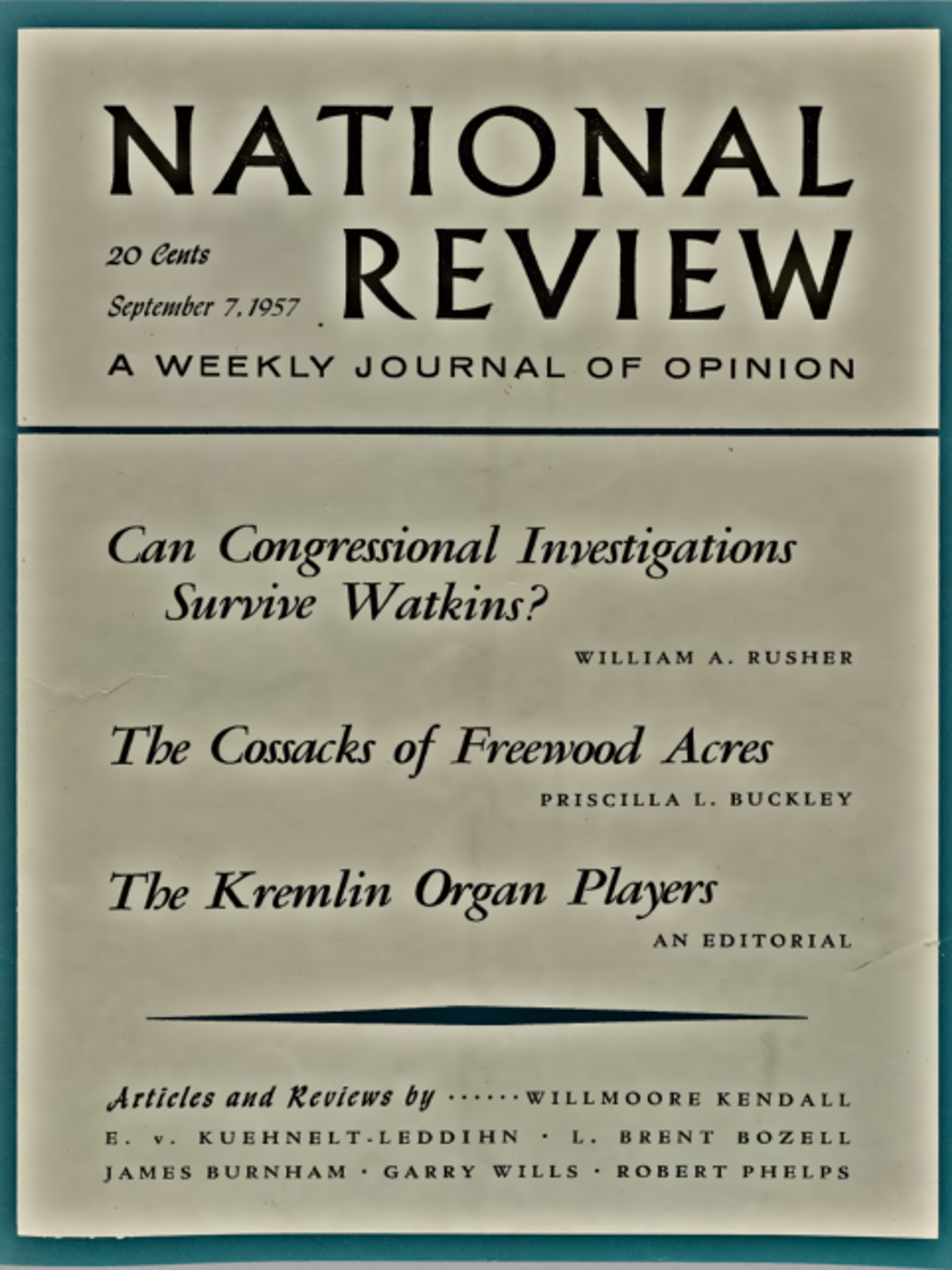
As Associate Counsel to the Senate Internal Security Subcommittee during the eighteen months ending in August, I was able to study at close quarters the impact of recent Supreme Court decisions on congressional investigations of Communism. For a time it was possible to contend that the Court was concerned only with erecting additional procedural “safeguards.” But in United States v. Watkins, handed down just two months ago, the Eisenhower Court revealed a deadly purpose. Today the issue is no longer the much-belabored “methods” of the committees, but their authority to ask questions—in effect, their very right to exist. The benign judicial gaze has become a glare.
One must bear in mind that every congressional investigating committee is created by a resolution of the Senate or House, authorizing it to investigate designated subjects. Once created, the committee proceeds by asking questions of persons who have the information Congress wants. This means, when investigations of Communism are concerned, interrogating those most conversant with current Communist practices: the Communists themselves.





Comments