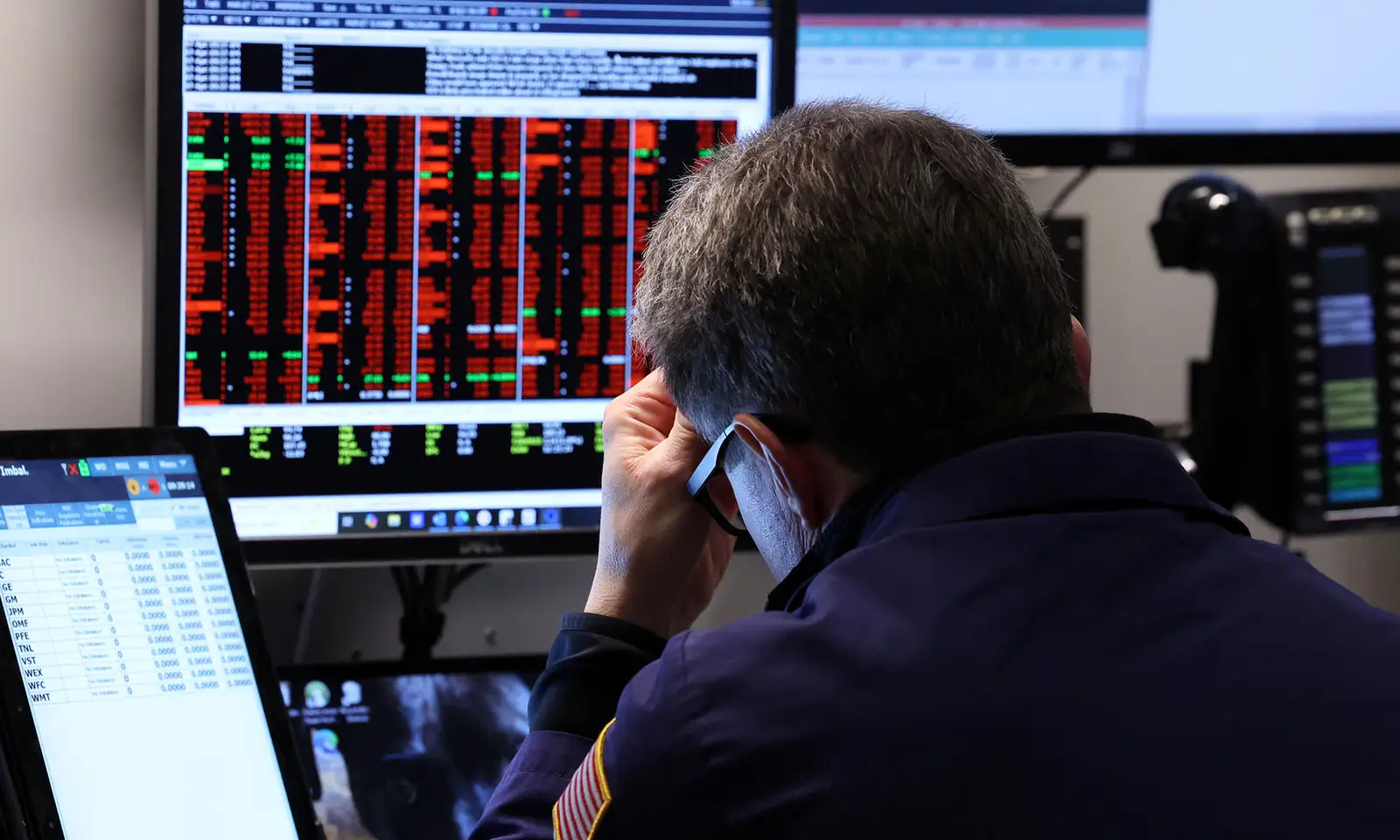
The Dow Jones Industrial Average fell another 1,300 points at the opening bell on Monday after President Trump spent the weekend defiantly defending the sweeping tariff policy he unveiled last week.
Investors were bracing for a devastating day in the markets after closing out last week with back to back 1,500 point drops in the Dow. The S&P shed 4 percent on opening Monday, bringing total three-day losses to 13 percent, a drop not seen since the Great Recession of 2008. If the S&P fails to recover before closing Monday afternoon, the benchmark will have dropped 20 percent from its February high, officially entering bear territory.
After initially posting steep losses, U.S. stocks saw a brief, dramatic swing into positive territory upon comments from Trump’s top economic advisor Kevin Hassett that a prominent X user misinterpreted to mean Trump was open to pausing tariffs. The market averages proceeded to drop again once the hysteria passed and the White House confirmed Trump is not weighing a pause.
Trump celebrated his tariffs Sunday night in a Truth Social post railing against American trade deficits with China and European nations.
“We have massive Financial Deficits with China, the European Union, and many others. The only way this problem can be cured is with TARIFFS, which are now bringing Tens of Billions of Dollars into the U.S.A.,” Trump said.
Speaking to reporters Sunday, Trump likened the market selloff to medicine needed to cure the U.S. economy, even though he is not rooting for markets to go down. Trump continued posting on social media to defend his agenda and urging people not to be “weak” or “stupid” as markets decline precipitously.
“The United States has a chance to do something that should have been done DECADES AGO. Don’t be Weak! Don’t be Stupid! Don’t be a PANICAN (A new party based on Weak and Stupid people!). Be Strong, Courageous, and Patient, and GREATNESS will be the result!” Trump said.
Trump has long believed trade deficits with specific countries are a product of other nations ripping off the U.S. with unfair trade agreements. Most economists dismiss the metric’s relevance to overall economic growth and trading relationships between countries.
Wall Street has reacted furiously since Trump announced last week his dramatic global tariff plan to impose a minimum 10 percent tariff on foreign nations and enact steeper tariffs on many nations around the world, including U.S. allies and trade partners. Trump administration officials have said more than 50 nations have reached out to negotiate trade deals as they downplay the possibility of significant price increases because of tariffs.
U.S. markets plummeted Thursday and Friday following Trump’s tariff announcement as the U.S. prepares to implement them, the worst Wall Street downturn since March 2020 at the start of the Covid-19 pandemic. China announced a 34 percent retaliatory tariff against the U.S. to match the American plan to add 34 percent reciprocal tariffs on Chinese products, on top of existing 20 percent tariffs.
Meanwhile, Wall Street’s “fear gauge,” the VIX, has been soaring upwards in the same way it has during previous market downturns. The VIX jumped to nearly 49 Monday, putting it close to the territory it reached amid the Covid-19 pandemic and 2008 financial crisis.
Over the weekend, markets plunged across trade-reliant Asian countries, with Hong Kong’s equity benchmark falling 13 percent and other indexes in China, Taiwan, and Japan falling by similar amounts. European stocks suffered as well, with the Stoxx Europe benchmark going down 6 percent and the British FTSE dropping by 5 percent.
Influential billionaires have begun publicly criticized the Trump administration’s tariffs because many economists believe they will jack up prices and harm economic growth. Hedge fund manager Bill Ackman, an outspoken Trump supporter, urged Trump to pause the tariffs and use the time to renegotiate America’s global trade position.
“I have a lot of respect for our president and what he has accomplished so far, but I don’t think he is infallible, which is why I am stating loud and clear that I strongly believe launching tariffs on April 9th against the entire world — massively in excess of what we are being charged — is a mistake,” Ackman said on X.
JP Morgan CEO Jamie Dimon, a Wall Street titan, wrote in his annual letter to shareholders that Trump’s tariffs will exacerbate inflation and hinder economic growth, echoing the company’s prediction that Trump’s tariffs will lead to a recession this year.
There are many uncertainties surrounding the new tariff policy: the potential retaliatory actions, including on services, by other countries, the effect on confidence, the impact on investments and capital flows, the effect on corporate profits and the possible effect on the U.S. dollar,” Dimon said.
“The quicker this issue is resolved, the better because some of the negative effects increase cumulatively over time and would be hard to reverse. In the short run, I see this as one large additional straw on the camel’s back.”
Billionaire Elon Musk, one of Trump’s top donors and advisors, lashed out at Trump’s pro-tariff trade advisor Peter Navarro on social media over the weekend. Navarro replied by suggesting Musk was motivated by self-interest, but denied the existence of a rift.
Musk appeared to criticize tariffs again Monday by sharing a video of legendary free market economist Milton Friedman using the example of a pencil to demonstrate the value of free markets and global trade.

Comments
On “Market Freefall Continues as Trump Shows No Sign of Backing Down on Tariffs”