Dear Weekend Jolter,
Our culture and history is strewn with examples — fictional, real, and nefarious — of hoaxes, including some that consume the attention of the Nation and the sanctimony of its Current Wisdom Czars.
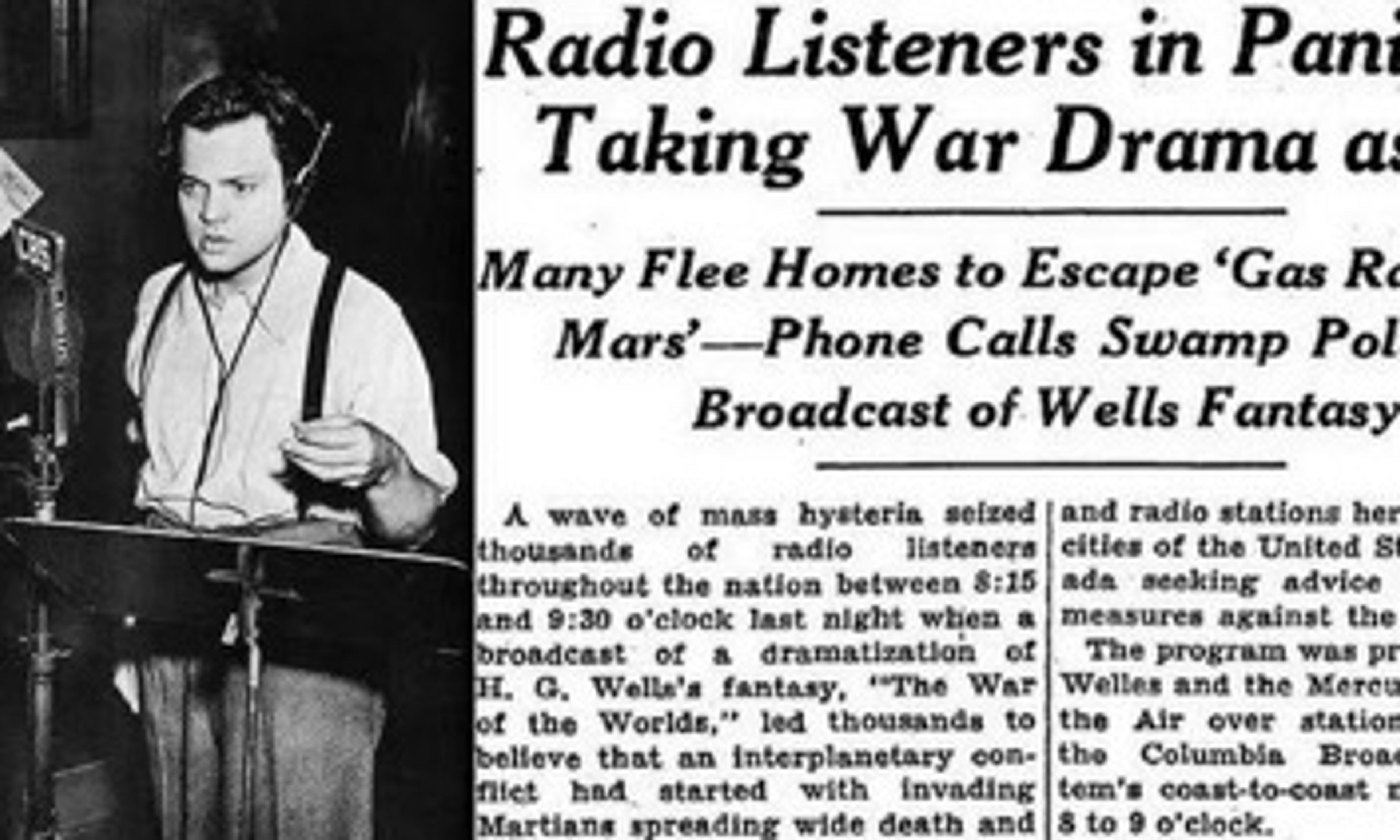
Maybe the classic hoax perpetrated on a dupable public happened in 1938, when Orson Welles and his Mercury Theatre troupe performed the radio version of H. G. Wells’ War of the Worlds.
In movies and books, you have Mayella Ewell in To Kill a Mockingbird, who contrived a rape and accused an innocent man in an affair that consumed the people of Maycomb, Ala. Death, more criminality, and community asunder-tearing ensued from the hoax.
But that was fiction. Tawana Brawley’s infamous late 1980s hoax (the uproar it created brought Al Sharpton to never-ending national attention) wasn’t fiction. Well, it was fiction — it just wasn’t the crux of a novel.
Between then and now scads of hoaxes, many done for money (Bernie Madoff) but many also perpetrated for the sake of victim creation, have been dumped on America’s head. The latest of this species of hoax concerns Mr. Jussie Smollet.
From the moment the now-arrested actor announced his accusation, NR — led by Kyle Smith — has been all over its dubiousness and all over the immediate fawning reaction of the Left. They cast the attack on Smollet (his cuts made him look like he was hit by a kindergartener) as typical of one that would be made by a white, racist, Trump-loving, murderous America. The back-pedaling that commenced this week has been a thing to enjoy, drop by precious drop, assuming it comes in drop form.
By the way: Charles Barkley’s take has helped burst a dam (aside: Shaq’s laugh is infectious).
There are mucho links about all this below. Enjoy them all.
And, if you are interested in Big Orson’s 1938 radio play, you can listen to it here.
Editorials
1. Former senior editor Jeff Hart, who began writing for NR in 1962, passed away this week. He was 88. From our R.I.P. editorial:
At NR he was WFB’s indispensable right hand, ready to put together a magazine or run an editorial conference on the not-infrequent occasions when No. 1 had some other unbreakable engagement. Sparks could fly — Jeff was a bonny fighter, and his editorial prose showed it — but he guaranteed that the wheels would spin.
Ideologically, Jeff was a fan of Richard Nixon and his attempts to broaden the Republican and conservative coalitions along what Nixon called “new majority lines.” Watergate derailed that strategy, but Jeff was always alert for opportunities to resurrect it. Checking the boxes on intellectual litmus tests was never his thing.
RELATED: Jeff’s writing for NR diminished after 2000, but there are some pieces, including some grabbed from the bound volumes from years prior, that you can find and read at Jeff’s author-archive page.
2. As for the use of emergency powers to fund the border wall, we find it to be a bad idea. From the editorial:
We oppose the president’s decision to declare an emergency and repurpose billions of dollars of defense spending to the border, purportedly to support the military, not because we are confident it will be ultimately blocked by the courts, but regardless of whether it will ultimately be blocked by the courts. Even if the president technically has this authority, using it explicitly to bypass the congressional spending power is an abuse of it.
The laws that the president will use were clearly written with some dire national-security event in mind that would make it impossible for the president to go to Congress with the necessary dispatch. We believe there is a crisis at the border, but obviously nothing of this nature, as witnessed by the years-long attempt by the president to get Congress to fund his border wall, including the latest drawn-out political confrontation and negotiation. The president isn’t acting unilaterally because he can’t go to Congress, but because he has done so and he did not fully get what he wanted.
3. Elizabeth Warren has a plan. Need more be said? Anyway, it’s about day care, and we say it’s a lousy idea that is nothing more than a “parent trap.” From the editorial:
Warren’s idea discriminates in favor of one type of arrangement for child care: commercial day care. Families where one parent stays home with young children — the arrangement that a majority of Americans, and a slightly larger majority of parents, prefer — would get nothing from the proposal, except, possibly, higher taxes. Ditto for families that prefer to rely on Aunt Bee. To the extent these families think day care is bad for children, they have some evidence on their side.
We can also expect Warren’s policy, over time, to yield ever more regulation and standardization. The government will not (as it should not) write a blank check to cover all child-care costs above 7 percent of an affluent family’s income; it will have to impose controls of some kind. Perhaps the result will be a tolerable blend of efficiency and child-friendliness. But there is room to doubt it.
RELATED: Mona Charen slams Warren’s plan in her new column.
MORE RELATED: Ditto for Heather Wilhem, in her column.
4. The rush to embrace infanticide faces a Capitol Hill test that — depending on how you look at — an increasing number of Democrats will pass. Upon them we heap scorn. Deserved deeply. From our editorial:
If abortion-rights proponents concede that perhaps it is inhumane to permit an infant to perish the moment after birth, even if it was meant to have been aborted one minute earlier, they cannot explain why they would permit directly killing that same human being one minute earlier. If they admit that an infant, even an unwanted one, gains rights upon birth, they cannot explain why that same infant has no rights when it is inside his or her mother.
Democrats who oppose this bill will tacitly acknowledge that they believe an infant’s moral status stems not from its developmental stage or its location but from whether it is wanted by its mother. They will reveal that abortion is not a woman’s right to end her pregnancy but her right to end the life of her child.
In voting on this legislation, Democrats must choose between rejecting infanticide and arbitrary beliefs about who gets to live.
You Don’t Need Boots to Hike this Summit
The NR Institute’s 2019 Ideas Summit — in which big conservative minds will make “The Case for the American Experiment” — is now about five weeks off, so Your Correspondent (not one of the big minds) is urging you to sign up.
Big News first: The Summit’s gala event — the Whittaker Chambers Award dinner — will feature the presentation of said award to Mark Janus. Yeah, the guy from the Supreme Court’s 2018 Janus v. AFSCME decision. Yep, the guy who, in the face of relentless intimidation, fought for the protection of government-union workers’ First Amendment rights.
That takes place on Thursday night, March 28th, at the Mandarin Oriental Hotel in Washington, DC, where the entire Summit shebang will occur on the day and the next.
There are a lot more participant names to be . . . named . . . in the soon-offing, but so far here’s a list of some Summit speakers: Kevin Hassett, Brooke Rollins, Tammy Bruce, Robert Bryce, the Hon. James L. Buckley (hooray!), Matthew Continetti, Charles C. W. Cooke, Lee Edwards, David French, Jonah Goldberg, Leonard Leo, Kathryn Jean Lopez, Richard Lowry, Andrew C. McCarthy, Jay Nordlinger, John O’Sullivan, Ramesh Ponnuru, Reihan Salam, Luke Thompson, Kevin D. Williamson, and last but never least, John Yoo.
NRI has a special rate and bloc of hotel rooms at the Mandarin through March 4, so don’t dawdle. Get complete information here.
Who Wants Links to 14 Wise and Profound NRO Articles Published These Last Few Days? You Do! And Here They Are.
1. Dan McLaughlin and his colorful charts celebrated President’s Day by talking up the reputation of no. 18, Ulysses S. Grant. From his article:
Despite Reconstruction’s successes in destroying slavery and secession and burying the hatchet between white northerners and white southerners, however, its failures — some on or before Grant’s watch, many more starting as soon as he left office — have haunted us ever since. Like Lincoln, Grant wanted to pursue a Reconstruction policy that would be both magnanimous toward white southerners and supportive and protective of freed slaves. But he ran rapidly into the hard reality that white southern society, as a whole, was hostile to giving African Americans any rights beyond the barest recognition of the end of slavery.
Rather than stage a futile guerrilla war on federal authority as a whole, groups such as the Ku Klux Klan initiated a campaign of terrorism targeted at freed blacks and their rights. It was a shrewd effort to drive a wedge between northern whites and southern blacks by giving white northerners what they had bled for (the Union) while testing the limits of their willingness to permanently occupy the South to protect a minority of the population that wasn’t treated as the white man’s equal even in the North. In the long run, the resistance gambled correctly: The northern public eventually gave up.
2. Andy McCarthy lays into the hottest weasel word now in regular use: “collusion.” From his column:
The reason for the collusion label is obvious. Those peddling the “Putin hacked the election” story have always lacked credible evidence that Trump was complicit in the Kremlin’s “cyber-espionage.” They could not show a criminal conspiracy. Connections between denizens of Trump World and Putin’s circle might be very intriguing, and perhaps even politically scandalous. But only a conspiracy — an agreement by two or more people to commit an actual criminal offense, such as hacking — would be a reasonable basis for prosecution or impeachment.
This dearth of proof was significant. The Russians apparently started hacking operations in 2014, long before Trump entered the race. The FBI first warned the Democratic National Committee about penetration of its servers in September 2015. By the time Trump won, the Bureau and U.S. intelligence agencies had been working hard to understand the nature and extent of Kremlin-directed hacking operations for two years. The investigation was so high-level, so intense, that shortly before the election, there were confrontational conversations between CIA director John Brennan and his Russian counterpart, FSB chief Alexander Bortnikov, and later between President Obama and Russian president Putin.
Yet, as thorough as the investigation was, no one could credibly say Trump was a participant in Russia’s malfeasance. The best Obama’s notoriously politicized CIA could say was that Trump was Putin’s intended beneficiary.
3. More Andy: He disagrees with Secretary of State Mike Pomeo’s decision on “Isis bride” Hoda Muthana, barring her reentry into the US on the grounds that she is not a citizen, thereby precluding criminal action against her. From the beginning of his article:
I had a column in the New York Post yesterday morning about the so-called “ISIS bride,” Hoda Muthana, who is detained in a Syrian refugee camp and now pleading to come back home to her family in Alabama. I argued that, despite the fact that she has treasonously waged war against our country, she had a right to be readmitted if she tried to enter because she was — according to the facts available at the time — a natural-born American citizen.
Now Secretary of State Mike Pompeo has announced that Muthana will not be allowed to reenter the U.S. because she is not an American citizen: While born in America, she was the daughter of a diplomat and thus not subject to the jurisdiction of the U.S. As the secretary put it in his statement, “Ms. Hoda Muthana is not a U.S. citizen and will not be admitted into the United States. She does not have any legal basis, no valid U.S. passport, no right to a passport, nor any visa to travel to the United States.”
This conclusion is disputed by Muthana’s family and allies, and they may have a case. I would strongly urge the Justice Department to file an indictment against Muthana for treason, material support to terrorism, and any other readily provable offenses. She is less likely to press the issues of citizenship and right to enter if she understands that she faces prosecution and, very likely, lengthy imprisonment if she succeeds in coming here.
4. You really must read this entire Kevin Williamson piece on the Left’s use of “merciless sympathy.” Here’s how it begins:
Jussie Smollett’s phony hate-crime story could have been taken apart in 24 hours, except for one thing: Nobody wanted to be the first to call bullsh**.
Who will bell the cat?
Not the police, and I don’t blame them. Smollett is a vocal critic of President Donald Trump who checks two protected-category boxes: He is gay and he is black. No police officer comes out ahead in any encounter in which he has to explain that he isn’t a racist or a gay-basher.
There isn’t much evidence that racist or homophobic attacks have increased in the Age of MAGA — partly because such episodes are so vanishingly rare in the United States that they are difficult to measure — but this is one of those things that everybody knows with such unshakable certainty that nobody really ever bothers to check. Imagine being the first cop to catch a whiff of baloney on Smollett’s tale of martyrdom.
Saying as much — especially in a city such as Chicago — would be to put one’s career on the line. Never mind what would happen if you were wrong about that — even being right but not right beyond all doubt would be professional suicide. For that matter, being unquestionably right but right too soon might have been just as bad.
Tell me you can’t hear it. “How dare you victimize him a second time! White privilege! Racist police!” Etc.
The same rhetorical strategy was deployed in the attempted character assassination of Brett Kavanaugh: merciless sympathy.
5. Truth Smooth. As to the Jussie Smollett debacle, Ben Shapiro finds the Left’s immediate all-in reaction — despite the obvious flaws in the wannabe-victim’s story — is just a sign that what matters is the narrative, not the facts. From his column:
Celebrities weighed in, too. Actress Ellen Page went on Stephen Colbert’s late-night show where she blamed Vice President Mike Pence for the attack. Cher tweeted, “VILLAINY, RACISM, HOMOPHOBIA, PROMOTED BY MOST INFAMOUS [clown emoji] IN [world emoji], IS THE POISON THAT KILLS [American flag emoji].” Singer Katy Perry tweeted, “Standing with and sending love to @JussieSmollett today . . . this is a racist hate crime and is disgusting and shameful to our country.” Director Rob Reiner added, “The horrific attack on Jussie Smollett has no place in a decent human loving society. . . . No intolerance! No DT!”
Then there were the Democratic politicians. Speaker of the House Nancy Pelosi tweeted, “The racist, homophobic attack on [Smollett] is an affront to our humanity.” Senator Cory Booker (D., N.J.), who is running for president, called the Smollett incident a “modern-day lynching.” Democratic congresswoman Alexandria Ocasio-Cortez slammed anyone willing to question Smollett’s account, stating, “The attack was not ‘possibly’ homophobic. It was a racist and homophobic attack.”
Why did so many on the political Left buy into the obviously incredible story from the moment that it broke? Because it perfectly fit narratives that the Left loves: the narrative of America as racist, homophobic hellhole; the narrative of Trump supporters as violent bigots; the narrative of Trump himself as an inspirational figure for such violent bigots. The story was too good to be true. So no one cared whether it was or not.
6. Did you believe Smollett’s malarkey? If you did, Kyle Smith has 25 common-sense questions he’d like you to answer. Here are three from his assemblage:
If you were beaten up, would you somehow remember to pick up your Subway purchase afterward?
If you were subjected to a vicious, racist, homophobic, life-altering attack that included a hint of lynching, would you really leave the rope draped around your neck and calmly walk, not run, home?
Would you then walk past the security desk at your apartment building without telling anyone what had happened?
7. More Smith: After the hoaxer was arrested, the shocked MSM chorus bellowed, “Why would Jussie do it?” Kyle, whose BS detector hit red the day news broke about the alleged “hate crime,” zeros in on CNN’s mind-boggled Brian Stelter for his particular display of dumb-struckery. From the piece:
Stelter was a toddler when a black teen named Tawana Brawley made up a story about six white men raping her, smearing her with feces, scrawling “KKK” and “n****r” on her torso with charcoal, and leaving her in a trash bag. He has lived nearly his entire life in the era of hate-crime hoaxes. He surely remembers the Duke-lacrosse gang-rape hoax of 2006, the University of Virginia gang-rape hoax of 2014, the incident just after Trump’s election when a woman on the New York City subway claimed drunken white men had ripped off her hijab. There are lots of other examples. Hey, do you remember as far back as January, when an Indian man tried to portray himself as the victim of a hateful mob of Trump-backing teenage goons? George Will once wrote of campuses, “When they make victimhood a coveted status that confers privileges, victims proliferate.” When the media can be relied upon to credit hysterics and axe-grinders the way campus administrators do, America effectively becomes a vast campus.
The reasons for Smollett’s hoax didn’t boggle anyone’s mind, assuming that the mind in question was functioning above the level of someone who eats a bowl of lead-paint chips for breakfast. In America, victimhood is currency. It is easily converted into actual currency, and if Smollett had gotten away with his hoax, he had every reason to expect that his vastly increased celebrity would have led to the salary bump Chicago police said he wanted from his show Empire.
If Stelter was awake in this country in the days following January 29, he noticed what Smollett gained after the phony attack: Nationwide attention. Outpourings of sympathy. Messages of support from the president and leading presidential candidates. Heartfelt encouragement from activist groups and high-ranking celebrities and also Ellen Page. Wall-to-wall coverage on TMZ. A coveted long segment on Good Morning America. For two and a half weeks, the previously obscure performer was the most talked-about actor in America, and this during Oscar season. (Sorry, Christian Bale and Rami Malek.)
8. Speaking of “hate crimes,” they’re just a smidge more common than unicorns. Peter Kirsanow reports the data that the MSM seems to have no interest in conveying, because . . . narrative. From his Corner post:
But facts confound the narrative. FBI statistics for 2015 (the most recent available at the time of the 2018 U.S. Commission on Civil Rights Hate Crimes Hearing ) show that there were 1,997,700 violent crimes in the U.S. A total of 5,850 crimes were designated hate crimes — whether violent or non-violent. There were 15,696 cases of murder or manslaughter in the U.S., of which 8, or .0005, were designated hate crimes. There were 764,449 aggravated assaults, of which 681, or .00089, were designated hate crimes. There were 124,047 rapes, of which 12, or .000096, were designated hate crimes. There were 327,374 robberies, of which 120, or .00036, were designated hate crimes.
Despite media flogging, there’s little credible evidence of an appreciable increase since then. In 2017, nearly 90 percent of reporting police departments registered zero hate crimes in their respective jurisdictions. True, not all hate crimes are reported. But neither are non-hate crimes. Moreover, not all incidents designated as hate crimes are motivated by animus toward the victim’s identity, and that’s not counting hoaxes or dual-motive cases.
9. Conrad Black can barely contain his laughter as he looks at the Democrats’ 2020 field. From his column:
This desultory parade of chipper, chirpy, wildly implausible, and unknown people putting themselves forward as the 44th successor to General George Washington at the head of the American people, as the sun sets on the impossible dream of reeling back and overturning the 2016 election, has proved a teeming breeding ground of completely unfeasible policy advocacy. An absurd ritual has developed, as unknown people pop up on our television screens, apologize for something in their obscure pasts as inadequately politically correct, and then stake out uncharted political waters. Spurred on by the ubiquitous and demiurgically verbose Congresswoman Alexandria Ocasio-Cortez, an inexhaustible storehouse of naïve political opinions, these candidates outdo each other in policy fatuities. She proposed 70 percent tax rates on the highest personal incomes, and the venerable Bernie Sanders, two generations ahead of her, chimed in at 77 per cent. He and Ocasio-Cortez still fit the comparison I made recently of them with the old Marxist guru Herbert Marcuse and the Spanish Communist La Pasionaria.
10. Rich Lowry looks at the big downside of firing an FBI director. Hell hath no fury like a Comey scorned. From his column:
Consider the lunacy of this: By providing Trump with a memo justifying Comey’s firing, Rosenstein participated in the scheme that the FBI considered a possible crime, or the culmination of a Russian plot. Then Rosenstein turned around and appointed a special counsel, whom he oversaw, to investigate the possible crime to which he was a party.
It’s also absurd that the FBI officials considered the firing of Comey to be potential obstruction of the investigation that they were continuing, and indeed making more serious by making the president an explicit target.
The comments that Trump made about Russia that McCabe and Co. found so disturbing were hardly damning. In his cover letter over Rosenstein’s memo, Trump mentioned that Comey had told him three times that he wasn’t under investigation. This was true, and Trump was frustrated that Comey wouldn’t make it public. That doesn’t make him a Russian agent.
11. As to this rebirth, of a sorts, of socialism, Matthew Continetti looks into where it came from, and how to stop it. From his piece:
If the death of the socialist idea was the most important political event of the last century, then the rebirth of this ideal must rank high in significance in the current one. Just as nationalism has reasserted itself on the political right, socialism has grown in force on the left. In the 21st century, the two ideologies are estranged and antagonistic twins, paired in Occupy Wall Street and the Tea Party, Jeremy Corbyn and Brexit, Bernie Sanders and Donald Trump. The Democratic victory in 2018 has elevated socialism to a height it has not reached in the United States in more than a century. Only in recent weeks, however, have defenders of democratic capitalism become aware of how great the socialist challenge really is. Only now are we beginning to formulate a response.
Take your pick of the headlines. Alexandria Ocasio-Cortez is the most talked about Democrat in the country. Her fellow member of the Democratic Socialists of America, Rashida Tlaib, opened the 116th Congress by saying, “Impeach the mother****er.” Their comrade Ilhan Omar apparently wants to offend every Jewish American by the end of her term. The Green New Deal, Medicare For All, eliminating employer-based health insurance, marginal tax rates of upwards of 70 to 90 percent, requiring corporations above a certain size to obtain a federal charter, the expropriation of wealth, heavy inheritance taxes, free college, universal basic income, abolish I.C.E., the anti-Semitism that has long been socialism’s fellow traveler — what was once radical and marginal is now embraced and celebrated by a large and vocal part of the Democratic party.
12. The Intolergencia is hounding Christian celebrities. David French takes on the new Woke Progressive jihad. From the beginning of his piece:
You may have missed this news, but Chris Pratt, one of the most likable celebrities in modern American life, is now problematic to some people. But he’s not alone. Justin Bieber, Kylie Jenner, and Selena Gomez are under scrutiny now also. Their crime? They’ve attended Evangelical churches — such as Hillsong and Zoe — that don’t make it crystal-clear that they adhere to the new progressive sexual orthodoxy.
That’s the thrust of one of the more intolerant Washington Post op-eds I’ve ever read, an essay by Post digital producer Drew Goins condemning Pratt for attending a church that doesn’t say that it “affirms” gay marriage and gay sex. You see, it’s not enough to be “welcoming” — loving each person who walks through the doors and inviting them to join in worship and seeking a saving relationship with Christ — these churches must be “affirming.” They must depart from Christian orthodoxy, or their celebrity members will pay a steep public price.
13. So Pete Wehner has left the GOP. The Left applauds. Yours Truly yawns. Still, AEI’s Peter Wallison dives deep into the foolishness and sanctimony behind the decision. From his piece:
But Wehner says that the Republicans are now “Trump’s party.” This is essential to his explanation for why he has abandoned the GOP, but it simply reflects his acceptance of what is little more than another trope of the Left, asserted to diminish the GOP. In reality, if the GOP is anyone’s party, it is still Ronald Reagan’s. Reagan articulated a set of policies — smaller government, lower taxes, individual initiative, conservative jurists, an assertive foreign policy vis-à-vis the Soviet Union, and many others — that essentially codified the Republican view. Trump, up to now, appears to be following that Republican catechism. Does that make the GOP Trump’s party, or is Trump simply an acolyte in Reagan’s? When Trump disappears from the governmental scene, no matter how successful he may be as a president, he is likely to be seen as a Reagan-restoration figure, but without Reagan’s ability to build a consistently winning coalition.
Yet Wehner now views the party — including the party as it existed before Trump — “through the clarifying prism of Donald Trump, who consistently appealed to the ugliest instincts and attitudes of the GOP base.” In other words, despite the fact that Trump is doing exactly what he promised he would do, Wehner has come to the view that Trump’s allegedly racist words, during the 2016 campaign and today, are the dominant source of his continuing Republican support. This is not remotely plausible.
Indeed, the “clarifying prism” Wehner describes is grossly distorted. He cites no polls or other evidence for generalizing about the attitudes of Trump’s base, much less the GOP as a whole. Of course, Trump has said some harsh and unworthy things about immigrants. For all I know, maybe he himself harbors racist attitudes. But to say that his “base” — whatever that is — and the whole Republican party hold these views, or support Trump because of them, is a scandalously unfounded charge.
14. Marlo Safi is into leather books. Tradition needs preserving. It’s . . . bound to happen. Read her piece here:
A few companies specialize in recreating the aesthetic of old books, and Gryphon Editions is one of them. CEO Dasha Stein and her husband Jeff tell me that most leather-bound-book companies are gone. Gryphon Editions has been trying to keep in circulation not only the classic texts that they print, but the beauty of the book covers that used to line bookshelves and that are slowly becoming extinct.
Based in Omaha, Neb., today, Gryphon Editions has been in operation since 1975. It was founded to produce leather-bound editions for lawyers and doctors, collected into a “Classics of Medicine” and a “Legal Classics Library” series. After the success of these collections, they branched out to create “libraries” for other subjects, including psychiatry and dentistry, and in 1980, Alan Dershowitz was appointed chairman of the editorial advisory board, where he wrote special introductions for the legal-profession collection. In 1990, Gryphon began developing their “Classics of Liberty Library” which included texts such as Common Sense and The Rights of Man, by Thomas Paine. Their newer collections include the “Conservative Tradition Library,” which is prominently featured in the pages of National Review, and include everything from Socialism, by Ludwig Von Mises, to the more recent Scalia’s Court: A Legacy of Landmark Opinions and Dissents.
A New Issue of National Review Has Appeared and From Its Contents, Four Majestic Examples of Brilliant Prose Have Been Extracted in Part, Attended by Links
1. Patrick Brown pens a meaty piece on why public policy should support mothers who choose to stay at home. From his essay:
Beltway and Wall Street types seem to believe that it’s best for a family to have two working parents. Surveys of the general population tell a much different story.
In a 2015 Gallup poll, 56 percent of women with a child younger than 18 said they would ideally like to stay home and care for their house and family. Even among mothers who were currently working full- or part-time, 54 percent wished they could stay home, but couldn’t. In a 2013 Pew poll, only 7 percent of mothers of young kids said they believed that the “ideal situation” was for mothers in their position to work full-time, would be to work part-time. Most Americans agree that kids would do best with a parent at home. Clearly, there are many moms whose vision of “having it all” does not include a fulltime job, although they are forced into the work force through economic necessity.
In our economic system, continuous employment is expected, full-time work is prioritized, and benefits are tied to unbroken longevity. That arrangement is uniquely unsuited to the desire of women — and some men — who want to balance the demands of early parenthood with career advancement or with just putting bread on the table. Many women are pursuing both a high-power career and a meaningful family life, and they deserve more support from industry and society. Even more women, however, wish they could afford to take time off to raise children but can’t for fear of incurring financial risk or sabotaging their future job prospects.
What does public policy offer them? The aggressively centrist paid-leave plan proposed by the American Enterprise Institute and the Brookings Institution suggested “improv[ing] women’s attachment to the labor force and their ability to continue pursuing their professional desires.” The D.C. think-tankers mean well, but for many — maybe most — American women (and many men), “professional desires” don’t necessarily include a corner office, a ride up the corporate ladder, or journal citations.
2. The great Andrew Stuttaford profiles one of the most central of the EU-crats, Luxembourg’s Jean-Claude Juncker. From his article:
Juncker came into office promising a highly political” commission, but, although he can boast of some technocratic achievements — such as this year’s trade deal with Japan — his political record, scarred by that rising populist challenge and, above all, Brexit, contains little to brag about. Brexit will, of course, remove the British brake on ever closer union, but that silver lining will accrue to a future president. The cloud is all Juncker’s.
A tin ear (fêting Marx’s 200th birthday was not a way to win over restless Eastern Europeans) and embarrassing public displays (his sporadically strikingly un steady gait has, however, been blamed by loyal officials on sciatica rather than alcohol) have all contributed to an impression of growing disengagement from a job Juncker recently described as “hell.” All this has made all the more credible allegations that he has fallen under the sway of a German puppet master, Martin “The Monster” Selmayr, the authoritarian Euro fundamentalist who was until recently his chief of staff. These fears were exacerbated when, in a charade rushed through in a few minutes and relying on a legally questionable technicality, Selmayr was appointed the commission’s secretary general (its top bureaucrat) in February 2018. Any opposition at the top of the commission was — it is claimed — muffled by talk of increased retirement benefits. After looking into the matter, the EU’s ombudsman expressed serious reservations last year. These were confirmed in a final decision issued on February 11: “Mr Selmayr’s appointment did not follow EU law, in letter or spirit, and did not follow the Commission’s own rules.” Meanwhile, in December, a vast majority of the normally docile European parliament had passed a resolution calling for Selmayr’s resignation. None of this has made any difference. Juncker will step down when his term ends later this year, but the Monster will continue to preside from his new lair.
3. In the cover story (you should see the cover!) our old colleague Travis Kavulla checks out the New Green Deal and the problems it might pose for the GOP. From his article:
If government commandeers the energy industry for a Green New Deal, that sector stands to profit enormously under a business model that rewards uneconomic investments. These state mini– Green New Deals are not so much a transition to least-cost sources of clean energy. They are vehicles to deliver favors with a green gloss. This type of bargain has passed legislatures or been approved at the ballot box in about a dozen states.
If Republicans do not come up with a persuasive policy response to such deal-making, it portends to be the eventual model for a federal Green New Deal — not the one progressives want but, as with health care, the one they’ll have to live with after the sausage-making is done. Republicans have often supinely capitulated to state-level energy-policy logrolling because too many of them view the utility as a trustworthy example of private business rather than as an instrumentality for perverse incentives. The GOP includes a skeptical camp, too. But all too often it traffics in an explicitly anti-clean-energy message, raving about climate science, the shadow flicker of wind farms, and the electromagnetic field of smart meters. The atmospheric concentration of greenhouse gases has not been higher since the dawn of human civilization than it is today. No debate about the niceties of climate science can eclipse this basic fact. It is prudent to encourage the development of power plants that emit no greenhouse gases, or less of them.
Fortunately, there is a more persuasive and elegant response to the Green New Dealers than what many Republicans have been pitching. Democrats have said that consumers are demanding clean energy. They then have demanded massive government programs to invest in it — or to co-opt monopolies to do it for them. Why not instead, if consumers are demanding clean energy, adopt policies that would make it easier for them to get it through their own choices? What
4. Yippie-ki-Jay Nordlinger heads west to hang with some cowboy poets. From his piece:
In the Western Folklife Center, high-school students recite poetry—their own and others’. A girl named Masha is originally from Moscow — not Idaho but Russia. She recites a poem attributed to Elizabeth I. A Russian girl at a cowboy festival in northeastern Nevada channeling a 16th-century British monarch — only in America.
Later, the governor of Nevada is in the house. He is Steve Sisolak. His wife, Kathy, is also introduced — described as “the first Chinese-American first lady in American history.” They and the rest of us are treated to Sourdough Slim. “I’m glad to be here,” he says. “Of course, as an accordion-playing, yodeling cowboy in the 21st century, I’m glad to be anywhere.” He is quality entertainment.
I’m back in the breakfast room, on my last morning in town. “Does anyone have a poem?” asks the hostess. A young man speaks up: “I don’t have my hat with me, but I do have a poem.” Yes, you’re allowed to recite one without wearing a cowboy hat. “I’ll read a poem by a poet you probably all know here: Wild Bill Shakespeare. This is very brief — Sonnet 51.”
Podcastapalooza
1. On the new, Flaying-of-McCabe episode of The Editors, Rich, Charlie, David, and MBD also discuss Smollet and Old Man Sanders’ next prezy bid. Listen up here.
2. Charlie returns to The Remnant with Jonah Goldberg to discuss Trump’s declaration of emergency, our decaying constitutional framework, accents, and more. Pay heed here.
3. If you really want to get to the bottom of this McCabe lunacy, then tune your ears to the new episode of The McCarthy Report. Andy and Rich are waiting for you, here.
4. Flannery O’Connor’s “A Good Man Is Hard to Find” is what John J. Miller and Liberty University’s Karen Swallow Prior are talking up on The Great Books latest podcast. Check it out here.
5. More JJM: On The Bookmonger, he sits down with Landfall author Thomas Mallon to discuss his new work. Listen here.
6. David and Alexandra have Chris Pratt’s back on the new episode of Ordered Liberty. Listen up here.
7. Notre Dame law prof Jeff Pojanowski joins Scooby Dooby Scot and Jim-Jam-Jumpin-Jive Jeff on Political Beats to gab about Pavement. The band, not the thing that smells of asphalt. Groove to the conversation here.
Lights. Cameras. Pundits.
1. Kyle Smith finds The Tree of Life to be “one of the most awe-inspiring films of the 21st century.” There’s a new “extended-cut” release of the 2011 movie (188 minutes). Our expert says it’s worth the time. From the review:
The Tree of Life is an eloquent, majestic film, but I add a word of caution: It’s far outside the mainstream of contemporary filmmaking. It can’t be taken in the way we ordinarily view films at home — while we send texts to friends, check email, finish up a work project, wander out for a bowl of chips. If you can’t put your devices out of the room and set up an undisturbed, cinema-like setting in which to watch it, don’t bother. Without your full concentration, the film will mean nothing to you. If you indulge yourself a couple of diversions, you won’t even make it to the end. And you’ll be depriving yourself of something wonderful.
2. Armond White declares war on Never Look Away and Cold War, two of this year’s foreign-film Oscar nominees, both of which “look a lot like Hollywood’s own politically woke claptrap.” From his review:
Never Look Away itself actually demonstrates the avoidance of artistic complexity. Von Donnersmarck specializes in the middlebrow art of self-congratulation. How ironic that his film about an artist figure uses a storytelling style that sidesteps artistic innovation and never challenges comfortable taste. (Its drama has a complacent, Sydney Pollack air.) Instead of recalling Fassbinder, Godard, or even Paul Verhoeven films that confront narrative conventions, Von Donnersmarck uses banal methods to underscore disapproval, in hindsight, of Nazis and East German socialism. Scenes of Kurt’s aunt enticing off-duty bus drivers to turn their depot into an orchestra’s horn section, her nude piano-playing breakdown, Professor Seeband’s mutilation of his own daughter, and Kurt’s various art-punk tantrums are all just schmaltzy virtue-signaling. . . .
Pawel Pawlikowski’s Cold War continues Hollywood’s fascination with political sacred cows in a sleeker vein than Von Donnersmarck’s leviathan. Yet Cold War similarly patronizes European modernity and turns it into soft-core kitsch.
Joanna Kulig and Tomasz Kot play Zula and Wiktor, Polish WWII survivors who exploit each other through sex and art. They meet as Cold War envoys, representing Polish musical culture in a nationalist troupe; then both escape to the West and enjoy the licentious, promiscuous titillation of jazz (also a theme of Pawlikowski’s Ida). They’re doomed lovers but mainly desperate characters whose ruthlessness is so glamorized beyond a political context that it seems to represent traits of modern, Millennial self-interest.
3. Armond listens to Agenda, the new four-track recording of “dance-pop sophisticates” the Pet Shop Boys (the guys that fix dogs, not your pickup), and, well, Armond gives it a thrashing, as only he can. From his review:
Pet Shop Boys lead singer–lyricist Neil Tennant and composer Chris Lowe are British Boomers who made their name with elegant, thoughtful, and danceable tracks during the 1980s, including “West End Girls” and the Dusty Springfield collaboration “What Have I Done to Deserve This?” 1993’s Very is their masterpiece. But this new song discards their pop savvy for left-wing populism.
“It’s all meant ironically,” Tennant told Clash magazine, yet the EP’s ironies confirm that PSB are up to date, clued in to why Millennials admire a neophyte demagogue like Ocasio-Cortez: They see themselves in her googly-eyed, unschooled optimism. Her image confirms their naïveté as a moral and political virtue, and the lead track’s cringe-inducing message name-checks many of her slogans and clichés, even some “Green New Deal” idiocies that have become media commonplaces. (The current crop of pusillanimous Democratic presidential contenders call the deal aspirational.)
But “Give Stupidity a Chance” won’t fire up Spotify or Pandora subscribers; it’s merely a hummable yet oddly unwinning try. PSB’s rejection of conservative nationalism pitches them into an ideational trap: By denouncing their adversaries, they take on the worst accusatory aspects of America’s Ocasio-Cortez and Britain’s Jeremy Corbyn, who both capture PSB’s attention because, sadly, they qualify as pop-media icons. PSB possess wit beyond AOC, but they know that the Left-weaned pop audience cannot resist a young-dumb rabble-rouser.
4. On this Oscar Weekend, Kyle chimes in to say that the Best Picture contest is a “surprisingly exciting” too-close-to-caller. From his take:
So what film might take advantage of faltering front-runners and pull off a big upset? A Star Is Born? It didn’t get a Best Director nomination and has been shunned all awards season. BlackKklansman might have a chance — but Black Panther is also nominated, and it won the actors’ guild equivalent of Best Picture. Having both of them in the mix could split the vote if any voters are thinking, “It’s high time a movie directed by a black person won Best Picture — that has only happened twice in the last five years!” That leads us to The Favourite: It could be framed as a win for feminism, since its principal characters are women (having a lesbian love triangle); unlike the dopey Green Book, it has a hip, mordant sense of humor and a cool, artsy director (Yorgos Lanthimos); and the Academy lavished it with ten nominations overall. The Best Picture winner is usually the one with the most nominations (or tied for it). But is The Favourite anyone’s favorite? It’s been in theaters since November and it’s grossed only $32 million, barely ahead of the notorious audience repellent Moonlight.
How Yours Truly Is Predicting Oscar Winners This Year
Going to my tried, true, and trusted source: The Online Magic 8 Ball.
The Six
1. At Religion Unplugged, Clemente Lisi recognized President’s Day — the Holiday Formerly Known as George Washington’s Birthday — by considering the first president’s strong stand for religious freedom. From his essay:
Many know the importance Washington had to the founding of the United States. A decorated general who commanded the colonies against Great Britain during the American Revolution, he went on to serve as the republic’s first president. Washington also took part in the Constitutional Convention of 1787, which established a new American government. For those reasons, he is widely referred to as the “Father of His Country.”
What has largely been forgotten over the course of the last two centuries is Washington’s faith and dedication to religious freedom before that became a political buzzword and a fight in the courts between conservatives and liberals. Although he was a member of the Anglican church (Episcopalian following the Revolutionary War), Washington recognized America’s pluralism and the constitutional role of religion in public life, historians said.
Indeed, Washington’s willingness to protect religious minorities is one of the many legacies this great man has left behind.
2. Three cheers for nuke power. In City Journal, James Meigs looks at the new voices seeking to offset the fading support for atomic-based (clean!) energy. From the article:
Political activism isn’t the only headwind facing U.S. nuclear operators. Solar and wind power today receive extensive federal and state subsidies. More than half of U.S. states have also enacted Renewable Portfolio Standards (RPS), mandating that utilities use more of these alternative energy sources. These programs are promoted as efforts to “de-carbonize” the energy grid, but nuclear power — a genuinely carbon-free electricity source — is usually excluded from both subsidies and RPS mandates. On top of all that, natural-gas prices bottomed out in 2016 — after dropping more than 80 percent from their peak a decade earlier — and have since stayed relatively low. Utilities are increasingly turning to gas as the most inexpensive way to generate reliable power. Squeezed between heavily subsidized competitors on the one side and historically low prices on the other, it’s no wonder that roughly half the nation’s nuclear plants are in economic trouble.
Have we reached the beginning of the end of the atomic era?
3. At Gatestone Institute, Amir Taheri wonders if, as Iran’s mullahs mark their fourth decade of power, their masquerading as patriots will divert attention from their scoundrel-ish seeking of refuge. From the beginning of his piece:
What do scoundrels do, when caught red handed in their shenanigans? According to an old proverb they wrap themselves in a flag and seek refuge in patriotism.
Something close to that seems to be happening to the Khomeinists dominating Iran, thanks to their control of the nation’s finances and monopoly on guns. As it marked its fourth decade in power, the regime implicitly admitted the bankruptcy of its narrative, according to which the 1979 revolution was prompted by a desire to “revive Islam” which, after the death of the Prophet, with the exception of the brief caliphate of Ali ibn Abi-Taleb, had been in agony. Thus, Ayatollah Ruhollah Khomeini was given the title of “Ihyagar” or “Reviver” of Islam.
Last Monday, however, Hojat al-Islam wa al-Moslemeen Hassan Rouhani, President of Iran, told a different story to marchers in Tehran marking the 40th anniversary of the mullahs’ seizure of power.
He shouted: “The Islamic Revolution was firstly made to protect Iran.”
How so, you might wonder.
4. At Law & Liberty, Tony Williams considers the questions raised by Jay Cost in his book, The Price of Greatness: Alexander Hamilton, James Madison, and the Creation of American Oligarchy. From his piece:
But the fact remains that the Federalist domestic and foreign policies of the 1790s such as enforcement of the whiskey tax or American neutrality did not seem to have led to the creation of an American oligarchy. There was not a small cabal of individuals or families controlling the strings of government or the economy. As we examine the domestic and foreign policy events of the decade, there may have been a few questionable episodic schemes related to finance that were carried out but there was no oligarchy running the country.
Curiously, the story continues about halfway through the book without one of its protagonists (because Hamilton perished in the duel with Aaron Burr) and delves into the Republican presidencies of Jefferson and Madison which swept in a Jeffersonian wave of spending cuts and smaller government — including the expiration of the national bank in 1811 — into national policy. As Cost notes, the Republican policies were disastrous for the country, leaving it woefully unprepared to fight the War of 1812. After the war, President Madison had a change of heart and embraced a Second National Bank, mildly protective tariffs, and internal improvements, albeit with a constitutional amendment for the latter.
5. If you made America great again, what would that mean? In National Affairs, Ryan Hanley delves into the task by finding out what leader might have already made his country great (again). From his essay:
But what exactly does it mean to make a nation great? And what exactly do those drawn to such promises think they’re likely to get in return for supporting them? Here the waters get murky fast. The clever and well-read have a whole host of terms at the ready to explain these promises. Calls for national greatness, they say, are expressions of nationalism, or maybe populism, or maybe plain and simple nativism. But invoking “isms” dodges the real question. For even if these or other such categories can explain why national greatness appeals to so many today, they leave still unanswered the crucial question of what exactly “national greatness” is.
Regarding that crucial question, we get little insight from those who most often invoke the term. In 2016 it was notoriously central to Trump’s campaign, for instance, but by January 2017, even before he had taken the oath of office, the president-elect had already coined his re-election slogan for 2020: “Keep America Great.” While this breathtakingly abrupt shift says much about the man, it gives little insight into the concept. Things don’t get much better when we turn from the politicians to the pundits. National greatness of course had a history in our country before the 2016 campaign; back in the 1990s, some will remember, David Brooks called for a “national-greatness conservatism.” But “national greatness” for Brooks was a catch-all — something that involved “grand American projects” and “global purpose” and “common mission.” Yet this too sheds little light on the concept, and we don’t get much more from Brooks’s open-ended conclusion that “[i]t almost doesn’t matter what great task government sets for itself, as long as it does some tangible thing with energy and effectiveness.”
6. Over at Real Clear Books, Barton Swaim has high praise for The Idol of Our Age: How the Religion of Humanity Subverts Christianity, Daniel J. Mahoney’s new, widely acclaimed book. From the review:
Mahoney gives a name to the heresy passing itself off as Christianity, and to my mind it’s about as unsatisfactory as “liberalism” was for yesterday’s Christian materialists: humanitarianism, or “the religion of humanity.” The word “humanitarianism” suggests inner city soup kitchens and aid workers handing out medical supplies in third-world countries, but Mahoney has reasons for his choice of terms. Humanitarianism in this sense holds that the Christian’s highest and, perhaps, only duty is to exhibit compassion and fellow-feeling toward humanity as a whole. The humanitarian’s chief concern is with humanity in the abstract, the supposed plight of faraway peoples of whom the humanitarian likely has little or no direct knowledge. Humanitarianism looks with suspicion on any attitude or religion that treats one’s own family, church, neighborhood, city, or country with special affection. “Good works, humanitarian works, are welcomed, of course, but one can love Humanity through a vague and undemanding sentimentality, Mahoney writes. “Loving real human beings is another matter altogether.”
Baseballery
Fans of the National Pastime know that one of the game’s oddest, and maybe even most disturbing, moments came in 1951, when St. Louis Browns owner Bill Veeck, a stunt guru, caused a sensation by having 3’ 7” Eddie Gaedel come up to bat, pinch-hitting to lead off the second game of an August 19 doubleheader against the Detroit Tigers. There is a famous image that captures the comical scene of the miniscule strike zone and one of the four balls, caught by befuddled Tigers catcher Bob Swift. Swift had made the obvious suggestion to Tigers starter Bob Cain (who took the victory, 6–2) to “pitch him low.” That landed Gaedel on first base.
About Gaedel pinch hitting: The Browns’ starting lineup included Frank Saucier in right field, which was nothing more than an ignominious set-up for him to be yanked for the diminutive baseball oddity. This would prove to be Saucier’s biggest baseball moment. His meager MLB career was limited to 18 games in 1951: 14 at-bats, one hit (a double) and one RBI. But of note, he was a great American: His baseball career ended in part because he returned to active military duty for the Navy during the Korean War (Saucier had also served for more than three years in World War II).
The Gaedel stunt ended when Browns manager Zack Taylor yanked him for pinch runner Jim Delsing. A journeyman who played decent ball for five teams over a decade, it proved to be his baseball claim to fame.
As for Gaedel, everything about him seemed short, including his troubled life: in 1961 he was beaten to death. His murderer was never found (in fact, the case was never truly investigated).
A Dios
I pray this week that those in the media who desperately need a thick, steaming slab of humble pie — chock full of lima beans and brussels sprouts and liver chunks — get it, and that The Great Big Dad will tell them that if they don’t eat it then and there, they’re going to find it the next morning in their bowl of Cheerios.
God Bless You and Yours,
Jack Fowler
Bracing for your critiques at [email protected]






Comments