Dear Weekend Jolter,
When the rest of the Western world is beginning to take a more cautious approach than America to an all-consuming issue concerning our kids, it should at least drive some curiosity as to why.
First the New York Times and now the Economist have devoted serious reportorial resources, and ink, to the debate inside the medical profession surrounding gender therapy. The latter’s cover this past week minces no words: “What America Gets Wrong About Gender Medicine.” It details how numerous European countries want to curb medical interventions for minors to allow for more study and declares, “The Europeans are right.”
If you read Maddy Kearns and others here at NR with regularity, the details won’t be a surprise. But, until recently, they had gotten little attention in the mainstream press, owing no doubt to the third-rail nature of the debate.
Few policy disputes in America today register at this level of intensity. After the Covenant School shooting, the Trans Resistance Network decried the “virtual avalanche of anti-trans legislation” and those supposedly seeking “the genocidal eradication of trans people.” Any attempt to do what Europe is doing is denounced by the White House as an “attack” on families. One young school-board trustee responded to Idaho’s bill barring gender-reassignment surgery for minors by vowing that when Governor Brad Little dies, “I’m pissing on your grave.” A week ago, swimmer Riley Gaines reportedly was assaulted and forced to take cover in a room by a mob of screaming college students. The offense? Talking about the disadvantages that female athletes could face against transgender opponents.
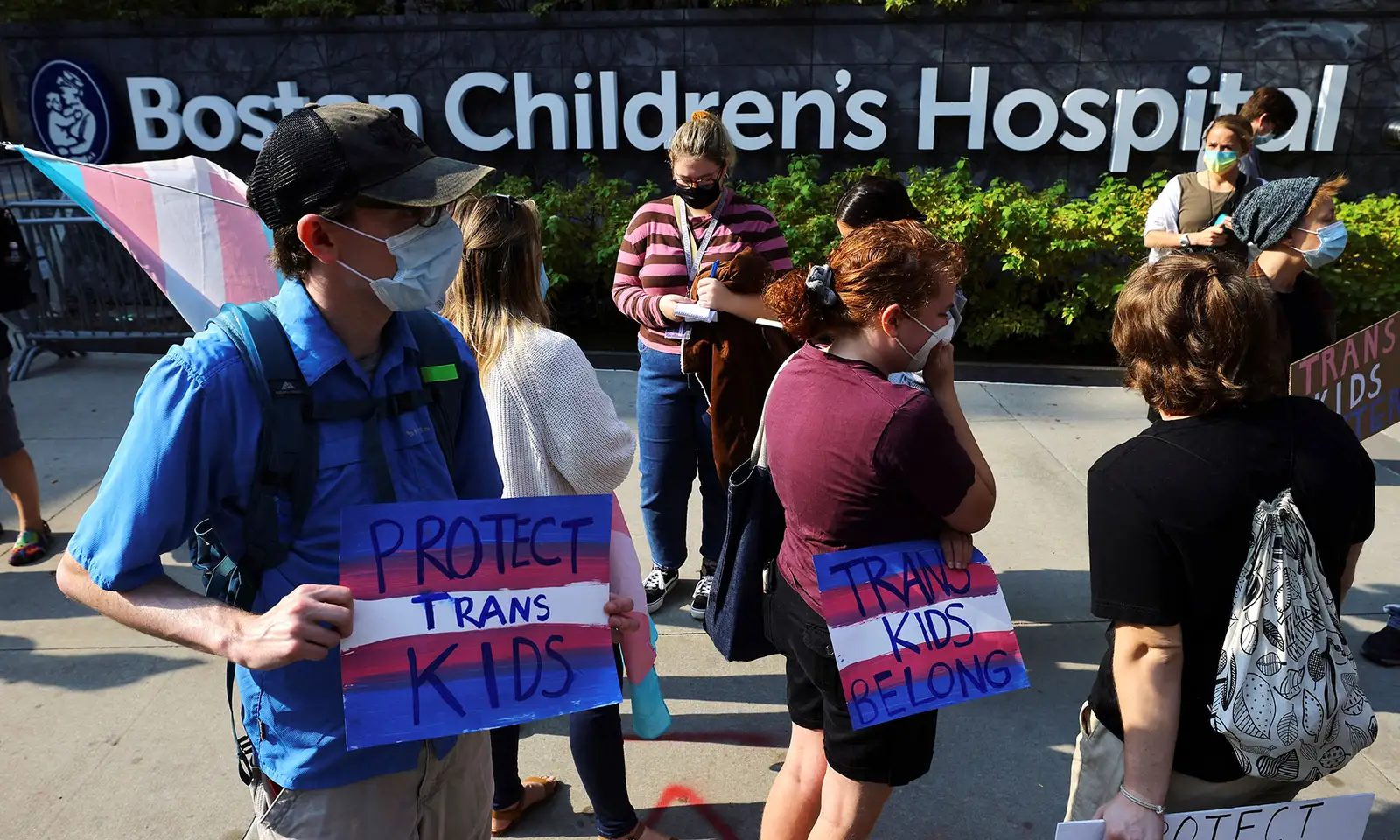
A real debate is coming on this issue, whether those invested in the absolutist view like it or not. Polling indicates at least a plurality of Americans favor restrictions on medical interventions for minors, and the coverage has started to reflect that the matter is not, in fact, “settled” science. But to succeed in the arena, where even a trace of skepticism gets branded as “phobia,” sponsors of these so-called “anti-trans” bills are going to have to flip the script that unfairly casts them as tormentors — that is to say, adopt, at least in spirit, the very slogan wielded by their critics: “Protect Trans Kids.”
They can reasonably lay claim to it; some already are. A newly published piece on NRO frames a Nebraska bill on gender surgeries in this way. Governor Little, in signing Idaho’s, also spoke of “protecting minors” from life-altering procedures. The bill itself is called the Vulnerable Child Protection Act (other state bills have similar titles) and focuses on the trinity of puberty blockers, cross-sex hormones, and surgery. Its opening text bars doctors from knowingly doing the following to a child in most circumstances:
Performing surgeries that sterilize or mutilate, or artificially construct tissue with the appearance of genitalia that differs from the child’s biological sex, including castration, vasectomy, hysterectomy, oophorectomy, metoidioplasty, orchiectomy, penectomy, phalloplasty, clitoroplasty, vaginoplasty, vulvoplasty, ovariectomy, or reconstruction of the fixed part of the urethra with or without metoidioplasty, phalloplasty, scrotoplasty, or the implantation of erection or testicular prostheses . . . [or] performing a mastectomy.
If that’s not “protecting trans kids,” what is?
To be clear, overheated rhetoric on the right about “grooming” and point-scoring legislation that nitpicks over pronouns are not helpful or focused on what matters. As Nate Grasz with the Nebraska Family Alliance wrote, the “fundamental” question is whether doctors should be allowed to perform sex-change procedures on kids: “Do we protect children who cannot consent to elective, permanent, and irreversible surgeries? Do we allow their bodies to be mutilated in the name of ‘gender-affirming care,’ or do we not?”
Plain language, reinforced by the emerging accounts of minors who grew up and now regret undergoing surgeries facilitated by adults, are the antidote to the intoxicating power of euphemisms in this debate. They make clear that “affirmation” does not equal “protection.” Maddy reported recently on a lawsuit filed by Chloe Cole against the entities that arranged for her transition, culminating in a double mastectomy, starting at 13; she needed love and therapy at that point in her life, “not cross-sex hormones, and mutilating surgery,” it states. The Economist described the haste with which some teens were ushered through the medical regimen, with one saying she had a single “15-minute appointment” before being given testosterone. Meanwhile, the underlying research faces scrutiny. Many studies of cross-sex hormones lacked a “control group”; estimates of detransition rates vary drastically, underscoring the need for better data; even the stats on suicide risk sometimes used to justify medical action are in question. A 2022 article by an Oxford sociologist calculated a suicide rate of 13 per 100,000 using data from a since-shuttered transgender-youth clinic in the U.K. — higher than the overall rate among adolescents, but low enough to reassure parents and counsel against “irresponsible” exaggeration.
Seeing this properly as a live and unsettled debate, more countries are realizing the obvious: We owe it to the adult versions of our kids to keep them from carving up their bodies based on medical advice deriving from shoddy data, while they are still kids. That doesn’t mean ignoring or denying their dysphoria; it means supporting them, short of irreversible surgeries and treatments that carry unknown physical risks.
State lawmakers in America who support these bills are allies, not enemies, of “trans kids,” and they shouldn’t be hesitant to say so.
NAME. RANK. LINK.
EDITORIALS
Look at that, all the world’s problems solved just by publishing the right words in the Federal Register: Biden’s Draconian Electric-Car Mandate
The expulsions in Tennessee might not have been politically prudent (or effective) for Republicans: Making Martyrs in Tennessee
The administration is trying to have it both ways: Biden’s Pretzel Logic on Men in Women’s Sports
Clarity is needed in the abortion debate: The Critical Need for Pro-Life Statesmanship
ARTICLES
Ryan Mills: ‘Her Brain Was Gone’: Parents Describe Horror of Daughter’s Marijuana-Induced Psychosis
Rich Lowry: The Media Found Their Tennessee Victims — and Promoted Them to the Hilt
Abigail Anthony: The Myth of Inclusive Ballet
Becket Adams: The George Soros Double Standard
Charles C. W. Cooke: Vivek Ramaswamy Isn’t Really Running for President
John McCormack: What Florida’s Abortion Law Says about Protecting the Life and Health of the Mother
Caroline Downey: Parents Say Middle-School Kids Pressured to Abide by LGBT Organization’s ‘Day of Silence’
Will Swaim: The California Agency That Has Gone So Rogue Even Newsom Can’t Control It
Jay Nordlinger: An Intrepid Chronicler of Evil
Michael Brendan Dougherty: The Hillary-DeSantis Voters
John Ullyot: The Disgraceful White House Defense of the Kabul Fiasco
Jeffrey Blehar: DeSantis Has Not Frozen the Field
Ari Blaff: The Top Ten Reactions to Bud Light’s Dylan Mulvaney Campaign
Andrew McCarthy: I Swear I’m Not Making This Up
Christian Schneider: What If the Wisconsin Supreme Court Election Wasn’t Actually about Abortion?
CAPITAL MATTERS
Dominic Pino shows the disconnect between different arms of the government on EVs: The Government’s Own Numbers Show Biden’s EV Mandate Is Crazy
Philip Klein provides his periodic update on America’s dismal fiscal picture: CBO: Federal Debt Payments Up 41 Percent Thanks to Higher Interest Rates
LIGHTS. CAMERA. REVIEW.
A pro/con on Air. Pro, from John Fund: Air Celebrates the American Dream . . . and con, from Armond White: In Air, Licensing Is the New Slavery
Brian Allen reports on a whiff, from an otherwise fine museum: Surprising Mediocrity from the Phillips Collection
FROM THE NEW, MAY 1, 2023, ISSUE OF NR
Daniel Hannan: How Shakespeare Changed Everything
Jack Butler: 9/11: An Atrocity Misused
Tal Fortgang: Conformity, Inequity, and Exclusion
Douglas Murray: Sensitivity Readers Are Distorting the Pages of the Past
Daniel Foster: The Prodigal Cousin
EXCERPTS MORE CONCISE THAN A 34-COUNT INDICTMENT (AND LESS REPETITIVE)
The new issue of NR is out, and you can read Mark Wright’s round-up right here. In fact, he describes Daniel Hannan’s cover story on Shakespeare as “one of the best essays published in National Review magazine.” Read for yourself:
White people did not properly exist as a category until Shakespeare called them into being. That, at least, is the claim made in a new collection of essays, White People in Shakespeare.
Well, of course it is. Every generation finds its values eerily anticipated in the corpus. Because our contemporary obsession is with race, we see race in every play. Not just the plays with non-white characters: Titus Andronicus, The Merchant of Venice, Othello, and (if you treat Caliban as a representative of colonized peoples) The Tempest. No, all the plays are supposedly about race and racism.
The essays’ authors, many of them academics in the field of racial literary analysis, are swimming with the intellectual current. London’s Globe Theatre, for example, has attached a trigger warning to its current production of A Midsummer Night’s Dream. You might think that pastoral play (the only one, as far as I can work out, whose plot Shakespeare did not borrow) is about woods and lovers and capricious fairies.
But the Globe, whose recent “Anti-Racist Shakespeare” seminars have included claims that Hamlet is “wrestling with ideas of blackness” and that King Lear is about “kingship and whiteness,” sees things differently. Its website carries the following warning: “Content guidance: The play contains language of violence, sexual references, misogyny and racism.”
Let’s leave aside, for a moment, whether lines like “Now, fair Hippolyta” (the words with which the play opens) disparage people with dark skins. What is more immediately striking is that neither the essay writers nor the Globe wokesters (Globalists, if you will) are exaggerating for effect. They plainly believe what they are saying. Shakespeare’s oeuvre really is, for them, all about racism.
Here we find the magic of the plays. As the late Harold Bloom once put it, “you can bring absolutely anything to Shakespeare and the plays will light it up, far more than what you bring will illuminate the plays.” Whenever we read Shakespeare’s words, they seem narrowly aimed at us, amplifying whatever mood we are in. Indeed, the same passages can speak to us in contradictory ways at different moments in our lives. If you’re familiar with the canon, you’ll know what I mean.
People whose chief preoccupation is with imagined racial hierarchies will find them in Shakespeare. Not only that, but they will find them more subtly and powerfully drawn there than anywhere else.
It is not so very different from, say, G. K. Chesterton’s being convinced that Shakespeare was a fellow Catholic, or the German Romantics’ argument that he was, in August Wilhelm Schlegel’s phrase, “ganz unser” — entirely ours.
“Of course he was a black woman,” Maya Angelou once wrote. “I understand that. Nobody else understands it, but I know that William Shakespeare was a black woman.”
And, in a sense, they are all right. Or, more precisely, as T. S. Eliot put it, “the most anyone can hope for is to be wrong about Shakespeare in a new way.”
Ryan Mills has a deeply reported, and deeply tragic, piece out this week that challenges the conventional wisdom about marijuana use:
For six years, Trent and Jane Mayberry had a front-row seat to their daughter’s spiraling descent into psychosis — her inability to communicate, her increasingly disheveled appearance, the piercings and tattoos. She heard voices. She had friends who likely weren’t real. Her descent ended in methamphetamine use and ultimately, a deadly overdose.
Both Trent and Jane are convinced that their daughter’s heavy marijuana use is to blame.
“I’m 100 percent certain that it came from cannabis,” Trent told National Review of his daughter’s psychosis. “If she never used cannabis, there’s a very high likelihood she would not have had these types of symptoms.”
Catherine Mayberry was born in June 1998, when inhaling marijuana was still potentially disqualifying for presidential candidates. Over her lifetime, shifting public opinion has increasingly backed legalization of the drug for medical and recreational use — a political position that has tended not to follow neat partisan fault lines.
In pop culture, marijuana users have tended to be portrayed as harmless slackers who just want to make a White Castle run or get high in their parents’ basement. The drug has acquired such a benign reputation in American culture that then-senator Kamala Harris felt comfortable joking about her history of use on a live radio broadcast while running for president in 2019.
When Trent and Jane testified about Cat’s experience before the Minnesota legislature in early March, the same relaxed attitude toward marijuana use was on display. Legislators laughed as former Minnesota governor Jesse Ventura joked that the worst thing he’d ever done while high on marijuana was attend a Jimi Hendrix concert.
Democrats in Minnesota, who have won control of both chambers of the legislature and the governor’s mansion, are fast-tracking legislation to legalize recreational marijuana in the state. . . . But the cultural makeover that led to widespread legalization has tended to hide a disturbing truth: Marijuana has never been the harmless drug that some advocates portray it as, and the high-potency versions available today can be dangerous, particularly for heavy users and young people whose brains are still developing. . . .
“We’re trying to at least tell people this is not the harmless drug that everyone thinks it is,” Trent said. “And we’ve got all the evidence in the world.”
“We’ve lived it,” he said, “We lost a kid to it.”
Christian Schneider’s got a theory about last week’s Wisconsin election:
Americans emerged from last week believing a number of unassailable, lead-pipe truths: The new pitch clock has once again made Major League Baseball watchable, the cast of Succession is going to sweep the Emmy Awards next year, and the April 4 Wisconsin supreme court race was a catastrophic loss for pro-life Republicans.
The latter point took hold on both sides of the partisan divide. “At some point, the GOP might want to acknowledge its glaring abortion problem—and do something about it,” wrote the Wall Street Journal’s Kimberley Strassel. The New York Times claimed that the race “signaled just how much last summer’s Supreme Court decision overturning Roe v. Wade has transformed American politics.” . . .
So now everyone thinks a conservative losing to a liberal in Wisconsin is a microcosm of the national mood on abortion. But to paraphrase Eli Cash: Maybe it’s not.
A perfectly plausible story about conservative Dan Kelly’s embarrassing loss can be written without using the word that, to quote Jonah Hill’s Knocked Up character, “rhymes with shmashmortion.”
To start, one can look at Kelly’s personal toxicity with the voters of Wisconsin. This is a guy who was appointed to the state supreme court by former governor Scott Walker in 2016, then proceeded to lose as an incumbent by eleven percentage points just four years later. This, of course, was a full two years before the U.S. Supreme Court handed down its decision in Dobbs v. Jackson Women’s Health Organization, which sent the abortion issue back to the states. . . .
Instead, the Kelly race last week seems more like a continuation of a Jordan Peele–worthy horror movie the GOP has found itself in since the election of Donald Trump as president. Trump won Wisconsin in 2016; when he took office, conservatives held virtually every elected office in the state and enjoyed a seemingly insurmountable 5–2 majority on the state supreme court.
Since then, it has since been a cataclysmic run, with Republicans/conservatives losing 14 of 17 statewide races, including two gubernatorial races and control of the supreme court. As Trumpism infected the state party, it hemorrhaged talent, letting its most feral members call the shots.
In doing so, the party threw away its best chance of winning major races.
Philip Klein looks at what happens to federal-debt payments when rates rise. Yep, you guessed it:
The Congressional Budget Office on Monday revealed that the cost of payments on the federal debt soared 41 percent in the first six months of the fiscal year thanks to higher interest rates — driving the deficit up to $1.1 trillion over the period.
Under President Biden, massive spending has fueled not only high deficits but also inflation. The Federal Reserve Board has pursued an aggressive rate-increasing campaign to try and tame inflation, but one of the risks was always that this would further exacerbate the nation’s fiscal problems by adding to the cost of interest payments on the debt. And there is now evidence this is exactly what’s happening.
Shout-Outs
Bernard-Henri Lévy, at Tablet: Free Evan Gershkovich
Aaron Sibarium, at the Washington Free Beacon: Texas Bar Application Adds Questions About ‘Incivility’ and Free Speech in Wake of Stanford Law School Fracas
David Strom, at HotAir: George Floyd riots rewritten as “2020 fires”
Tom Holland, at UnHerd: Why dinosaurs are awesome
CODA
Here’s something a bit different. In the category of artists who are massively popular in their home countries but not very well known outside of expat communities here: Andrés Cepeda. He’s Colombian, and a big deal there. I had never heard of him. My wife recently picked me up a record of his, El Carpintero, while visiting for work. We’ve probably played it 20 times already. “Tengo Ganas” is representative of an album that sets a life-exalting mood.
Thanks for reading, all.





Comments
On “Yes, Protect Trans Kids”