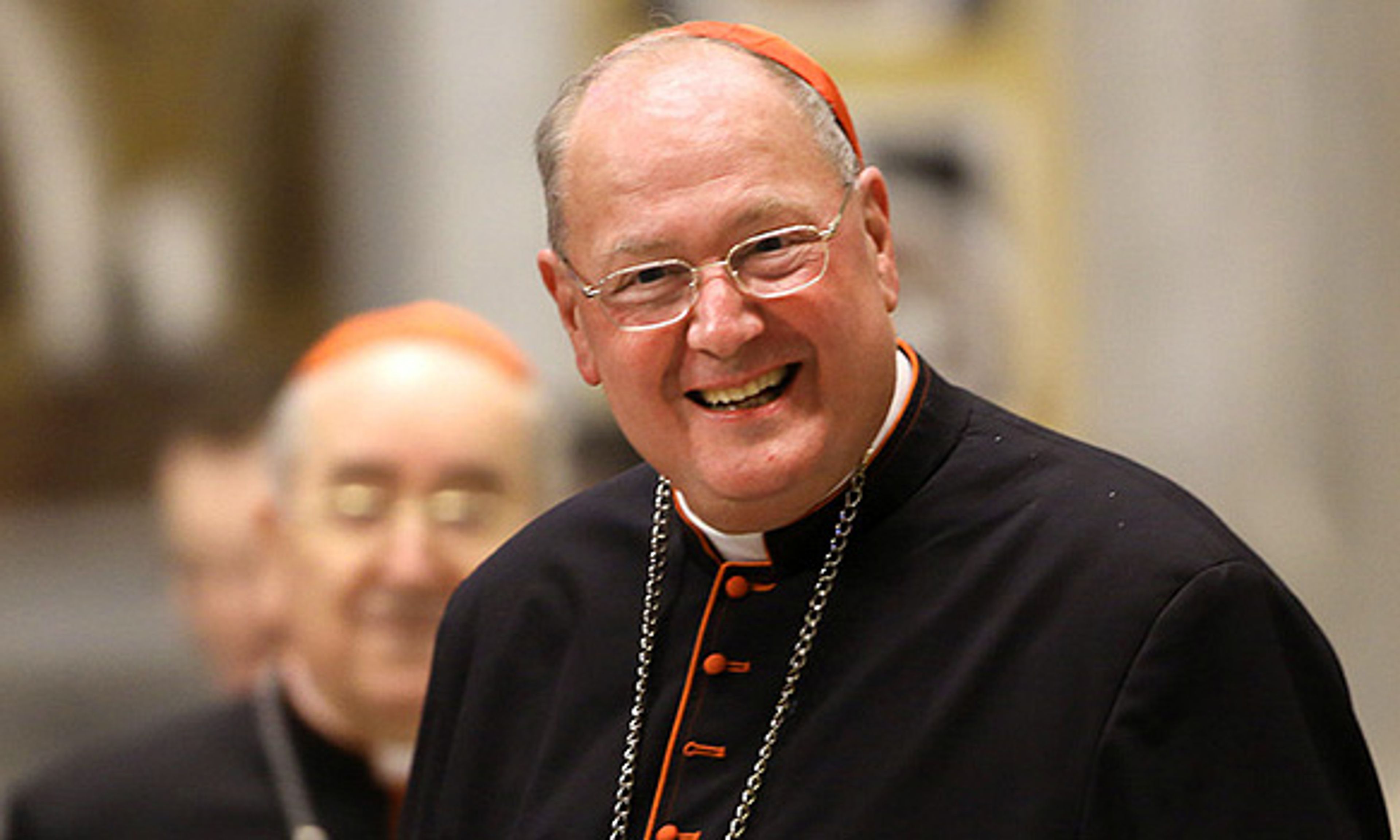
‘Our lives are at their best when centered not upon ourselves but upon babies!”
The president of the United States Conference of Catholic Bishops, Timothy Dolan, made this contention at the same time as, across the Potomac at the annual Hollywood-meets-Beltway White House Correspondents’ Dinner, the president of the United States was joking about Michele Bachmann book burnings. Dolan was speaking at an uplifting alternative to what D.C. insiders call “the nerd prom”: The Chuck Colson Center for Christian Worldview had brought together evangelicals and Catholics to celebrate religious liberty, giving thanks for the freedom to live an integrated life of faith in the public square, in service and love.
The Colson Center was honoring Cardinal Dolan for defending religious liberty against the attack on conscience posed by the Obama administration’s policy mandating insurance coverage of abortion pills, contraception, and sterilization. But as concrete a threat as that particular policy is, attempts to understand it get sidetracked by a dwindling common vocabulary on things like conscience and anything remotely related to sex. Given his commitment to one born in a stable in Bethlehem, the cardinal naturally went to babies to help clarify precisely what’s at stake.
Dolan announced that the most joyful event of the past few months for him was not his first papal conclave but the baptism of his newest grandnephew. He said that he was inspired by “the profound change” he saw in the baby’s mother and father. “Their whole identity was transformed with the arrival of Charlie, their first born!” In place of the “rather diverse and self-referential” interests that used to occupy them, Charlie now dominates “their sleep schedule, their plans, their budget, their conversation, their calendar, their future, their dreams.”
“The human project,” Dolan proposed, “is all about babies! A man and woman are made for babies!”
And culture itself, he said, is “simply humanity’s best effort to protect the baby, the mother, the father.” The purpose of culture, he said, is “to embrace, nurture, protect the baby, the mom, the dad, and to see that this precious infant has the embrace of a community to grow ‘in age and wisdom’ until — guess what? — that baby is an adult, can tenderly and faithfully love a spouse, then have his/her own baby, and the sacred cycle begins again.”
He added: “Can we not even claim that culture is our attempt to ‘extend the womb,’ as babies and children are welcomed, protected, cherished, formed and educated with our highest values, so that they eventually then have their own babies?”
He made this contention at the same time that the horrific Kermit Gosnell trial was winding up in Philadelphia, shining a light on the brutality of late-term abortion. “Ensuring fetal demise” is the term of art in abortion clinics, as can be seen in a series of investigative videos the pro-life group Live Action has released. Dr. Gosnell is by no means the only abortionist who operates under the rule that if a woman walks in wanting an abortion, she is entitled to a dead baby.
Not quite the culture of life the cardinal had in mind. Thus the need for his exclamatory emphasis.
We do not, of course, talk in these terms — “a woman’s right to a dead baby” wouldn’t have been a winning campaign theme for President Obama. Instead, we delude ourselves with euphemisms that keep us complacent and complicit; we pretend that a woman isn’t a mother unless she says she is, even as a life that combines her DNA and the DNA of another human being develops within her. We try to pretend that a 23-week-old bears no resemblance to a newborn — as an Arizona doctor tried on one Live Action video — when sonograms show us the truth. We know better than to be where we are today. And yet here we are.
Most of us can agree that we can do better than this. That, as the underreported pro-life rallying cry puts it: Women deserve better. We don’t do better, all too often, because we get caught up in disagreement about the hows. So we surrender to the delusion or we simply look away.
Gosnell has got to mark the end of this.
If culture is all about babies, as the cardinal proposes, then many of our most uncivil and controversial debates might benefit from our confronting the baby in the room, and our relationship to and responsibility for him or her.
That baby has a dignity that does not come from his mother’s will, or his father’s engagement, or a doctor’s signature. It is inherent. The differences between men and women, which are worthy of embracing and even celebrating, might just speak to us of an order that predates our country, but which we have a stake in supporting, protecting, and encouraging. That order is marriage. It’s for the baby. Who needs us and whom we need.
If we’re willing to reconsider the popular understanding of freedom — which all too often is defined down to license — this is all quite liberating. We’re not made for ourselves. We’re not in this alone.
In How the West Really Lost God, Mary Eberstadt observes: “Family and faith are the invisible double helix of society, two spirals that when linked to one another can effectively reproduce, but whose strength and momentum depend on one another.”
She concludes: “It appears that the natural family as a whole has been the human symphony through which God has historically been heard by many people — not the prophets, not the philosophers, but a great many of the rest; and the gradual but now recognizable muffling of that symphony is surely an important and overlooked part of the story of how certain men and women came not to hear the sacred music anymore.”
We want that music playing. Even if we’re in the quiet car, there’s a peace that comes from knowing that it is playing elsewhere, and that we can join the concert already in progress. We need to know it’s there. People can’t quite always hear it, and increasingly, when they do, they are hearing only some pop remix that doesn’t quite reveal the same beauty. Some of us feel called to write chords. Some, to be instruments. Others, patrons. Still others, the supporting audience, drinking the creation in.
The baby. With a dignity, with an actual right to life. What a gift to play a role in his flourishing!
As Eberstadt notes, “Because of the experiences so many have had, it’s hard for an individual to see how exactly any rules have any relevance, how they are anything other than unnatural restrictions and impositions on freedom.” But how about listening to some re-proposals?
John Paul II said that true faith produces culture. In the recently translated On Heaven and Earth, Pope Francis says: “No believer can limit the faith to himself, his clan, his family, or his city. A believer is essentially someone who goes into an encounter with other believers, or non-believers, to give them a hand.”
We need religious liberty because we need people to give us a hand in the renewal of culture. We need people who see clearly and who hear the symphony, who are inspired by the Maker of it all. We might start with Cardinal Dolan’s exclamation points.
— Kathryn Jean Lopez is editor-at-large of National Review Online and a director of Catholic Voices USA who serves on an advisory pro-life commission for the Archdiocese of New York. This column is available exclusively through Andrews McMeel Universal’s Newspaper Enterprise Association.

Comments