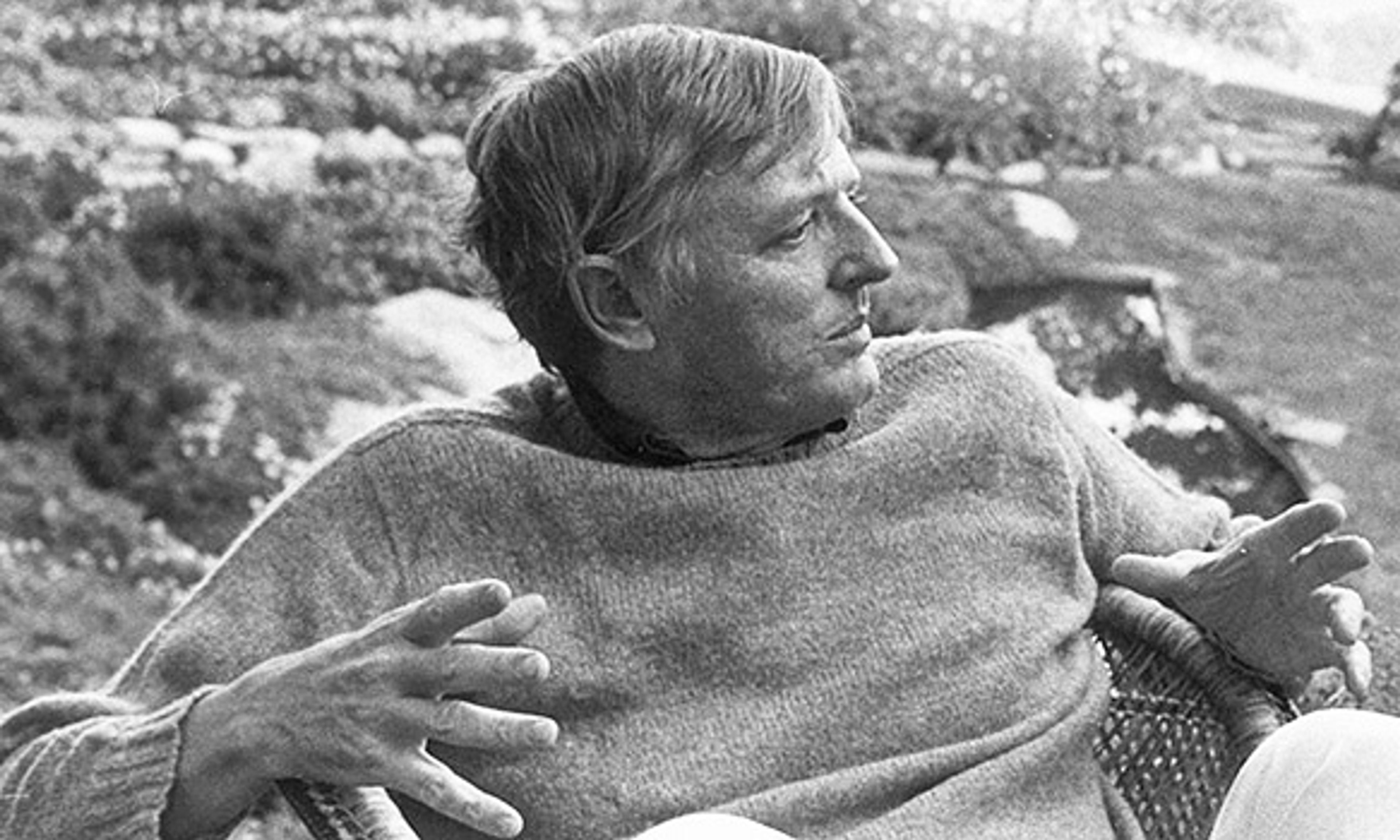
Five years ago today, National Review founder William F. Buckley Jr. passed away at home, at his desk, while working. We miss him and wonder what he might be writing and advising and asking today. Some NR family and friends remember and consider.
RICHARD BROOKHISER
WFB was smart, devout, funny, generous, etc. etc. Maybe what we should most remember now is how hard he worked, and how accustomed he was to the long haul. He founded this magazine, his love child, in 1955. There was not a president to his liking for 13 years — and then he turned out not to be to his liking. So there was not a president to his liking for 25 years — and even then not everything was magically fixed. The Berlin Wall fell after 34 years, the Soviet Union after 36.
You could extend the list of bad things that lasted a long time. During all that time, WFB ran, or oversaw this magazine, shot his TV shows (1966 to 1999), wrote his three-times-a-week column (1962 until the day he died).
The man he admired most was Whittaker Chambers, and the Chambers line he quoted most often was that political activism was a dance along a precipice — the precipice being the temptations of quietism and despair. No handwringers or crybabies need apply. If you don’t want to work, go home — and leave the job of defending your home to others.
— Richard Brookhiser is a senior editor at National Review and author, most recently, of James Madison.
LEE EDWARDS
Bill was a master fusionist at National Review, able to bring together and keep together the most disputatious of intellectuals — Frank Meyer, Russell Kirk, Ernest van den Haag, Jeffrey Hart, etc. He never forgot a metaphor which his Yale mentor Willmoore Kendall often used in class.
Conservative forces, Kendall said, were strung out in isolated outposts over a wide front, allowing liberals to overrun them one at a time. Only when the conservative outposts united in recognition of a common enemy would conservatism prevail.
Bill Buckley constantly reminded traditionalists, libertarians, and anti-Communists (and later neoconservatives and New Rightists) of their common enemies — liberalism at home and Communism abroad. And for decades they formed a unified movement, inspired by that remarkable political fusionist, Ronald Reagan.
Bill would do the same today, exhorting the conservative faithful in their varying denominations to lay aside differences and unite to roll back the welfare state — “Leviathan delenda est!” And he would chide those who would read this or that “faction” out of the movement, pointing out that in the house of conservatism there are many rooms.
— Lee Edwards is a distinguished fellow at the Heritage Foundation and author of William F. Buckley.: The Maker of a Movement.
WILLIAM GAVIN
One evening, back in 1958, and quite by accident, I came upon William F. Buckley Jr. being interviewed on television. I had never seen him or heard him speak, although I was vaguely aware he had written a notorious book, God and Man at Yale. But what could a Yale snob who talked like Little Lord Fauntleroy have to say to me, a Jersey City working-class guy? I listened to what he was saying in that unique aristocratic drawl, and I liked what I heard. The wit, the easy manner, the civility, the reasonable, if not always persuasive, arguments — all quite captivating. I subscribed to National Review and, in 1960, had my first paid article published in the magazine, a satire on Japanese student riots called “Rave, New World.” (Oh, well, it sounded clever at the time.)
Those were the early days when NR set the tone that still inspires the magazine today: scrappy, confident, irreverent, and tough-minded, with a happy-warrior feistiness. Every two weeks I awaited the newest issue and read it straight through, learning about conservative principles, not in some textbook fashion but in the slam-bang, head-on collisions of clashing ideas and current controversies that constitute NR’s unique glory. National Review was not simply a by-the-numbers catechism of conservative principles, but an intra-family battleground where arguments over freedom and virtue, and libertarian and traditional values, were fought.
There was a lot I had to learn and NR proved to be my post-graduate school of political and cultural education. The night I saw Bill on television for the first time changed my life. He gave me somewhere to stand in order to fight for what we both believed in. And, later on, I was fortunate enough to work with his sainted brother Jim.
Conservatism today needs Bill’s happy-warrior spirit.
— William F. Gavin is author of Speechwright, from which this is adapted, and a former assistant to Senator James L. Buckley.
JONAH GOLDBERG
When people ask me what William F. Buckley was like, I always tell them that he had the best manners of anyone I ever met. Understandably, people first think I’m referring to decorum or personal dignity — or maybe they think I mean he always knew which fork to use. But while he was of course, decorous, dignified, and knowledgeable of all the proper ways to do the proper things, that’s not at all what I mean.
At their core, good manners are the things we do and say to show others respect. Sometimes they are formalized. Of course, some people use these formal manners, customs, and rules of etiquette to belittle or ostracize the unwashed or uninitiated. “Oh you don’t know what that spoon is for? What are you, a farmer?” Buckley might even call such practices a ritualized esoteric gnosis. Though, given his playfully obscurant tendencies, he’d no doubt construct an even more daunting sesquipedalian and holophrastic term for the guild-like tendency of excluding the uninitiated.
But while he could build gilded cages with words, he always left the door open for conversation. He had the sort of good manners that stem from near-biological certitude that every person had something worthwhile to share, at least until proven otherwise. For a man with so much to say, he was among the best listeners I ever met.
I’ve lost count of the number of times I’ve met people with stories of his generosity of spirit that only served to confirm my own experience. I’m neither naïve nor an egomaniac. I understand that some of it must have been an act, not least because I know what I had to say to the man couldn’t have been that interesting. But while good manners may be a reflection of character, they are measured by what you actually do. And if he was playing a part, I personally never saw him break character.
And such charm was essential to the role he played. The conservative movement, in its infancy, was a chaotic constellation of cranks, dyspeptics, recluses, oddballs, and extroverts. Brilliant eccentrics with poor social skills and bitter geniuses quick to grievance were a dime a dozen. Doctrinal disputes could emerge from perceived slights, never mind competing agendas. William F. Buckley’s gift lay in his ability to smooth over differences, entice the wayward, corral the incorrigible, and convince the heretical to craft a movement built on common cause. That took genius. That took energy. That took commitment, patience, and courage. But all of those things could be found among the generals-without-troops on the right. As much as anything else, what made Bill the indispensable man was his ability to demand — without asking — the same respect he showed others.
— Jonah Goldberg is editor-at-large of National Review Online and author of The Tyranny of Clichés.
JOHN O’SULLIVAN
In books like Cruising Speed, Bill described his own life with merciless good humor. It was very definitely not the life of a saint, or of a philosopher, or of a political leader, though he has often been confused with all three. Especially after he married Pat, Bill’s life had more than a touch of Cole Porter. Together they had:
[T]oo many cars, too many clothes,
Too many parties and too many beaus
They have found that the fountain of youth
Is a mixture of gin and vermouth, etc., etc.
The beaus were, of course, Pat’s. She was rarely without a witty, well-dressed, gay walker in tow. But the parties, the clothes, the cars, and the Martinis were decidedly mutual. Bill’s life was the life of a star — a star of Tales of Manhattan rather than Tales of Hollywood — but a star nonetheless.
But he was a star who, unlike most stars, wrote his own dialogue. Early in the game, he emerged from an impromptu television interview through which he had quipped his way with his usual effortless superiority, to say to one of his close circle of loyal friends: “I can keep this s**t up indefinitely.” Not perhaps Bill’s usual elegant essay in verbal acrobatics, but it was true.
He could keep up the columns, the television interviews, the books, the debates, the Blackford Oakes thrillers, the novels, the plays, the harpsichord concerts, maybe not to the highest professional standards in every case, but well enough to please himself and to amuse his ever-growing circle of friends. Inevitably, he sometimes fell flat on his face. In Switzerland, against the firm advice of all, he insisted on showing one of his own paintings to Chagall, who looked at it intently and then said sadly: “Oh, the poor paint.”
But did the occasional disappointment matter? He was doing most of these things in a true amateur spirit for the love of them; and some succeeded triumphantly. The Blackford Oakes novels are almost a cult. Firing Line was an endless series of The Perfect Squelch with very clever liberals as the squelched victims.
Too many cars? Too many clothes? Too many parties? Solemn, puritan reviewers of Cruising Speed thought so. As did a certain kind of grudging conservative who could never mention Bill without a resentful reference to “vintage wines.” For the rest of us, though, Bill’s high life could never be too high.
He was our representative at White House dinners, Geneva diplomatic occasions, Oxford high tables, Metropolitan Museum of Art charity balls, and all the glittering black-tie occasions that we usually attended from outside, our faces pressed to the window. He was the proof that conservatism was not the preserve of provincial bores — well, not solely of provincial bores — but a sophisticated intellectual enterprise. When he traded economic theories with J. K. Galbraith, epigrams with Noël Coward, or jokes with Woody Allen, we did the same thing vicariously. And he did all these things — maybe, who knows, even paint — with apparent assurance and élan. It was as if Cary Grant were playing the lead role in a biopic of F. A. Hayek.
As with Grant, Bill’s personality wasn’t wholly natural or spontaneous. He told his father in letters about his fear that the soldiers he trained with disliked him. Creating WFB took a little time and some thought. Once it had been accomplished, however — say, about the publication date of God and Man at Yale – Bill was a star ever after. His life was the role of our dreams and we loved him for it.
Incidentally, I don’t think I should end without mentioning that he also established National Review and more than anyone else helped to launch the American conservative movement. Those things may seem important one day.
— John O’Sullivan is editor-at-large of National Review and author of The President, the Pope, and the Prime Minister.
GEORGE WEIGEL
Bill Buckley had that essential (but rare) element of leadership that involves energizing others. Like few other men I have known, his very presence charged up the atmosphere, got brain cells working that you hadn’t known you’d had before, and inspired you to projects you hadn’t imagined possible. The languid manner masked the reality of a man: This was a high-energy character whose almost ridiculously high level of juice didn’t exhaust others but rather energized them.
His leadership also involved another infrequently encountered but essential skill, especially when leading a community of ideas and argument: He could ask just the right question that would get you to the nub of an issue, make you think about something differently, or cause you to imagine that you just might be, er, wrong. Given this talent, he would have been a fabulous classroom teacher; but he chose another way of being an educator, and America was changed for the better because of that decision.
I’m in Rome at the moment, in a culture where lethargy is more often encountered than high-octane energy; but perhaps because I’m writing this a few blocks from the bones of St. Peter, it now occurs to me that Bill’s energy was in an important sense nurtured by his Catholic faith. The time he consciously made for recharging his spiritual batteries — for being with the Lord — had effects, I suspect, throughout his life. Anyone who imagines that Catholic doctrine and ritual dull the senses and retard one’s imaginative faculties never conjured with Bill Buckley’s convictions and their effects on his life. He was no theologian, but he knew the faith of the Church and it shaped his life, his thought, and his often-remarked-upon quiet generosity.
May his energetic commitment to the permanent things continue to inspire his beloved country, and may his intercession at the Throne of Grace aid his Church in perilous times.
— George Weigel is the author of Evangelical Catholicism: Deep Reform in the 21st- Century Church.






Comments