
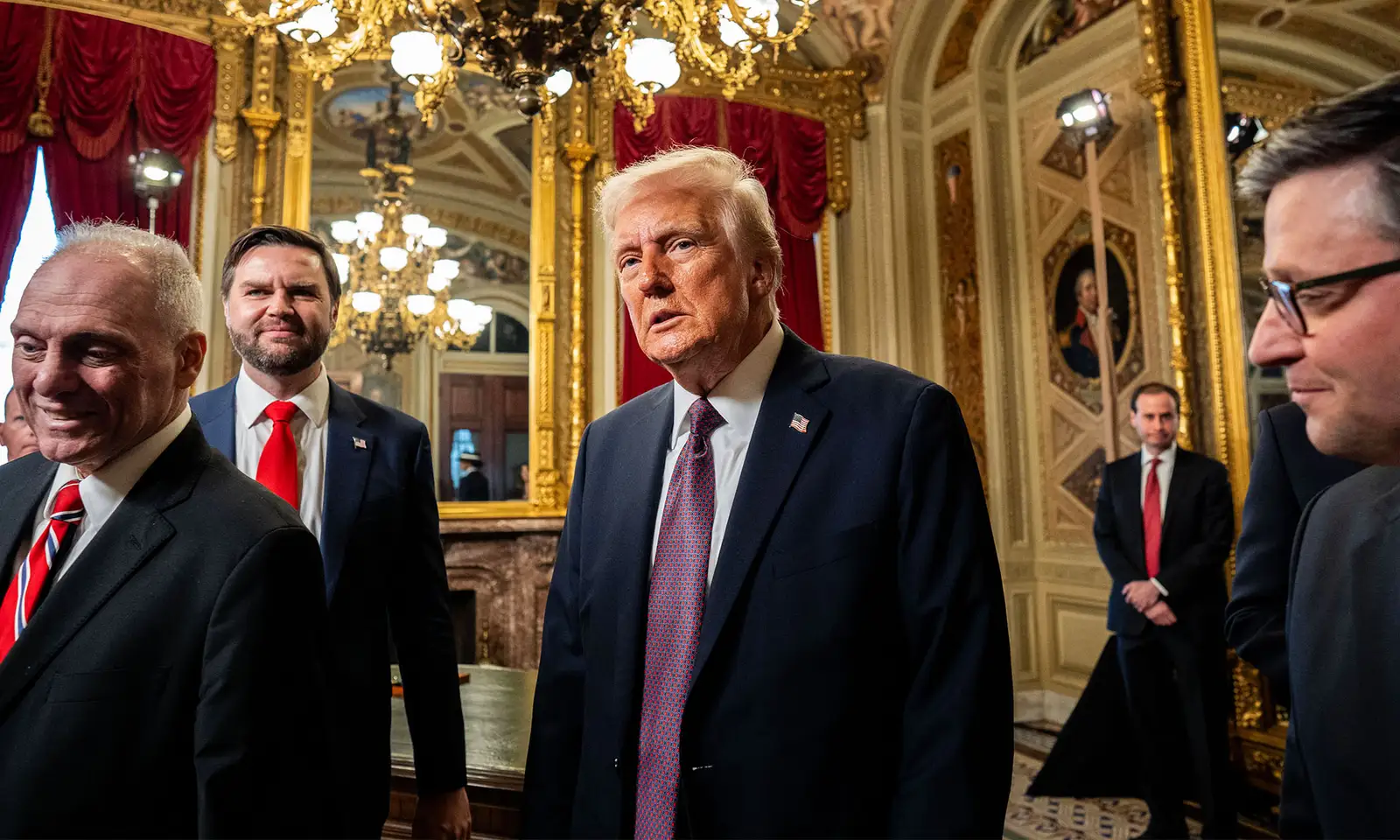
It’s too bad that Donald Trump’s second inauguration had to be moved indoors.
The limited space denied the many joyous Trump supporters who came to Washington this weekend their chance to cheer in person, and to take in the civic pomp. At best, they ended up gathering for a rally at a basketball arena, which unavoidably took on the atmospherics of another campaign event rather than a uniquely accessible yet still solemn exercise in republican governance.
But moving indoors also denied the new administration, its supporters, and assorted political junkies the valuable jarring experience of subjecting their enthusiasms to the unforgiving, biting cold of a January day. I’ve always thought there was something profoundly appropriate about the decision (codified in a constitutional amendment in 1933) to move Inauguration Day from March to January. It not only shortened the seemingly interminable transition between the declaration and fulfillment of the public’s choice of president but also forced every new president to reckon with the cold hard world on Day One, and to make his most audacious claims and promises right into the bitter wind.
I’ve shivered out in that wind with the crowds since I was a college student. Ever the sucker for civic ceremony, I attended every presidential inauguration from Bill Clinton’s second in 1997 through Donald Trump’s first in 2017 — whether I had voted for the winner or not. All were pretty frigid. Obama’s first in 2009 certainly felt like a much colder day in D.C. than Monday did. But all were also joyous in their own ways, surrounded by people who were thrilled at the election’s outcome and were plainly moved to see their political hero take on (or reaffirm, when reelected) the trappings of public authority. Singing the national anthem with hundreds of thousands of people will never get old.
But the last two inaugurations have denied all but the most select VIPs the chance to observe them in person. There was no general-public audience at Biden’s inauguration for reasons of both pandemic and security. The observers consisted of the political uber-elite, alone to an almost surreal degree, while other Americans could only watch at home. And at Trump’s second inauguration, on Monday, concerns about cold temperatures meant the ceremony was brought indoors for the first time in 40 years. The alternative surroundings emphasized the surreal in their own way, as Donald Trump took the oath in the Capitol rotunda, right near the spot where the QAnon Shaman in pseudo-Viking garb paused for a photo four years ago while trying to disrupt the certification of Trump’s election loss.
Trump was there because the public reconsidered, or perhaps decided not to learn, the lesson of what culminated on that day back in 2021. In a sense, his return to power is a refusal to learn lessons from both of the last two presidencies. Whatever your ideology or party, Trump’s first term should have shown us all at the very least that character and temperament matter in a president, while Biden’s presidency should at least have taught us that the president should not be 78 years old at his inauguration. Well, we have brought back the very same low, intemperate character who should have taught us that first lesson, except this time he is 78 years old at his inauguration.
But in another sense, of course, these last two inaugurations have been all about reconsidering past choices. Joe Biden’s election felt at the time like an attempt to pretend Trump never happened. There, at his inauguration in 2021, was the American political class elevating the vice president of Trump’s predecessor to the presidency, essentially picking up right where Barack Obama had left off. Trump didn’t even show up to force them to recall how that had ended. And Monday, Republicans did much the same, giving Trump the second term that Biden had denied him, so he can pick up right where he left off.
This was not a coincidence. Both Trump’s and Biden’s presidencies were treated by their political opponents as implicitly illegitimate and best ignored and wiped from memory rather than contended with, digested, and adapted to.
That, at least, is unlikely to happen again this time. After each party got a do-over, what comes next will have to build on the next four years and not ignore them. Even Trump’s most rabid opponents can see that this time it’s for real. Most of them at least are not engaged in rejectionist resistance playacting. They’re in shock, and some are even asking hard questions, like election losers should be.
The cultural vibe shift that led to that election and has been accentuated by it is surely real, too. The sudden pull-back of DEI policies in swaths of corporate America and of woke “fact-checking” on social media has looked to some on the left like kowtowing to Trump’s thuggishness. There is no doubt some of that. But to me, it actually suggests that DEI and woke policies were themselves the kowtowing, and that the Left’s cultural agenda was the real thuggishness, which many institutional leaders abided because they felt they had no choice. Corporate America now sees an opportunity to settle where it was always more comfortable — not in any kind of right-wing stance but in a position to sell its wares to Americans of all parties without having to take positions on politics, morals, or metaphysics. As a wise man once said, “Republicans buy sneakers, too.” Some institutions — many elite universities for instance — are run by people who really do embrace the Left’s cultural line, and they won’t be changing quite so easily. But in much of America, the public’s rejection of the Democrats was received with a sigh of relief.
That rejection was rooted in part in the perception that the Left had come to represent a corrupt elite that held others to standards it did not itself uphold. Looking at the final phase of the Biden administration, it is hard to argue with that sense. Biden chose to end his presidency by making a mockery of all his talk about constitutional norms. Even before the election, he had recklessly attacked the legitimacy of the independent judiciary and had demanded and facilitated a campaign of deception about his own age-related decline. But since the election, he has abandoned even the pretense of norm-following, among other things insisting that he could declare the Equal Rights Amendment ratified and preemptively pardoning assorted relatives and friends. He leaves disgraced, and not because he was not reelected but because he has acted disgracefully.
But at the same time, there is no getting around the disgrace involved in bringing Donald Trump back to the White House after his own post-election betrayals of his constitutional oath in 2021. Whatever you think of Trump, however you voted, it’s important not to look away from this element of disgrace that must always accompany our society’s entanglement with him. Seeing it can help us grasp, among other things, the fundamentally negative tenor of the public’s choice in the last two elections.
Trump has returned because the Left could not take the electorate’s “no” for an answer and reorient itself. Democrats wanted Trump’s loss in 2020 to be followed by a redo of all the progressive excesses that had made it possible for him to be elected in the first place, and the public did not want that. They just wanted Trump gone. Exactly for that reason, it is vital that Republicans not make the same mistake now. Republicans want Biden’s loss in 2024 to be followed by a redo of all the Trumpist excesses that made it possible for him to be elected in the first place, but that is not what the public appears to be looking for. Trump’s circle seems to think the public has said “yes” to their agenda, and so is still not taking the electorate’s repeated “no, thank you” in all directions for an answer. Trump won very narrowly, but insists he won in a landslide. That won’t end well.
That can be hard to see in this moment in no small part because the people who most respect Trump and the people who most disrespect him tend to treat him the same way: with rapturous praise and public adoration. Many world leaders, and many corporate and other leaders in American society, walked away from Trump’s first term thinking he could be manipulated through praise. Tell the world you think he’s strong enough to do what you want, and he will do it. There’s some truth to this. His desire to be seen as strong makes him weak. It’s how the CCP got Trump to begin his second presidency with an act of abject capitulation to China — promising to openly defy on behalf of our most dangerous adversary a perfectly straightforward law that was enacted to protect our national security and was just reaffirmed by the Supreme Court last week.
That both those who love him and those who want to manipulate him approach Trump by praising him means we are starting this second Trump term in an atmosphere strangely thick with praise of Donald Trump. It’s odd. And Trump has taken note of this himself, telling reporters in December that since the election, “everybody wants to be my friend.” Seeing through that would not be easy for anyone, and it is probably not possible for him. But over-reading his mandate is a grave threat to Trump’s ability to make the most of the exceptional opportunities he does now confront.
Trump’s inaugural address suggested that such over-reading is likely. But of course, the occasion calls for gusto, so that may not tell us much. The speech was direct and substantive, and suggested that Trump means to govern along the lines he sketched to voters last year — which is as it should be. It lacked some of the vision and poetry that sometimes accentuates inaugurals, but it’s hardly the first to lack those. And of course, it was quite partisan, as recent inaugural addresses have tended to be.
Trump spoke of unity only in the terms in which he did last time. “If we work together,” he said Monday, “there is nothing we cannot do and no dream we cannot achieve.” He said the same thing in 2017: “When America is united, America is totally unstoppable.” Biden, in 2021, made exactly the same point: “We have never, ever, ever, ever failed in America when we have acted together.” This is nonsense, of course, in all three forms, and it encourages a misimpression of just what unity involves in a free society. But it’s a sort of elevated sentiment, and forgivable enough in presidential rhetoric.
Aside from that one note, the defining theme of the address was not unification but vindication. Trump is back. He could hardly fail to take note of the sheer, stunning fact of his comeback. And he sought to use that fact to illuminate his vision for the country: America is back.
I am hopeful this will prove true in some ways. The new administration will take many actions and pursue many policy ambitions that I think will be good for our country, along with some that I’ll oppose, I’m sure. It will also employ many capable and patriotic people who have the country’s best interest at heart and the ability to turn good intentions into good outcomes. But at its heart, empowered again with the awesome authority of the American presidency, is Donald Trump. And this means that our country is also at grave risk.
The good may outweigh the bad. I very much hope it does. And we may also be lucky again, and avert the worst consequences of our bizarre choice of leaders. We’re Americans after all, so we already know we’re lucky. But leaning on luck should make us very uneasy at the outset of this new administration. And although it got its formal start in the warmth of the Capitol rotunda, this presidency, like every other, will have to pursue its ambitions in the cold, harsh, bitter wind of an unpredictable and often unforgiving world. Here we go again.



Comments
On “Trump Redux Begins”