
In 1949, the Truman administration filed an antitrust suit to break up AT&T — the “Big Tech” of its day. The case dragged on until President Eisenhower’s defense secretary, Charles Wilson, wrote to Attorney General Herbert Brownell expressing concern that a breakup would destroy the “usefulness for the future” of AT&T’s equipment arm, Western Electric. With the Cold War intensifying in the background, Wilson’s alarm persuaded the DOJ to accept a settlement in 1956 in which AT&T would restrict its business to regulated telecommunications and license its existing portfolio of patents to other companies at below-market rates. AT&T now licensed core technologies, including the newly invented transistor, not only to American companies, but to emerging Japanese and European competitors, which soon challenged and in some cases destroyed U.S. firms.
Today, the Biden administration and its “Neo-Brandeisian” supporters in Congress (who advocate aggressive anti-trust enforcement) are turning back the clock, seeking to break up the current generation of large tech companies — especially Google, Amazon, and Facebook — with a raft of legislative and regulatory proposals. As in the 1950s, national-security-minded policy advisers are issuing warnings about the likely consequences. Their predecessors in that role were right then, and they are right today: Breaking up Big Tech would weaken U.S. national security by diminishing these innovative companies, thereby strengthening our nation’s biggest adversary, China.
Among the national-security leaders who have been raising concerns are John Negroponte, former director of national intelligence, and Leon Panetta, former defense secretary and CIA director, who, with others, warned in a letter to House Speaker Nancy Pelosi and House Minority Leader Kevin McCarthy:
The current effort to regulate the U.S.’s largest technology companies should not be done at the expense of U.S. economic and national security. Rather than passing bills that cede U.S. tech leadership to China, we must build on America’s key advantages and ensure that the United States remains a technological powerhouse for decades to come.
This didn’t sit well with anti-big-business progressives, who were quick to react because they know appeals to national security are often the only way to keep avid campaigners from marching over the ramparts. But in this case, national-security arguments are likely to jolt some of the Republicans who are angry at big Internet-platform companies for purportedly censoring conservative voices, and some of the Democrats who see breaking up Big Tech as the first step in a broader anti-capitalist campaign, into pulverizing big U.S. companies into smaller ones.
Led by the misnamed American Economic Liberties Project (a group that is for anything but economic liberty; it wants to dramatically expand the regulatory state and break up large corporations for the sin of bigness itself), a coalition of anti-corporatists drafted their own letter, arguing that “Big Tech is not here to help national security or the public interest, but to maintain monopoly rents and market power.”
So, here we go again: One side argues that subjecting the country’s leading tech companies to overly aggressive antitrust interventions would risk weakening economic and national security, and the other side argues that doing so would free us from monopolistic oppression that is sapping our innate strength. But instead of falling into the same trap that doomed AT&T in the Fifties, we should heed the lessons history has already provided. The clear pattern is that cutting down U.S. market leaders benefits foreign competitors.
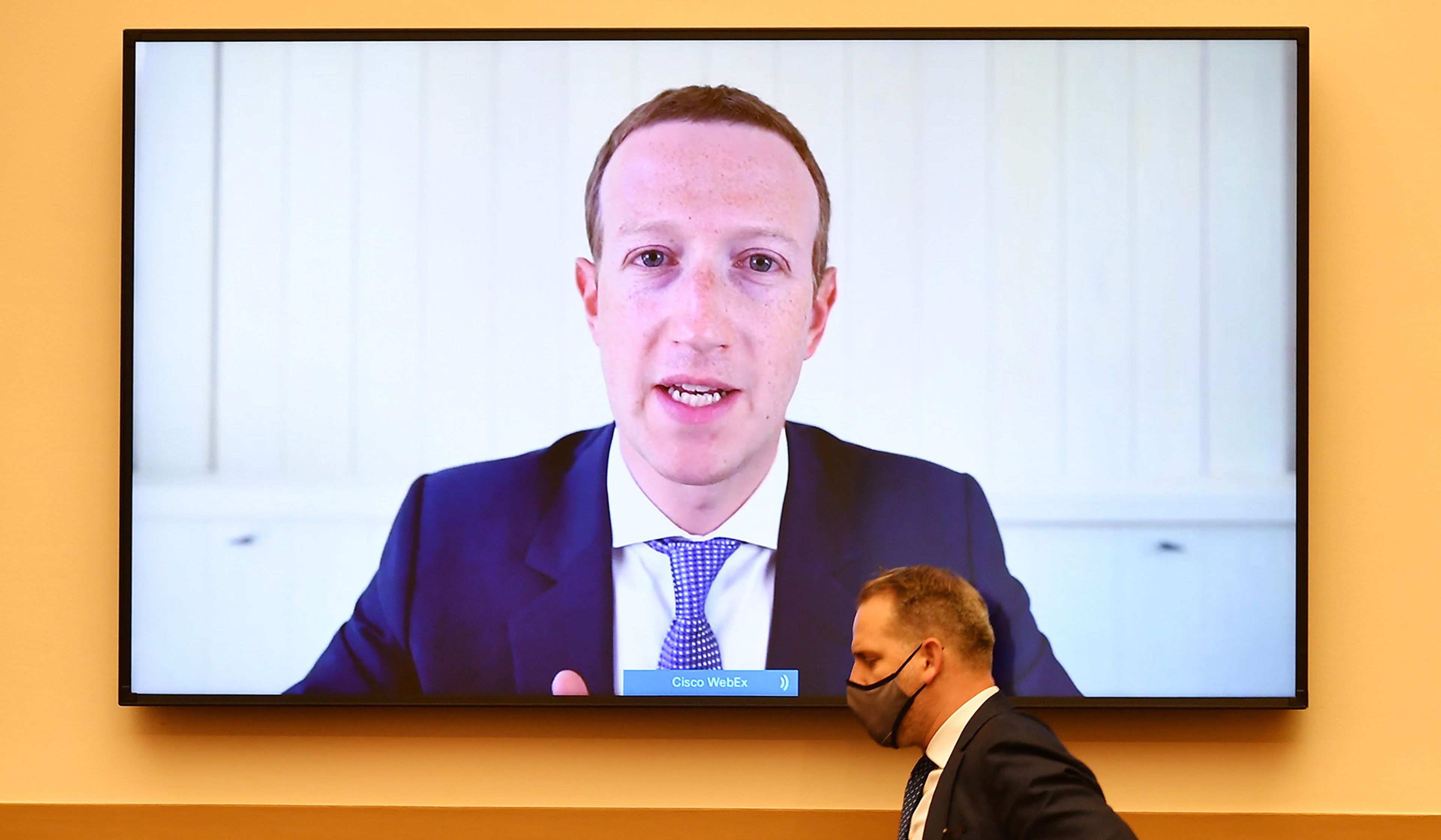







Facebook CEO Mark Zuckerberg testifies before the House Judiciary Subcommittee on Antitrust, Commercial and Administrative Law on “Online Platforms and Market Power” on Capitol Hill, July 29, 2020.
Mandel Ngan/Pool/via Reuters
Take the case of RCA (Radio Corporation of America). As hard as it is to believe, the United States used to be the global leader in television technology. That was thanks to RCA’s pathbreaking advances in color TV. But in the 1950s the Justice Department determined that RCA’s dominance called for an antitrust intervention and required it to let other U.S. companies use its patents at no charge. RCA had long relied on licensing revenue, so to make up its shortfall in the United States it began licensing its technology to Japanese companies such as Sony. “RCA licenses made Japanese color television possible,” technology historian James Abegglen wrote. Similar actions against AT&T in 1956 led to the fall of Bell Labs (the leading U.S. innovation engine), crippling the U.S. telecommunications-equipment industry and allowing the Chinese firm Huawei to emerge as the market leader. Cases against onetime market leaders Xerox, IBM, and Kodak provide further evidence that aggressive antitrust interventions can significantly weaken leading firms. The beneficiaries are not just domestic competitors, as antitrust crusaders may wish, but also foreign rivals. There is little reason to believe that this time would be different.
Why is it so dangerous to apply aggressive antitrust remedies, especially breakups and compulsory IP-licensing programs, to technology leaders? The answer is simple: First, most advanced-technology industries require firms of massive scale. This is especially true in today’s intensely competitive global economy, with China showering its tech giants with huge state subsidies. So, denying American firms the opportunity to operate at scale does more than just constrain them; it suffocates them. Second, these firms serve the dual purpose of bolstering the country’s economic and national security, because they are both leading commercial exporters and leaders in the kind of research and development that produces innovations with a wide range of civilian and military applications.
Whether or not one believes that the U.S. government should respond to China in kind, the reality is that for political and budgetary reasons, any direct government support of U.S. technology industries is likely to be limited. So, for better or worse, America will need to rely on its so-called Big Tech companies to compete with China’s large, state-backed champions.
How is that going? Quite well, so far. It turns out that the largest U.S. technology companies are the global leaders in R&D spending. In 2020, combined R&D expenditures by five U.S. superstars — Alphabet (Google), Amazon, Apple, Meta (Facebook), and Microsoft — of $1.284 trillion were equal to 95 percent of R&D spending by all Japanese firms among the top 2,500 R&D investors in the world. It amounted to 57 percent of R&D spending by all EU firms in the top 2,500. These five firms’ R&D expenditures were equal to around one-third of all Chinese R&D spending, private and public combined. Moreover, according to the National Science Foundation, more than two-thirds of the total increase in R&D spending by U.S. businesses from 2008 to 2019 came from the information sector, which includes Alphabet, Meta, and Microsoft. To say that this massive investment in the future is impeding innovation by “maintain[ing] monopoly rents and market power,” as the anti-tech progressives wrote in their letter, should win an award for disinformation.
Moreover, the relationship between competition and innovation is more complex than the authors from the American Economic Liberties Project, et al., suggest. In their letter to House leaders, they argued that “monopolies do not foster innovation.” But as my organization, the Information Technology and Innovation Foundation argues, innovation depends on both the competitive forces in an industry and technological leadership. When firms are neck and neck in a contest for technological leadership, increased competition can spur them to innovate more. But when an industry is characterized by technology leaders and followers, increased competition can dampen the drive to innovate, because the rewards for becoming the technology leader (i.e., profits) are reduced by the higher degree of competition. And this means less, not more, investment in research and development. In the United States, where industries may more closely resemble the technology leader–follower model, having fewer firms can drive innovation. Moreover, the benefits of that concentration overwhelmingly redound to consumers. As Nobel Prize–winning economist William Nordhaus found, just 2.2 percent of the total present value of social returns to innovation are captured by the innovative firms themselves, with the remaining 97.8 percent accruing to consumers.
To be fair, the Neo-Brandeisian progressives acknowledge that “the Chinese state will direct their [monopolies’] research and production, and help them undercut foreign firms.” But rather than seek to fight, they argue that policy-makers should give up on the notion that our big firms can compete with their big firms. Presumably, the Neo-Brandeisians think it will be our thousands of start-up baristas and craft-beer companies that will help us counter the China threat. The reality is that the appropriate response to the market leadership of Big Tech companies is to refrain from hobbling them with aggressive antitrust breakups. Undermining U.S. firms by reducing their scale and their ability to capture the value of their intellectual property and earn revenue will make them less effective competitors against Chinese state-supported monopolies.
To understand how the five U.S. superstar firms that are now the focus of antitrust bills in Congress directly support national security with their investments in R&D, consider that a recent report by the National Security Commission on Artificial Intelligence noted that “a new warfighting paradigm is emerging because of AI” and that “advantage will be determined by the amount and quality of a military’s data, the algorithms it develops, the AI-enabled networks it connects, the AI-enabled weapons it fields, and the AI-enabled operating concepts it embraces to create new ways of war.”
The companies that the progressives demonize in their letter have developed, and continue to develop, the vast cloud-computing infrastructure that leading-edge research in AI requires and that the Defense Department relies on. Amazon, Microsoft, and Google typically invest over $25 billion in capital expenditure per quarter, much of which goes toward building and equipping their fleet of over 340 hyperscale data centers, according to John Dinsdale of Synergy Research Group. Moreover, these companies lead research on AI itself and on a host of other dual-use technologies, including autonomous systems, Internet-of-things systems, and quantum computing. These are all technologies the DOD sees as critical to future war-fighting.
Hobbling U.S. superstar firms will only make Chinese firms more attractive to American consumers and limit these U.S. companies’ ability to make security-enhancing investments. Congress and the administration would do well not to compromise our economic and national security with misguided antitrust bills or aggressive suits to break up these companies.










Comments