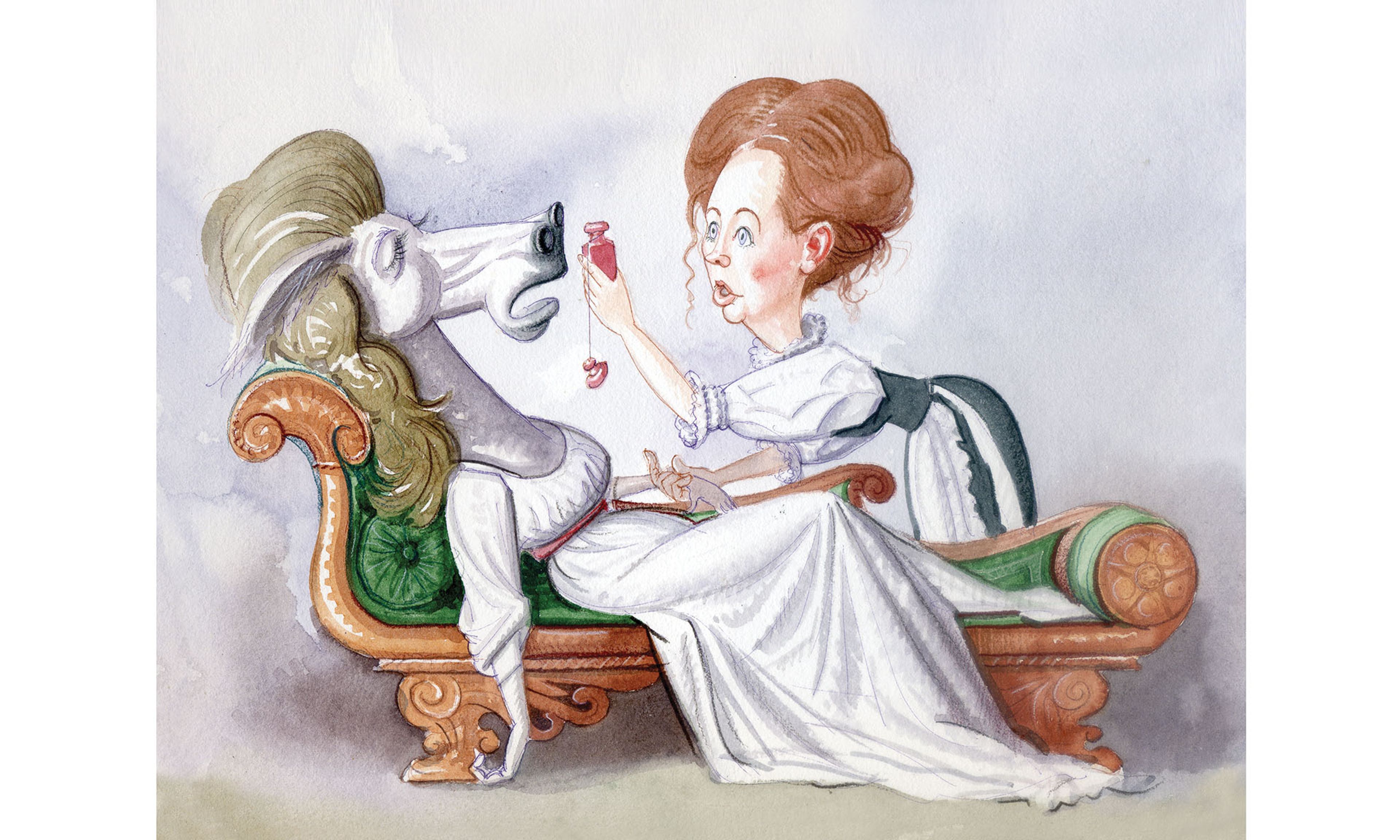
As President Joe Biden casts about for a winning campaign theme (“Dark Brandon,” “Bidenomics,” and whatever that bizarre Andy Rooney–style disquisition on “shrinkflation” was that he delivered on Super Bowl Sunday have not caught fire), perhaps he should take a page from some leading Democratic women, who are honing a message: Be afraid. Be very afraid.
In January on The View, Vice President Kamala Harris told host Joy Behar she was “scared as heck” of the possibility of another Trump presidency. “We should all be scared,” she added, that Trump could get reelected by “the crazies.”
Fear of “the crazies” electing someone Democrats don’t like might appear to be a reiteration of Hillary Clinton’s declaration in 2016 that Trump voters were a “basket of deplorables,” but it’s different in scale and tone. Clinton quickly had to express regret for calling American voters deplorable, although it was too late to undo the damage she had caused. By contrast, today, Democratic women are leaning into fear and terror about the possibility of anyone other than a Democrat controlling the country, particularly if the alternative is another Trump term. As Harris put it on The View: “There’s an old saying that there are only two ways to run for office: Either without an opponent or scared. So on all those points, yes, we should all be scared.”
This was a winning strategy for Democrats in the 2022 midterm elections, after the Supreme Court overturned Roe v. Wade, and they are determined to keep using it. “Democrats can win if they embrace the politics of fear,” wrote Ana Marie Cox in the New York Times in 2022. “Plenty of progressive voters don’t need to be made aware of the danger. They are already terrified for the future. But everyone should be.”
It’s a sentiment now echoed by Democrats about politics in general, not just the politics of abortion. Appearing recently on Jay Shetty’s podcast On Purpose, former first lady Michelle Obama said, “What’s going to happen in this next election? I am terrified about what could possibly happen.” She complained that too few people appreciate everything government does: “The fact that people think that government — ‘Eh, does it really even do anything?’ — and I’m like, ‘Oh my God does government do everything for us, and we cannot take this democracy for granted.’” She added, “Those are the things that keep me up.”
This is a significant change of tone from Barack Obama’s message in his 2008 presidential campaign, “We choose hope over fear.” Back then, Democrats enjoyed pointing out how fearful conservatives supposedly were of powerful Democratic female politicians. In “Fear of Female Democrats,” an article in Salon in 2007, Carol Lloyd asked, “Will threatened right-wing pundits persuade male voters that it’s wimpy to vote for a woman?” Lloyd went on to argue that conservatives — especially conservative men — who registered dislike of “empowered” Democratic women such as Senator Barbara Boxer, Representative Nancy Pelosi, and Senator Hillary Clinton were “overcompensating weenies with a castration complex.”
By 2018, fear had apparently spread to some Democratic women voters. “Democratic women fear America isn’t ready for a woman president,” tut-tutted Ed Kilgore in New York magazine, arguing that “of all the indignities Donald Trump has imposed on Democrats since he decided to run for president, the fact that he convinced many of them they dare not nominate a woman to oppose him is among the worst.”
Of course, fear has long been understood to be an effective — if polarizing — weapon in the political arsenal. A 2015 study in Psychological Bulletin found that fear-based political messaging was twice as effective as messaging that encouraged other emotions. But while fear might motivate left-leaning women to vote, it’s not helping them cultivate well-being. Michelle Obama might believe that government does “everything for us,” but women who embrace left-leaning values and politics are less happy than their more conservative peers. By some measures, liberal women today are some of the unhappiest people in the United States. The 2022 American Family Survey found that only 15 percent of liberal women ages 18–55 were “completely satisfied” with their lives (compared with 31 percent of conservative women) and that only 15 percent of liberal women were “completely satisfied” with their mental health (compared with 36 percent of conservative women).
Fearmongering might also have an impact on how women perceive their status in society. My colleague Daniel Cox at the American Enterprise Institute says of a survey he took recently: “We found that young liberal women expressed the greatest feelings of discontent with the treatment of women in the US. Less than one in three (32 percent) young liberal women said they were satisfied with how women fare in American society. In contrast, 44 percent of young liberal men, and 70 percent of young conservative women, report being satisfied with how women are treated in American society.” These feelings are “closely connected to negative feelings about the direction of their own lives,” Cox writes. “Young liberal women who are unhappy about the way women are treated feel much more pessimistic.”
Could the female fear factor be a long-term winning strategy for Democrats? Given the growing political gap between young men and young women, it might. Recent Gallup polling found that in less than a decade, women ages 18–30 became 30 percent more liberal than their male peers. If apocalypticism continues to encourage these female voters to vote for Democrats, as it did in 2022, the party will likely continue to embrace it.
Much of that will depend on the quality of the candidates the Democrats offer to voters in the years to come. No candidate embodies this challenge more clearly than Vice President Harris. As the Wall Street Journal reported, during her January “abortion-rights tour” of several states, she often spoke to large crowds of women; at one Wisconsin rally, the hall was decorated with an enormous sign that read, in black-and-white letters, “Trust Women.”
Yet Harris’s own voters apparently don’t place much trust in her; polls show that her disapproval ratings are even higher than Biden’s. They are even record-setting. As Axios reported, an NBC News poll from last summer showed that Harris’s net negative rating, minus 17, is “the lowest for a vice president in the history of its poll.” As political scientist Thomas Gift told Newsweek in December 2023, her unpopularity “could end up being a difference-maker” in the 2024 election.
Urging voters to trust women while simultaneously encouraging those same women to believe that the apocalypse is nigh if Trump is elected president in 2024, as Harris and other leading Democratic women have been arguing, might be sending female voters something of a mixed message. During her appearance on The View, after telling everyone to be scared, Harris flattered the hosts as a “table of very powerful women” and said, with her famous articulacy, “We don’t run away from something when we’re scared. We fight back against it. Right. Yeah. So many of us know when we are scared for the future of our children, do we then stay in bed with the covers over our head? Nope. No we can’t. We cannot. We cannot.” Harris’s “fight back” message was delivered almost as an afterthought; clearly the Biden-Harris campaign finds fearmongering more effective.
Given the reality of her approval ratings, however, if Democrats hope to retain the White House in 2024, they should urge Harris to spend less time stoking fear in female voters and more time worrying about her own plummeting popularity.











Comments