
• Democrats would like to forget the past few weeks, and President Biden is leading the way.
• Donald Trump is not doing very well in court, but then his legal strategy isn’t really about winning in court. Arthur Engoron, a justice of New York’s supreme court who found Trump liable for civil fraud before a trial even started, ordered Trump to pay $355 million for overstating his financial condition to lenders — even though no lender ever lost a cent. A court system that follows the law would throw out most of this award as unconstitutionally excessive, just as it would E. Jean Carroll’s $83 million jury award for defamation in New York federal court. State supreme court justice Juan Merchan denied all of Trump’s efforts to throw out criminal charges for lying to his own checkbook about the purpose of payments to Stormy Daniels; the case is set for trial starting March 25 in New York. In Washington, D.C., Trump is pressing his claim for immunity from criminal prosecution with the United States Supreme Court. Jack Smith’s case could also be derailed by a case the Supreme Court will hear April 16 on the obstruction-of-official-proceedings law that has been used in other January 6 cases. Trump’s strategy of delay, meanwhile, is bearing fruit in Atlanta. The three-ring Fani Willis circus is unlikely to result in a dismissal of charges, but the case could be put on ice for months if Willis is forced out over allegations that she benefited financially from a relationship with a prosecutor she appointed. All of which makes it likelier that the sword of Damocles will still be over Trump’s head in November.
• When Joe Biden reemerged as a presidential candidate in 2019, it was obvious that he was a lot older and slower than he had been as vice president. The 2020 “basement campaign,” justified as a response to Covid, helped mask some of Biden’s frailty and wandering mind. As president, Biden has maintained a light schedule — late-morning starts, afternoon finishes, frequent weekends at his home in Delaware, rarely more than one public event per day. In February, special counsel Robert Hur issued his final report on Biden’s handling of classified documents, concluding that he could not bring criminal charges because a jury would see the president “as a sympathetic, well-meaning, elderly man with a poor memory.” The frightening details from Hur’s interview of Biden: “He did not remember when he was vice president, forgetting on the first day of the interview when his term ended (‘if it was 2013 — when did I stop being Vice President?’), and forgetting on the second day of the interview when his term began (‘in 2009, am I still Vice President?’).” Biden defenders claimed Hur was in no position to assess the president’s capacity to perform his duties, but all Hur did was confirm that the Biden away from the cameras is a lot like the Biden we can see — a forgetful octogenarian who struggles with the duties of the presidency now, never mind four years from now.
• Special counsel David Weiss indicted the FBI informant who had implicated President Biden and his son, Hunter, in a bribery scheme. Ukrainian oligarch Mykola Zlochevsky had supposedly given them $10 million to protect him from prosecution by his government while the elder Biden was vice president. The informant, Alexander Smirnov, is accused of making false statements and reports. Democrats are crowing because the explosive allegations by Smirnov were the grist for a government report (Form 1023) that Senator Chuck Grassley (R., Iowa) and House Republicans pried from the FBI — with Director Christopher Wray arguing that the claims were uncorroborated. Obviously, Republicans got ahead of themselves on the bribery claim. Their mistake, however, does not erase the evidence of Biden-family corruption in connection with Zlochevsky’s company, Burisma, which paid Hunter millions to sit on its board. Nor does it erase the millions in payments Republican investigators have shown were made to the Biden family by foreign agents. Watch for the press, inevitably, to act as though it does.
• At this writing, Nikki Haley is soldiering on toward a likely lopsided defeat in her home state’s February 24 Republican primary, with no prospect of finding states she can win. She gave a defiant speech on February 20, vowing that even if she lost South Carolina she was “not going anywhere,” would campaign “until the last person votes,” and would resist “the herd mentality” according to which she should exit the presidential race and get behind Donald Trump. We’ve heard that before from candidates just before they dropped out. Haley, who praised Trump while working for him and even said she would not run in 2024 if he ran, is undoubtedly right to say today that “many of the same politicians who now publicly embrace Trump privately dread him.” If she follows through by staying in the race for the long haul, it will be solely as a protest, albeit a defensible protest. If Trump wants the votes of her supporters in the fall, it will, as always, be the candidate’s job to earn them.
• A group called “True the Vote” has repeatedly alleged fraud in the 2020 presidential election. Dinesh D’Souza relied on the group’s allegations in his film 2000 Mules. The group has now admitted to a Georgia court that it has no evidence of fraud. Don Bolduc was the 2022 Republican senatorial nominee in New Hampshire. He said the usual things. He now says, “I played a political game, right?” And “I’m going to say what I honestly believe, and that is, the election wasn’t stolen.” Andrew Hitt was the chairman of the Wisconsin Republican Party. He signed up as a false elector in 2020. He now says he did so out of fear for his physical safety. “Can you imagine the repercussions on myself, my family, if it was me, Andrew Hitt, who prevented Donald Trump from winning Wisconsin? It was not a safe time.” It was, in fact, a low, dishonest time.
• The NFL’s Kansas City Chiefs — currently in the news for winning the Super Bowl as well as for the fact that tight end Travis Kelce is dating musician Taylor Swift — have been participating in a nefarious conspiracy, if you believe social media’s least reputable yet highest-profile Trump-affiliated “influencers.” Many of them, including former presidential candidate Vivek Ramaswamy, argue that all of this is part of an “op.” Her success, apparently, is the product not of savvy branding and decades of work but rather of a series of shady agreements between her, the NFL, and George Soros to achieve peak crossover appeal right before she endorses Joe Biden in 2024. Needless to say, the argument is absurd and reflects the combination of lunacy and cynicism of those promoting it. The credulous response it has received in some quarters — including, reportedly, among Trump’s staff — also reflects Trumpworld’s well-founded anxiety that his unpopularity with young and middle-aged women may be irreparable.
• Will the last responsible House Republican to leave the chamber please turn out the lights? In the span of one week, three committee chairmen announced they would leave after this Congress: Energy and Commerce Committee chairwoman Cathy McMorris Rodgers of Washington, Select Committee on the Chinese Communist Party chairman Mike Gallagher of Wisconsin, and Homeland Security Committee chairman Mark Green of Tennessee. Some of the brightest and most serious workhorses among House Republicans are heading to the exits, while the ones who would probably be happier on a prime-time reality show, like Marjorie Taylor Greene and Lauren Boebert, appear hell-bent on staying. (Boebert even switched districts to improve her odds at reelection.) Right now, 23 House Democrats have announced their retirement, as have 22 House Republicans. But the Republicans who are retiring are younger, in more powerful positions, in the prime of their career. Under both Kevin McCarthy and Mike Johnson, the small House majority elected in 2022 appears hopelessly divided, incapable of reaching any acceptable deals with the Democratic-controlled Senate or President Biden, and more interested in symbolic gestures than in getting any of its agenda enacted. Rodgers, Gallagher, and the rest are sending a not-so-subtle signal: If you want to do something important to help your country, the House of Representatives isn’t the place to do it.
• The House got it right on the second try — which, for this House majority, is not a lot of attempts — and voted 214–213 to impeach Homeland Security Secretary Alejandro Mayorkas. The bill of impeachment charges Mayorkas with “willful and systemic refusal to comply with the law” for wholesale refusal to comply with immigration laws, and with “breach of public trust” for misleading Congress. The difference from the first vote was made by the return of Steve Scalise from cancer treatments. The only prior impeachment of a cabinet secretary, that of Secretary of War William Belknap in 1876, ended with Belknap resigning rather than face conviction by the Senate. But Republicans don’t control the Senate, and even some Republican senators seem uninterested in prioritizing a trial. It can’t help that the team of impeachment managers is stocked with grandstanding rabble-rousers such as Marjorie Taylor Greene and Andy Biggs. Senate rules require immediate consideration of impeachment articles, but the rules alone won’t force the Senate to hold a trial. Only political will can do that.
• Inflation is still dogging Biden’s popularity, as the Federal Reserve continues to hold interest rates and the inflation rate remains above its target of 2 percent. Before the Super Bowl, the White House posted a video showing Biden complaining about shrinkflation, or food companies reducing their packaging size as a way to cut costs. The number of chips in a bag seems like it probably shouldn’t be on the radar of the leader of the free world, especially since the examples Biden gave of shrinkflation took place two or more years ago. If anything, shrinkflation probably helps Biden by either understating the true rate of inflation in government statistics or better concealing price rises from consumers when they do occur. The White House is right about one thing: The inflation issue isn’t going away.
• The Biden administration announced an effective moratorium on any new permits for liquefied-natural-gas (LNG) export terminals. Projects already in progress will not be affected, but the federal government will hold up future projects while it reviews the impact such terminals have on the climate. That impact is basically zero, even according to the EPA’s own methodology. LNG is going to be produced and sold on the global market. The question is only whether that will become easier or harder. Making it harder, as this moratorium does, might even harm the climate. The largest contributor to recent reductions in U.S. carbon emissions has been the switch from coal to natural gas for electricity generation, and the story is similar in other countries. Restricting the U.S., the largest LNG exporter, from exporting makes it more difficult for the world to make that switch. It also limits the effectiveness of LNG as a geopolitical tool, especially against Russia, which depends heavily for revenue on oil and natural-gas exports. The administration’s decision makes no sense as climate policy, energy policy, or foreign policy. But other than that . . .
• Congress created the Emergency Broadband Benefit Program in its end-of-the-year spending bill in 2020. Supposedly to address a crisis of broadband access during the pandemic, it started only in May 2021 and has since evolved into the Affordable Connectivity Program, which pays $30 per month to qualifying households to cover internet bills. More than 20 million households are currently enrolled. The program has been subject to fraud. One way to qualify is by having a child who receives free or reduced-price lunch; the FCC’s inspector general has found dozens of schools across the country with more ACP enrollees than students. And even if the program were squeaky-clean, the federal government should not be subsidizing internet bills. A chunk of the subsidy goes to internet-service providers, which have branded their service as “free” after aggressively encouraging customers to enroll in the Affordable Connectivity Program and buy service that costs $30 per month. Fortunately, Congress can end the program by doing what it does best: absolutely nothing. Funding is scheduled to run out in April, and the FCC is already winding down the program, with no new applicants having been accepted after February 8. Congress should let the ACP be the exception proving the rule that there’s no such thing as a temporary government program.
• With wars raging in Gaza and Ukraine, Secretary of State Antony Blinken found time to confront the scourge of gendered language. In an official February 5 cable obtained by National Review, Blinken informed State Department staff that making assumptions about other people’s gender identity based on their appearance or name “can be problematic” and send a “harmful, exclusionary message.” In order to avoid offending their co-workers and, presumably, all of the Oberlin graduates they’ll encounter in the course of their diplomatic work around the world, department employees should avoid using terms such as “mother/father,” “son/daughter,” and “husband/wife,” Blinken wrote. He also urged his staff to give their pronouns in email signatures and when introducing themselves in meetings, “to show respect and avoid misunderstandings.” “Commonly used pronouns could include she/her, he/him, they/them, and ze/zir,” the cable says, adding that some people use more than one set and some people may accept all pronouns. “This is a personal decision that should be respected.” America (she/her?) could use better leaders.
• The American Political Science Association (APSA) released its periodic ranking of “presidential greatness,” as determined by 154 members and scholars it selected. Trump ranked dead last. Biden ranked 14th; he, Barack Obama, Bill Clinton, and former APSA president Woodrow Wilson all ranked above Ronald Reagan. Other rankings reflected partisan and ideological bias, including FDR above George Washington and Jimmy Carter above Calvin Coolidge. Lyndon Johnson made the top ten; all is forgiven for Vietnam. No president has declined so much in the last decade as Andrew Jackson, which was overdue; the two to improve the most were Obama and Ulysses S. Grant, only the latter of whom deserves the upgrade. The data that APSA released imply that less than 10 percent of respondents were conservatives or Republicans. The rankings reflect not just the leftist drift of the academy and the press in an election featuring both Biden and Trump but also the lack of agreed standards for “greatness.” Making a large mess is not actually superior to preventing one. The rankings should not be taken too seriously, nor the people who make them.
• Since 2022, the Navy, Air Force, and Army have fallen far short of their recruitment and retention goals. There has been much speculation about the reasons. But the most significant obstacle may be a new health-records system, MHS Genesis, that has required extensive documentation and revealed medical histories that were easier to conceal under the previous self-report system. Now every past prescription and surgery, however unimportant, becomes a red flag. National Review reported that the Air Force saw twice as many medical disqualifications after MHS Genesis began. It is characteristic of our military to take a truism — military readiness requires fit servicemen — and turn it into a bureaucratic nightmare.
• One of the lesser-discussed provisions of the Ukraine and Israel aid bill passed by the Senate but so far rejected by House Republicans is an appropriation of $3.3 billion that would increase the production of submarines. This money is needed to meet already-existing commitments to sell secondhand Virginia-class submarines to Australia in the 2030s. In 2021 Australia broke a sure-thing submarine contract with France in favor of these promised American subs as part of AUKUS — the trilateral agreement between Australia, the United Kingdom, and the United States to cooperate on the most advanced defense systems for the security of their interests in the Indo-Pacific. Australia’s ditching its contract with the French was no small incident between the two nations. French foreign minister Jean-Yves Le Drian called it a “stab in the back”; so far, Australia has maintained a diplomatic silence. For the U.S. to fail to meet its side of a bargain it invited Australia to join would be negligent in the extreme. The U.S. commitment to AUKUS is a worthy one, and it should not be held hostage to the more contentious politics of foreign aid or the war in Ukraine. Congress should find a way to pay for it as a matter of the regular budgeting process (if Congress can ever make budgeting regular, that is).
• Ahead of the Starbucks shareholder meeting this year, the Strategic Organizing Center, a coalition of unions including the SEIU, has publicized scary numbers about how much Starbucks is spending to prevent unionization. The coalition alleges that these expenses are being hidden from shareholders. But upon closer inspection, many of them turn out to be in response to lawsuits and NLRB actions brought against Starbucks by unions and union-supported groups. The costs pale in comparison with revenue, and the company is profitable and growing. It raised pay and benefits company-wide at the end of last year. “Starbucks is a company in crisis,” the SOC says, but that’s wishful thinking. And the proposed solution to the claimed crisis — unionize with an SEIU affiliate and put three labor-approved Democratic politicos on the board of directors — demonstrates that this is nothing more than a progressive political campaign. In other words: organized labor as usual.
• In a recent editorial, we posed the two key questions that would be answered by the Washington, D.C., jury that had been tasked with resolving Michael Mann’s crusade against American journalism. The first: whether Americans are “able to disagree about hotly contested political topics without being harassed, dragged into court on the most specious of pretexts, and subjected to ruinous legal fees.” The second: whether the protection of American law “attaches to those who ruffle feathers.” In February, in the nation’s capital, the jury answered both with a “No.” It ordered a writer, Mark Steyn, to pay Mann $1 million in punitive damages for having “defamed” him in a post at National Review, and another writer, Rand Simberg, to pay $1,000 in punitive damages for a separate post published by the Competitive Enterprise Institute (CEI). Before he embarked on his crusade, Mann wrote to a friend of the “possibility that I can ruin National Review.” He has not relinquished that ambition. In 2021, both National Review and CEI were removed from his suit. Having prevailed against his other targets, however, he intends to put us back in his sight. Asked about his plans for National Review and CEI, Mann’s lawyer said simply: “They’re next.” And who isn’t, for, ultimately, this lawsuit is not about Mark Steyn or conservative magazines or climate change, but about the integrity of free speech in America. The Supreme Court has held that “debate on public issues should be uninhibited, robust, and wide-open,” and that “it may well include vehement, caustic, and sometimes unpleasantly sharp attacks.” To this, Michael Mann has said, “Pish!” Between the First Amendment, an array of anti-SLAPP statutes, and a defamation standard that demands proof of “actual malice,” the shields available for the defense of free expression are many. Alas, they can also prove paper-thin. Our system is designed to prevent “self-censorship,” but who will not self-censor if this is the result of speaking out? Even if Steyn and Simberg had won, the process would have been punishment enough. This case has been running for twelve years. It has obliged its victims to shell out millions of dollars in legal fees and thousands of hours in attention, and has caused stress, uncertainty, and fear. These are not the preconditions of robust debate but the causes of journalistic anemia. That anemia will be felt for years to come.
• Say what you will of Vladimir Putin, he has been a great strengthener of NATO. Member states have boosted military spending in response to his aggressions, while neighbor Finland has joined the alliance and near-neighbor Sweden is about to do so. Meanwhile, Donald Trump chips away at it. At a rally in South Carolina, he described how he demanded that NATO allies meet the guideline of spending 2 percent of GDP on defense. “One of the presidents of a big country” allegedly asked him whether the U.S. would defend it against Russia if it had fallen short. Trump said he told him no. “In fact I would encourage [Russia] to do whatever the hell they want. You got to pay.” Many NATO members are laggard, and all U.S. presidents urge them to spend more. More disturbing were his thoughts at a rally in Nevada two weeks earlier. “I hate to tell you this about NATO — if we ever needed their help, let’s say we were attacked, I don’t believe they’d be there.” But we were attacked, on 9/11, and NATO allies, as per Article 5 of the treaty, joined us in the invasion of Afghanistan. It’s the only time Article 5 has been invoked. If a former president doesn’t know this, it is shocking. If he knows it and ignores it for demagogic purposes, it is worse.
• Tucker Carlson, until recently Fox’s top commentator, now an independent journalist, landed an interview with Vladimir Putin. Nothing wrong with that in principle, and not much wrong in practice as it turned out. Carlson, no Oriana Fallaci, endured a Putinland boat ride through Russian history but did urge the cause of Evan Gershkovich, the Wall Street Journal reporter held as a bargaining chip in Putin’s jails. The stench arose afterward when Carlson produced shorts marveling at the bounty of Moscow stores (Americans can buy a lot in poor countries) and even the Moscow subway system, a Stalin-era showpiece (which train did Alexei Navalny take to his last camp?). Carlson even said, of his recent host’s bloody hands, “Every leader kills people, some kill more than others. Leadership requires killing people.” Which is true, though whether it is done on D-Day or at Auschwitz matters. Four days after that remark it was revealed that Navalny had died in custody, making him one of Putin’s “more than others.” Carlson called his fate “horrifying, . . . barbaric and awful.” Which shows that Carlson’s heart, at least, is not rotten. Only his brains.
• The White House, prodded by alarming comments from Representative Mike Turner (R., Ohio), the chairman of the House Permanent Select Committee on Intelligence, confirmed that Moscow is working to put a new nuclear device into space. According to accounts, this weapon, which is not yet ready to be deployed, could use a nuclear blast to disable satellites. At the very least, any such capability would be another tool the Kremlin could use to deter the West. The news should be another wake-up call about the importance of space as a domain of warfare, which it has already become, never mind all the romantic nonsense about keeping it free of weapons. The Space Force, however widely ridiculed when the Trump administration created it, was a first step. This White House is attempting to cajole Russia into not deploying the weapon, but America must take a more realistic approach. We should be using space to make our missile defenses much more robust, while launching new, smaller satellites that can keep military communications online in the event of an attack in space. The Russians are taking space warfare seriously. So should we.
• The reckoning with the U.N.’s association with anti-Israeli terrorism continues. The Israel Defense Forces recently found a Hamas intelligence center beneath the Gaza City headquarters of the United Nations Relief and Works Agency, the scandal-plagued aid organization for Palestinians. The IDF didn’t catch it the first time they passed through the area, since the entrance to the tunnel is on the grounds of a school nearby. The half-mile-long facility, which journalists toured, is impressive, hosting a computer-server farm and electrical equipment. It’s an intelligence gold mine. UNRWA leaders denied any knowledge of the facility operating under them, an explanation undermined by the fact that the agency has lied numerous times about its links to Hamas. Just days after making the discovery, Israel undermined the claims of ignorance further by revealing that it had identified 30 UNRWA staffers, in addition to the twelve previously known, who took part in the October 7 massacre. Each new revelation is another argument for the agency’s dissolution.
• The International Court of Justice ordered Israel to exercise more restraint in Gaza, without yet having judged the merits of South Africa’s absurd genocide case. The court concluded that “at least some” of Israel’s actions in response to the October 7 Hamas attacks are “capable” of falling under the terms of the Genocide Convention. But the case against Israel is morally bankrupt. On October 7, terrorists based in Gaza invaded Israel and massacred more than 1,200 people, from babies to the elderly; set houses on fire; raped women; and kidnapped hundreds of civilians. Hamas still holds civilian hostages and still fires rockets at Israeli civilians, even on the day that the ICJ decision was being announced. Israel set out to destroy Hamas so that the October 7 atrocities could never be repeated — and the Jewish state has sought to minimize civilian casualties and has allowed for the flow of humanitarian aid while fighting against an enemy that hides behind civilians and steals aid. The ICJ decision relied heavily on information from the UNRWA. Critics had hoped that a ruling against Israel would be a stain on the Jewish state. Instead, it is a stain on the credibility of the court.
• While 123 million Americans were watching the Super Bowl, the IDF mounted a daring raid deep into the city of Rafah in the Gaza Strip. While under fire, the IDF liberated two Hamas hostages. The successful raid isn’t just a coup for Israel but also a blow to its critics, who have maintained that Rafah is little more than a refugee camp packed with innocent civilians upon whom Israel is taking out its unjustified vengeance. Perhaps that explains why Israel’s critics are, even more than usual, rending their garments over this effort to save Israeli lives. “The Super Bowl has been used as a driver of war in the past,” read one especially unhinged reaction, from the Nation’s Dave Zirin. “Now we have ‘the Super Bowl massacre,’” he added in reference to the social-media hashtag campaign to which the joyless shut-ins who spent Super Bowl Sunday in psychological agony committed themselves. “Most Americans would also agree Israel has a right to respond,” the Philadelphia Inquirer’s Will Bunch wrote. “But like this?” To the Israelis who did not seek this war and had few expectations that their captive family members would survive it, the answer is undoubtedly, “Yes.”





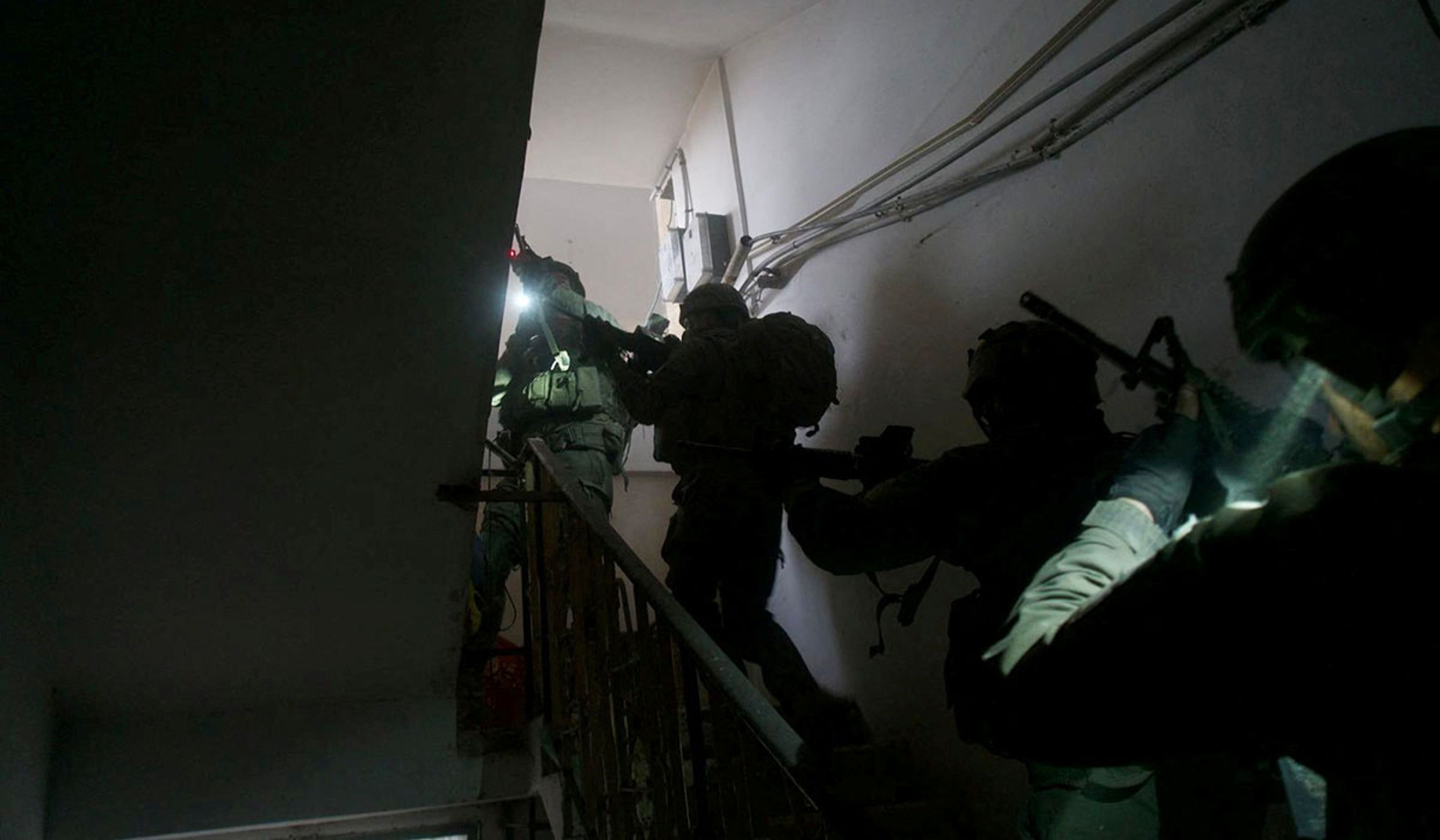









Israeli soldiers operate in the Gaza Strip amid the ongoing conflict between Israel and the Palestinian Islamist group Hamas, in a handout picture released February 4, 2024.
Israel Defense Forces/Handout via Reuters
• Anti-Israeli student protesters at Brown University ceased a weeklong hunger strike over the university’s refusal to divest its endowment of any investments in companies supplying military goods to Israel. Student protest is nothing new, particularly at Brown, an activist hotbed, but the university’s brush-off of the students’ complaints represents a praiseworthy stiffening of the spine of its president, Christina Paxson. In November, shouted down by students, she cravenly failed to read her prepared remarks defending the right of Jews on campus so much as to wear a Star of David. Perhaps the most absurd detail of the Brown hunger strike came from elsewhere: A handful of Harvard University students also forwent food, in solidarity with the Brown protesters . . . for twelve hours. One assumes that the smarter ones started the clock right after dinnertime.
• Dartmouth College dropped its SAT/ACT requirement for all applicants in June 2020, nominally as a response to the Covid-19 pandemic and the difficulty of administering standardized tests in lockdown conditions. The requirement remained suspended for several years, as part of a larger experiment throughout elite academia in relaxing standardized-testing requirements. Apparently Dartmouth was none too pleased with the resulting student body, because it is now reinstating testing requirements for all applicants starting next year. It would be pleasing to believe that Dartmouth backtracked on its experiment because recent matriculating classes turned out to be shockingly unprepared; more likely it is because they turned out to be shockingly rich and white. That outcome should have surprised no one: When standardized testing — which allows even the poorest and least privileged to demonstrate intellectual ability — is removed from the mix, applications become the province of elites with access to résumé-padding extracurriculars and insider knowledge of the admissions process. The optimistic gloss is that learning is still possible, even for university administrators.
• A Bay Area elementary school had a quarter million in federal dollars to put toward boosting its students’ woeful math and reading scores. Glassbrook Elementary spent that sum on a program called “Woke Kindergarten,” described on its website as “a global, abolitionist early childhood ecosystem & visionary creative portal.” The program, which teaches slogans such as “Eradicate borders,” refers to children as “lil’ comrades,” and presents the “woke word of the day” (example, “abolish”), didn’t help children do better on tests — in fact, after two years, their scores went down. The company founder had other priorities: “I believe Israel has no right to exist, I believe the United States has no right to exist. . . . We’ve been trying to end y’all.” She translated her personal views into a “Teach Palestine” unit, the webpage for which features a sign saying “From the river to the sea, Palestine will be free,” with the word “Palestine” scrawled across the entire map of Israel and a drawing of a child aloft on a paraglider (paragliders having been used by Hamas in the October 7 massacre). Glassbrook discontinued the program (though its commitment to “anti-racist teaching” remains “a focus,” the principal says), but two third-grade teachers in Brooklyn have taken it up, seeking to enlighten kids about “the dynamics of oppression and privilege.” Evidently education is something else that has no right to exist.
• There has been a slew of memoirs detailing the daily dramas of “open” and “non-monogamous” marriages and relationships, as well as excerpts and op-eds in the New York Times, the New Yorker, and the Wall Street Journal, and at NPR. New York magazine published a cover story last month titled “Polyamory: A Practical Guide for Curious Couples,” which featured an image of four cats awkwardly touching and staring soullessly ahead. Peacock, the streaming service, has a new reality series titled “Couple to Throuple,” which was reviewed positively by USA Today: “Expect to challenge your misconceptions.” Promiscuity is sinful, but rationalization is just sad.
• Parker Byrd is a sophomore at East Carolina University. He plays on the baseball team. In 2022, he was in a boating accident and lost part of his right leg. He has now taken an at-bat for his team. He is apparently the first Division I athlete ever to play in a game with a prosthetic leg. We bow in humility to the human spirit, and are at the same time encouraged by it.
• Alexei Navalny was one of the bravest men of our time. He stood up to one of the most evil men of our time: Vladimir Putin. Navalny was known as the “leader of the opposition” in Russia. Life expectancy is not very long in that job. The previous leader, Boris Nemtsov, was gunned down within sight of the Kremlin in 2015. In 2020, FSB agents nearly killed Navalny with poison. He recovered with medical treatment in Germany. And then he went back: back to Russia, knowing that he would be arrested and imprisoned, which he was. He thought his place was in Russia, regardless. Late last December, he was transferred to a notorious prison called “Polar Wolf,” in the Arctic Circle. He has now died — effectively murdered — at 47. He leaves a wife, Yulia, and their children, Dasha and Zakhar. In 2021, Navalny was able to send a handwritten note to a journalist friend, saying, “Everything will be all right. And even if it isn’t, we’ll have the consolation of having lived honest lives.” R.I.P.
The Stat
Forty-nine percent — the proportion of U.S. union members in 2023 who work for government, according to the Bureau of Labor Statistics.
The image of union members as predominantly blue-collar workers in the trades or heavy industries lives on in the public imagination but does not reflect reality. Only 6 percent of private-sector workers in the U.S. are union members, but 32.5 percent of public-sector workers are. That comes out to 7.41 million private-sector union members and 7.01 million public-sector union members. Even within specific private-sector industries that are commonly thought of as bastions of “union jobs,” the vast majority of workers aren’t unionized. Manufacturing employed 14.9 million Americans in 2023; only 1.2 million, or 7.9 percent, were union members. Construction employed 8.9 million; only 954,000, or 10.7 percent, were union members. The most heavily unionized industry in the private sector is transportation and utilities; even there the union-membership rate is only 16.5 percent. In total, 90 percent of U.S. workers are not union members, something to keep in mind next time you hear someone conflate “pro-labor” and “pro-union.”
by Dominic Pino
Protect Our Allies, and Ourselves
The House of Representatives is stuck. The defense-supplemental bill that passed the Senate with 70 votes also has majority support in the House, but Speaker Mike Johnson doesn’t dare bring it up for fear of losing his job.
So the $95 billion bill, with important funding for Ukraine, Israel, and Taiwan, as well as the U.S. defense–industrial base, is languishing in a box canyon. The aid is especially urgent for Ukraine, which cannot force Russia to make a settlement on terms favorable to the West — and may not even be able to survive — without it.
One way to get it on the floor is a so-called discharge petition. This is a rarely successful maneuver to free a bottled-up bill on the floor by having 218 members sign on to “discharge” it. This works about once a decade. It usually requires a unified minority party and a handful of highly motivated members of the majority willing to buck their leadership.
The problem here is that the most progressive members of the Democratic caucus — opposed to unconditional Israel funding — might not be willing to sign on, which would push the number of Republicans needed to join implausibly high.
If the Senate bill were to make it on the floor and pass, meanwhile, it would mean Republicans would get nothing on the border. While President Biden needs no new statutory authority to enforce the immigration laws much more vigorously than he has done, lasting progress on the border requires some congressional action.
If Johnson has a plan to deal with the situation, he hasn’t shared it with anyone. Simply bringing the bill up for a vote would cause a revolt among the GOP’s fiercest opponents of Ukraine aid. They would vote against the rule, the procedural measure setting the conditions for debate on the bill. It used to be that such rules automatically passed, but Republican backbenchers now fairly routinely tank them. So it’s not an option to have Republican members vote for the rule and then vote against the underlying bill (while Democrats provide the margin for passage).
And, of course, a few discontented members, as we’ve already seen this Congress, can depose a speaker. Johnson doesn’t want to find his own head on a platter.
There may be no way out. But Republican members who want to see something along the lines of the package pass should continue to see if they can find a formula that works. A bipartisan group of centrists has proposed adding border measures to the Senate-passed defense supplemental. Their proposal isn’t going anywhere, but the basic idea is the right one. It may be that combining stronger, stripped-down versions of the border provisions from the failed Senate deal, taking out the $19 billion nondefense spending in the bill, and structuring the Ukraine aid as a loan, as suggested by Donald Trump, makes the package attractive to more Republicans. It might still require a discharge petition to get it on the floor, though, and such a proposal would lose many more Democrats.
The Republican House majority hasn’t done itself any favors over the last few months, as it has presented an image of chaos and dysfunction to the public. While we understand the obstacles, corralling a thin and unruly majority is what Johnson signed up for, and it is his responsibility as leader to forge a path forward. Not finding a way even to vote on this legislation — as Russia gains the upper hand in Ukraine and as Israel continues to wage a war of self-defense against its terrorist enemies — would add to the dismal picture.











Comments