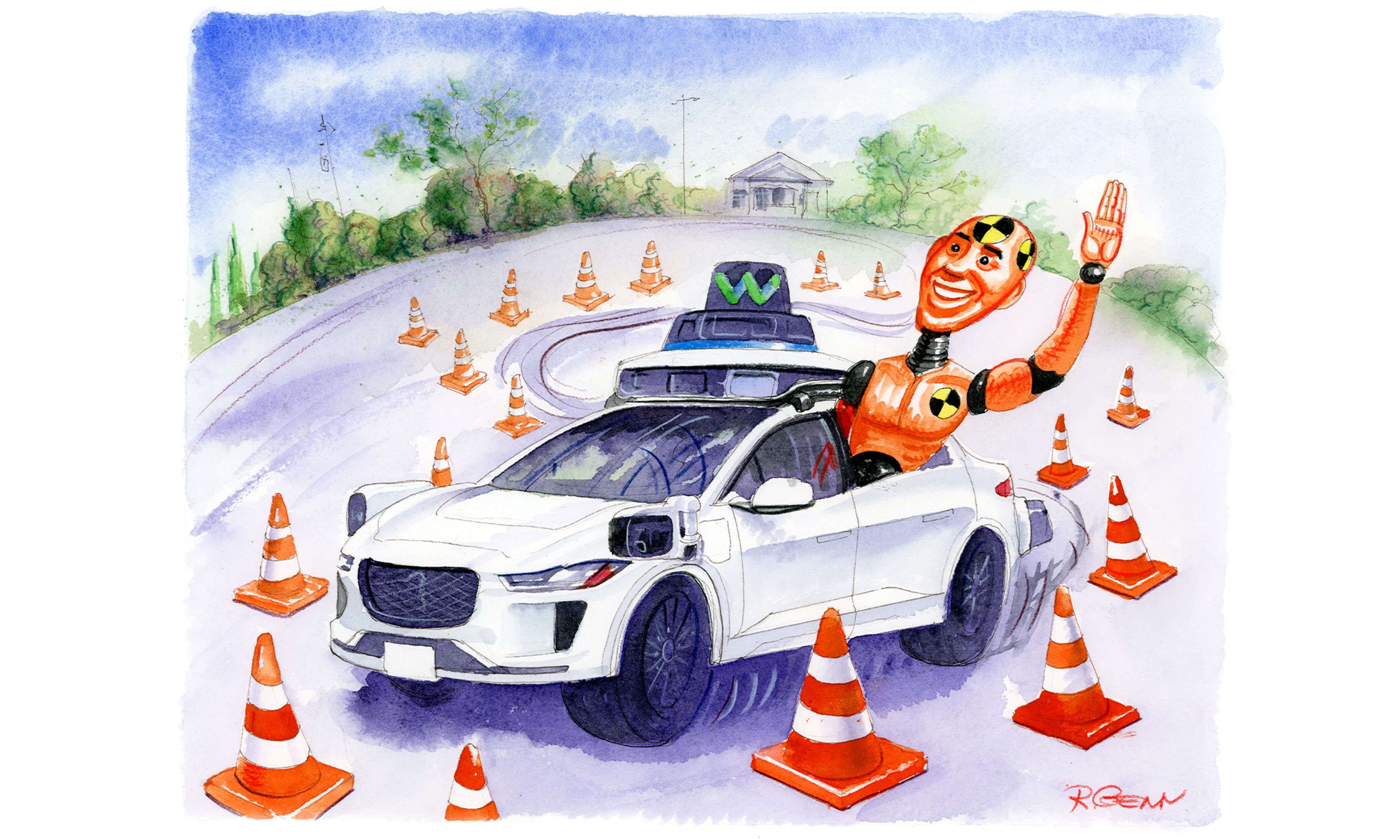
The future tends to sneak up on you, especially when it has a whisper-quiet electric motor. The thing looks like a typical white SUV, save for the multiple cameras protruding from every corner and the giant, spinning dome of a sensor that’s seated on the roof. It flashes your initials in white letters, just in case you mistake your ride for the neighbor’s Subaru.
This alien craft pulls up at an angle that seems awkward, until you reach the door and realize it would have collided with the curb otherwise. The door automatically unlocks. Take the front seat or back seat — the driver doesn’t care. Because there is no driver.
Still friendly, though. A synthetic voice chimes, “Good afternoon, John.” It makes sure you buckle up, and then — get this — the steering wheel turns on its own, and the vehicle starts moving. In this case, the destination is the Silicon Valley headquarters of Waymo, an autonomous-driving technology firm owned by Google’s parent company, Alphabet. It is one of Waymo’s self-driving vehicles that is now carrying your life in its nonexistent hands, down a busy commercial street.
The Bay Area is one of three American metros, along with Phoenix and parts of Los Angeles, where Waymo’s unmistakable self-driving cars have become a common sight. Soon, like many birds and taxpayers, they will migrate south, as Miami, Dallas, Houston, San Antonio, and Orlando are next on Waymo’s expansion list. No slowing down from there. The company plans to be in more than a dozen American cities by the end of 2026, including the nation’s capital. It’s running tests in New York City and wants to offer its driverless rides internationally, starting in London and Tokyo.
Note that word, “driverless.” Not just self-driving. According to federal regulators, vehicles can be at a certain level of autonomy while still requiring an attentive human at the wheel, ready to take over at the first sign of trouble. Waymo doesn’t need that hassle. Unless there is an emergency or the car gets truly stuck, the rider doesn’t need to do much of anything. Play on your phone if you like — the Waymo app lets you adjust the vehicle’s climate control and legroom. Use the touch screen to select music. Or simply watch the screen to see what the vehicle sees. Waymo’s technology renders a 360-degree real-time image of your environment: cars, trucks, bikes, pedestrians, and dogs. It knows whether every traffic light around an intersection is green or red, recognizes when a police car is driving by with its siren on, and identifies any roadwork ahead before you do.
Most incredible is how normal it all feels. Anxiety is the enemy in this business, so Waymo’s objective is to give passengers the sense that it’s like any other ride. In fact, sitting in a Waymo feels safer than taking a taxi or ride-sharing service with an unknown driver. That is by the company’s meticulous design. There are no sudden starts or stops, no angry-honking, and never any risky maneuvers to circumvent traffic. Waymo will never go a single mile per hour over the speed limit. The vehicle drives as though a high school driver’s ed instructor were in the passenger’s seat, jotting down its every move.
If anything, the problem with Waymo is that it’s too cautious in uncertain situations. When San Francisco experienced a blackout in December 2025, human drivers knew to treat disabled traffic lights as they would stop signs. Waymo’s autonomous vehicles took no such initiative, instead freezing in the middle of the street. Stopping is the technology’s deliberate fail-safe, but it becomes a hazard in a crowded city. The company took the failure as a lesson, updating its fleet to better cope with future blackouts.
In other incidents covered breathlessly by the media, Waymo has been held to extreme safety standards that are not applied to any human. The internet erupted in outrage when KitKat, a locally beloved cat in San Francisco’s Mission District, scampered in front of a Waymo and was killed as the car was pulling away. To put this accident in context, 5.4 million cats are struck by cars annually in the United States, and up to 97 percent die. That didn’t stop local officials from jumping on the opportunity to propose legislation to restrict Waymo. One progressive member of the city’s board of supervisors let her mask drop when she warned the company, “We are absolutely coming for your bottom dollar.”
State-level policymakers have typically been more accommodating, in large part thanks to Waymo’s extensive lobbying efforts. Half of all states have explicitly legalized autonomous vehicles so far, creating dozens of different permitting regimes. The company’s biggest challenge now is getting the other half to enact permissive regulatory frameworks. Governor Kathy Hochul has been a key ally in New York, bucking organized labor to push for legislation that would legalize robotaxis nearly statewide. The goal for driverless cars’ rapid deployment, however, would be a uniform federal standard to override state laws with relatively light-touch rules. Representative Bob Latta (R., Ohio), a friend of the autonomous-vehicle industry, has introduced such a bill. His SELF DRIVE Act was recently advanced in the House Energy and Commerce Committee by a single vote — all Republican members in favor, all Democrats against.
Besides a lack of stable regulation, Waymo’s greatest barrier to expansion remains a general trepidation regarding the safety of its fleet. Based on YouGov polling from late 2024, nearly half of Americans now expect driverless cars to become ubiquitous on U.S. roads, and a growing share believes that such cars will reduce the carnage caused by traffic accidents. Yet 70 percent of Americans remain very or somewhat worried about the use of autonomous vehicles. A narrow majority says that they would not want to ride in a driverless car if given the chance.
Waymo believes the best way to turn those numbers around is through ambient exposure. When concerned residents pass a driverless car every day on their morning commute, or when a tech-enthusiast friend finally convinces them to try a ride, they usually grow less frightened. That is why support for allowing autonomous vehicles in San Francisco grew by 45 percentage points in just two years of Waymo’s operating there, from a net negative rating in 2023 to a net positive of 38 percent in 2025.
To change people’s minds, however, Waymo first must be allowed in their neighborhoods. The jittery politics of self-driving cars makes that a challenge. YouGov found that 54 percent of people oppose allowing robotaxis in their city or town, compared with 32 percent in support. Most Americans say they would feel unsafe not only as riders in an autonomous vehicle but also as other drivers or pedestrians in a city with driverless cars. Local politicians rely on such fears to justify blocking Waymo’s expansion.
The company has found that the best way to assuage safety concerns is to publicize the cold, hard statistics of its accident history. Across 127 million miles of rides with no human driver present, Waymo has achieved a rate of injury-causing accidents that is 81 percent lower than the general population’s on surface streets, and 90 percent fewer crashes that result in serious injury or worse. Of the few serious accidents Waymo vehicles have been involved in, nearly all were caused by the other driver’s human error. It makes sense — the Waymo never drives drunk, never gets distracted by a text, never becomes drowsy. The safety record of autonomous cars is so impeccable, in fact, that applying it nationwide could eliminate the bulk of annual traffic deaths.
Among the political class who understand the safety potential of self-driving cars, the true reason for opposition to Waymo is not that its technology isn’t good enough. Rather, the worry is that the latest autonomous vehicles might be too good and are therefore fated to displace entire industries of human drivers. Hundreds of thousands of Americans work as drivers for taxi or rideshare services, directly competing with Waymo. Millions more are employed as drivers of trucks, buses, shuttles, limousines, and delivery vans. Once refined, the self-driving technology that Waymo has pioneered could theoretically replace them without demanding wages or benefits.
Blocking Waymo on populist economic grounds is increasingly a bipartisan affair. The most adamant Luddite in Congress is Senator Josh Hawley (R., Mo.), who has proposed a national ban on self-driving technology because its widespread adoption would be “terrible for working people.” In California, the Teamsters union has joined with Democratic lawmakers to advance legislation requiring trained human operators to be stationed in the driver’s seat of autonomous vehicles, defeating their very purpose.
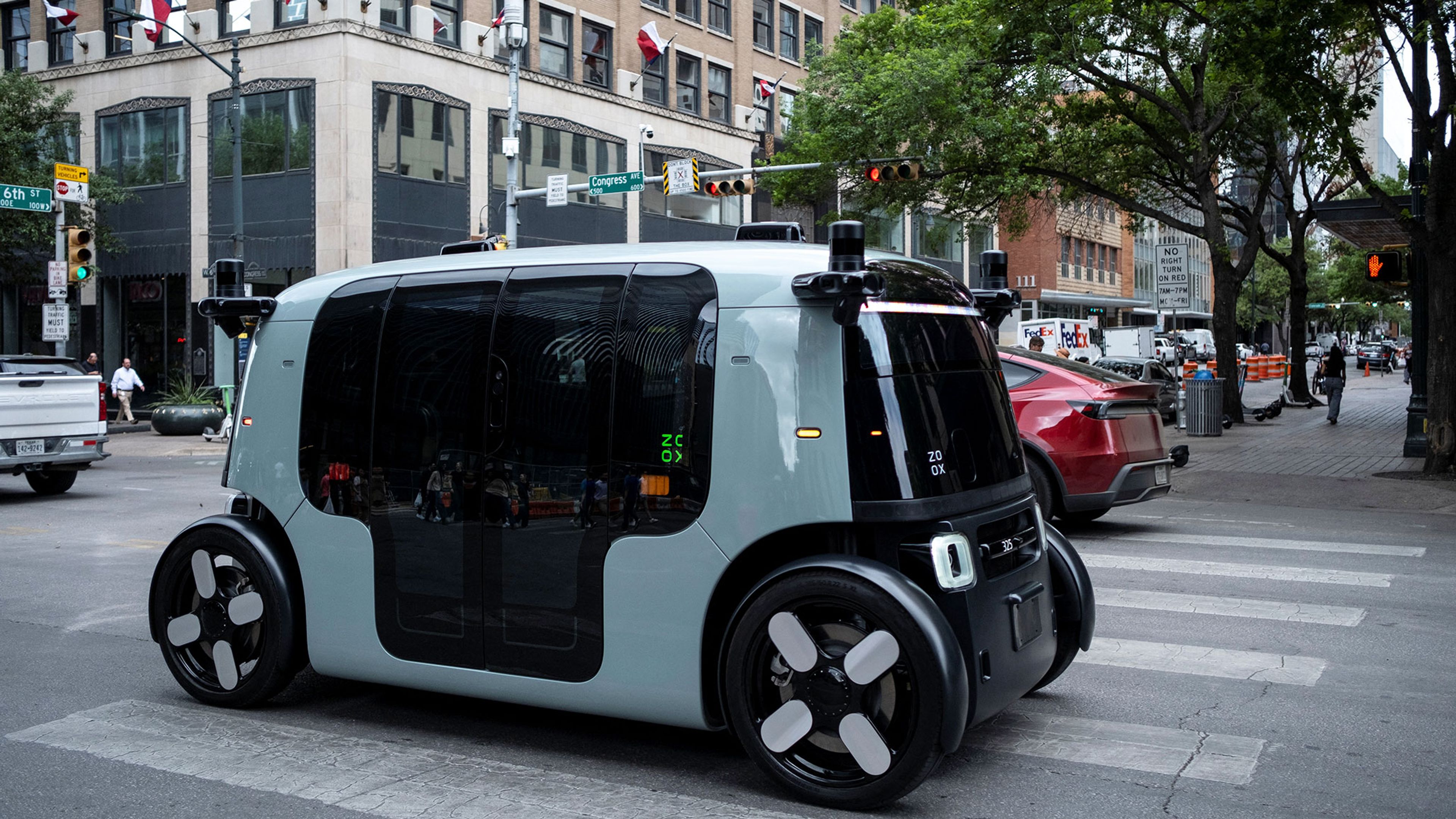
Fortunately, none of this resistance will succeed — not in the long run, anyway. Driverless technology has simply gotten too good, and its safety and cost-saving potential is too great, for politics to meaningfully slow it down. As Waymo charges through the thicket of public opinion, automakers such as Tesla and General Motors are cautiously moving in behind it to install full self-driving features in personally owned vehicles. Waymo is expanding to freeways for the first time, while Amazon tests a rival robotaxi service on the Las Vegas Strip. Uber has begun offering autonomous rides through Waymo in certain cities, a business tactic akin to having horses pull the Ford Model T around.
Like it or not, the Waymo revolution is already in motion. It will stop for no obstacle — except, one can hope, for stray cats.











Comments