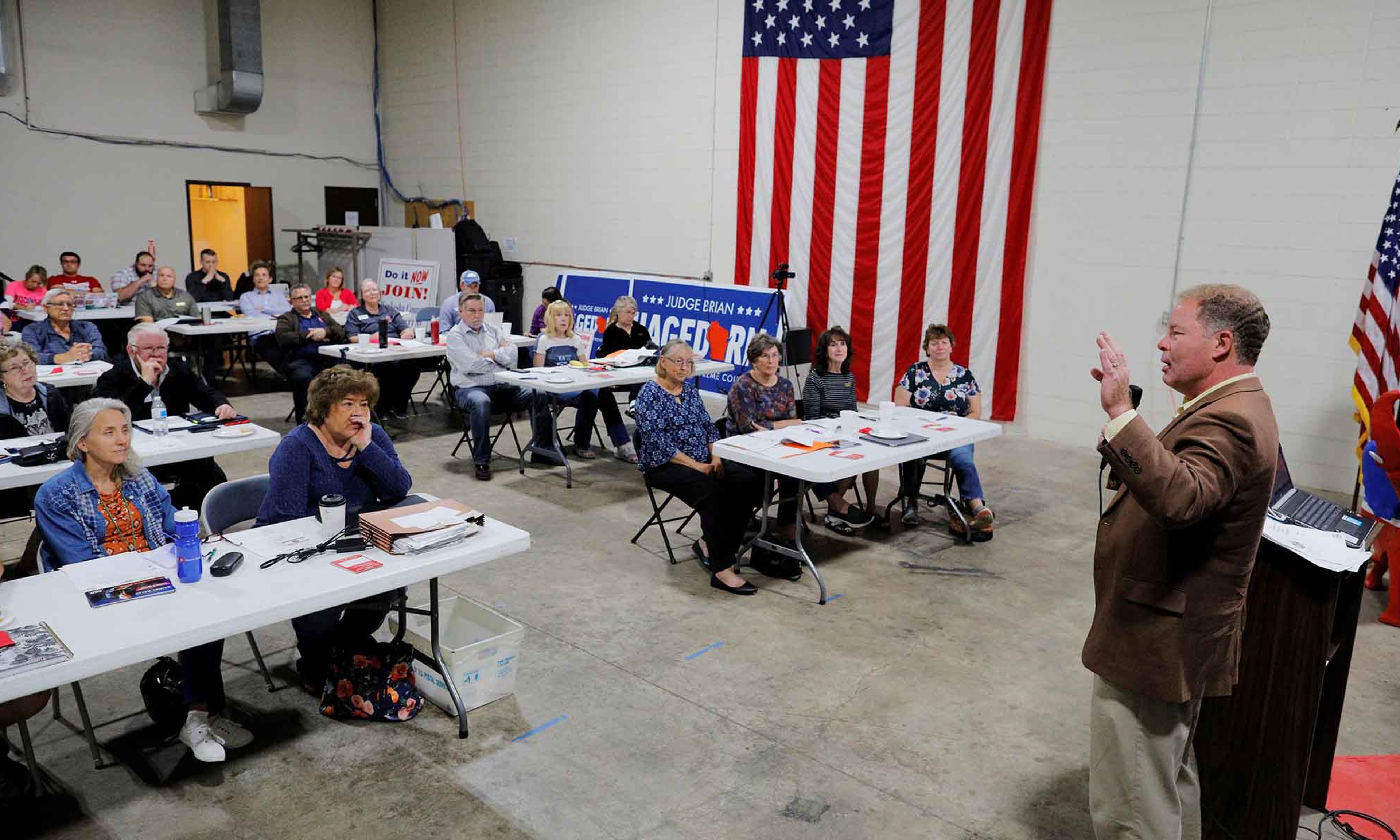
Elections for Wisconsin’s supreme court used to be sleepy, low-turnout affairs, but this year’s contest, to be decided on April 4, is shaping up to be the most expensive, the most consequential, and perhaps the most vicious state-supreme-court election in U.S. history.
By the end of February, with five weeks to go, a whopping $18 million had already been spent on the race, a sum that exceeded the previous record for a supreme-court race ($15 million in Illinois in 2004), according to the Milwaukee Journal Sentinel. It may sound strange to talk about candidates scrapping for votes for the office of supreme court — justice is supposed to be blind, after all — but the practice is fairly common: Thirty-eight states have some type of supreme-court election. What makes this election unusual is that it’s the first time in many years progressive activists could win a majority on the court in this swing state, and flipping the court could have far-reaching consequences on a wide array of issues.
When Scott Walker served as governor, from 2011 to 2019, he ushered in a number of significant conservative reforms regarding school choice, taxes, and (most notably) public-sector unions. Walker’s budget and public-sector-union reform — known as Act 10 — was the subject of two hotly contested elections, a recall gubernatorial election in 2012 and Walker’s reelection in 2014. He won both races decisively, and although he lost his 2018 reelection campaign by one point in the “blue wave,” his reforms have endured because Republicans held on to the legislature.
“The most important thing we did with Act 10 was take the power out of the hands of a handful of union bosses and put it into the hands of the taxpayers and the people they duly elect,” Walker told National Review in a recent interview. “Those things have saved millions and millions of dollars that schools were then able to reinvest into the classroom — in some cases rewarding exceptional teachers.” Many schools were able to expand curricula, implement merit pay, and avoid teacher layoffs, while taxpayers benefited, too. “We’ve seen something like $15 billion in tax relief since 2011,” Walker said. Now, all that he accomplished and much more could be undone by an activist court. “In a word, it’s everything,” Walker said when asked to describe the stakes of the election.
Milwaukee judge Janet Protasiewicz, the supreme-court candidate backed by Democrats in the race, is a self-described progressive who isn’t hiding her intentions. It’s been obvious for years, in statements and in the support of political parties and activist organizations, whether a candidate was more Scalia or more Ginsburg, but Protasiewicz has taken things to a whole new level. “Judge Protasiewicz has pioneered what may be a new style of judicial campaigning,” the New York Times reported in February. She has called the drawing of the state’s legislative districts “rigged” and predicted that the supreme court would take up a case challenging them if she were elected. In TV ads, she says she believes in a right to abortion. And she has called Walker’s reforms paring back the power of public-sector unions unconstitutional.
Her conservative opponent, Dan Kelly, was appointed by Walker to fill a supreme-court vacancy in 2016 but lost the election for a ten-year term in 2020. A former president of Milwaukee’s chapter of the Federalist Society, Kelly warns on the campaign trail that his opponent will replace “the rule of law” with “the rule of Janet.” There hasn’t been any public polling in the 2023 race, but most political observers think that Protasiewicz has the edge, and both candidates are acting as if she does. While Kelly pushed for many debates — he accepted invitations to eleven of them — Protasiewicz agreed to just one, on March 21, a week after the sending out of mail ballots. In the four-way February primary, Protasiewicz and the other progressive in the race garnered a combined 54 percent of the vote, while Kelly and the other judicial conservative in the race combined for 46 percent. Primary results haven’t been great predictors of the runoffs in recent years. Runoff results were skewed in Republicans’ favor in 2016 because a competitive GOP presidential primary brought Republican voters to the polls; Democrats got a similar boost in 2020 (when Kelly lost), a year with a competitive Democratic presidential primary. This year, neither side will have such an advantage on Election Day.
Democrats have been more energized than Republicans in special elections since Roe v. Wade was overturned last June, and Wisconsin’s pre-Roe abortion law, now the subject of litigation, is unpopular because it generally bans abortion and offers an exception only when the mother’s life is in danger. That law, which was in effect from about the time the state was founded until the Roe ruling in 1973, was never repealed by its legislature. Protasiewicz has made it clear she would likely invent a broad state-constitutional right to abortion — a right that the framers of the state constitution didn’t think existed. The legislature banned abortion after “quickening” in 1849, a year after Wisconsin became a state, and generally banned abortion in 1858.
In addition to campaigning on the issue of abortion, Protasiewicz and Democrats are tying Kelly to Donald Trump’s efforts to overturn the results of the 2020 election. After leaving his post at the supreme court, Kelly was hired by the Republican Party of Wisconsin in August 2020 to provide legal advice. The state-party chairman, Andrew Hitt, signed up to serve as an “alternate elector” for Donald Trump despite Joe Biden’s victory in the state. Hitt testified to the January 6 committee in Washington that in December of 2020 he “specifically called [Dan Kelly] and asked whether or not he was in the loop on this alternate-electors meeting. He said he wasn’t.” Hitt said he and Kelly “talked for about a half hour, kind of thinking through . . . the issues and . . . what other questions do I need to ask.” Citing attorney–client privilege, Kelly has declined to say what legal advice he provided to Hitt, but his spokesman told the Journal Sentinel: “Justice Kelly believes Joe Biden is the duly elected president of the United States.”
If Democrats are genuinely convinced that Kelly represents a danger to democracy, they’ve had a strange way of showing it. During the primary, a Democratic group spent $2.2 million to sink Kelly’s conservative opponent Jennifer Dorow (who gained fame as the judge presiding over the murder trial of the man who committed a massacre with his vehicle at a Waukesha Christmas parade in 2021). Dorow was viewed by many as more electable.
Despite the apparent advantage of Protasiewicz, it would be wrong to write off Kelly. Democrats ran heavily on the issue of abortion in 2022, but Wisconsin voters rendered a split decision, reelecting both GOP senator Ron Johnson (by one point) and Democratic governor Tony Evers (by three points), while giving GOP House candidates a statewide two-point edge over their Democratic opponents. Wisconsin is a closely divided state where four of the past six presidential elections were decided by less than one percentage point. Conservatives have been underdogs in two supreme-court races in recent memory in which they prevailed by less than a point. In 2011, conservatives were expected to lose amid backlash to Act 10. In 2019, conservative Brian Hagedorn was outspent by a ratio of 14 to one until the last week of the race. He was left for dead by pro-business groups after being attacked as an anti-LGBT bigot for founding a private school that upholds traditional Christian beliefs about marriage and sex. While an internal poll late in the race showed Hagedorn down eight points, Wisconsin voters defied expectations and put Hagedorn over the top on Election Day. The polls badly underestimated support for Donald Trump in Wisconsin in 2016, when he narrowly won, and again in 2020, when he narrowly lost.
Protasiewicz has her own vulnerabilities, most clearly on the issue of crime. The Journal Sentinel reported in February that on three occasions prosecutors asked Judge Protasiewicz to sentence a felon to prison for severely harming a child, but she sentenced the felon instead to time served plus probation. Two of the cases, the Journal Sentinel reported, “involved adults convicted of sexually assaulting a minor, and a third was a mother who pleaded guilty to chronic neglect of her 16-year-old son after he died while weighing just 42 pounds.” One man Protasiewicz declined to send to jail in 2018 was charged again in 2021 with “repeated sexual assault of the same child and sexual contact with a child under 13. But the charges were dismissed because of problems with the criminal complaint.” The other man whom Protasiewicz declined to sentence was arrested in 2021 for handgun possession. When a reporter asked Protasiewicz in January whether she regretted her decision not to sentence that man to prison time, she said, “No, because you don’t have a crystal ball. I knew the facts that I knew at the time.” A group backing Kelly has hammered Protasiewicz in TV ads for putting a child rapist “back on our streets.”
The Protasiewicz camp has sought to muddy the waters by lambasting Kelly for working as a defense lawyer for child molesters. The narrator of a Protasiewicz TV ad says: “Dan Kelly won’t keep our communities safe. As a lawyer, Kelly defended child sex predators who posed as ministers in order to prey on vulnerable young girls. They lured young children to locations they believed to be safe only to sexually assault and molest them. And Dan Kelly defended those monsters. Do you want someone like that on the supreme court? Dan Kelly: an extremist who doesn’t care about us.”
Kelly’s campaign says he was assigned the case in question (for a single hearing) by the firm he worked for in his first job out of law school. And regardless, in America the accused are entitled to a defense. It is remarkable for Protasiewicz to undermine that principle. Were the stakes not so high, most of Protasiewicz’s civil-liberties-minded supporters would probably concede that criticizing a judge’s sentencing decisions is fair game in a way that imputing to a defense lawyer the wickedness of his client is not.
The stakes, of course, could not be higher. Expect more viciousness before April 4.












Comments