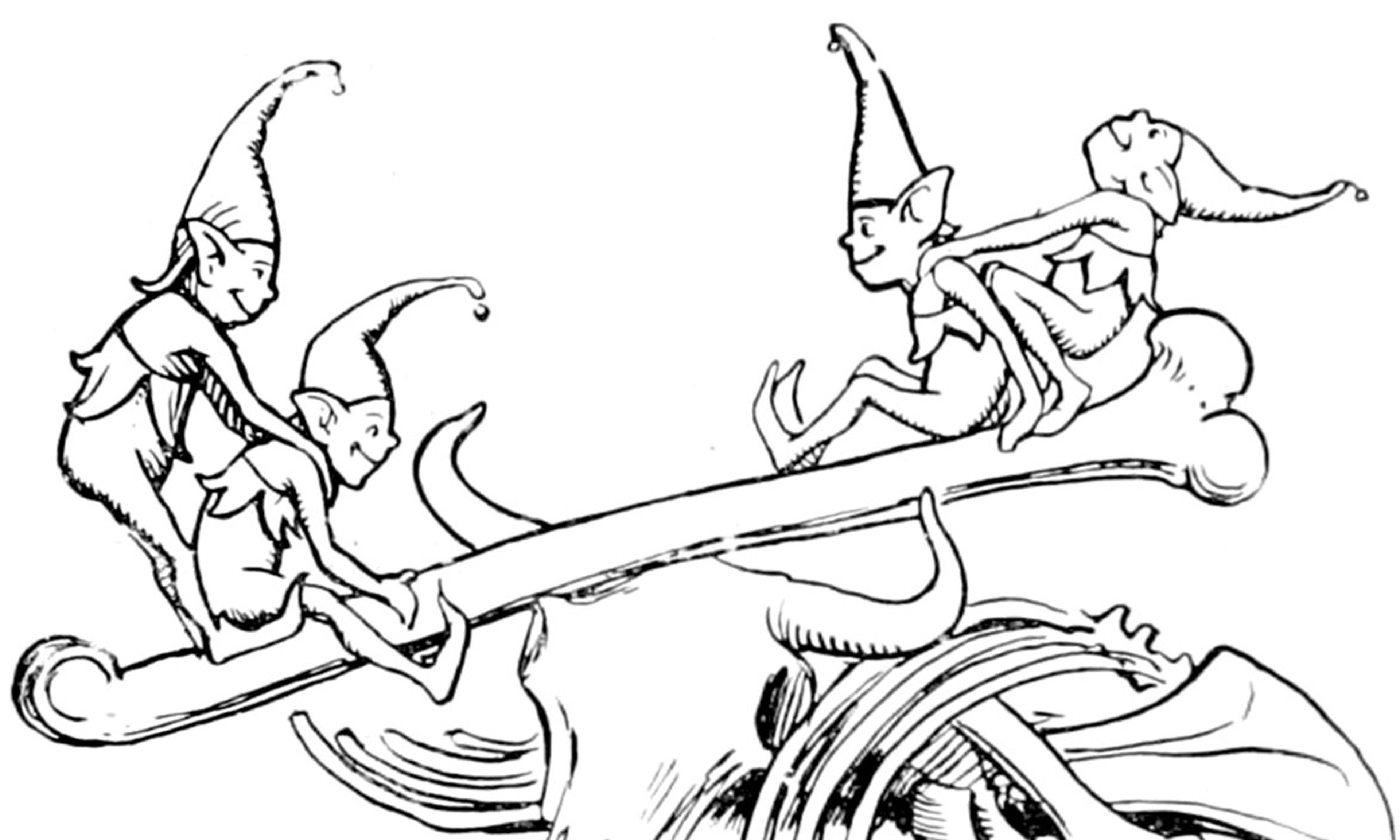
Tormented people are said to be “pursued by the Furies.” I am eminently qualified for membership in what, in today’s parlance, probably would be called the tormented community, but the Furies just aren’t that into me. Instead, for as long as I can remember, I have been pursued by the Pixies.
The classic Pixie is the cheery thug who gambols up to a perfect stranger sitting quietly in a public place, minding her own business, and brays, “Whatcha so sad about? It can’t be that bad — smile!” The Pixie’s glass is so half-full that it runneth all over you, as happened with a boy I dated in college, who put his arm around me, gave me a reassuring pat, and said, “You’d be a great gal if only you’d develop a sense of humor.” He gave me a how-to book called something like “Three Weeks to a Funnier You!” with worksheets in the back. He saw nothing funny about the worksheets, but he roared at the author’s stories, e.g.: “When my son said he was reading David Copperfield in English class, I said ‘What the dickens!’ and we all had a good laugh.” When I remarked that the son probably went around in a perpetual cringe, saying, “Jeez, Dad, cut it out, will ya?” he said I didn’t get it because I was too bitter.
Pixies never get anything, which is why they never stop trying to simplify the complex and complicate the simple. Now that the subject of health insurance rivals the quantum theory, they are raising their half-full glasses to Pixiecare.
The monthly bulletin put out by my local hospital just came in the mail. These publications regularly show people wreathed in smiles in unlikely situations — in the shade of their IV trees or while being sucked into the giant maw of a CT scan — but the latest issue has a lead article on women and heart attacks illustrated by a big Valentine-candy-box heart superimposed over a female chest. Hey, it was February.
Pixiecare’s thought for the day is headlined “Something to Laugh About” and illustrated with a politically correct assortment of people all convulsed in mirth. The text reads:
“The next time you find yourself sweating the small stuff, laugh it off. Laughter increases the release of endorphins, compounds in your brain that give you a sense of well-being. Research also shows that laughter and joy can boost immune functions, and produce natural cells that help defend the body from illness. So read your favorite comics, watch your favorite silly movie, and laugh to good health!”
Arm-twisting optimism became the mainstay of Pixiedom back when Reader’s Digest started running its “Laughter, the Best Medicine” feature, but it was the jogging craze that got them started on endorphins. “Gotta get those endorphins goin’,” the panting joggers explained, until the word captured the Pixie imagination and spread through the land, compliments of the media anchors who make up Pixiedom’s priestly class.
The actual definition and value of endorphins was scientifically as well as hilariously explained by Dr. Ronald W. Dworkin in Artificial Happiness: The Dark Side of the New Happy Class, but that wasn’t the end of it. Now we have Barbara Ehrenreich’s latest, Bright-Sided: How the Relentless Promotion of Positive Thinking Has Undermined America. Ehrenreich witnessed an attack of the giant endorphins at a breast-cancer clinic whose patients refused to say they “had” cancer; no, they were “battling” it, and they expected to defeat it because they were convinced that a positive attitude could make a cancer give up and go away. She soon discovered that “dissent [is] a kind of treason” when she posted hers online and was told she needed counseling.
Another venue of Pixiedom are the high-tech troubleshooting manuals in the “Idiot’s Guide to . . .” and “. . . for Dummies” series whose authors try so hard to be funny that they skimp on thoroughness. They will say something like “If you need more space on your hard disk, get your hand out of that jar and delete your cookies!” How? They don’t say because they are too intent on making the desperate feel insouciant.
Even worse is AOL’s Live Help. In theory you sign on and type out your questions and a rep types out his answers, but in reality it turns into an Alphonse-Gaston gavotte. The rep types, “I will do everything I can to help you,” which leads the customer to type, “I’m sure you will.” It being impossible to describe in logical fashion the freezes and crazy dialogue boxes you keep getting, the rep types, “I hope I’m helping you resolve your problem,” and you, still hopeful, type, “Yes, you are.” You try to say what’s wrong without saying, “It’s doing something funny!” but you can’t. Finally, your time is up and the rep types, “Have I helped you resolve your problem?” and the wrung-out customer, who just wants to end it and get drunk, e-babbles, “Yes, you’ve been so helpful.” Congratulations, you have turned into a motivational speaker. The next day they send you an e-survey that goes on forever, every question phrased in such a way as to ask: “How do you rate the way your problem was resolved?” Afraid to ignore the first survey for fear they will send another, you go through and check every “Excellent” just to get rid of them.
Observe that by now you too are a Pixie. It’s contagious, and Barbara Ehrenreich explains why: “We have become the emotional wallpaper in other people’s lives, less individuals with our own quirks and needs than dependable sources of smiles and optimism . . . [urged to] see the glass half full, even when it lies shattered on the floor.”
I may weaken now and then, but I refuse to become a great gal. I stand or fall on the paradox of the clown identified by Carol Burnett in her memoir, One More Time. Taken to the circus as a child, she was repelled and terrified by the clowns because their obvious striving for humor — bulbous red noses, silly wigs, flappy shoes — translated as menace.












Comments