• “Rum, tickling, and the lash” just doesn’t have the same ring.
• Chief Justice John Roberts, belatedly responding to the president’s State of the Union address, said it was “troubling” for the justices to be surrounded by hooting and hollering critics of their campaign-finance decision without being able to respond. White House press secretary Robert Gibbs said it was the Court’s decision that was troubling. (Translation: Democrats think they have found a winning issue.) Roberts was right. Next year, the justices should stay home.
• Last month, we commented on Wisconsin Republican congressman Paul Ryan’s ambitious free-market “roadmap” for the future of American tax, health-care, and entitlement policy. We find much to admire but have reservations: Ryan’s tax plan undervalues investment in children, and we generally prefer incremental to comprehensive plans. Needless to say, the liberal reaction to Representative Ryan has been less mixed. The prevailing line is that Ryan’s plan would savage the poor while still failing to balance the budget. The studies purporting to analyze the roadmap have not been notably competent: One widely quoted paper, from the Center for Budget and Policy Priorities, used an old version of the roadmap rather than the one Ryan proposed to reach its negative conclusions. The liberal critics also ignore that Ryan would make Social Security and the big tax break for health care more rather than less progressive. It would not be accurate to say that the liberals have scored no points in this debate. Have they shown that their plans to bring the government’s books into long-term balance are superior to Ryan’s? To do that, they would first have to have such plans.
• A dinner was held in Kentucky to honor retiring Republican senator Jim Bunning, at which he received praise, deservedly, for holding up a $10 billion extension in benefits to the unemployed. The media storm over Bunning’s hold was full of righteous fury at his supposed heartlessness, but these knee-jerk condemnations ignored the fact that Bunning supported the extension, insisting only that Congress offset the spending. Why not take $10 billion in unspent stimulus funds and redirect it? he suggested. Bunning released his hold after Senate majority leader Harry Reid agreed to allow a vote on a funding amendment, which was narrowly defeated along partisan lines. After all, to the Democrats, it’s just another $10 billion, a rounding error on this year’s deficit of $1.4 trillion. “Many people asked me, ‘Why now?’” Bunning wrote in an op-ed defending his hold. “My answer is, ‘Why not now?’ . . . If the Senate cannot find $10 billion to pay for a measure we all support, we will never pay for anything.” A toast to a rare outbreak of good sense in the Senate.
• When the House Ethics Committee started investigating charges that Rep. Eric Massa (D., N.Y.) had harassed male staffers, he claimed it was payback for his opposition to Obamacare (he supported a single-payer plan). He soon became a former Rep. but continues to deny the allegations: He had tickle fights with his male staff, he said, because “I never translated from my days in the Navy to being a congressman.” The Navy, well-known hotbed of tickle fights. “I have not yet begun to tickle.” “We have tickled the enemy, and they are ours.” “You may tickle when ready, Gridley.” Your sail is done; dismissed.
• The Senate can pass only one reconciliation bill per year, which is why the Democrats — who seem to intuit that they won’t be so numerous next year — want to combine the health-care reconciliation bill with legislation that would make the government the direct provider of most student loans. The combination is poetic: American college-loan policy offers an illustration of how the government can absorb an activity incrementally, claiming to cherish the benefits the private sector provides until the bait has worked and it’s time for the switch. Government support for student loans began in the form of subsidies for private loans, much as the Democrats’ health-care bill would succor the insurance industry by subsidizing its product while forcing people to buy it. In the 1990s, Democrats added a “public option” — making government the direct provider of some student loans — with the Clinton administration claiming that “students and schools are served by healthy competition” between the private sector and the government. This is the same rhetoric Obama used when he tried to sell us a public option for health care. And now we see how quickly Democrats dispense with the rhetoric of competition when a government takeover seems viable: The new student-loan bill would make the public option the only option, thus completing the absorption of the activity. In a similar way, the current health-care legislation isn’t the endgame.
• The Securities and Exchange Commission has once again shown itself the prisoner of Big Business, adopting rules restricting “short” sales. Under the new rules, short sales would be banned when a firm’s shares have dropped more than 10 percent in a single trading day. In other words, the regulators are insisting on an upside bias in the marketplace (cf. bubbles, inflation of). Short-sellers are the misunderstood watchdogs of Wall Street who bet that the price of a stock is going to go down. Successful shorts are the ones who root out incompetence, laziness, and complacency. And they are subsequently hated by the incompetent, the lazy, and the complacent, who are to be found in corporate boardrooms just as they are found in Washington bureaucracies.
Liberty Abhors a Cultural Vacuum
Ask a Frenchman how to “act French” and he will know exactly what to do (and, no, this isn’t a setup for the punch line “surrender to the Germans”). The French have all sorts of phrases that prove my point: “Plus Français que les Français,” which means “More French than the French.” These days it’s used to describe non-French folks who are trying too hard to be authentic. There’s also “Plus royaliste que le roi” — “More royalist than the king,” which nicely evokes people who are more committed to a cause than the symbol of the cause, and also literally describes several of my reactionary friends. The French also talk of “la France profonde,” which refers to deep and profound Frenchness, particularly as found in rural areas.
Something similar is true of nearly every advanced nation in the world. Britain, Japan, and Russia: Each has a core conception of its national essence. One obvious exception is Germany, for reasons either too complex or too obvious to get into here. But the old joke gets at it well enough: How do you tell if someone’s a German? If he says he’s a “European.”
Another seeming exception is America. Ask someone how to “act American” and he’ll most likely be perplexed. There is no one way to act American, he might say; in America the individual is king. Or, if he’s of a certain leftist bent, he will likely make fun of cowboys, cheeseburgers, John Wayne, or cowboy John Wayne eating a cheeseburger. One can imagine how obnoxious Bill Maher or Michael Moore would be if asked to “act American.”
But Americans are wrong about this. America has a culture. It may not be as old as Japan’s or have as many pretty brands of furniture as France’s, but American culture is there, and it is obviously there to immigrants and visitors. Indeed, it is a major reason why people immigrate here, and why they visit, too.
Vast swaths of the American Left do not like this fact, or at least they do not like it when you say something like, “I like American culture the way it is,” or “That program sounds fine for Belgium, but it really doesn’t fit American culture.”
A perfect case in point has been the reaction to Rich Lowry and Ramesh Ponnuru’s recent National Review cover essay on American exceptionalism. The response from liberal writers has been almost entirely incoherent. That’s not to say that none of their criticisms have weight. But at the end of the day, their fundamental objection is to the notion that “American way” means anything beyond the constellation of platitudes and special pleadings represented by groups like the ironically named “People for the American Way.”
Amusingly, the people most outraged by the notion that there is an American culture are often — not always — the people most eager to lecture their fellow Americans about the richness, delicacy, and permanence of nearly every other culture in the world. We must understand that there is an Arab culture or a Vietnamese culture. We need to grasp that the Chinese way of doing things is different from ours and deserves our respect. And, truth be told, at the level of platitudes, I don’t know a conservative who disagrees with such statements. But turn things around and talk about how American culture should constrain the actions of our government at home even a little bit, and their hackles rise.
And I think that gets to the core of things. The notion that there is an American culture is an impediment to the schemes and will to power of progressive domestic imperialists. The more you subscribe to the idea that there is a cultural vacuum here at home, the more empowered you feel to fill it with whatever you see fit.
— Jonah Goldberg
• The Obama administration released its proposal to change federal K–12 education policy. It is seeking tighter standards for the worst schools while easing up on most of them — a defensible approach. There is plenty of continuity with the Bush administration, especially rhetorically: The utopian goal of “universal proficiency by 2014” has been replaced by the utopian goal of “universal college readiness by 2020.” This new goal will be pursued with the same seriousness as the last, i.e. none. Many experts and pundits have high hopes for the Obama administration’s education policy; many of the same ones had high hopes for Bush’s. What none of them allow themselves to learn is that education cannot be reformed from Washington.
• It’s not the federal government’s job to set state and local education policy, but if it’s going to do so, it should at least put its muscle to good use. Initially, it appeared that this was what the Obama administration was doing with Race to the Top: In the scramble for federal funds, education secretary Arne Duncan promised, states that capped the number of charter schools would be at a disadvantage, and states that banned the use of student test-score progress in teacher evaluations wouldn’t even be eligible. But the finalists for the first round of funding have been announced, and results aren’t promising: New York, which both caps charter schools and bans the use of student test-score data in tenure decisions, is on the list; so is Kentucky, which doesn’t allow charter schools at all. Meanwhile, the process has been shrouded in secrecy: Neither the judges’ names nor the states’ actual scores on the 500-point scale will be released for another month. We’re awaiting announcement of the winners, but so far, Race to the Top is stumbling out of the gates.
• We must leave al-Qaeda terrorists at liberty unless there is enough admissible evidence to convict in civilian court: That was Eric Holder’s argument in two briefs submitted as a private lawyer in the case of “dirty bomber” (and, now, convicted terrorist) Jose Padilla. We must accept the risk of catastrophic attack, Holder told the Supreme Court, in order to avoid the true evil, an overly powerful president (translation: George W. Bush). These views should have sparked aggressive questioning when Holder was nominated to be attorney general, but they were not asked, because Holder did not disclose the relevant briefs, and others, to the Senate. As Sen. Jon Kyl (R., Ariz.) observed, Holder’s claim of an accidental oversight “strains credulity.” Holder submitted only a handful of Supreme Court briefs as a private lawyer. Moreover, in February he defended his handling of the “Christmas bomber” case in a letter that tracked the argument in his briefs. Perhaps DOJ can offer Holder a refresher course in legal ethics.
• In our last issue, we commented on transportation secretary Ray LaHood’s heavy-handed testimony at congressional hearings investigating sudden acceleration in Toyotas. A guardian of the nation’s motor safety invites doubt when the nation bankrolls two competing car companies. Is the underlying story itself dubious? James Sikes, owner of the Toyota Prius that he says zoomed up to 94 m.p.h. all by itself, filed for bankruptcy in 2008; one of his creditors is Toyota Financial Services, from which he leased the allegedly errant car. Sikes says he is not interested in suing, though he would like another car. Meanwhile bloggers Theodore Frank and Megan McArdle looked at the ages of drivers in fatal accidents allegedly caused by accelerating Toyotas. The median age, when it could be determined, was 60. A sign that the problem, in at least some cases, was driver error? More study needs to be done before we can say yes or no — but to do that we need to avoid the sudden acceleration of a rush to judgment.
• The latest polls have Marco Rubio far ahead of Gov. Charlie Crist in Florida’s Republican Senate primary. Crist started the race with liabilities, notably his support for Obama’s stimulus, and has since only compounded them. (First Crist denied having supported the stimulus; then he suggested that all the Republican governors who opposed the bill but took their state’s share of the money were hypocrites.) Perhaps the governor should drop out. We’re all in favor of primary competition, but at this point Crist is not even providing that.
• Counterintuitiveness has long been blogger Mickey Kaus’s stock-in-trade, but he has surpassed himself with the announcement of a primary challenge to Sen. Barbara Boxer of California. Kaus says he intends not to defeat Boxer but to raise issues — namely, the Democratic party’s ill-advised support for illegal immigration, labor unions, and affirmative action. We wish Kaus had as much zeal for fiscal restraint as he does for iconoclasm — he says, “I believe in affirmative government and spending gobs of money,” alas — but he is an independent voice and a real mind; if he would like our endorsement in the Democratic primary, he may have it.
• Republican moderates are always on the lookout for a chance to throw social conservatives under the bus. But sometimes the so-cons jump, as in the recent fight over Texas’s history curriculum and textbook standards. A faction on the state board of education led by Don McLeroy — a young-Earth, Adam-rode-a-brontosaurus type straight out of liberal caricature — has been on a jihad against academic liberals, Charles Darwin, and . . . Thomas Jefferson. (T. J. will no longer have a place in a lesson about Enlightenment writers’ effects on revolutions.) Texas’s curriculum practices are clumsy, with officeholders in Austin micromanaging mentions of particular individuals and groups: not William Travis and the Rangers, but Phyllis Schlafly and the Heritage Foundation. (Love ’em both, but jeez.) The conservatives protest that they’re just beating the liberals at their own game — “I’ll see your MALDEF and raise you an NRA!” — but they are not covering themselves in glory. In the battle over education, victory for conservatives should mean depoliticizing the textbooks, not politicizing them along conservative lines. Some sensible conservatives in Texas agreed, and Republican Thomas Ratliff defeated McLeroy in the March election.
• Forbes magazine has published a list of America’s 25 richest counties, as measured by median household income. The first, second, and third are all suburbs of Washington, D.C. Altogether eleven of the top 25 are in close proximity to the federal capital. Note that what is being measured here is not wealth at its billionaire extremes, but solid middle-class prosperity, the foundation of any stable modern society. The gushing fount of that prosperity in today’s United States is the federal government. Political employment, not commercial employment, is now the guarantee of a good life. Within living memory the District of Columbia was a sleepy southern town with scores of working farms within its boundaries; now it is a great imperial hive of bureaucracy, and of the lawyers, lobbyists, and consultants who leech off the federal mandarinate.
• Iraq held parliamentary elections of great promise. They were clean and inclusive, putting to shame Afghanistan, not to mention Iran. The Sunnis, who had disastrously boycotted the 2005 elections, voted in droves and for a secular Shiite, former prime minister Iyad Allawi. Iran’s preferred candidates did not do particularly well. And the split result will mean a divided parliament requiring deal-making and coalition-building. All to the good. Sorting out what happens from here will be the byzantine work of months, but it wouldn’t be surprising if prime minister Nouri al-Maliki were forced to relinquish his office. Such a peaceful, democratic transition of power would be another notable event. Yet on the cusp of a sustainable success in Iraq, when it should be working to cement a strategic partnership, the Obama administration has signaled a lack of interest. Our ambassador there, Christopher Hill, is passive and unengaged, and Obama cannot even muster statements commensurate with Iraq’s achievement in holding the fairest elections in the Middle East outside of Israel, so soon after emerging from a vicious civil war. He should swallow his pride and consolidate the gains made possible by his maligned predecessor.
• The Israelis humiliated the vice president of the United States by announcing the next stage in planning for housing construction in Jerusalem just as he arrived in Israel. Prime Minister Netanyahu rightly apologized, explaining that he didn’t know of the announcement in advance. That should have been the end of it, but Secretary of State Clinton called to bawl him out a few days later, in a calculated move by the Obama administration to blow up the episode into a diplomatic crisis. If the administration wants to try to bring down Netanyahu, it is misreading the effects of its actions on Israeli politics. Regardless, the diplomatic escalation is a mistake. No Israeli government is going to forswear new housing in undisputed areas in and around Jerusalem, and it’s folly to make such a cessation a goal of U.S. policy. Besides, the more critical the U.S. is of Israel, the greater incentive the Palestinians have to make more demands. This accounts for the seeming paradox that the most “evenhanded” American administration in at least a decade is failing to get the Palestinians to agree even to sit down and negotiate with the Israelis directly. There’s only one way for this spat to end: badly.
• Anyone trying to understand Middle East developments should study the behavior of Walid Jumblatt. He is the leader of the Druze in Lebanon, a small minority that long ago learned to take care of themselves by the simple method of being useful fighters and always making sure to fight for the winning side. Occasional miscalculations have had dire consequences. In 1977 Kamal Jumblatt, Walid’s father and then the Druze leader, opposed Syria’s designs on Lebanon. The then-dictator of Syria, Hafez Assad, had him murdered. Since then, Walid has lived in a castle on a mountaintop protected by his Druze militia. Succeeding his father as Syrian dictator, Bashar Assad has also used murder as a political tactic. But his assassination of Rafik Hariri, the Lebanese prime minister, was too blatant. With the backing of the United States, a coalition of Lebanese communities formed a democratic bloc that has governed the country until now. Walid Jumblatt was one of the most enthusiastic supporters of this embryo democracy, and he made a point of criticizing Bashar outspokenly. Cozying up to Bashar in a totally unpredictable switch of policy, the Obama administration has placed Walid in sudden danger of his life. So on television he has been apologizing to Bashar. “Forgive and forget,” he pleads, and in public too. Imagine what it means to be the son of a murdered man appealing for mercy to the son of the murderer. This is the stuff of high tragedy. It’s also evidence that Lebanon is again slipping away.
• Brazil claims that U.S. farm subsidies artificially depress world commodity prices and injure developing-world farmers. The World Trade Organization has cleared the way for Brazil to impose retaliatory countermeasures, which would depress demand for U.S. products in Brazil and harm a broad swath of export-oriented businesses. Reuters columnist James Pethokoukis astutely noted that Obama’s reliance on pro-labor Democrats to pull his health-care mess across the finish line has impeded his ability to act on the advice of his own economic team, which wants to halt our backsliding on trade. Reduced growth from increased protectionism can be added to the growing list of Obamacare’s liabilities.
• On February 23, Orlando Zapata Tamayo, a Cuban prisoner of conscience, died after an 83-day hunger strike. President Lula da Silva of Brazil happened to be in Havana, visiting with the Castros. Democracy activists pleaded with him to say something about human rights. He refused. And he has refused to do so since. Instead, he has defended the Castros’ dictatorship. He said, “We have to respect the decisions of the Cuban legal system and the government to arrest people depending on the laws of Cuba.” He further said, “I don’t think a hunger strike can be used as a pretext for human rights to free people. Imagine if all the criminals in São Paulo entered into hunger strikes to demand freedom.” Thus did he compare prisoners of conscience to drug dealers, rapists, and murderers. Silva himself was a hunger striker, back when he was a prisoner of his country’s military dictatorship. But now he has changed his tune: “I would never do it again. I think it’s insane to mistreat your own body.” In January, the World Economic Forum (famous for its annual meeting in Davos, Switzerland) gave Silva its first-ever Global Statesmanship Award. Perhaps a Nobel is in the offing.
• The Dalai Lama, one of the world’s great men, was born in 1935, and Tibetans are beginning to worry about his successor. Whoever holds the office is the national as well as the spiritual leader of Tibet. Doctrine has it that, upon death, the Dalai Lama is reincarnated as a newborn child, and Tibetans attach supreme importance to the careful process of discovering this child. But already top Chinese officials are saying that they will have first to endorse the candidate before they recognize him as the Dalai Lama’s reincarnation. There is a precedent. Second only to the Dalai Lama is the Panchen Lama, who is selected by the same process. When last this happened, the young new lama and his family were disappeared into “protective custody,” and a Communist-chosen alternative, to be educated by the Chinese and groomed as an apparatchik, was installed in his place. In March 2008, nationalist and anti-Chinese riots confirmed how the Tibetans really feel about their forced incorporation into China. Hundreds of people are thought to have been killed in the crackdown. Should the succession of the Dalai Lama be similarly rigged, Tibet is certain to explode with yet more violence.
• The PVV, Geert Wilders’s anti-Islamic party, won local elections in Almere, Holland’s eighth-largest city, and finished second in The Hague. The PVV already holds four (out of 25) Dutch seats in the European parliament, and nine (out of 150) seats in the Dutch parliament. Some polls show it finishing first in Holland’s parliamentary elections in June. It would be interesting to see how Wilders governed, since he lives under 24-hour guard, thanks to Muslim death threats. (Which are not empty: Filmmaker Theo Van Gogh was murdered, and former MP Ayaan Hirsi Ali forced to leave the country.) Wilders wants to ban the burqa, the Koran, and the construction of mosques, as well as immigration from Muslim countries. “I want to defend freedom,” he says, “which I think will disappear into thin air the moment the Islamic ideology gains a stronger foothold.” A paradoxical program. Yet free men must defend themselves when attacked. The Dutch establishment’s failure to do so leaves the field to Geert Wilders.
• Moammar Qaddafi, doing what comes naturally, called for a holy war against Switzerland: a “jihad,” he said. This was in retaliation for the decision of Swiss voters to ban the construction of minarets on mosques. At the State Department, spokesman P. J. Crowley was asked about Qaddafi’s call for jihad. He said he was reminded of the dictator’s speech at the United Nations last September, during which the speaker ripped pages from the U.N. Charter. Said Crowley, “Lots of words and lots of papers flying all over the place, not necessarily a lot of sense.” Qaddafi was aggrieved. He threatened retaliation against U.S. interests, including oil companies. Crowley apologized: “I understand that my personal comments were perceived as a personal attack. . . . These comments do not reflect U.S. policy and were not intended to offend. I apologize if they were taken that way. I regret that my comments have become an obstacle to further progress in our bilateral relationship.” There is a line between diplomacy and groveling, and Crowley has crossed it.
• The BBC reports that the 1985 Live Aid concerts, which were meant to raise money for starving Ethiopians, ended up killing many of them instead. A good-sized chunk of the concert’s receipts, perhaps as much as $100 million, went to militias fighting the government of Mengistu Haile Mariam — who is known to have diverted aid money for his own forces. Officials from the 1980s rebel army of Meles Zenawi (who today is Ethiopia’s prime minister) have told how they dressed as merchants, set up fake food-distribution networks, and substituted sacks of sand for grain in order to siphon off money for guns and ammunition. The Ethiopian famine was a genuine emergency, though one greatly exacerbated by human venality, and Live Aid money did save many lives. Yet the case is a reminder that a large part of any aid project in an area without conscientious and effective government will end up arming and lining the pockets of vicious thugs.
• It has been going on for as long as anyone can remember: the effort to get Congress to pass a resolution declaring that the Turkish massacres of Armenians in 1915 were genocide. This effort has always been defeated, in the name of U.S.-Turkish relations, among other things. In 2007, the House Foreign Affairs Committee passed a resolution saying, “Genocide.” Turkey recalled its ambassador. The resolution went no further. In early March, the committee passed the resolution again, on a 23–22 vote. Turkey again recalled its ambassador. And so it goes. Before the vote this year, Rep. Gary Ackerman (D., N.Y.) pointed to three elderly — very elderly — survivors of the massacres. “They’re here for justice,” he said. “How long can they wait?” Justice is, alas, beyond the power of Congress.
• Oscar liked The Hurt Locker, Kathryn Bigelow’s low-budget film about an Army explosive-ordnance disposal team in Iraq. It won Best Picture, she won Best Director. After a string of anti-American agitpix, Hurt Locker gave American troops their due, and Miss Bigelow dedicated her Best Director award “to the women and men who risk their lives on a daily basis in Iraq and Afghanistan.” Well done, ma’am. The following week Green Zone, starring Matt Damon, opened and went back to the same-old same-old: Bush lied (about WMD), thousands died. It tanked, opening to just $25 million ($9.7 million of that overseas), after costing $100 million to make. The larger story is the shrinkage of Hollywood as a human storyteller. Stars are known for their antics rather than their work; all the genres — not just history or recent history — limp along, except for new-tech fantasy twaddle (Avatar, Alice in Wonderland), and video games purvey that just as lucratively. Will the last Oscar winner turn out the lights?
• Ronan Tynan is an Irish tenor who has been a fixture in New York City for about a decade. His signature tune is “God Bless America” (once the signature tune of Kate Smith). He sang it for rescuers at Ground Zero, while serving food as a volunteer. He sang it at 9/11-related funerals and memorial events. He sang it at Yankees games, during the seventh-inning stretch. He was an inspiring figure to many, standing on his two artificial legs. (Owing to a childhood disability, he had to undergo amputation in his twenties.) But then something happened: He was accused by a lady of making an anti-Semitic remark. And that was that. The Yankees ditched him and he became a tarnished man in the city. He pleads his innocence, and his plea sounds reasonable: He was not, in fact, making an anti-Semitic remark; the woman who accused him misconstrued his reference to “two Jewish ladies.” But he could not remove the tarnish. He has now decamped to Boston, where he’s singing “God Bless America” in a Red Sox jersey. There is much anti-Semitism in the world, some of it murderous and even genocidal. But at least we’re doing something about Ronan Tynan.
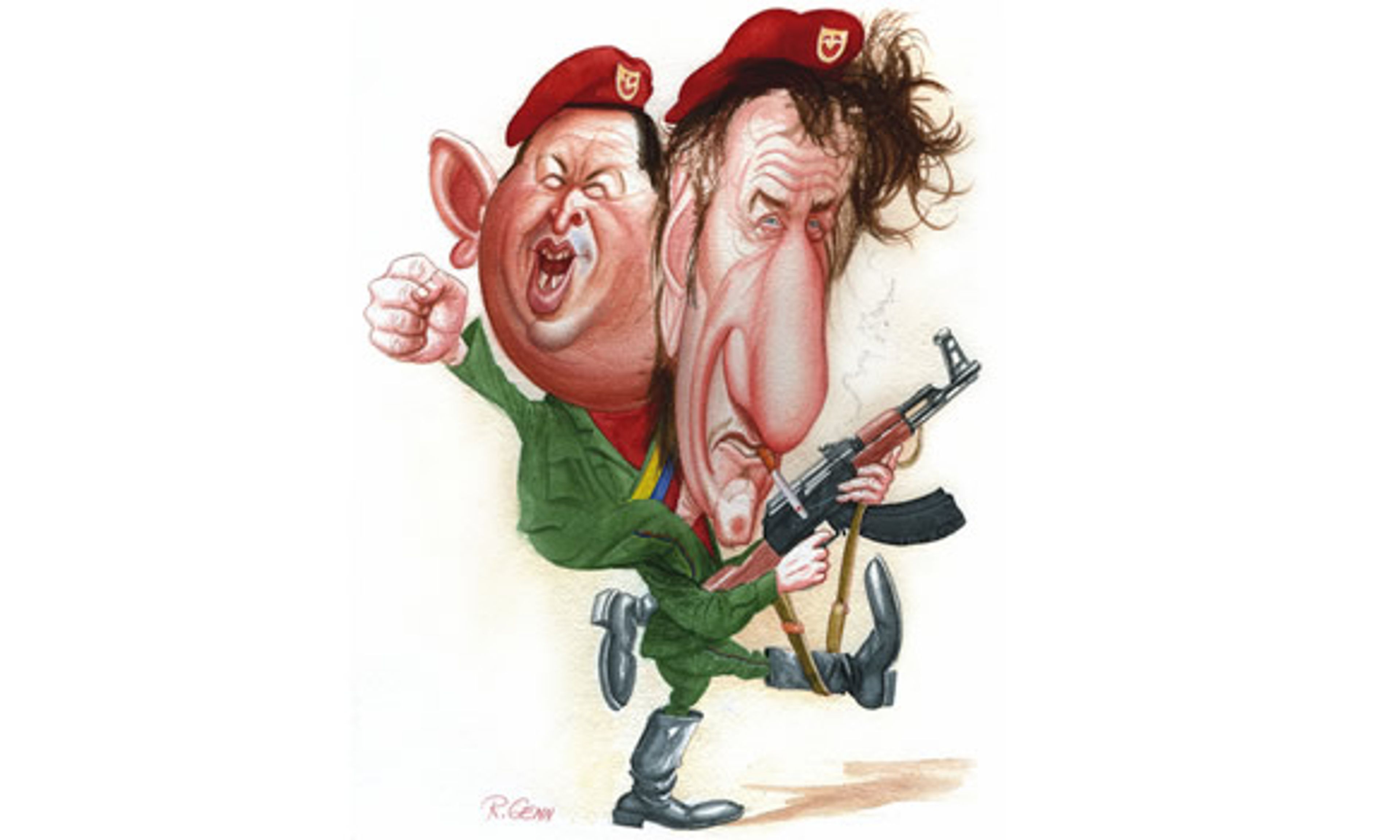
• Appearing on Bill Maher’s television show, actor Sean Penn said that anyone who calls Chávez a dictator should go to jail. In Venezuela, Chávez is way ahead of him.
• Movie actor Tom Hanks has a new production out, a TV docudrama series about the Pacific theater in WWII. In a gushing interview with Hanks for Time magazine, historian Douglas Brinkley tells us that the diffident star has become “American history’s highest-profile professor.” What does Professor Hanks have to tell us about the motivations of the Japanese in the Pacific war? “They were out to kill us because our way of living was different. We, in turn, wanted to annihilate them because they were different.” Really? Name “Pearl Harbor” mean anything, Tom? And weren’t the Chinese, with whom we were allied, equally different? Why didn’t we want to annihilate them? In best professorial get-the-students-thinking mode, Hanks followed up with: “Does that sound familiar, by any chance, to what’s going on today?” We’ve been on campus, so yes, it sounds familiar.
• Before the Bolshevik Revolution, the theater in St. Petersburg — with its opera and ballet — was the Mariinsky. When the Bolsheviks took over, the theater underwent some name changes. After 1935, it was the Kirov, named after Sergei Kirov, the brutal Bolshevik who, in grand Soviet tradition, was killed by other brutal Bolsheviks. When Communism fell in 1991, the theater became the Mariinsky again. But the opera, ballet, and orchestra continued to travel in the West under the name “Kirov” — because the West had gotten used to that name. The relevant authorities, understandably, were reluctant to harm a brand. Then they took an intermediate step — billing the orchestra, for example, as the “Kirov Orchestra of the Mariinsky Theater.” Now, at long last, after almost 20 years, they are the Mariinsky, plain and simple. “Kirov” is consigned to the ash heap of history — where the name and the man belong.
• If the salt have lost his savor, wherewith shall it be salted? Well, you could ask New York State assemblyman Felix Ortiz of Brooklyn. Mr. Ortiz wants to ban salt entirely from food preparation in the restaurants of his state. A chef caught salting his dishes could be fined up to $1,000 under the Ortiz bill. Is there any connection here to current national political obsessions? You bet: Mr. Ortiz tells us that his salt ban will save $32 billion in health-care costs. Imagine what prodigies of rigorous data analysis must have gone into generating that number! Heaven forbid we should take it with a grain of salt. “We need to keep our country healthy,” says the assemblyman. Collectively, of course.
• “Stepping” is a form of dance that involves lots of foot stomping, singing and chanting, hand-clapping, and so forth. It is practiced almost exclusively by blacks, yet at a recent “step off” championship sponsored by Sprite, an all-white group of sorority girls from the University of Arkansas won the top prize. Shared the top prize, we should say, because nearly a week after their victory, Sprite posted a cryptic statement on its website saying: “After the competition, we conducted a post-competition review and discovered a scoring discrepancy. There is no conclusive interpretation, nor definitive resolution for the discrepancy.” A black sorority from Indiana University was belatedly named co-winner, and both groups received the full amount of prize money. If only Bush v. Gore could have been settled that easily . . .
• When the Germans overran France in 1940, Andrée Virot took immense risks on behalf of the Resistance. Code name Agent Rose, she was active in clandestine publishing, and in passing on to the Allies information about the naval base, with its U-boats, at Brest, her hometown. Her network rescued more than 100 pilots and airmen who had been shot down and smuggled them back to England. Arrested by the Gestapo in 1944, she was sent to Ravensbrück and Buchenwald, tortured, and saved from execution at the very last moment. Afterwards she lived in England with her English husband. “You don’t know what freedom is if you have never lost it”: These words from an interview she gave are a fitting epitaph for this heroine, who died aged 105. R.I.P.
• Michael Foot belonged to a privileged family from the south of England but nevertheless, or perhaps therefore, was a man of the hard Left. A journalist by profession, he wrote in the mode of prosecuting counsel. As an orator, he seemed to be acting permanent outrage. A pacifist who himself had not served in the war, he insisted on unilateral nuclear disarmament, every inch one of Lenin’s useful idiots. Once he became a member of Parliament, the Labour party took him to its heart and made him its leader. The general election of 1983 was a turning point, when Mrs. Thatcher proved that the country thought more highly of her than of Foot’s Socialist alternative. He was 96 when he died, and at his funeral they sang “The Red Flag.” R.I.P.
The Legal Front
In one corner, Attorney General Holder. In the other corner, members of Congress and Keep America Safe, a national-security advocacy group run by Elizabeth Cheney, William Kristol, and Debra Burlingame (sister of Charles Burlingame, pilot of American Airlines flight 77, which crashed into the Pentagon on 9/11). The latter wanted to know how many lawyers who offered pro bono services to Gitmo detainees are now working in the Justice Department. After much hemming and hawing, the attorney general released their names.
Many in the legal guild, on the right as well as the left, were made as uncomfortable as Holder by this process. Former attorney general Michael Mukasey, whose record on counterterrorism is stellar, called the search for Gitmo lawyers “shoddy and dangerous.” Lawyers who represent odious clients — he mentioned drug dealers as well as terrorists — should not “automatically . . . be identified with their former clients and regarded as a fifth column within the Justice Department.”
Yet Mukasey acknowledged that there are limits to his defense of his profession. “It is plainly prudent for us to assure that no government lawyers are bringing to their public jobs any agenda driven by views other than those that would permit full-hearted enforcement of laws that fall within their responsibility.” Why would one think that of the Gitmo bar?
Gitmo lawyers are allowed to transmit legal documents confidentially to their clients. Yet Gitmo lawyers themselves have admitted sending their clients anti-American polemics (e.g., a comparison of military physicians to Joseph Mengele), maps of the detention camp, and interview questions from news outlets. Some of this is rationalized as building “rapport and trust with our clients.” All of it suggests that they view the Gitmo crowd as defendants in an ordinary American court, not irregulars captured on a battlefield. Congress and the public should know whether the Gitmo lawyers now in Justice have engaged in such behavior, what they think of it, and what responsibilities they now have.
Some of the Gitmo lawyers call themselves the John Adams Project, after Adams’s successful defense of the British troops who perpetrated the Boston Massacre of 1770. Be careful of this comparison. John Adams was part of the revolutionary strategy of his older cousin Sam, who devoutly believed that British rule was unjust. With one hand, he encouraged confrontation, and made hay out of the violence that ensued. With the other, he sought to show that Americans were capable of running their own institutions. John played the second gambit.
If the DOJ lawyers acted out of the patriotic sentiments of the Adamses, why so much effort to conceal their identities?
Political Poison
At press time, Speaker Nancy Pelosi and Pres. Barack Obama seem absolutely determined to get House Democrats to pass the Senate health-care bill. Arms aren’t all they’re twisting: They are also bending the rules of Congress. The latest gambit is to have the House “deem” the Senate bill to have passed without actually voting on it. Like so much about the Democrats’ health-care initiative, this tactic is both outrageous and senseless: Everyone will know that a vote for this procedure is a vote for the bill, and congressmen will be held to account accordingly.
Pro-life Democrats are coming under particularly heavy pressure. They have long been isolated within their party, but until now they have been allowed to vote with their consciences and their districts. Now, for the first time, party discipline is being imposed on an abortion-related vote. The Senate health-care bill facilitates government funding of abortion; it is the most pro-abortion legislation ever to come close to passage in Congress. Those congressmen who succumb to the pressure to vote for it should know that they are forfeiting the pro-life label.
Democrats hope that Obamacare will become more popular once it is enacted and the debate dies down. But the debate will not die down: Republicans have at least two election cycles to go before the legislation goes into effect, and in the interim Democrats will have ownership over every aspect of the health-care system. Do Democrats really believe that their bill will cause public satisfaction with that system to undergo a large increase?
The Democrats might well succeed in getting this legislation passed on a mixture of will, procedural tricks, and deception. (Obama is still insisting that the bill does not cut Medicare.) If so, Republicans should call for the repeal of the legislation’s major elements and their replacement by sensible, modest, free-market health-care reforms. And they should challenge those Democrats who balked at Obamacare to do the same. Pelosi’s troops want nothing more than for this war to be over. Conservatives have to make it clear that it will merely have moved on to a new front — and that the Left’s fortifications will be no sturdier.












Comments