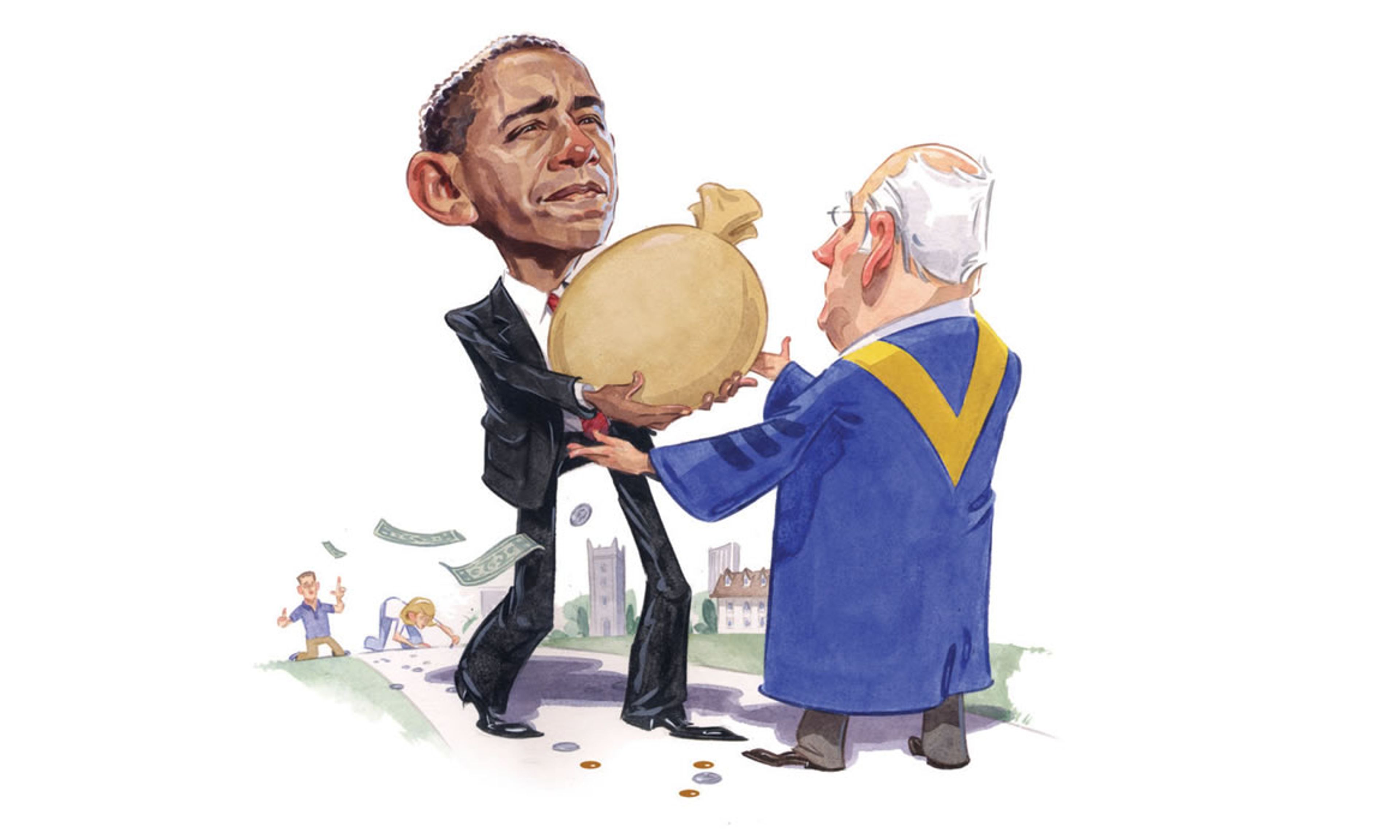
America’s higher-education lobby has enjoyed spectacular success over the past three decades. By zealously marketing their degrees as indispensable to employment and a ticket to personal fulfillment, universities have convinced millions of mediocre students to enroll, spend gobs of (mostly) other people’s money, and then fail their way off the campus to make room for warm bodies. In a cycle as regular as the tides, administrators first raise tuition, then go before state legislatures and Congress complaining about rising tuition, seeking more subsidies purportedly to benefit their cash-strapped customers. At the same time, universities have vastly expanded business enterprises on their campuses, such as hospitals and sports teams, that often boost their immediate cash flow and always boost their sales pitches to wealthy donors and powerful politicians.
Nice work if you can get it. And with Barack Obama in the White House, universities will be getting a lot more. Conservatives need to understand both the details of his proposed largesse and the political circumstances in which he proposes it. And they need to craft alternative policies that, rather than simply obstruct, put Obama and the Left on the defensive.
In his first address to Congress, President Obama called it every American’s patriotic duty to enroll in post-secondary education, repeating the thesis, long discredited by careful research, that maximizing university attendance creates large economic benefits. “That,” the president said, “is why we will provide the support necessary for you to complete college and meet a new goal: By 2020, America will once again have the highest proportion of college graduates in the world.”
While challenging young people to achieve their potential is praiseworthy, the president is mistaken on two important points. First, the goal of leading the world in college graduation is neither achievable (because of our demographics) nor particularly worthwhile. Far greater economic and social benefits would accrue from boosting high-school graduation and encouraging hands-on vocational and technical training. Second, spending tens of billions of additional federal dollars on grants, loans, and tax credits is unlikely to boost college graduation much anyway — though it may well boost attendance, and thus revenue for the colleges.
The Obama administration is certainly committed to the spending part. The president’s stimulus monstrosity raised the maximum Pell Grant by $500 (to $5,350) and expanded eligibility. It provided massive bailouts to state governments, allowing them to mitigate funding cuts to public colleges and universities in the midst of budget deficits, and even more massively expanded federal spending on scientific research, which will largely flow to campuses. The bill expanded federal work-study and loan-guarantee programs. And it transformed a nonrefundable $1,800 tax credit (the Clinton-created Hope Scholarship) into a $2,500 tax credit that is now partially refundable (the American Opportunity Tax Credit). Next came the outline of Obama’s proposed budget, which would further boost research subsidies and eliminate longstanding federal guarantees for private lending in exchange for a federal-government monopoly over student loans.
Much of this agenda is deeply misguided. Unfortunately, much of it is also popular. Millions of Americans are either saddled with big student debts, struggling to pay tuition for current college students, or worried that they won’t be able to afford the tuition when their younger children grow up. Many will welcome another political promise that help is on the way — but when universities raise their prices again to capture most of the new federal aid, these voters won’t know to blame Obama and the Democratic Congress.
The basic problem here has been well understood since at least Bill Bennett’s tenure at the Education Department in the 1980s: When Washington or the states expand government aid, they make parents and students less sensitive to price. The dynamic is similar to the third-party-payment problem in health care. If it looks like someone else is footing the bill, customers are less likely to go without or shop around for a better deal.
The result is that as subsidies rise, most of the benefit goes to universities and their employees, in the form of higher tuition and fees. Some students may end up going to college who previously could not, but most will be unprepared for college-level work. Even after extensive remediation during their freshman and sophomore years, many will either drop out — the six-year graduation rate is less than 60 percent — or further depress academic standards as the faculty inflates grades to keep them enrolled and happily filling out laudatory course reviews.
So simply shoveling additional taxpayer dollars into universities doesn’t significantly increase the nation’s human capital. It just redistributes money from the general public to affluent professors and residents of college towns. Fiscal conservatives are right to object.
At the same time, conservatives need to grapple with another insight: Because college is essentially an investment, college expenses should be tax-deductible to some degree, for the same reason that IRAs and 401(k)s are and should be tax-deductible. If the government taxes your income before you have a chance to invest it, it lowers the return you make on the investment. If it then taxes whatever return you do make, it has charged you a higher effective tax rate than it would have if you’d simply spent the money — thus favoring consumption over investment. People respond by spending instead of investing, denuding the capital stock of the economy and inhibiting long-term growth.
Educating your children certainly can be an excellent investment, increasing their future (taxable) income. But successful investing depends on the freedom to choose among competing options and to reap the consequences of your choices. The Left has adopted the language of investment to market its latest spending binge while refusing actually to treat education as an investment by enacting policies that will encourage real growth and progress. Instead of simply saying no to Obama’s agenda, conservatives should retort: “Absolutely, we should help American families invest in their children’s education. But why are you being so unfair and stingy about it?”
Specifically, conservatives should offer a counterplan with three elements:
First, in lieu of modestly increasing the higher-education tax credit, we should propose a universal tax credit for deposits into Coverdell educational-savings accounts (ESAs) and 529 plans, both of which currently allow people to save money for college expenses tax-free. We should then suggest that families be given wide latitude in using these funds: for college tuition and fees, textbooks, educational technology, tutoring, and home- and private-school expenses.
There is some useful precedent. Coverdell ESAs already allow some K–12 expenses. In addition, embedded within the stimulus bill is a temporary provision allowing parents to spend their 529 dollars on computers for educational use even if their children are not yet enrolled in college. The provision expires in 2011. Why should it? Parents will love the idea of gaining more access to their own funds.
Expanding federal tax relief for educational savings has several advantages. It builds on an existing structure used by millions of Americans. Some states already offer tax deductions for deposits into 529 accounts, so legislatures could easily transform them into true parent choice. And focusing deductions and credits on educational savings rather than same-year educational expenditures would help break up the tuition-cost spiral by giving families the same tax benefit even if they shop around for lower tuitions and fees. Those who choose schools that charge lower tuition should be able to accumulate their unspent funds, tax free, for future educational needs — or even for retirement, though in the latter case the withdrawals ought to be taxable.
Second, instead of modestly expanding the current Pell Grant program, we should propose devolving it to the states and sending the money directly to needy students rather than to institutions. As Ohio University’s Richard Vedder has argued, letting universities collect and distribute Pell Grants gives them at least some ability to game the system by shifting their institutional aid away from need-based scholarships and toward merit-based awards designed to attract the superstar students who boost schools’ national rankings.
Vedder suggests sending Pell funds to qualified students in the form of debit cards for approved expenses. That would turn them into true means-tested vouchers for higher education. We should also ignore tuition in determining students’ Pell Grant amounts; more of the help would then go to the most disadvantaged students, who typically attend community colleges rather than Ivy League schools. And since going to an expensive school would no longer get students and parents more government cash, we would create another incentive for them to shop around.
Third, instead of embracing Obama’s federal takeover of student lending, we should endorse his call for an end to federal guarantees for student loans — and leave it at that. Loan guarantees for education create the same problems that currently bedevil the mortgage-lending industry. Unlike on-budget cash grants or tax breaks, they hide the fiscal risks to taxpayers while creating harmful distortions in the market. In their absence, families would have to make more judicious use of debt, particularly if their children want to pursue degrees in the humanities or social sciences that may have personal value but not a lot of financial payoff.
Rather than yield the field to the Obama administration and the Left, conservatives can offer assistance to these families without violating limited-government principles. We should seize this opportunity to make the case that parents know best how and when to invest in their children’s education, and that their options should not be artificially constrained by bureaucrats, unions, and Washington politicians.












Comments