• Perhaps somebody should advise the suave diplomats in the Obama administration that the most reassuring symbol of U.S.-Russia relations is not a big red button.
• David Broder sounded the call, just before the spring peepers: “The Obama honeymoon is over.” Other establishment commentators and pollsters — Howard Fineman, David Brooks, Douglas Schoen, Scott Rasmussen — have weighed in with similar judgments (“These are not little Rush Limbaughs,” Broder pointed out). Broder et al. are noting the tug of political gravity, which was to be expected after an inaugural ascent as gaseous as Obama’s. It has been strengthened by the circumstances Obama finds himself in, and his response to them. The recession and the credit crunch, hyped to Great Depression status by Obama himself, would be stumpers for any politician. Obama has addressed them with strategic hubris: He wants to fix not only the economy, but health care, energy, and education, all in one swoop. All this he proposes to accomplish with tactical timidity (his default first move is to let congressional barons propose solutions) and an executive team that can give him nothing better (tax-challenged Timothy Geithner at Treasury has yet to staff his department). Obama remains popular, and the Republicans, leaderless and bickering among themselves, are quite unpopular. But the classes and the masses both are getting the wind up.
• In his first weeks on the job as chairman of the RNC, Michael Steele has been a gaffe-production factory. In the latest incident, he made garbled remarks on abortion that sounded pro-choice and then had to explain that he is still, as he has always been, pro-life. Some Republicans are urging Steele to avoid the spotlight and instead work on fundraising and organization. It’s bad advice. Steele won the RNC chairmanship largely on the strength of his communication skills. He ought to be able to master both the low-profile and high-profile aspects of his job.
• The Rush wars continue with a Newsweek cover story by David Frum (“Why Rush Is Wrong”). It is hard to jump into a bar fight when both contestants are old friends. Rush Limbaugh assumes special political stature when politicians themselves are anemic, as they usually are in minority parties at the beginning of a presidential cycle (NR ran a cover story on Rush, entitled “The Leader of the Opposition,” in 1993 — just after Bill Clinton’s shellacking of the elder Bush). When some politician emerges — as Newt Gingrich did in 1994 — Rush reassumes his wonted role, as an expounder of conservative ideas, suited to his medium and his particular take on things. Sometimes we disagree with his take, as when we said, contra his recent speech to the Conservative Political Action Conference, that repeating the old principles will not carry us to victory (we also have to suit them to current events and present political opportunities). Mostly we are on the same wavelength. Which is a good thing, because Rush is not going anywhere, and it’s futile to wish he would. Let’s all try to do our jobs better, and not tweak one of our number who does his job surpassingly well.
• Charles Freeman withdrew his name from consideration for the chairmanship of the National Intelligence Council after being criticized, mostly for his ties to the Saudis and his support for China’s crackdown on democracy activists in Tiananmen Square. He blamed the controversy over his nomination on the “Israel Lobby,” writing that “the aim of this Lobby is control of the policy process through the exercise of a veto over the appointment of people who dispute the wisdom of its views.” (What political group doesn’t have this aim?) Never mind that Nancy Pelosi, an advocate of human rights in China, reportedly killed the nomination. Perhaps the most dismaying aspect of the affair is that David Broder, the somnolent dean of Beltway journalism, credited Freeman’s conspiracy theory. Paranoid views about the Jewish state and its supporters seem to be everywhere these days. That is not conspiracy, but poison.
Obama’s New Math
I share this little cubby at the front of the magazine with an economist of national renown. He uses lots of charts and graphs, and when he adds up percentages, the sum actually comes to 100. So the last thing I want to do is poach on his territory. Still, there’s something that’s been gnawing at me. It’s a vague suspicion, a ghost at the edge of conscious thought, a formless query that defies easy articulation. But I will try to put it into words:
What the hell is Barack Obama talking about?
On almost any given day, Obama insists that his predecessor caught small children in a butterfly net and cooked them in hot oil. Oh, wait, sorry; that’s Bill Moyers. What Obama goes on and on about is how President Bush was a tightwad who refused to spend a dime on vital domestic priorities. Here’s Obama responding to the charge that he’s doing too much: “To kick these problems down the road for another four years or another eight years would be to continue the same irresponsibility that led us to this point.”
In his address to Congress, Obama constructed a Potemkin army of straw men, and they were all Republicans and conservatives: “I reject the view that . . . says government has no role in laying the foundation for our common prosperity.” In another speech he boldly rejected “a philosophy that says every problem can be solved if only government would step out of the way; that if government were just dismantled, divvied up into tax breaks, and handed out to the wealthiest among us, it would somehow benefit us all. Such knee-jerk disdain for government — this constant rejection of any common endeavor — cannot rebuild our levees or our roads or our bridges.”
Ah, yes, I believe it was Milton Friedman who said, “Bridges must never be rebuilt.” Just for the record, I reject a philosophy that says we must spend trillions to stimulate the economy just because vests have no sleeves and cats bathe themselves with spit.
Anyway, Obama often goes on to lament the deficit he “inherited” from George W. Bush, suggesting that if only someone like Barack Obama had been at the helm these last eight years, things would be better.
So here’s what I don’t get (and, again, my apologies to Mr. Economist Guy). Spending under George W. Bush went through the roof: education (up 58 percent), Social Security (17 percent), Medicare (51 percent), health research and regulation (55 percent), highways and mass transit (22 percent), and veterans’ benefits (59 percent). Spending grew twice as fast under Bush as it did under Clinton. But Obama thinks that amounts to laissez-faire.
To recap: Obama says Bush ignored necessary spending, which is why our new president needs to borrow $7 trillion just to spend enough money to catch up to where we should be. But he goes on to suggest that if he — or some other responsible party/messiah/lightworker type — had been running the show, we wouldn’t have this Republican-fueled deficit that he inherited, because Democrats would have spent two, three, or ten times as much money as Republicans. Something doesn’t compute there.
But, hey, I’m no economist.
— JONAH GOLDBERG
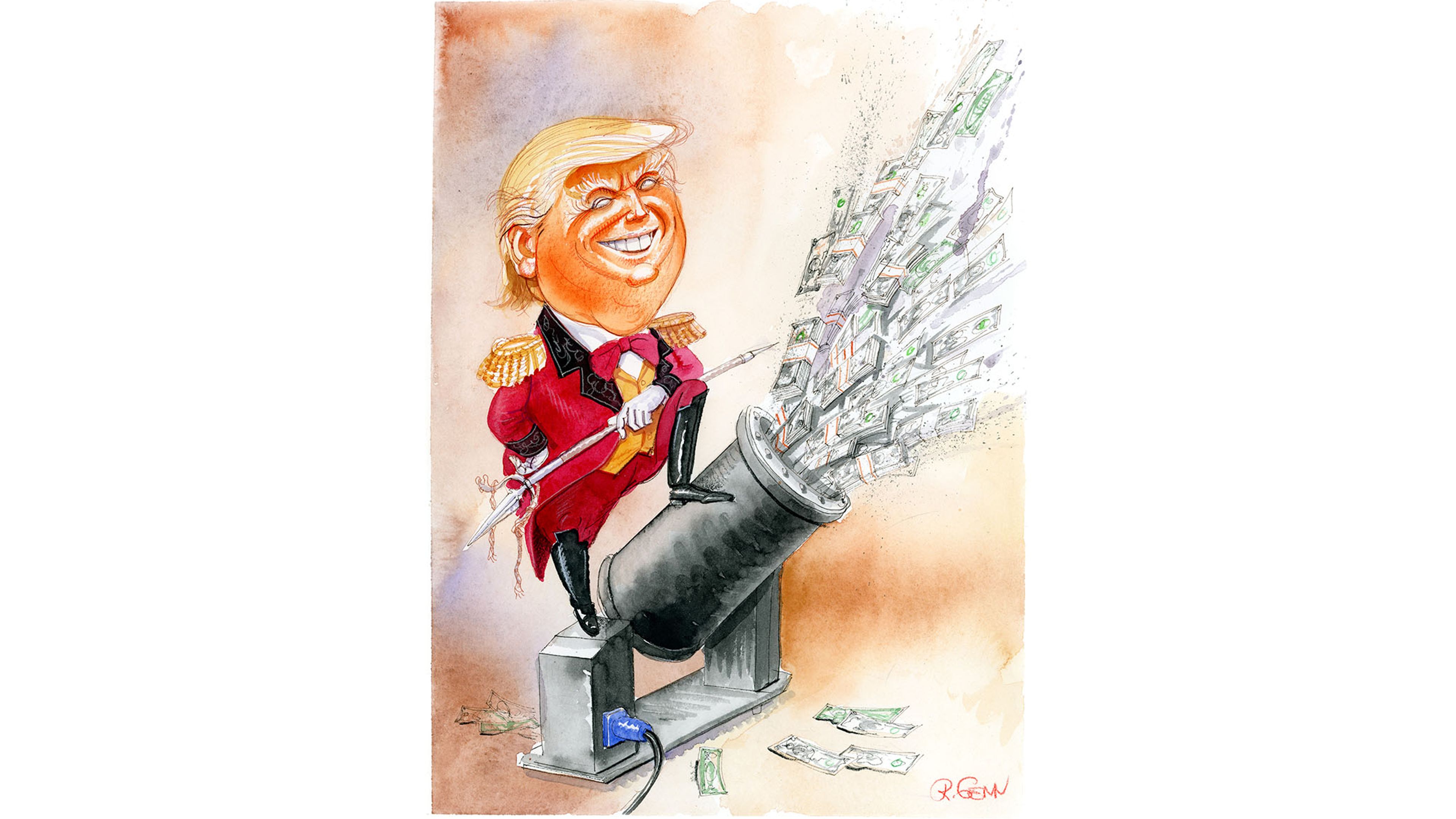
• On the matter of insurance giant AIG, President Obama has been milking two issues — employee bonuses and payments to foreign counterparties — but he is talking through his hat. AIG was contractually obliged to pay its bonuses; if Obama had wanted to demand concessions from the firm’s employees, as the government did in the case of the autoworker unions, he could have done so when AIG came back for a fourth serving of bailout bucks on March 2. Instead, the president makes speeches, congressmen fulminate, and Andrew Cuomo subpoenas the paycheck stubs of private citizens. Now Senate Democrats are trying to concoct a 91 percent excise tax to punish AIG executives — but, since it’s unconstitutional to target a particular firm in that way, other financial-services employees almost certainly will be dragged into the fracas. Obama can hardly complain about AIG’s current leadership or the structure of its bailout, given that his Treasury secretary, Tim Geithner, helped put both in place. Equally phony is outrage that much of AIG’s bailout money has been used to pay off domestic and foreign banks that served as counterparties in AIG credit-default swaps. Sane people desire that these financial institutions meet their obligations: That was the point of the bailout in the first place. Sending another wave of wealth destruction through the markets in a fit of populist pique would be a mighty high price to pay for the pleasure of tweaking the Bank of Montreal. But if Obama really wants to reopen the AIG bailout, he is the president of the United States, which owns 80 percent of the firm–it’s his mess.
• As usual, Congress failed to pass its annual appropriations bills on time. Instead, it rolled up all of its overdue work into what’s known as an “omnibus spending bill.” This one, a 1,130-page, $410 billion monstrosity, increased domestic spending by 8 percent over last year and contained more than 8,000 earmarks. (Obama shrugged off his pledge to veto bills that contain earmarks and signed the omnibus without hesitation.) Eight Senate Republicans — six of whom serve on the Appropriations Committee — joined the Democrats in voting for the bill, demonstrating that conservatives have very little hope of stopping big annual spending increases.
• Obama’s budget director, Peter Orszag, said the administration might be open to taxing employer-provided health benefits. When John McCain proposed the idea last year, Obama denounced it in a series of ads as a middle-class tax increase. But neither Orszag nor anyone else in the administration is talking, as McCain did, about coupling the tax hike with a new tax break for individually purchased health insurance. This plan thus really would increase taxes on the middle class, and disrupt people’s health-care arrangements to boot. Moving away from a subsidized employer-based health-care system to something more market-friendly would be terrific. Moving away from employer coverage to a more government-centered system, as Obama appears to want to do, is a mistake.
• Mexico threatened to impose new tariffs on American products in response to a move by Congress to block Mexican truckers at the border. Obama is scrambling to find a solution that satisfies everyone, but trying to have it both ways on trade is what got him into this mess. Although the president says he understands the value of free trade, his U.S. trade representative, Ron Kirk, sounds more skeptical. For starters, Kirk says that the pending U.S.–South Korea Free Trade Agreement “simply isn’t acceptable.” Never mind that the deal would add an estimated $10 billion to $12 billion to annual GDP and around $10 billion to annual merchandise exports: Organized labor has called the tune. Trade agreements offer a cost-free way to stimulate the economy and strengthen ties with important allies, but Obama has decided that he cannot afford to alienate his left-wing base. His administration will try to straighten out the Mexican-trucking situation, and it might move forward on the tiny U.S.-Panama deal, but deals with Colombia and Korea – as well as the stalled Doha Round of world trade talks – are dead on arrival.
• While rescinding President Bush’s stem-cell-research funding policies, President Obama congratulated himself for keeping politics out of science. The boast is empty. Obama did not lift all restrictions on human experimentation, and he spoke against the use of cloning to create human babies. What are these policies if not political interference with science — and laudable interference at that? Under Obama’s new rules, taxpayers will be encouraging the destruction of human embryos for research purposes. At a minimum, those embryos will include the “leftovers” from fertility clinics. He has left it to the federal science bureaucracy to decide whether they will also include cloned embryos created for the purpose of experiments. Taxpayer funding for cloning has never been widely debated and, if Obama has his way, never will be.
• At his March 10 speech on education, Obama was not so bold as to take credit for inventing the Internet, but he did claim that federal funding of science and engineering education “made possible somebody like a Sergei Brin to attend graduate school and found an upstart company called Google that would forever change our world.” Thank you, Mother Government. He went on to gripe about “the same old debate” in education-policy circles: “It’s more money versus more reform, vouchers versus the status quo.” So he apparently decided to declare a victor, calling for massive new spending on education — there’s $44 billion of it in the “stimulus” bill — and saying not a peep about the tiny school-choice program for poor kids in Washington, D.C., that congressional Democrats are desperate to ban. Obama tried to seize the mantle of reform by praising charter schools and merit pay for teachers. But these ideas are almost completely absent from the legislation he has actually supported or enacted. Making them real would require engaging in one of those tired, old debates that he so despises — a debate against the teacher unions.
• Obama’s wartime detention policy takes cynicism to new heights. It is not a new policy; it is the Bush administration’s old policy. There are some crumbs to satisfy those in Obama’s hard-Left base who actually believed the hopey-change campaign rhetoric: Detainees won’t be called “enemy combatants” anymore, and the administration purports not to be relying on the commander-in-chief’s inherent constitutional powers to hold them without trial. But we are still going to hold them. The Justice Department explained to a federal court that under the international law of war and Congress’s post-9/11 authorization of military force, the president has unilateral power to imprison anyone he judges to be providing substantial assistance to our terrorist enemies — with no requirement that such persons be apprehended on a traditional battlefield or have committed an act of terrorism. Of course, when Bush took this position, the Left was in froth-flecked rebellion, but now there’s nothing more than some harmless grumbling from the ACLU. Sighs of relief on the national-security Right may be premature, however. By apparently forswearing his constitutional war powers, Obama is betting he can prosecute war under the direction of courts (including international tribunals) and an anti-war Congress. We have our doubts.
• During the campaign, then-Senator Obama ripped Bush’s use of executive signing statements, issued upon the signing of legislation into law, as a brazen snub of Congress on the road to an imperial presidency. Now, in signing that omnibus spending (and spending, and spending) bill, Obama has had yet another epiphany. Turns out he won’t abide — he decreed in his first signing statement — “legislative aggrandizements” that usurp executive powers. He is also quite put off by sundry provisions that “unduly interfere with my constitutional authority,” and which will thus be ignored. Call it the audacity of continuity.
• When British prime minister Gordon Brown called on Barack Obama, he brought rare and thoughtful gifts: a pen holder and a framed commission from Royal Navy ships used against the slave trade, and a first edition of Martin Gilbert’s biography of Winston Churchill. Obama, like a harried father who hit Kmart at 8:00 p.m. on Christmas Eve, reciprocated with a set of DVDs. Brown did his dour Scottish best to feign delight. There was no trip to Camp David, no formal dinner, no joint press conference with flags, and no Churchill bust in the Oval Office (Obama was so eager to send it back to England that he couldn’t wait until after Brown’s visit). An Obama aide explained to the U.K.’s Sunday Telegraph: “There’s nothing special about Britain. You’re just the same as the other 190 countries in the world. You shouldn’t expect special treatment.” Perhaps if Britain, our staunch ally in Iraq and Afghanistan, threatened to set off one of its nuclear weapons, it would get a friendlier welcome.
• For decades the Voting Rights Act has been read to forbid any changes to the borders of congressional districts that would “dilute” the political power of blacks and Hispanics. The Supreme Court has just ruled that the act forbids such dilution only in districts that are majority-black or majority-Hispanic. Justices Clarence Thomas and Antonin Scalia concurred with the ruling but noted that the act, as written, does not forbid any type of vote dilution. Racial gerrymandering is a troubling enough practice without being imposed lawlessly by courts.
• Not many people get excited about “federal preemption,” but what is at issue is how much of the national economy trial lawyers get to carve up. The Constitution limits federal power, but it also limits the power of state governments to interfere with interstate commerce. The Supreme Court has stopped enforcing both limits. In Wyeth v. Levine, it has just ruled that having FDA-compliant warnings on their drugs does not protect pharmaceutical companies from lawsuits in state courts. (National law, that is, does not “preempt” state law.) Instead of a national standard, then, we will have whatever results from the scrum of lawsuits in 50 states — with a bias in favor of whichever state’s courts are most aggressive. In other words, we will now see the chaos of our product-liability system brought to bear on medicine. The litigation explosion did not just happen. It is the result of an ongoing breakdown in federalism.
• With at least 3 percent of the population infected with HIV, possibly twice that number, AIDS stands at epidemic rates in Washington, D.C. The story is bleak, and it is familiar: Black men and men in their forties have the highest rates of infection, at 7 percent for both groups, with male homosexual acts the leading vector of transmission, followed by heterosexual activity and intravenous drug use. For a sense of proportion, consider that the percentage of Washingtonians living with HIV is six times that of the general U.S. population living with cancer. In the case of AIDS, as in the cases of crime and the corruption of civic institutions, Washington is a Third World enclave in the United States. Worse than that, in fact: HIV is more prevalent in Washington than in Somalia.
• China has enjoyed a surge of growth comparable to the biblical seven fat years, fueled largely by exports to the United States. It has plowed its savings back into U.S. Treasuries — a symbiosis nicknamed Chimerica. Chinese premier Wen Jiabao recently worried in public about the investment: “President Obama and his new government have adopted a series of measures to deal with the financial crisis. We have expectations as to the effects of these measures. . . . Of course we are concerned about the safety of our assets.” President Obama responded with encouraging words. “There’s a reason why even in the midst of this economic crisis, you’ve seen actual increases in investment flows . . . into the United States. I think it’s a recognition that the stability not only of our economic system but our political system is extraordinary.” Our political system, certainly; and the Chinese, for all their totalitarian zeal, can only envy us. Our economic system is also stable, in the sense that we would never default. But since Obama and his congressional allies are taking on a trillion new dollars of debt to fund all their favorite projects, the Chinese premier is right to be worried. Communist rentiers of the world, unite.
• The first foreign-policy crisis of George W. Bush’s presidency came in April 2001, when the Chinese forced down a U.S. surveillance plane. History seemed about to repeat itself on March 8, this time at sea. The unarmed U.S. Navy surveillance vessel Impeccable was conducting operations in international waters near Hainan Island, a few dozen miles from where the 2001 incident took place. Five Chinese boats approached, the sailors waving Chinese flags and shouting at Impeccable to leave the area. Impeccable turned fire hoses on one boat, but the crew stripped to their underwear and continued their harassment. Probably the Chinese thought a show of national self-assertion wouldn’t hurt ahead of the meeting of our two nations’ presidents at the April 2 G-20 summit. Probably they are also keen to strike poses for the benefit of China’s legions of hyper-nationalist young college graduates, whose numbers have been swollen by a recent expansion of higher education, but who have trouble finding jobs in a slowing economy. This year is the 20th anniversary of the Tiananmen student movement, and the 90th anniversary of an even bigger movement that radically changed China’s political culture. It is the perfect time for some assertive nationalism.
• France is rejoining NATO, Pres. Nicolas Sarkozy has announced. He claims to be the heir of Gaullism, but General de Gaulle must be turning in his grave. He it was who in 1966 kicked Americans out of their bases in France and withdrew from the alliance. The alleged refusal of American administrations to recognize the grandeur of France had bred in the general a resentment that went deep into French society. In actual fact, the pull of NATO proved too strong, and French snubbing of the alliance was mostly attitudinizing. France continued to contribute money and troops, and by the 1990s was attending defense meetings, participating in exercises and even operations — for instance, sending aircraft to Bosnia. At this moment French troops are in Afghanistan under NATO auspices. In the future, several hundred French officers will be able to take up NATO jobs and France will be allotted two commands concerned with planning. Latter-day Gaullists and the socialist Left in France are horrified by what they perceive as a cave-in to the United States, but quite a few commentators are suggesting that Sarkozy’s true aim is to build a European army and that he is making this gesture of rejoining NATO in the hope that the United States will not stand in the way of the one military initiative that really matters to him.
• Two British soldiers stationed in Northern Ireland were members of a unit on the eve of being posted to Afghanistan. Their kit was ready. For a last-minute party, they ordered pizzas. As they waited outside the barracks, gunmen opened fire, killing them both, and wounding four others, including those delivering the pizzas. Two days later, gunmen shot dead a policeman, a Catholic with a record of long service. The Troubles, as the Irish call them, have started up. Actually, they never quite ended. There have been several terror attacks in the recent past, none of them fatal, and only lately a very sophisticated car bomb was defused. For the shootings, the police have arrested three suspects who belong to dissident IRA groups, said to number up to 300. Youths are once again in the streets throwing Molotov cocktails and rioting. Gerry Adams and Martin McGuinness, the old-style IRA leaders, have made some pretty cold and unfeeling statements, and the former has been in the U.S., fundraising as usual. What’s different this time is that they are in a power-sharing government trying to carry out a peace process, and the local population, Catholic as well as Protestant, is evidently, vociferously, almost unanimously disgusted with violence.
• Obama has sent what the New York Times describes as a “secret letter” to Russian president Dmitri Medvedev. Its not-so-secret contents threaten to undo several of the Bush administration’s most significant gains in the area of missile defense. The missive to Moscow supposedly offers the Russians a deal: If they help prevent Iran from developing long-range missiles, Obama will pull the plug on a NATO-approved missile-defense system in Eastern Europe. This is a high price to pay for Russia’s cooperation, which may not materialize. In fact, abandoning the missile-defense project — which involves building a radar in the Czech Republic and basing a few interceptors in Poland — would force European allies to question America’s commitment to their security and convince Russian leaders that bullying has its rewards. Obama’s offer raises the risk that the United States will be left vulnerable to precisely the form of nuclear blackmail from Tehran that missile defense seeks to frustrate.
• There are few U.S. ambassadorships as important as the one in Iraq. And we have enjoyed in that post three highly qualified men: John Negroponte, Zalmay Khalilzad, and Ryan Crocker. President Obama has nominated an ambassador of his own: Christopher Hill. Under George W. Bush (and, perhaps more to the point, Condoleezza Rice), Hill was chief U.S. negotiator in the North Korean disarmament talks. He was far too eager to accommodate the North Koreans, and naïve about the threats we face. He also appeared indifferent to human rights. Moreover, he has no experience in the Middle East. There is nervousness in Iraq about Hill. For one thing — no small thing — will he wish to be as accommodating of Iraq’s nuclearizing neighbor, Iran, as he was of North Korea? In a desire to make nice, will he be accepting of an Iranian presence in Iraq? Among Senate Republicans, there is staunch opposition to Hill, and there may well be a filibuster. We join those opponents in hoping that the nomination is blocked. Still, foreign policy rests with the president: and what our country does in Iraq, and elsewhere, will be on Obama’s head, as it was on his predecessor’s.
• You know what the Obamites say about their predecessors, the George W. Bushies: They were a bunch of diplomatic blunderers, when they were deigning to try diplomacy at all. By contrast, they, the Obamites, are all understanding and smoothness. Which brings us to Secretary of State Clinton’s meeting with her Russian counterpart. She, President Obama, and Vice President Biden had been saying they wanted to “press the reset button” on U.S.-Russia relations. So she presented Foreign Minister Lavrov with a strange little device: a yellow box with a big red button. There was a Russian word on the button that was supposed to say “RESET.” Instead it said “OVERCHARGE.” Oops. For a time, the United States was the laughingstock of Russia. We all make mistakes, and this was not the worst thing in the world. But perhaps the Obama people could be a little more humble.
• Our great friends the Saudis have a way of setting the highest standards in cruelty. In the city of Jeddah, an unmarried woman of 23 was abducted and gang-raped. Finding that she was then pregnant, she desperately tried to have an abortion. Brought to court, she explained what had happened, whereupon the judge ruled that she had committed adultery. Result: a sentence of one year in prison, and a hundred lashes once she has had the child. Meanwhile, over in another town, al-Chamli, two men called on a 75-year-old grandmother by the name of Khamisa Sawadi. One had once been breast-fed by this lady, and the other was delivering bread to her. But women are not allowed to be in the presence of men who are not family members. Result: Khamisa Sawadi is sentenced to forty lashes. Neither of these women is likely to survive being flogged. Nobody in or out of government here or anywhere, and certainly not the U.N. committee currently preparing for the Durban II conference on human rights, seems prepared to throw these outrages in the face of our great Saudi friends.
• For years, people have feared that Pakistan is about to become a failed state. This latest crisis might indeed push it over the edge. What’s happening is the kind of personalized test of strength that constitutes the political process in countries without meaningful democracy. Two power-hungry men, President Asif Ali Zardari and former prime minister Nawaz Sharif, are engaged in a no-holds-barred struggle. One apparently prime issue is the role of the chief justice, Iftikhar Muhammad Chaudhry, a vital player suspended from office and in a position to affect the outcome of the power struggle. But, as always in conditions like these, force is decisive. Zardari placed Sharif under house arrest and rounded up hundreds of his supporters. Sharif countered by mobilizing his supporters for a march on the capital, Islamabad, to be followed by a mass sit-in. But suddenly the police supposed to be confining Sharif melted away, proving that Zardari could no longer count on having effective control. He has also had to acquiesce in the reinstatement of Chaudhry as chief justice. Sharif is proclaiming victory and revolution, but there might instead be a military coup, a spate of suicide bombers motivated by the Taliban or other Islamists, a last-gasp crackdown by Zardari, or some sort of anarchic free-for-all on the Afghan model. Anything and everything is possible.
• Back in 1985 the Hanshin Tigers, a Japanese baseball team, won their first Central League championship in 21 years. In accordance with one of those incomprehensible Japanese traditions, ecstatic fans dressed as members of the winning team leapt from Osaka’s Ebisubashi Bridge into the Dontonbori River. Alas, no one could be found who even faintly resembled the team’s imported American power slugger, Randy Bass; so the fans took a statue of Colonel Sanders from a nearby KFC outlet and dropped it into the canal in lieu. The Tigers have not won a championship since, and the long dry spell has come to be taken as a curse imposed by the late colonel’s shade for disrespect to his effigy. Now construction work on the canal has unearthed the colonel’s statue (minus his left hand and spectacles). Tigers fans are fired up for a winning streak. So are superstitious speculators: The 1985 Tigers victory was followed by a five-year stock-market boom. Watch the Nikkei.
• Our bathroom correspondent alerts us to the growing popularity in East Asia of the Modern Toilet restaurant chain. In a Modern Toilet franchise, patrons sit on a tastefully decorated bathroom pedestal (lid down), eat from a miniature model of the same fixture, drink from a small urinal, and select from desserts with names we’d rather not print. The light fixtures are shaped like . . . well, we’d prefer not to go into detail on that, either. “It’s supposed to shock and confuse the senses,” explains the chain’s (or should that be “handle’s”?) Taipei franchisee. We are sufficiently shocked and confused by the current economic ructions, thanks all the same, and would prefer not to have to confront novel conundrums like: Should hands be washed before the meal, or after?
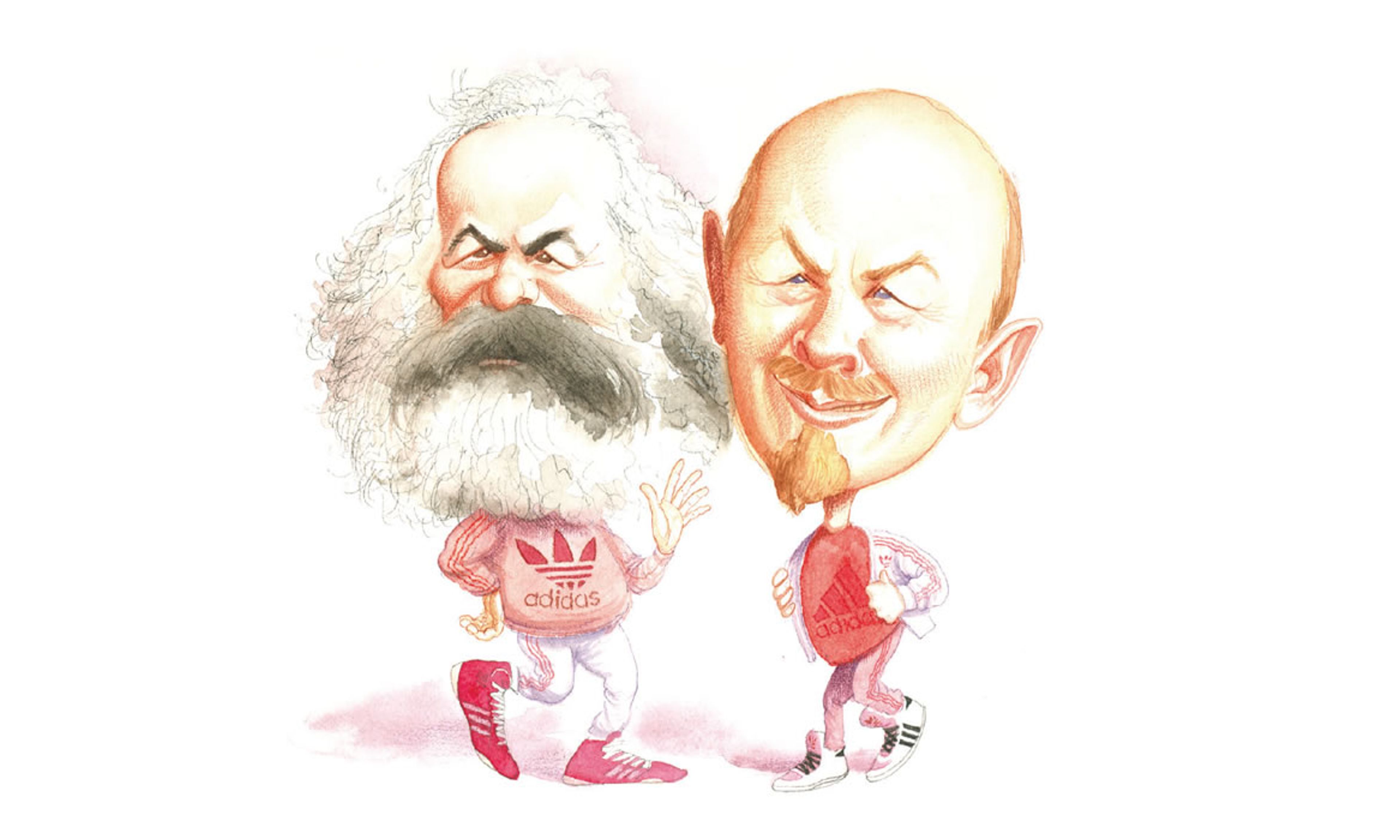
• Adidas has been marketing a hat showing the hammer and sickle. How do they sell you the hat? They say, “Show your love for the former USSR during training time.” Yeah, feel the burn, show your love — for a brutal system that killed tens of millions and immiserated many more. Well, at least Adidas has given us something to wear with our Che shirts.
• Through her 50 years on toy-store shelves, Barbie, the ectomorphic doll who goes Hollywood starlets one better by being made entirely of plastic, has been a vehicle for girls to act out their fantasies — and for adults to project their anxieties. Some grown-ups say her unrealistically slender proportions cause girls to be weight-obsessed, though they never say Weebles cause obesity, or Raggedy Ann bad fashion sense. It was once suggested that a pull-string Barbie who said “Math class is tough!” kept girls from mastering differential equations. Selling Barbies has actually been banned in Iran (not very surprising) and Montpelier, Vt. (even less so). Now a West Virginia legislator wants to add his state to the list. The bill’s sponsor, Jeff Eldridge, is no brie-and-Chardonnay elitist, even by West Virginia standards; he grew up in a house with no plumbing and recently introduced a bill to legalize Ultimate Fighting Championship. Did his sister’s Barbie kick his Hulk Hogan action figure in the groin when they were kids? No, but he wants to emphasize the importance of education and let girls know they can’t get by on looks. That’s good advice, but here’s a better idea: School Choice Barbie, complete with fetching uniform.
• Great hopes have been invested in President Obama, and those hopes can be a little creepy. There is a bumper sticker that says, “One Nation Under Obama.” There is also one that says, “Obama Saves.” Is that second sticker meant to be tongue in cheek? In any case, we heard a nice suggestion for a different sticker: “Jesus Saves. Obama Spends.”
• It’s an age-old story: A law is passed; bureaucrats devise a blizzard of rules to enforce it; lawyers and judges widen their scope; and citizens end up shying away from anything even remotely questionable for fear of a lawsuit. A New York City real-estate brokerage recently sent employees a list of 200 words and phrases that are forbidden in its ads, lest these sound discriminatory. Among them: “family-friendly” (might discourage singles), “walking distance” (ditto for the handicapped, though “close proximity” is fine), and “professional” (the blue-collar). “Quiet” and “safe” are also banned, for some reason. The resulting dodges and circumlocutions are reminiscent of an 18th-century novel: “No smokers” is out, but “building has a no-smoking policy” is okay; naming the school district, a vastly important consideration in New York, is out, but customers may be directed to a website containing that information; and when buyers ask about the ethnic makeup of a building’s tenants, the broker may only suggest that they stand outside the building and look. Thus do crusaders and do-gooders reduce grown men and women to communicating by nods, winks, hints, and code words.
• Ross Douthat, a former NR intern and our current film critic, was tapped to be an op-ed columnist for the New York Times. Douthat has done many other things than write for us in his 29 years — senior editor of The Atlantic, blogger on their website, author most recently (with Reihan Salam) of Grand New Party: How Republicans Can Win the Working Class and Save the American Dream. We wish him the best, we expect the best, and we note that, by joining former NR-nik David Brooks, he advances our project of osmotic hegemony (we need some work — David — on mission retention). N.B.: Douthat described himself as “sort of a squishy pro-lifer.” That makes him a lot more pro-life than any other conservative employed by the Gray Lady.
• Ron Silver had a splendid career on screen (Reversal of Fortune, Enemies: A Love Story), on stage (Speed-the-Plow), and on TV (The West Wing). Then 9/11 changed the world. Silver was a rare actor who recognized it, and his recognition changed his world. The work still came, but it was accompanied by ribbing and incomprehension, for Silver identified himself as a “9/11 Republican” and supported George W. Bush’s reelection. “If we don’t get this right,” he said, meaning by this the War on Terror and, conversely, the terrorists’ war on us, “all the other things don’t matter worth a hill of beans.” Silver saw that all civilized life and discourse, conservative and liberal, religious and skeptical, was challenged by death-loving jihadis. He wanted to put his fame and his talents on the side of survival. He was a liberal to the end, but a liberal who was willing to fight in self-defense. Frater, ave atque vale. Dead at 62. R.I.P.
• Schuyler Chapin was many things in life: Jascha Heifetz’s tour manager, head of the Metropolitan Opera, dean of the Columbia School of the Arts, and so on. He was also a friend of WFB. They attended the same school, the Millbrook School, in Dutchess County, N.Y. And WFB thought Chapin just about the best raconteur he ever heard. Once, the Buckleys and Chapin went on a cruise together, shortly after Chapin’s wife died. (She was Betty Steinway, of the piano family. His second wife was the delightful Catia.) Bill, Pat, and Schuyler had endless meals together: breakfast, lunch, and dinner, day after day. And WFB marveled that Chapin never ran out of stories, or the ability to amuse and edify. He was an elegant man, an aristocrat with humility. He was sheerest pleasure to be around, as many of us can attest. He passed away on March 7, aged 86. How grateful we are to have known him! R.I.P.
• Did NR, Inc., ever have a more cheerful employee than Jerry Garvey? Driver extraordinaire to Pat and Bill Buckley, various dogs, and countless human beings for over two decades, the retired New York City fireman had the noive needed to navigate a limo through Manhattan’s brutal streets. His presence at NR’s headquarters was always a loud and happy occasion (especially if his Mets or Jets had won), and his colleagues loved him for many reasons, not the least of which was that he treated all people equally and with decency. There wasn’t an arrogant bone in his body. Retired and on vacation in Florida, he died — dropped dead, as he would matter-of-factly say it — on February 27, a year to the day that WFB passed away. Too sudden, too soon, he leaves his beloved wife Eleanor, his four children, and many friends here, in offices now quieter and less cheerful. R.I.P.
Signs of Life
Has spring arrived? Stocks, especially bank stocks, are up. The velocity of money, which dropped calamitously during the financial panic of the fall, continues to pick up. The Fed’s loose money is having its expected stimulative effect on the yield curve (even if it is also storing up some future trouble). There has even been a rare outbreak of good sense in liberal-run Washington. Fed chairman Ben Bernanke, House Financial Services Committee chairman Barney Frank, and Democratic economic guru Warren Buffett have all endorsed the relaxation of a particularly onerous regulation of the financial industry.
The problem is the interaction of new “mark to market” accounting rules with capital-adequacy standards. Those rules, adopted in 2007, can be expected to have perverse effects in both booms and busts. During booms, overvalued assets exaggerate financial companies’ capital cushion and thus allow them to lend too freely. During busts the devaluation of assets leads to a downward spiral in which fire sales are needed to meet capital standards, driving prices downward for the next company — which then has to sell assets to meet its capital requirements. The rethinking of this policy in Washington is long overdue.
Pollyanna is not writing this editorial. Even if the economy has hit bottom, there will be pain for months to come. Unemployment is a lagging indicator. Nor do we know for sure that a recovery will soon be under way. Washington is easily distracted by populist gales and its own obsessions. Tim Geithner walks the halls of a Treasury empty of both money and personnel. The administration shows no particular urgency about devising a solution to the problem of banks’ toxic assets. It is much more zealous about planning to divide the proceeds of the fantastically strong recovery it simply assumes will take place.
The rest of the government should make a virtue of Obama’s dithering. Either Congress or the regulatory agencies have it within their power to implement mark-to-market reform quickly. That reform may detoxify some assets and make it possible for banks to work down others over time. The financial industry’s remaining problems would be more manageable — perhaps sufficiently so that the administration will finally devise a plan for them. And by then, we may have seen a few more green shoots come up.











Comments