According to liberals, the fortunes of working-class Americans have declined with the ebb of organized labor since the 1970s. But their story overlooks how the rise of public-employee unions has transformed the labor movement. It also ignores how conflict between public-sector and private-sector unions is a barrier to the revival of organized labor.
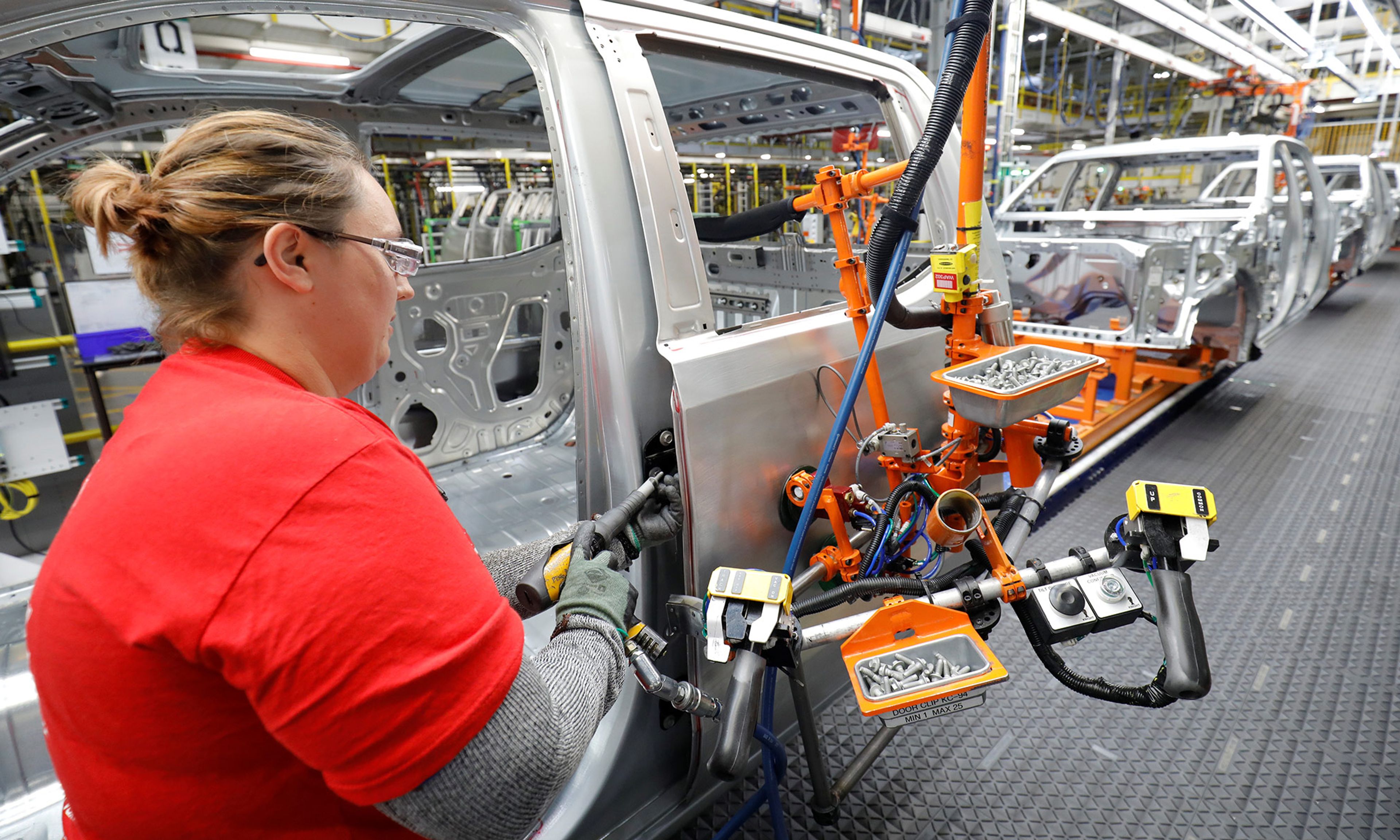
Many of us think of union members as burly white-ethnic guys in steel-toed boots and hard hats and with dirt under their nails. We think of union members as being skilled tradesmen (carpenters, plumbers, or electricians) or industrial workers (coal miners, autoworkers, or steelworkers). But that image is an anachronism. Today, a union member is as likely to be a middle-aged female schoolteacher with a master’s degree and an income of $80,000 a year.
At its high point in the 1950s and 1960s, the labor movement was primarily made up of urban-dwelling white men who had high-school degrees and worked blue-collar jobs. Today, organized labor has achieved near gender parity and it includes a more racially diverse group of white-collar workers, many of whom live in the suburbs, have college degrees, and enjoy a degree of material affluence. By comparison, in 1983, only 20 percent of union members had a four-year college degree. By 2008, 38 percent did.
Two forces have driven this demographic transformation: the rise of public-employee unions and the decline of private-sector union membership. Prior to the 1960s, public employees were less than 10 percent of all union members. But with the passage of collective-bargaining laws in many states between 1959 and 1984, public-employee-union membership shot up to about 35 percent of all state and local workers by 1983, where it has remained ever since. This trajectory was very different from that of private-sector unions, whose members declined from 33 percent of the non-agricultural work force in 1955 to just 6.7 percent today. In 2009, for the first time, public employees became a majority of all union members.
These divergent trajectories led unions to slowly give up their historic title as champions of the working class. According to political scientists Jan Leighley and Jonathan Nagler, as the percentage of public-sector union members in the work force increased between 1971 and 2004, the fraction of union members in the top third of the nation’s income distribution increased by 24 percent, and the proportion of unionists in the bottom third of the distribution declined by 45 percent.
Another unexpected effect of public-sector unionization has been to undermine union solidarity by creating conflict with private-sector unions. To the extent that unions representing government workers have won better pay, benefits, and work rules for their members, they have imposed new costs on local taxpayers. Increasing the costs of government has created an unhealthy amount of fiscal stress in states and cities around the country. Detroit’s bankruptcy was the canary in the coal mine, but other cities and states are struggling under the weight of the deferred compensation (pension and health care) they owe public employees.
As Mayor Rahm Emanuel has pointed out, Chicago could double its property taxes and it would still not be able to afford its pension obligations under current law. Pension costs in Los Angeles have risen from 3 percent of the city’s budget in 2000 to 20 percent today. In New York City, retirement benefits for city workers constituted 15 percent of the city budget in 2002 but rose to 34 percent in 2014. In each case, public-employee unions have opposed any diminishment of their benefit packages and called for higher taxes to pay for them.
A similar course of action is increasingly untenable for private-sector unions. They realize that insofar as their members depend on a healthy business climate for their jobs, they cannot continue to back policies, such as ever-higher taxes, that discourage people and businesses from remaining or moving into in their jurisdictions. What business would want to relocate to Chicago under the shadow of major property-tax hikes? Why would citizens want to pay higher taxes to fund retirement packages rather than current services?
Consequently, private-sector unions increasingly support politicians and public policies that are anathema to public-sector unions. In Chicago, the construction unions have lined up behind Mayor Emanuel, while the American Federation of Teachers pledged $1 million to defeat him. In New Jersey, Democratic state senator Stephen Sweeney, who is also the leader of an ironworkers’ union, has argued that public workers should take a pay cut to stave off tax hikes. In neighboring New York, a number of private-sector unions have joined a coalition to back Governor Cuomo in his battles with public-sector unions. “We’re advocating for a fiscally sane economy in New York,” said the head of the Building and Construction Trades Council, Gary LaBarbera, because “without a fiscally sound environment, we will not be able to attract new businesses to the city.” Similar dynamics played out in Rhode Island’s most recent Democratic gubernatorial primary: Private-sector unions sided with Gina Raimondo, the state treasurer and the engineer of a major pension overhaul, while public-sector unions backed her opponents.
In some cases, private-sector unions have even tacitly or explicitly endorsed Republicans. In New Jersey, a dozen private unions in the building trades endorsed Republican Chris Christie for governor, while public unions backed his Democratic opponent, Barbara Buono. Private-sector unions backed the pro-growth agenda of Governor John Kasich in Ohio, while public-sector unions were still angry with him for trying to roll back their collective-bargaining rights during his first term. Even Wisconsin governor Scott Walker, public-employee unions’ nemesis, managed to secure some private-union support in 2014.
The house of labor is divided. Private-sector unions are rethinking their alliance with public-sector unions that consistently support higher taxes, policies that slow growth, and more generous retirement benefits. And that is in addition to the hard facts that the decline of manufacturing jobs and the rise of the hard-to-organize service sector make a revival of private-sector unions improbable. One of organized labor’s longtime advantages was that it presented a unified political front. Today, it no longer does.
Liberal expectations that labor unions will reduce inequality and improve the prospects of workers with low levels of education and few skills are fanciful, because a labor movement dominated by public employees no longer represents such workers. For better or worse, your father’s labor union isn’t coming back.
– Mr. DiSalvo is an assistant professor of political science in the Colin Powell School at the City College of New York–CUNY and a senior fellow at the Manhattan Institute. His latest book is Government against Itself: Public Union Power and Its Consequences.











Comments