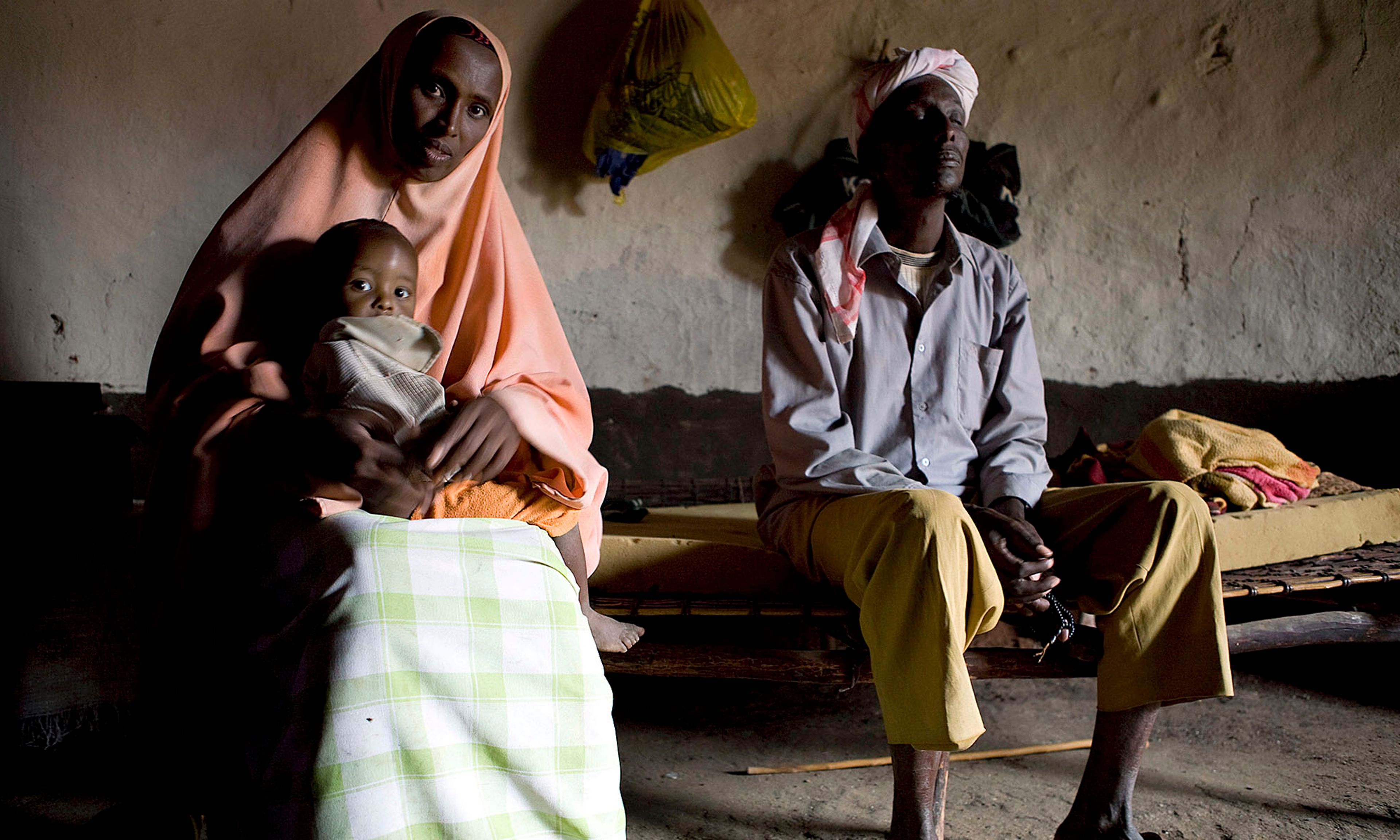
The intersection of the environment and demography continues apace. In the old days, we worried about “overpopulation” in general, which, if only by implication, indicted the fecund mothers of Asia and Africa at least as much as the developed world, if not more. But eco-demography is a more exact science these days. Issuing a stirring call for the British to breed less, and doing it from the exalted perch of the British Medical Journal, doctors John Guillebaud and Pip Hayes explain the arithmetic: Every new baby born in the United Kingdom will in his or her lifetime produce 160 times more greenhouse-gas emissions than a baby born in Ethiopia.
We’ve known for years, of course, that a Brit is worse than . . . well, almost anyone apart from a Yank. But we’ve known it only in the very general sense that the Brit is the purveyor of imperialism, colonialism, racism, economic exploitation, and other planetary toxins. Now environmentalism enables us to nail down the formula once and for all: An Ethiopian baby is 160 times better for the planet than a British baby. So if you’re an Anglo-Celt and you care about the Earth, have fewer kids. Having fewer children is “the simplest and biggest contribution anyone can make to leaving a habitable planet for our grandchildren.”
Grandchildren?
Well, we’ll come back to that.
Guillebaud and Hayes’s gimlet eye on the British maternity ward is matched by Oregon State professors Michael Schlax and Paul Murtaugh’s equally withering gaze on the American nursery in a study called “Reproduction and the Carbon Legacies of Individuals.” Or as the Los Angeles Times headline writer put it: “Tie Your Tubes and Save the Planet?”
Save it for what? And for whom? Presumably for those 160-times-more-environmentally-responsible Ethiopian babies, who’ll get to grow up and enjoy it, albeit briefly. (Ethiopian male life expectancy: 44.6 years.)
I was reminded of one of many striking vignettes in Christopher Caldwell’s new book, Reflections on the Revolution in Europe. He notes that Italy’s “lovely public parks” require a level of manpower the country’s shrinking native population can no longer supply. “Without labor from Algeria and Mali,” he writes, “those parks will either disappear or be ‘automated,’ as American parks are (through sprinkers and the replacement of elegant landscaping with grass). In many walks of life, Italy has a choice between keeping the population looking the way it did 50 years ago and keeping the landscape and the social structure looking the way they did 50 years ago.” They chose to preserve “the environment.”
It works for a while: When there are no Italian gardeners, Algerian gardeners will still lovingly tend their parks in the Italian style even as there are fewer and fewer Italians to stroll in them. But eventually demography tells. A German beer garden is not as beguiling as an Italian park but it has a certain claim on the cultural landscape. According to the Federal Statistics Office, this year German beer sales have fallen to an all-time low. Putting a brave face on the evaporating head of his lager, Peter Hahn, head honcho of the German Brewery Association, attributed the slump to inclement weather. But as he also noted: “We have a changing population. Older people drink less and there are not enough young people to make up for it.”
True. Herr Hahn is a victim of demographic temperance. This month, Eurostat released figures showing that Germany has the lowest birth rate in the EU. That would be a non-alcoholic headache for the German Brewery Association in the best of circumstances. But Herr Hahn was too discreet to add that what few young people Germany now has increasingly belong to a demographic not known for its beer intake. A few months back, when the Merkez Mosque opened in the old industrial working-class town of Duisburg boasting splendid minarets and public subsidies totaling more than 3 million euros, Deutsche Welle reported as follows: “New mosque seen as a symbol of integration.” Maybe. But it’s also a symbol of transformation: There will not be many foaming steins (if you’ll forgive the expression) in Duisburg’s future.
Perhaps the environmentalists are right, and the best way to preserve the planet for the next generation is not to have a next generation. But somebody will. Germany’s Turkish Muslims drink less beer than their Teuton compatriots, but is their carbon footprint otherwise significantly different? I doubt it. The British Medical Journal’s rebuke of English motherhood is already unnecessary: Britain has a below-replacement fertility rate; its population increase depends entirely on immigrants and their children. If Scots and Ulstermen and the like are despoiling the planet, you can tie their tubes. But their place in the maternity ward will be taken by Pakistanis and Bangladeshis, and even some virtuous Ethiopians: As Europe already knows, no matter how fast you self-extinguish, First World infrastructure does not stay empty. Ethiopia comes to you: Abyssinia in all the old familiar places.
As I usually say around this point, the future belongs to those who show up for it. The Germans, Italians, and Spaniards have upside-down family trees of the type the bien-pensants are commending to the Anglo-Americans. But a people without grandchildren cannot grandfather in their environmental fetishism for all eternity. The health of the planet will be determined by those who stick around — like the Ethiopians. I’m chary about predictions but I’d be willing to bet that by the end of this century the anguished Western liberal environmentalist will be on the endangered species list.












Comments