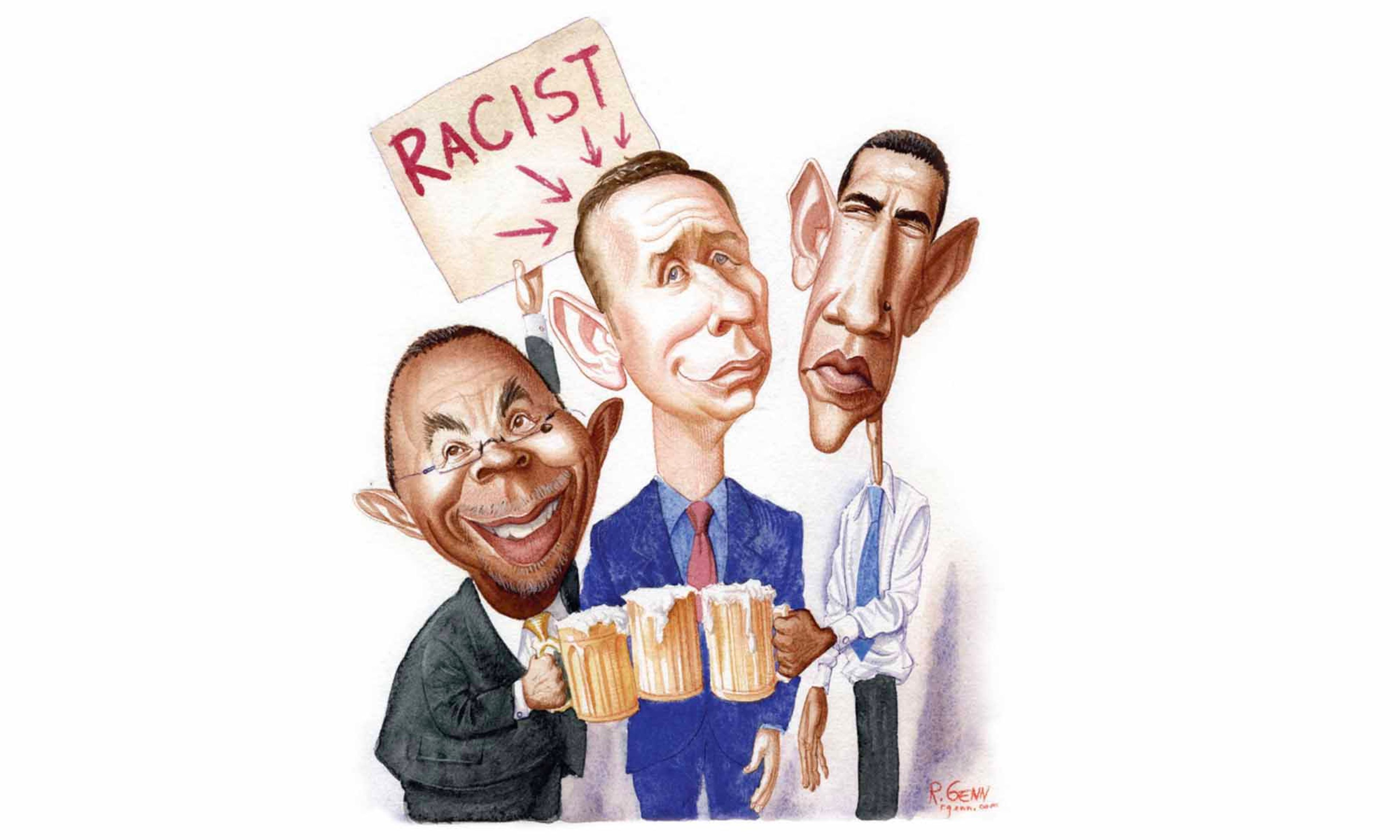
• First the president called him stupid, then he had to have a beer with Joe Biden. Hasn’t Officer Crowley been punished enough?
• “I have immortal longings in me,” said Cleopatra as she clasped the asp. Barack Obama got to go to Olympus much more cheaply, as his cool, America’s racial fevers, and a haggard media establishment desperate for life support boosted him to a kind of divinity. But spring and summer polls show him returning to earth. Washington Post/ABC finds approval of his handling of health care at 49 percent, down from 57 percent in April. NBC/Wall Street Journal shows approval of his handling of the economy also at 49 percent, down from 56 percent in February. USA Today/Gallup finds more disapproval than approval of his handling of both issues (49/47 for the economy, 50/44 for health care). Obama’s personal popularity remains solid, and Republicans have not made up significant ground. But the trillions being thrown around, first to stimulate the economy, then to remake one-sixth of it, seem alarming. Because they are. In the wake of this alarm, Barack Obama rejoins the ranks of ordinary mortals.
• Newsweek ran a cover story arguing that the recession is probably over, leading President Obama to warn against serving champagne. They are both right. The recession has probably been over for months. New unemployment claims have been dropping for many weeks now, which is usually a sign of recovery. The manufacturing index is up, as are home sales and the stock market. The most intense period of inventory contraction seems to be behind us. The economic pain will not be ending for some time. Unemployment is a lagging indicator — more and more of one following recent downturns. Once it drops, all that will be left is for Obama to take the credit.
• The Democrats have raised the cigarette tax. They have said that they will allow tax rates on dividends, capital gains, and high earners to rise next year. They have tried to impose hidden energy taxes through their cap-and-trade legislation. Their health-care bills raise taxes on hiring — which is to say, they indirectly raise taxes on employees. Treasury Secretary Tim Geithner was recently asked on ABC whether the administration had any additional plans to raise taxes in order to close the deficit. In response he said nothing about spending cuts, and he declined to affirm (when invited to do so) Obama’s campaign pledge that people who make under $250,000 will not pay higher taxes. (White House press secretary Robert Gibbs says Obama is committed to the pledge.) Geithner added, “I think what the country needs to do is understand we’re going to have to do what it takes, we’re going to do what’s necessary.” We understand, all right.
• “Cash for Clunkers,” the federal government’s $4,500 car trade-in subsidy — which already has cost taxpayers a billion dollars — is dumb on both environmental and economic grounds. Environmental: It subsidizes the switch from relatively fuel-inefficient cars to relatively fuel-efficient ones, but doesn’t take into account the energy consumed in manufacturing new cars or the environmental impact of disposing of the old ones. Building a new Toyota Prius, for example, uses the equivalent of burning about 1,000 gallons of gasoline, meaning that, in many cases, the “greener” thing would be buying a good used car — which Cash for Clunkers will not subsidize, no matter how fuel-efficient it is. Economic: It is obviously impossible to build wealth by wantonly destroying assets, even if the asset is a 1994 Chevy Blazer with 140,000 miles on the ticker. The Democratic Congress seems set to expand the program, which is as good a symbol as any of Obamanomics.
Start Spreading the TED
While the economic data have continued to be chilly, financial markets have been positively buoyant. The S&P 500, for example, has advanced about 50 percent since its trough in March. The stock market clearly believes that the storm has passed. But stock markets go up and down, often for little obvious reason. There is only one way to know whether the storm has truly passed: It’s time to check back in with “TED.”
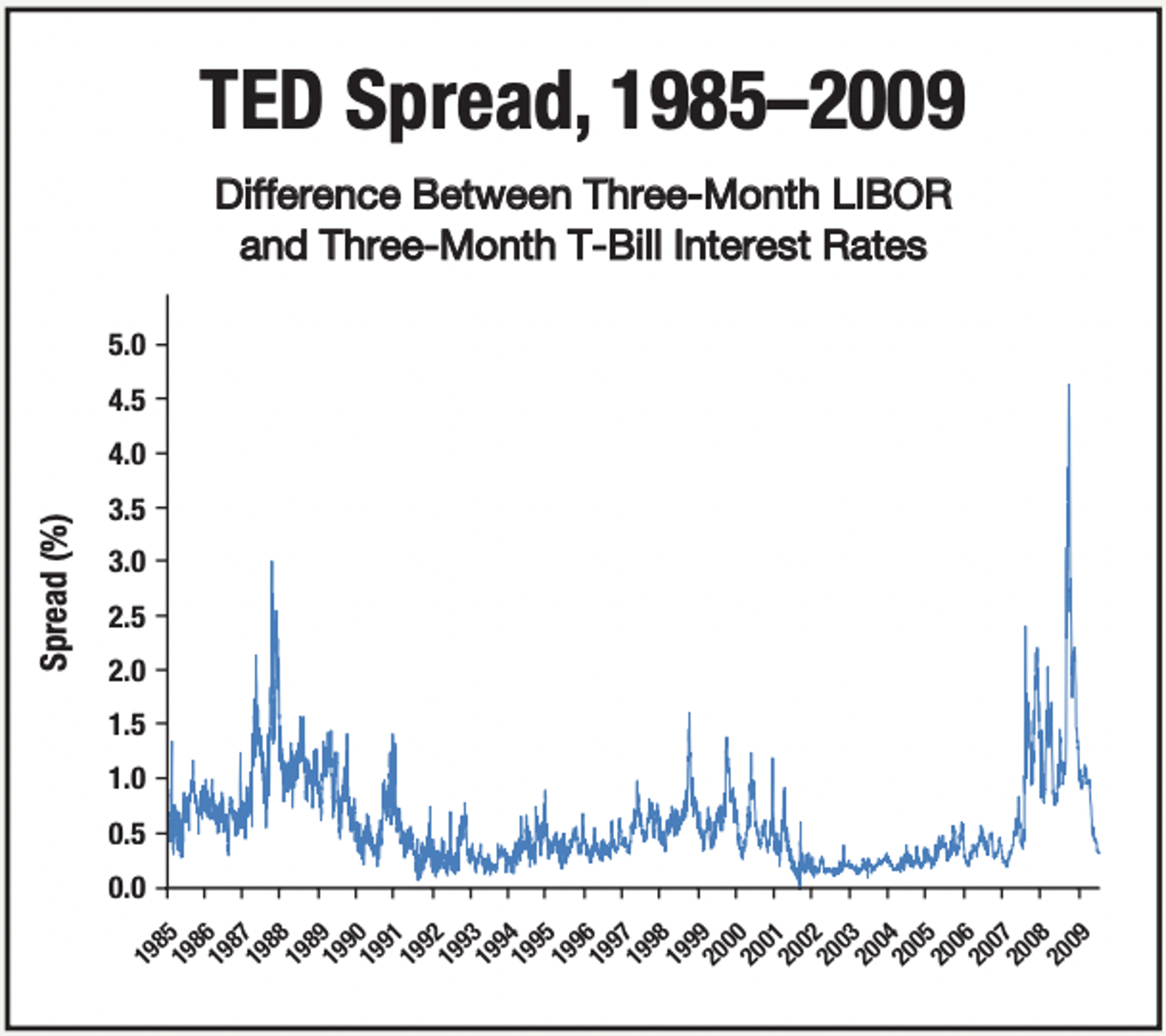
Last October, a chart in this space showed the difference between the rate that the world’s most prominent banks pay one another in order to borrow money for three months and the three-month U.S. Treasury rate. The first rate is called the LIBOR, or the London Interbank Offered Rate. Their difference is known in the industry as the “TED spread.”
If Deutsche Bank borrows money from J. P. Morgan for three months and pays it 4 percent interest, and the U.S. three-month Treasury rate is 3 percent, then the spread on the chart would be 1 percent. Over history, this spread has been about half a percentage point. Last fall it climbed to almost 5 percent. The bluest-chip banks were singing the blues. Interest rates were high because the odds of default were perceived to be high as well. Panic swept faster than swine flu from investor to investor and risk-taking stopped, as did the world economy.
I wrote last fall that surely those defaults could not possibly happen, both because safety nets the world over would catch the plummeting banks and because panics inevitably overstate the likelihood of catastrophe. Indeed, as can be seen in the chart below, the TED spread has returned approximately to its historic norm. Banks have stepped back from the abyss, and no longer treat one another like junk borrowers.
Since financial panic set off the economic calamity, this clear sign that the panic has subsided is a precondition of a lasting recovery. It is necessary but not sufficient. In particular, banks have not defaulted in part because governments and central banks stepped in. Yet governments themselves have rung up enormous debts, both to finance the bank bailouts and to “stimulate” the economy.
Whether the recovery endures will surely depend on the fiscal situation. If government finances return to sound footing, then the government backstop will continue to serve its calming function and the economy will eventually boom again. But if deficits expand, as they will if Obamacare becomes law, then the market may well begin to wonder whether governments have enough resources left to sustain the safety net in the event of another panic. At that point, the panic will recur, and TED will again take center stage.
The TED spread is so low that markets must think that governments will work things out. For those opposed to the current president’s agenda, that might be the best news yet.
— KEVIN A. HASSETT
• By now all America knows of Harvard professor Henry Louis Gates Jr.’s arrest, for disorderly conduct, by Sgt. James Crowley, and Barack Obama’s comment that the Cambridge police had acted “stupidly.” Perhaps even Uighurs and Darfurians know of it. The racial tensions, and the anxiety to resolve them, that helped to propel one of these men to the White House finally brought all three of them there for a beer summit. Hyped and pummeled though the event now is, it still has points of interest. Gates’s angry sense of entitlement marked a member of the overclass and not just a racial grievance monger (among whom Gates is a comparative moderate). Should outbreaks of temper be grounds for arrest? The police work for us, not vice versa. And while it is true that there are reasons black men are more likely to be scrutinized (they commit more crimes), it is nonetheless an affront to the innocent to pay for the sins of the guilty. Still, calm and courtesy is the best policy; and most of our endless national conversation on race does nothing to instill those virtues. The three principals got a beer out of it. America, rather less.
• Much foolishness has become attached to the question of President Obama’s place of birth, and a few misguided souls on the right have indulged it (to the delight of the press and the White House). The president’s birth certificate has been made available to reporters for inspection, and its authenticity has been repeatedly confirmed by the authorities in Hawaii, where he was born. Conservatives ought to leave conspiracy theorizing to the likes of Rosie O’Donnell and the one in three Democrats who believe that 9/11 was an inside job. Obama is a wrongheaded president, but not an illegitimate one.
• A solution in search of a problem: To fulfill the president’s reckless promise to close Gitmo, the administration now toys with creating a new one inside the U.S. — probably in Michigan. That state’s heavily Democratic congressional delegation will offer less resistance than earlier brainstorms — e.g., sprinkling the 230-odd trained jihadists throughout the country — had to face. Because Michigan is an economic basket case, it can be bought off: billions in spending to build a suitable facility, pitched as a job saver for hundreds of corrections officers. But the proposal is ill considered. Gitmo is a perfectly good facility. Even Eurocrats have piped down about it (rather than share the security burden). The alternatives are not as good. Trained terrorists who plot to escape and kill their military jailers are beyond the capabilities of regular corrections officers. Residential areas will have to be protected against plots by other jihadists to free their imprisoned confederates. And federal judges will be able to accord these jihadists the full panoply of constitutional rights — and to order their release.
• Sens. Chris Dodd and Kent Conrad, Democrats both, are recipients of sweetheart deals from disgraced mortgage lender Countrywide, having secured discounted loans under the firm’s infamous program for “Friends of Angelo” — that’s Angelo Mozilo, the former CEO. Alphonso Jackson of the Bush cabinet and Donna Shalala of the Clinton cabinet were Friends of Angelo, too. Dodd and Conrad avow that they had no idea they were receiving special treatment because they were senators. Robert Feinberg, who managed Countrywide’s VIP program, says otherwise. Dodd has a history of dodgy real-estate deals. He purchased a Washington condo with the aid of Edward Downe Jr., a financier later convicted in a massive insider-trading and fraud scheme (and pardoned by Bill Clinton, thanks to the intercession of Chris Dodd); then he purchased a seaside estate in Ireland with one of the same fraudster’s business partners. Senator Dodd is chairman of the Senate Banking Committee, with a portfolio that includes financial reform. Senator Conrad chairs the Budget Committee. Each claims not to know a good deal when he sees it — and signs his name to it.
• It sounds like a far-fetched Ayn Rand story line (is there any other kind?): Andrew J. Hall, the head of Phibro, a small commodities-trading firm based in Connecticut, is being set up as a candidate for public crucifixion. That is because Hall has done a particularly good job this year for one client — Citigroup. He is an oil trader, and, under the terms of his contract with the struggling financial giant, he is entitled to a percentage of the profit he produced for the bank this year — and that number comes out to about $100 million. Citigroup, recall, was bailed out with $45 billion in taxpayers’ money, and the Washington “pay czar” — dreadful phrase to read, isn’t it? — has been snooping around and may try to block the payout. Yes, $100 million is a lot of money, and financial-industry compensation can be mind-boggling to those of us in less rarefied tax brackets. But consider this: Hall has made Citigroup about $2 billion in the past five years, so his big payday is equal to about 5 percent of what he’s produced. If every Citigroup operation performed as well as Hall’s, there’d have been no bailout. Hall and Phibro, the New York Times reports, are so disgusted by bailout politics that they are looking to end their relationship with Citigroup. And there you have Bailout Nation in a nutshell: The failed and failing are propped up while the profitable are forced from the field. Surely this, and not a sudden decline in literary taste, explains the surging sales of Atlas Shrugged.
• President Obama may be silver-tongued, but he botched his recent press conference, broadcast on television in prime time. He repeatedly stepped in it, insulting doctors, policemen, and probably others, too. If he and his team could efface this press conference from the record, they would. But what did Tom Shales, the Washington Post’s television critic, think of it? “About the most justifiable criticism that could likely be made: ‘Barack Obama still seems too good to be true.’” No doubt he thinks the same thing about his journalism.
• John Holdren, director of the White House Office of Science and Technology Policy, has the résumé, well-credentialed and slightly boring, of a lifelong academic and science bureaucrat. In 1977, however, he walked on the wild side, co-authoring Ecoscience: Population, Resources, Environment, a course book, with Paul and Anne Ehrlich. The Ehrlichs were population-explosion scaremongers; the book they and Holdren wrote discussed the issues involved in this supposed problem. The solutions they considered make interesting reading: mandatory family limits, compulsory sterilization, a worldwide “Planetary Regime” to coordinate all of the above, along with resource development and consumption. These ideas are presented in a foam of hypothesis, but the urgency is plain, and on Planet Holdren, rights, ethics, and religion give way to the crisis. When Barack Obama promised to “restore science to its rightful place,” is this what he had in mind?
• You can tell a lot about a president by the Medals of Freedom he awards. President Obama, in his first round, is giving one to Mary Robinson, the erstwhile U.N. official. Indeed, she was the perfect U.N. official: a tribune of the Third Worldists and Israel-haters. It was she who presided over the 2001 Durban conference, that hate-filled, anti-Semitic jamboree. The late Democratic congressman Tom Lantos (a Holocaust survivor) said that “much of the responsibility for the debacle” rested with her. Some Jewish groups have expressed disappointment over Obama’s decision to honor her. In response, she has said, “There’s a lot of bullying by certain elements of the Jewish community. They bully people who try to address the severe situation in Gaza and the West Bank.” Yes, she is the perfect U.N. official — and the perfect recipient of an Obama Medal of Freedom.
• Kay Bailey Hutchison has decided to leave the Senate and challenge her fellow Republican, Rick Perry, in his bid for reelection as governor of Texas. Both are conservative, Perry a little more so. The state’s economy is doing well, remarkably well given the national climate. Texas is not running a deficit. So what’s the case for unseating Perry? Hutchison’s attacks on him have an ad hoc feel. “Yet another Rick Perry disaster” was her description of the governor’s decision to turn down $55 million out of $14 billion in federal stimulus funds for the state. Her position is wrong and her passion is fake. In Washington she has been an effective senator and supported worthwhile policies. It would be a shame if she ended her career with a vanity project.
• Typically, when politicians want to keep an event on the down-low, they time it so that news breaks at close of business on a Friday. Once in a while, though, a little more secrecy is in order. This, apparently, was the case with the California state assembly’s vote on a plan to allow more offshore drilling near Santa Barbara: After the plan was defeated, the assembly voted to expunge the vote. (There’s no word on whether they also intend to vote to expunge the vote that expunged the vote.) Somehow, this Orwellian tactic was not immediately controversial; the assembly approved it with a voice vote, and not a single assemblyman objected. But the expunging of a public record — a major blow to government transparency — is not merely inept, it is corrupt, and those who enabled it deserve a sharp rebuke from the voters.
• It was as stark a case of voter intimidation as you will probably ever see. And, thanks to modern technology, you can see it on YouTube. On Election Day in Philadelphia, members of the New Black Panther party stood outside the polls wearing paramilitary gear and wielding nightsticks. They issued threats and insults. One Panther told a voter, “Cracker, you about to be ruled by a black man.” Republican poll watchers, a husband and wife, were called “race traitors.” (They were black.) The Justice Department won a default judgment against the Panthers in federal court — not very difficult, given the circumstances. But a funny thing happened when the DOJ went to seek sanctions: Its new political appointees, overruling the career lawyers, dropped the case. This decision has left Republicans, and maybe some others, confused and alarmed. Congressman Frank Wolf said, “There are many questions that need to be answered. This whole thing just stinks to high heaven.” Not to worry, though: One of the Panthers is getting his just deserts. As the Washington Times reported, an injunction prevents Mr. Samir Shabazz from brandishing a weapon outside a polling place through Nov. 15, 2012. Justice spokesman Tracy Schmaler said that the department “will fully enforce the terms of that injunction.”
• The Fire Department of New York lost 343 firefighters in the collapse of the World Trade Center following the 9/11 attacks. You know that these firefighters were heroes. Did you also know that they were the beneficiaries of “intentional race discrimination”? That was the complaint lodged against the FDNY by the U.S. Justice Department under the last administration. New York City was 25 percent black, 27 percent Hispanic at the time; corresponding percentages for firefighters were 3.4 and 6.7. The discrepancy arose because black and Hispanic applicants to the city’s Fire Academy passed the entrance examinations at a much lower rate than other groups. What could this be but intentional discrimination — examination questions subtly slanted to fox nonwhite examinees? District-court judge Nicholas Garaufis has now given summary judgment for the plaintiffs. In a 93-page ruling he declared that the entry-level examination was “not fair” and “not adequately related to the job for which it tests.” Nowhere in those 93 pages did the judge show an instance of a question that was unfair to minority test-takers or unrelated to firefighting skills. Nor did he suggest a selection procedure more objective than written testing. How could he? There is none.
• The City of Los Angeles is asking Washington for $30 million to finance a ten-year run of the Cirque du Soleil, prompting economist Donald Boudreaux of George Mason University to lament: “So it’s finally come to pass — America has embarked on the same road down which ancient Rome marched to its ruin: Uncle Sam not only subsidizes bread (by subsidizing wheat production) but now also circuses.” Clowns.
• Tehran 2009 is a replay of Stalin’s Moscow. The show trial has once again come into its own, demonizing selected victims and terrorizing the public. By this means the “Supreme Leader,” Ali Khamenei, and his mouthpiece, Mahmoud Ahmadinejad, are establishing their power just as Stalin once did. About 100 defendants have been brought into court, most of them shackled, all dressed in prison gray uniforms, and with plastic shoes and no socks. Clerics are deprived of their turbans. The accused have been carefully selected as men who once held important posts, so that examples may be made of them, under threat of the death penalty. In pure totalitarian style, defendants plead guilty to harming the Supreme Leader and the revolution, and to being agents of foreign powers. Outside the court, paramilitary forces are making sure to be in control. So confident was Stalin of public opinion that he allowed foreign correspondents to cover his show trials, but Khamenei allows only official media. Dissidents speak of hundreds, even thousands, in jail awaiting summary justice, and torture and execution appear commonplace. Nobody can verify the names or numbers of the victims, but the son of an aide to one of the losing presidential candidates, it is reliably confirmed, has been beaten to death in prison. Repression is stoking the rage of the population.
• Slate’s Jacob Weisberg has figured out what’s wrong with Barack Obama’s Iran policy — George W. Bush. “Surely if not for Bush, Obama’s instinct after the Iranian election would have been to identify with those risking their lives to free their country, not to get back to his attempt at dialogue with Ahmadinejad.” But surely Obama’s instincts as a left-liberal are to defer to despots, so long as they are of color and anti-Western. Iran’s possession of nuclear weapons, now or soon, makes the left-liberal even more temporizing. Meanwhile, think of the years of power and influence that stretch before George W. Bush. FDR, who was president for only three terms and change, has nothing on him. W. will be shaping policy as long as the Weisbergs of our time walk the earth.
• During Bush’s time in office, the U.S. Interests Section in Havana was a very interesting place. We erected a mockup of political prisoner Oscar Biscet’s cell — to dramatize his plight, and that of his fellows. We had Lech Walesa speak to dissidents by video hookup. And so on. We were engaged with the population, not merely the dictatorship. We also had — another of our gestures or gambits — a news ticker. This flashed information to Cuban passersby: information that the dictatorship was not keen for them to see. In Cuba, there is only one news source: the dictatorship. Well, the Obama administration has now turned the ticker off. Cuba turns out to be the one place where liberals aren’t for a Fairness Doctrine.
• Venezuelan president Hugo Chávez was already upset that Washington and Bogotá are negotiating a military pact that would enlarge the U.S. presence in Colombia. Then, on July 27, Colombian vice president Francisco Santos announced that Colombian troops had recovered Venezuelan anti-tank rocket launchers (originally made in Sweden) from the FARC, the leftist narcoterrorists who have waged a guerrilla war in Colombia for decades. Chávez responded by freezing diplomatic relations with Bogotá. His government continues to deny that it has aided the FARC, but those denials are now risible. A new U.S. Government Accountability Office report confirms that American officials believe Venezuela has provided the FARC with “safe haven” and “material support.” In a May 2008 speech, Barack Obama pledged that his administration would “shine a light on any support for the FARC that comes from neighboring governments. This behavior must be exposed to international condemnation, regional isolation, and — if need be — strong sanctions.” Tough talk. But will he back it up?
• The elder statesmen of Central and Eastern Europe have got together to write an open letter to President Obama, and an extraordinary document it is. The 22 signatories include former dissidents who became heads of state, including Lech Walesa and Václav Havel, plus other presidents, prime ministers, and foreign ministers from the years after the fall of Communism. These men and women are representative of the gratitude, indeed outright love, that their countrymen feel for the United States because it freed them from the Soviet grip. But now America’s popularity and influence are declining. “All is not well either in our region or in the transatlantic relationship.” They see Russia intimidating its neighbors, “pursuing a 19th-century agenda with 21st-century tactics.” A stronger NATO would make them feel more secure. Nor should Russia be allowed to undermine America’s planned missile-defense installations or disrupt energy supplies in Europe. Expressing themselves with unmistakable sorrow, they feel neglected, taken for granted. Given that the Obama administration is busy promising an open hand to many other countries — and many of these unfriendly — they are quite right to be anxious.
• Natalya Estimerova is the latest to pay the price in Russia for documenting the abuse of human rights. Part Chechen herself, she worked in Grozny, the capital of Chechnya long since reduced to rubble and ruin by the ruthless war waged by Russia against local separatists. A historian by training, Estimerova traced prisoners and hidden graves, and handed her dossiers to prosecutors. She confronted Ramzan Kadyrov, the Chechen president put in by Moscow to do the dirty work and himself accused of participating in torture and executions. Then a white car, or possibly a van, drew up outside her house, and she was heard shouting that she was being kidnapped. The car was waved through checkpoints, an indication that it was recognized as official. Later that day, Estimerova was murdered and her bullet-ridden corpse thrown out by the roadside. Human-rights activists accuse Kadyrov of responsibility for the crime, but in all such cases he makes the implausible claim that some of his enemies are killing others of his enemies for the purpose of discrediting him — as though that were necessary. At least two other opponents of his have been killed in recent weeks. As usual in today’s Russia, there is no likelihood that Kadyrov or anyone else will be brought to justice.
• Anti-Christian rioting in the town of Gojra in eastern Pakistan claimed the lives of several persons, including women and children. Some were shot, some burned to death in their houses. Twenty others were injured. Fifty houses were burned. The occasion of the rioting was a rumor that pages from the Koran had been desecrated at a Christian wedding. Christians make up around 5 percent of Pakistan’s population and enjoy theoretical protection from the majority’s abuses. But when that majority includes uneducated masses and jihadist fanatics, legal protections can be very theoretical indeed.
• In early July a squad of police burst into a restaurant in Khartoum, the capital of Sudan, and arrested several women on charges of indecency. The nature of the indecency was that the women were wearing trousers. Most of the perps accepted summary punishment of ten lashes each. Lubna Hussein, however, chose to go to trial in hopes of getting the law changed. If convicted at trial, Mrs. Hussein, a thirtysomething widow who works as a journalist, will face 40 lashes administered in public. She is, however, a lady of admirable spirit, and has been bravely defiant of the Islamic authorities, sending out printed invitations to her trial and averring that “I am ready to be whipped not 40 but 40,000 times.” We wish her well, and hope she will not be too disturbed by the fatwas that are surely being called down on her even as we write.
• Out of the blue, the British home secretary, Jacqui Smith, put Michael Savage on a list of people banned from entering Britain. Savage’s San Francisco radio show is certainly nasty, but who knew it had such long-range power? The others on that list were extremists and gangsters of one sort or another, most of them Islamists. And Savage? According to Jacqui, he could foment hatred in a way “likely to cause inter-community tension or even violence.” Leaked memoranda revealed that in truth he was on the list only to counter-balance all the Islamists. Meanwhile Jacqui was on quite another list — also leaked to the national press — of those claiming parliamentary expenses to which they might not be entitled. The nation was suddenly entertained to learn about her bath plug, for instance, which cost the taxpayer 89 pence, and about porno films bought for her lonesome husband. She protested that she hadn’t been trained for a job of the home secretary’s importance, whereupon, in a comic-opera finale, Prime Minister Gordon Brown sacked her. For years to come, Savage need only mention her name to be sure of a laugh.
• It is a staple of Palestinian propaganda that Israeli authorities smuggle drugs into the Palestinian territories in order to corrupt young Arabs. Hamas, the terrorist group now in charge of the Gaza Strip, has come up with a new variation on this well-worn theme. Hamas police spokesman Islam Shahwan claims that aphrodisiac chewing gum has been found in the territory, and its distribution linked to “Zionist intelligence services.” A young Palestinian girl had experienced “dubious side effects” (not further specified) after chewing the gum. Given Israel’s well-known demographic anxieties (population annual growth-rate percentages: Israel 1.67, Gaza 3.35), it all seems wildly unlikely; but then, so does the prospect of sanity’s breaking out in Hamas-ruled Gaza anytime soon.
• The Italian weekly magazine L’espresso published transcripts of conversations it claims took place between Prime Minister Silvio Berlusconi and a young lady named Patrizia D’Addario, who is a professional escort. Sig.na D’Addario released the tapes because Berlusconi did not arrange a zoning permit in return for her services, as he had promised to do. When she pressed him on the matter, the PM offered her a seat in the European Parliament instead. Che ingiustizia! The tapes, however, are not unflattering to 72-year-old Berlusconi. On one, apparently recorded at breakfast following an entire night of transactions, the lady reported having been completely satisfied for the first time in several months. When confronted with L’espresso’s revelations, the PM responded: “Non sono un santo.” And people say Europe is finished!
• The New York Times had to publish what its own public editor called “an especially embarrassing correction,” addressing seven errors in one story. Since the story was an obituary for Walter Cronkite, whose reporting did a lot to fix in the public mind the mistaken idea that the Tet Offensive was a great military victory for the Viet Cong, we can’t help but find the incident a fitting sendoff.
• Cool enough for you? This July, Chicago experienced its lowest average temperature since at least 1942, when the recording station was moved to its current spot; New York City was colder than it’s been for at least a century; and in Minneapolis, John Hinderaker of the Powerline blog reported witnessing “something I’ve never seen before: a man wearing a winter coat in July.” Proof that global warming is a fraud? Of course not. It’s disappointing that none of our clairvoyant atmospheric scientists predicted this year’s cold spell, but quite understandable: Temperatures are affected by many things, including long-term cycles and sunspots, which can overwhelm the likely effects of greenhouse gases. So climate-change skeptics should be cautious, exercise restraint, and remember that one year’s results cannot prove or disprove a theory — just as climate-change believers like Al Gore will undoubtedly do the next time there’s a heat wave . . .
• It has been a long while since the Philippines was a fixture in the international news. In the 1980s, along with South Africa and a few other countries, it fairly dominated the front pages. These are the essential facts: A man named Benigno Aquino was a prominent leader of the opposition. The dictator, Ferdinand Marcos, first jailed him, then exiled him. When he returned from exile in 1983, he was shot dead, even before his feet were able to touch the tarmac. Aquino’s widow, Corazon, became the symbol of the opposition. In 1986, she challenged Marcos in an election. This was “people power.” The candidate was known as “Cory” the world over, and her color was yellow. People in countries far and wide wore it, in solidarity with her and her movement. She won the election; but Marcos tried to cheat her of it. Crowds massed in the streets. The situation was volatile, dangerous. The Reagan administration finessed Marcos’s departure, and that was that. Corazon Aquino served a six-year term, then gave way to future leaders. The Philippines has a great many problems, but holds on to democracy. Aquino — with her religious dignity and democratic spirit — performed well at a critical hour. She took the dramatic and awful circumstances of her life and did good with them. She has now died at 76. R.I.P.
• Leszek Kolakowski was a crucially important anti-Communist thinker; his three-volume work Main Currents of Marxism (1976–78) has deservedly been considered a classic ever since its publication. But Kolakowski was more than just a politically engaged intellectual: He was a lasting exemplar of the life of the mind at its very best. His writing is suffused with a love of truth, a love that manifested itself in the scrupulous fairness of his accurate and sympathetic presentation of differing views. His 1995 book God Owes Us Nothing: A Brief Remark on Pascal’s Religion and on the Spirit of Jansenism is a model of how to write about spiritual matters, which were Kolakowski’s central concern. Leszek Kolakowski died on July 17, at age 81. R.I.P.
• Ernest Lefever grew up as a Christian pacifist, and his conscience kept him out of uniform during World War II. Over time, he maintained his faith but came to realize that America’s most aggressive foes sometimes require a fight, especially the totalitarians. He endured a fight of his own in 1981, when President Reagan asked him to serve as assistant secretary for human rights at the Department of State. In a fit of anti-anti-Communism, Senate liberals rejected the nomination. Lefever returned to the Ethics and Public Policy Center, a think tank he had founded in 1976, and ran it until 1989. There, he helped steer the Evangelical movement toward a serious engagement with public-policy problems. His research undermined the credibility of the World Council of Churches, a left-wing front group. When he wasn’t promoting freedom at home and abroad, he enjoyed stamp collecting, woodworking, and limericks. Dead at 89. R.I.P.
• Sidney Zion, lawyer, journalist, and raspy-voiced raconteur, though born in Passaic, N.J., was a mainstay of New York life and nightlife for almost 50 years. If you went into Elaine’s, he would be holding down a table and commenting on the passing scene, including you. Zion had anecdotes and opinions about everyone and everything, from the Pentagon Papers to Roy Cohn to mobsters. (One of Zion’s best: After a mob informant was defenestrated, a former colleague offered a toast, “To the canary, what could sing, but couldn’t fly.”) When his 18-year-old daughter Libby died from mistakes in her care in a New York hospital, Zion became a crusader, ultimately pressuring the state to limit the shifts of interns and residents to 24 hours straight, down from an impossible 36. Dead at 75. R.I.P.
• A week after the death of Henry Allingham, another British veteran of World War I, Harry Patch, passed away. He manned a machine gun in the Duke of Cornwall’s Light Infantry and fought in the battle of Passchendaele (or Third Ypres) beginning in June 1917. Over the next five months half a million men lost their lives. Patch was spared until September, when a German shell killed three members of his crew and injured him, taking him out of the war. As a centenarian, Patch spoke with passion of the war’s pointlessness. “It was not worth it, it was not worth one let alone all the millions” of lives lost. “The Germans suffered the same as we did,” he would add. Yet Patch performed air-raid duty in World War II, and admitted that he would have shot the Kaiser and Hitler to save lives. So would we all, except for the most dedicated pacifists, but the opportunity never arose. Dead at 111. R.I.P.
Fight the Fallbacks
In 2007, Barack Obama told a union group about his plans for health care. “I don’t think we’re going to be able to eliminate employer coverage immediately. There’s going to be potentially some transition process.” The “public option” that his administration is promoting — a government-run insurance program open to all Americans — is part of that transition. It will both compete with private insurers and be able to shift its costs to them. Over time private insurers will be squeezed out and we will be left with a government monopoly on health insurance: single payer. But don’t take our word for it. Rep. Barney Frank, a supporter of that monopoly, has recently said that the public option is “the best way to lead to single payer.” Liberal representative Jan Schakowsky has echoed the sentiment.
Removing the government insurer from the health-care bills in Congress would, unfortunately, merely slow down this transition. Even without that public option, all the leading bills rely on mandates, regulations, and subsidies that will increase the government’s role in health care. The mandates — effectively, they are taxes — will reduce wages, limit new hires, and increase prices. The subsidies, hugely expensive from the outset, can be expected to grow with time to cover a larger and larger share of the population, just as Medicaid has done, and for the same political reasons. The bills also contemplate having the federal government tell doctors and hospitals what constitutes appropriate medical practice. Much more ill than good seems likely to come of that.
Most of the Democrats believe that markets cannot work in health care or can do so only under the direction of the government. Under duress they may make concessions on the speed with which we move to a new, government-heavy system. But they are not going to change direction. Those of us who disagree with their basic point of view should be clear about our goal: to stop this train, not just slow it down.











Comments