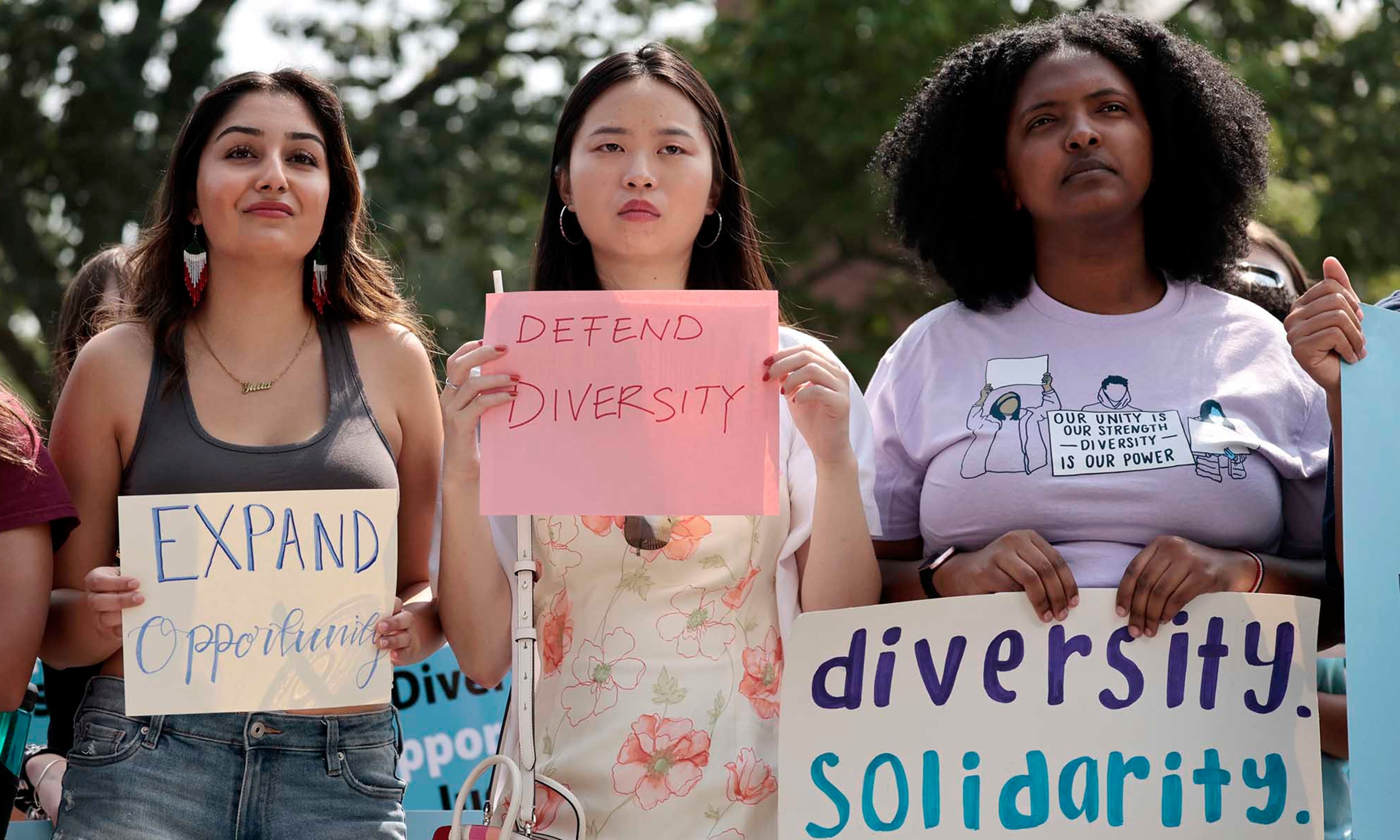
This June, pointing to both the plain language of the 14th Amendment and the Civil Rights Act of 1964, the Supreme Court ruled race-based college admissions unconstitutional. As Chief Justice Roberts wrote in Students for Fair Admissions v. Harvard, “eliminating racial discrimination means eliminating all of it.”
The college–industrial complex immediately announced its intent to subvert the ruling. Stanford law professor Richard Thompson Ford took to the Chronicle of Higher Education to argue that colleges shouldn’t “help promote the covert segregationist agenda of a reactionary faction of the court.” The American Education Research Association insisted, rather bizarrely, that “the Court did not expressly overrule prior rulings that allow race as a factor in admission.” Damon Hewitt of the Lawyers’ Committee for Civil Rights Under Law said: “No matter what this court says, nothing can deprive us of what we call a race conscious future.” The Washington Post editorial board helpfully floated work-arounds, such as eliminating merit-based scholarships and favoring applicants who claim “challenges relating to their race.”
After President Biden declared, “We cannot let this decision be the last word,” his assistant attorney general for civil rights encouraged a national summit of college leaders to heed Justice Ketanji Brown Jackson’s dissent. The official took care to highlight just one point in the majority opinion: Roberts’s disclaimer that nothing in the opinion “should be construed as prohibiting universities from considering an applicant’s discussion of how race affected his or her life.”
Given the secretive reality of selective admissions, it’ll be tough to ensure that colleges abide by the law.
In truth, the problems go far beyond race-based (or legacy) admissions, and the solutions should, too. It’s time to stop sending a fortune in public funds to colleges that select students in accord with an ethos of self-serving convenience: favoring the offspring of wealthy donors, dressing up suspect agendas in the guise of “holistic” admissions, and pocketing massive taxpayer-subsidized premiums from students seeking admission to their charmed circle.
Such a proposal isn’t as radical as it may seem. For one thing, to be eligible for federal aid, colleges already accept a raft of conditions, including a number of rules regarding admissions, such as the prohibition on paying recruiting bonuses to admissions staff. For another, “selective” colleges constitute only a tiny slice of higher education. In 2019, Pew sampled 1,364 four-year colleges and found that just 46 of them accepted fewer than 20 percent of applicants; over half admitted two-thirds or more.
Elite-college presidents like to lecture the nation about equity while running a boutique cartel of famed, deeply endowed, and extraordinarily influential breeding farms for left-wing ideology. Their admissions regime processes students who can afford pricey application coaches or whose highly educated parents carefully “review” their personal essays. Indeed, new research by Harvard’s Raj Chetty finds that legacy students from families in the top 1 percent of the income distribution are five times more likely to be admitted to the nation’s most selective colleges compared with middle-class applicants with similar test scores and demographics.
The hypocrisy runs deep. College leaders lament the nation’s declining faith in higher education even as they oversee admissions processes that the 2019 Varsity Blues investigation and the affirmative-action lawsuits have shown to be rife with extortion and fraud. Indeed, in 2023, more than 60 percent of college students reported lying on their applications (about their high-school activities, their personal experiences, and even their race). And, inevitably, a fascination with getting beyond “mere” academics has rewarded applicants who have access to savvy guidance counselors and pricey travel programs in sports, or has led them to spend their high-school years advocating fashionable progressive causes.
Higher-ed apologists offer several justifications for selective admissions. None are compelling.
It’s suggested that good teaching is a scarce commodity and the best college teachers should work with handpicked students. Even if one accepts the premise, though, researchers have found no evidence that teaching at elite colleges is better than at other schools. That’s no surprise, given that faculty at selective colleges are rewarded for their research, grants, and star power — not their classroom chops.
Selective colleges argue that they identify the students most likely to benefit from their offerings. But there’s cause to doubt whether admissions staff can fairly or responsibly make such determinations. After all, the affirmative-action litigation illuminated long-standing pathologies, such as the preferences enjoyed by connected applicants and the reductionist racial caricatures that dot admissions files. Chetty raised additional questions about these processes, noting that admissions staff score applicants from the top income percentile significantly higher on nonacademic traits than they score those from less affluent families.
Some argue that only high-achieving students are prepared for the rigors of selective schools. In reality, though, these schools aren’t particularly demanding. Grade inflation has exploded at selective colleges in recent decades (Harvard’s average GPA climbed to 3.8 in 2022), despite evidence that students are studying less than they used to. These schools celebrate their near-perfect completion rates: Ninety-eight percent of Princeton and Harvard students graduate, as do 97 percent of students at Swarthmore and 96 percent at the University of Chicago. Anyone who has spent much time at these schools knows the expectation is that, once students are in, they’ll get waved through.
Finally, there’s supposedly great value in assembling a curated population of “diverse” students. When one takes a hard look, though, the student bodies at selective colleges aren’t obviously deserving or diverse. Ivy League schools admit more students from the top 1 percent of the income scale than from the whole of the bottom 60 percent. The Harvard litigation revealed that nearly half of the students are enrolled thanks to some preference, such as being a legacy applicant or the child of a wealthy donor. Meanwhile, 68 percent of Ivy League students are Democrats, and just 12 percent are Republicans. The data suggest that selective schools do an exceptionally poor job of fostering free inquiry or debate, with a national survey of 37,000 students by FIRE and College Pulse, for instance, finding that elite-college students are more likely than their peers to think it’s okay to shout down speakers or use violence to prevent objectionable speech. One can see the value of students’ interacting with diverse peers and still think today’s groupthink bubbles are ill suited to bringing it about.
Selectivity is no longer about fulfilling an educational mission (if it ever was). Today, it’s mostly an exercise in influence-peddling and progressive social engineering. Yet selective colleges have been free to continue with business as usual because they operate as an entrenched oligopoly, insulated from the consequences of competition by massive endowments, powerful alumni networks, vast public subsidies, and a captive accreditation and regulation regime. As with exclusive country clubs, colleges use admissions policies to help pad their coffers, extend their influence, and curry favor among elites.
Colleges have a First Amendment right to free association and may admit whomever they like. But the public has no obligation to keep subsidizing institutions whose membership is determined by a suspect, self-serving process that neither advances the public interest nor aligns with American principles of equal opportunity, earned success, and meritocracy.
To those who’d say, “Colleges know what they’re doing; this is a private affair,” the problem is that this is decidedly not a private affair. Colleges aren’t like hoity-toity country clubs, which may be tax-exempt but are otherwise privately funded. Even selective private colleges collect a fortune in taxpayer-funded aid, subsidies, and grants. In 2021, private institutions including MIT, the University of Pennsylvania, Columbia, and Duke each pocketed more than a billion dollars in public funds. Between 2010 and 2015, Ivy League schools collected a total of $4.3 billion each year in federal grants, contracts, and direct payments (and this tally doesn’t even include federal student loans).
If colleges wish to be eligible for publicly funded grants, contracts, or aid, they should be required to establish transparent admissions qualifications and then randomly select from among those who qualify. For particular programs that require particular knowledge or skills (think engineering or dance), institutions should be free to set a higher bar, require auditions, or institute similarly open and competitive measures.
That would be a recipe for elite colleges to get back to accentuating merit (marking a stark U-turn at a time when 80 percent of colleges no longer require the SAT or ACT for admission). Clear, performance-based admissions just might help college leaders start to rebuild some of the public’s collapsing trust in higher ed, and it’s almost sure to make colleges more inclusive. In fact, Chetty has observed that, while higher-ed ideologues decry testing as racist, selective colleges that employ clear academic criteria enroll a larger share of middle- and low-income students than those employing “holistic” approaches. MIT, for instance, is more socioeconomically diverse than most elite colleges, owing to its emphasis on the SAT.
Eligibility for public funds should also hinge on colleges’ transparently reporting data on applications and admissions and having the data regularly audited by a third party. The Harvard and University of North Carolina affirmative-action cases illuminated the opacity of selective admissions. Normalizing disclosure would enable prospective applicants to make better-informed choices.
Reforms such as the ones I have outlined will mightily inconvenience both the admissions consultants charging $950 an hour to game the system and comfortable campus bureaucrats such as the University of Chicago’s admissions dean, who earned $825,283 last year. So be it. This cosseted exercise in insider trading is overdue for some healthy disruption.
Ending public subsidies for colleges that embrace the ethos of a restrictive country club isn’t radical — it’s democratic, meritocratic, and equitable. Taxpayers have the right to ask publicly subsidized institutions of higher education to focus on educating qualified students and to set transparent, performance-based requirements for admission. Colleges that prefer to use a subjective and self-serving approach ought to do it on their own dime.











Comments