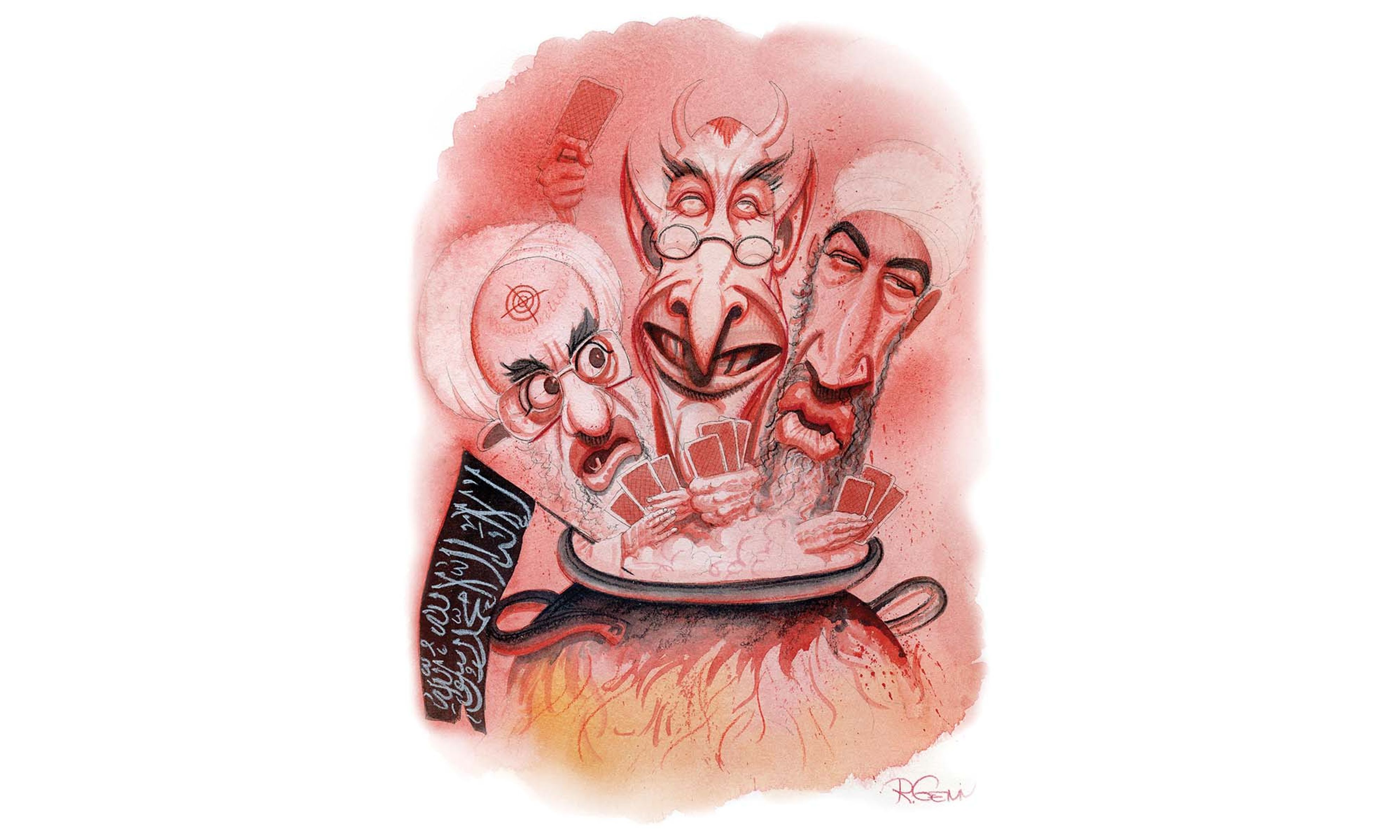
• The good news: The Biden administration can finally claim honest credit for creating thousands of new jobs. The bad news: They’re all in the IRS.
• As we go to press, the FBI has searched former president Donald Trump’s Mar-a-Lago estate. Ostensibly, the Department of Justice is moving on long-standing claims by the National Archives that, upon abruptly vacating the White House in January 2021, Trump shipped documents that were government property under the Presidential Records Act, including classified information, to Florida. That raised the specter of felony misconduct unless Trump had declassified such intelligence while he was still president (which is unclear). Nevertheless, the DOJ rarely prosecutes the mishandling of classified information (see: Hillary Clinton).
• If, as it will undoubtedly insist, the Justice Department had no choice but to take the action it did, it will presumably feel comfortable making that case before the American public. It should do so immediately. Transparency is the bare minimum that law enforcement can provide to reassure the public that it understands the difference between enforcing the law and abusing its discretion.
• Republican primary voters in 2022 have defied narrative, defied direction, and defied advice. They rewarded some Republicans who stood their ground against Donald Trump, and punished others. Most recently, Wisconsin house speaker Robin Vos survived a spat with Trump, but Arizona house speaker Rusty Bowers did not. They sent packing candidates of dreadful character such as Eric Greitens in Missouri, but elevated others with significant baggage such as Herschel Walker. They followed Trump’s often imprudent lead in divided primaries, most recently elevating Blake Masters for the Senate in Arizona. They renominated some House Republicans who voted to impeach Trump, but ousted more, with Liz Cheney’s fate yet to be decided. Their worst decisions have come in governor’s races, most recently in choosing 2020 election conspiracist Kari Lake for Arizona’s governorship. Brian Kemp ran successfully on his own record in Georgia; Rebecca Kleefisch in Wisconsin failed to overcome a Trump-backed opponent on the basis of her successful partnership with Scott Walker. The lesson: Candidates, ideas, and campaigns still matter, and Republicans may pay in November in races where those things matter differently than they did in the primaries. A broader lesson is that the party still hasn’t decided what it wants to be after Trump — or even if it wants “after Trump” to happen yet.
• Texas governor Greg Abbott may not have the power to enforce immigration laws while Washington refuses, but he does know how to put on a show. He has brought attention to the border crisis by sharing his state’s burden with Democratic-run cities such as New York and Washington — whether they like it or not. Abbott has been loading illegal immigrants onto buses in his state and sending them to places such as the Port Authority Bus Terminal in Manhattan. New York mayor Eric Adams calls the practice “horrific,” but, given the terminal’s usual state, New Yorkers will probably hardly notice anything short of a Walking Dead–style zombie apocalypse. The scene is chaotic — that is, after all, the point: Refusing to enforce our laws creates chaos, and that chaos is felt most strongly in border states. Abbott is spreading the chaos around only a little bit. Mayor Adams complains that Governor Abbott is “using innocent people as political pawns to manufacture a crisis,” but the crisis is not of Abbott’s manufacturing. While it is natural to sympathize with the terrible situation of many people in Guatemala, Mexico, El Salvador, etc., it is possible — and necessary — to have an orderly, sensible, humane immigration policy based on the interests of the American people. Governor Abbott may be theatrical, but he is dramatizing a real problem caused by dereliction of duty in Washington.
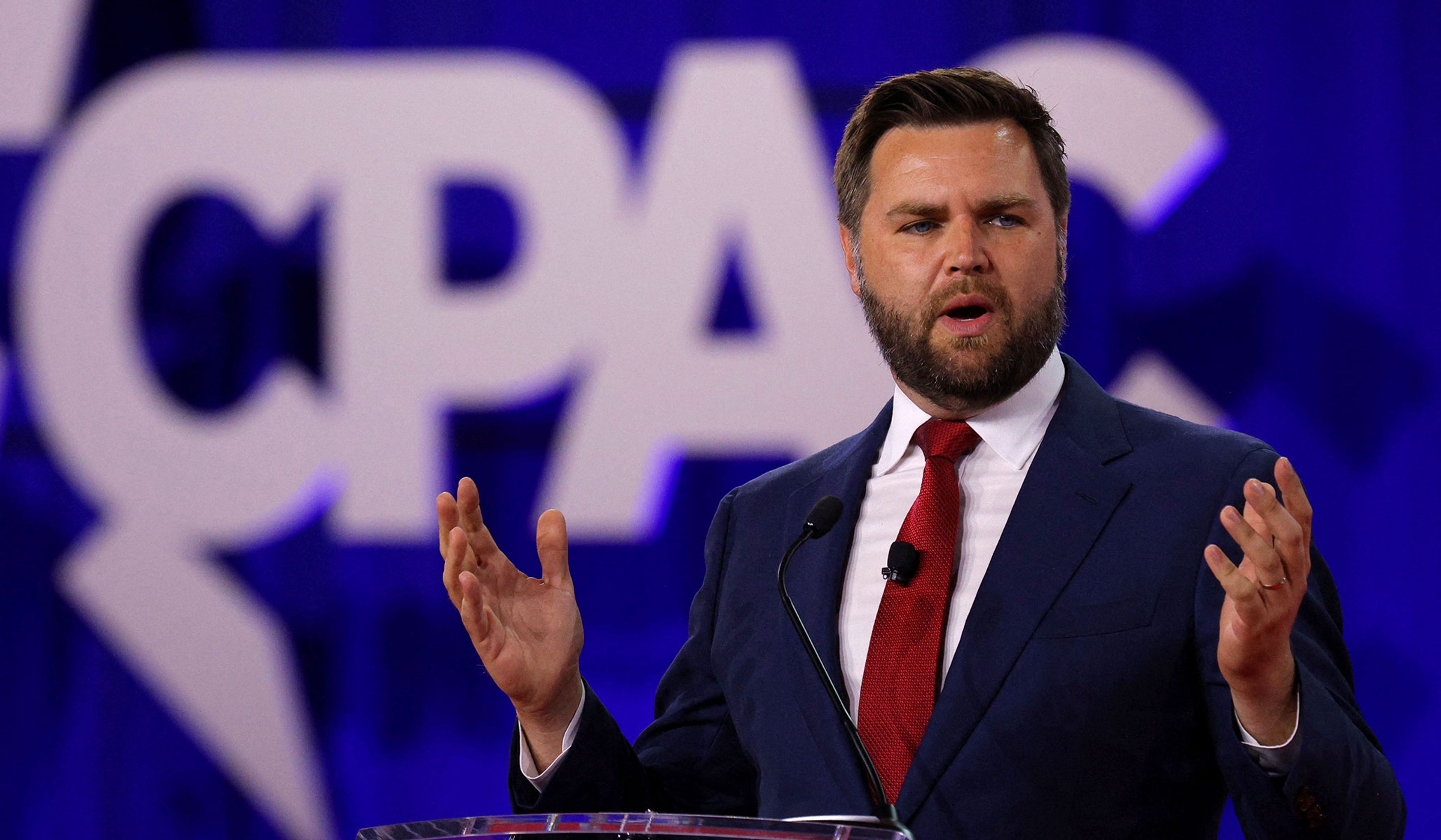
• The CPAC meeting in Dallas was quite a show. Here are some of the “highlights.” Hungarian prime minister Viktor Orbán, fresh off a speech in which he boasted that his countrymen resist race-mixing, received a standing ovation for his performance. His populism (“The globalists can all go to hell”) was familiar, and his arm-waving at “our Judeo-Christian teachings” was somewhat forced, but the audience was nonetheless enraptured. Turn from Orbán to the man in the orange jumpsuit, sitting in a cage, looking distraught. A martyr to the cause of trying to overturn a presidential election, he pleaded guilty in a trial over his role in the Capitol riot last year. Behold: Marjorie Taylor Greene steps inside, kneels, and takes his hand. They pray and are joined by a gaggle of spectators outside. But, not to be outdone, the nation’s most famous performance artist, the former host of a reality-TV show, closes out the weekend with a 110-minute stem-winder, a medley of his greatest hits, including “drain the swamp” and “the election was rigged.” Good night from CPAC, the Conservative Political Action Circus, Texas 2022 edition.











A cardboard cutout of former President Donald Trump displayed at the Conservative Political Action Conference in Dallas, Texas, August 4, 2022.
Brian Snyder/Reuters
• The July employment report was surprisingly strong, with the economy adding 528,000 jobs and the unemployment rate falling to 3.5 percent. The U.S. now has the same number of jobs as it did before the pandemic. But inflation is still high, and real wages are still declining. Total dollar spending is still accelerating, and the Federal Reserve still needs to tighten monetary policy. The Fed runs a lot of risks right now, but being too hard on the labor market does not seem to be one of them. As for the political consequences, Democrats should not get too excited. Although the total number of employed people has returned to normal, the labor force (the number of people working or looking for work) is still 623,000 workers short of February 2020. The July jobs report also showed more people working second jobs (presumably because many wish to counteract the inflation eating away at their pay), fewer full-time workers, and more part-time workers than in the previous month. And employers are still dealing with staffing shortages throughout the economy. There’s a word for stagnation combined with inflation. It isn’t “recession,” but it isn’t good, either. Just ask Jimmy Carter, who was recession-free for the first three years of his presidency.
• About making medical care available to U.S. veterans harmed by exposure to toxins from burning trash at military bases, there was relatively little disagreement. There was, as there should have been, some disagreement about how to structure the program. Democrats sought and won an arrangement under which the benefits will take the form of a new entitlement program for veterans — “mandatory” spending — which had the effect of making it procedurally easier for Congress to increase “discretionary” spending on anything from diversity training to windmill subsidies. Democrats nevertheless pretended that Republicans were being stingy with veterans, perhaps just to be cruel, and the media amplified the demagoguery rather than correcting it. Democrats are happy to honor veterans, especially when it enables spending programs unrelated to them.
• Harvey Marcelin murdered his girlfriend in 1963. Released early, he murdered another in 1985. Released early again, he was placed in a women’s shelter, having remade himself as Marceline Harvey. Anne Brennan, a nurse practitioner at a housing shelter in the Bronx, told the New York Times that she raised the issue of his serial murders with her supervisors, but “apparently his feelings and identity were far more important than all the other women that were terrified of him.” The Times quoted a spokeswoman for the city’s Department of Social Services who said “rules were followed”: “Our policy — in accordance with the law — is to place individuals in shelters based on their reported gender identity.” The killer, continuing to live his or her truth, has now been charged with a new murder.
• A number of prominent U.S. businesses have filed amicus briefs in support of maintaining racial preferences in admissions at Harvard and at the University of North Carolina as the Supreme Court prepares to rule on challenges to the practice. It is the usual drivel from the usual corporate suspects: “For science and technology companies to achieve . . . competitive advantages, universities must admit racially diverse classes of students and foster inclusive cultures.” It is not as though the elite schools that feed the commanding heights of science and tech lack diversity: Stanford is about half as white as the population at large, almost exactly as Latino, about five times as Asian, and about four times as Jewish. The underrepresented populations are the foreign-born and African Americans. Without race-based admissions, Stanford would probably have more Asian students rather than more white students. There are racial disparities in education in the United States, but the problem for black students isn’t who gets to go to Harvard but who is made to go to terrible public schools in Philadelphia and Baltimore. IBM should neither practice racial discrimination in hiring nor deputize Harvard to engage in racial discrimination in its behalf.
• Nancy Pelosi followed through on her plans to visit Taiwan, ignoring President Biden’s warnings and defying the regime in Beijing, which had threatened to shoot her plane out of the sky. Pelosi’s example is a courageous one. She explained her reasoning for the visit in the Washington Post soon after arriving at the airport. U.S. support of the country is important not only to “the 23 million people of the island but also to millions of others oppressed and menaced by the PRC,” Pelosi wrote, also citing the Chinese Communist Party’s crackdown in Hong Kong, the erasure of Tibetan identity, and the effort to ethnically cleanse the Xinjiang region of Uyghurs and other Turkic peoples. The House speaker, with whom we disagree on almost everything else, is absolutely right. Backing Taiwan begins with high-level, high-profile support of the island to bring visibility to Beijing’s designs on it. And Pelosi understands that exposing and dismantling malign CCP propaganda and influence efforts, and standing with Beijing’s victims and targets, is an essential project. Unfortunately, far too many people have accepted CCP propaganda tactics, blaming the House speaker for China’s unacceptable response: military exercises, trade sanctions on Taiwan, even cyberattacks. But by precipitating Beijing’s overreaction, Pelosi has created a new opportunity for Taiwan’s friends to take decisive action against the CCP. It should not be wasted.
• Lu Shaye, China’s ambassador to France, is reading out his stage directions. Amid the international fracas surrounding Pelosi’s trip, Lu gave two interviews on French television, vowing that the Chinese Communist Party would implement a “reeducation” program in Taiwan following the country’s so-called reunification with the mainland. It’s no idle threat. Beijing seems intent on continuing the military exercises it began in the aftermath of Pelosi’s visit, suggesting that it is getting closer to an eventual invasion. Lu said that such an invasion is always an option. Using the word “reeducation,” of course, evokes the Chinese Communist Party’s genocide of Uyghurs and other ethnic minorities, not to mention the murderous and culture-smashing horrors of Mao’s Cultural Revolution. If there’s a silver lining, it’s that Lu’s statement of the CCP’s intentions for a post-invasion Taiwan could motivate Taiwan and its international partners to prepare even more urgently than they have been.
• Josh Hawley (R., Mo.) was the only senator to vote against ratifying the accession of Sweden and Finland to NATO. Hawley argued that, while he understands the desire of those countries to join the alliance, supporting their membership would distract Washington from the threat of China. Hawley’s argument is neither isolationist nor naïve about Russia. But Senator Marco Rubio (R., Fla.) has the better argument in an op-ed titled “A stronger NATO allows America to focus on the threat of Communist China.” He’s right. There are legitimate concerns about burden-sharing within the alliance — and Finland and Sweden would enter NATO with a history of relatively high defense spending. They are more than likely to pull their weight when it comes to countering Russia, thereby freeing up some of Washington’s energies to focus on the Indo-Pacific. Senator Tom Cotton (R., Ark.) noted that Hawley had previously voted for NATO accession by Montenegro and North Macedonia. On the Senate floor, Cotton noted dryly: “I would love to hear the defense of such a curious vote.” So would we.
• Constant atrocities are a grim attribute of Russia’s effort to crush and re-subjugate Ukraine. But some atrocities stand out, such as the Russian prison camp at Olenivka, a village in eastern Ukraine. There are reports of grotesque torture and murder at Olenivka. Moreover, the camp was the target of an explosion on July 29. At least 50 POWs were killed, dozens more injured. Russia has blamed Ukraine for the attack — but the evidence points to Russia. The Red Cross is being shut out of Olenivka. The Geneva conventions are being violated and laughed at.
• Brittney Griner is a professional basketball player and an American hostage in Russia. In February, she was arrested for having hashish oil in her luggage. She has been sentenced to nine years in prison. “But she broke the law!” some Americans are saying. Griner has not been sentenced to nine years because she broke the law; she has been sentenced to nine years because she is a valuable American hostage. Putin breaks the law — official Russian law — every day, surely. Laws against corruption, for example. Do Russian authorities care about what’s in Steven Seagal’s luggage, or in that of other foreign friends of the Kremlin? Whether President Biden should trade a Russian prisoner in America for Brittney Griner is another question. Whether he should trade for Paul Whelan, another American hostage in Russia, is another question. About what the Kremlin is doing, though, we should be absolutely clear-eyed.
• Al-Qaeda mastermind Ayman al-Zawahiri has rejoined his co-conspirator, Osama bin Laden, somewhere in the hereafter. The terrorist leader was reportedly killed in Afghanistan by a drone strike ordered by President Biden. Al-Zawahiri was second only to bin Laden himself within al-Qaeda’s hierarchy. Alongside bin Laden, he orchestrated the 9/11 attacks, in addition to a wave of Islamist violence across the world. To al-Zawahiri, mass death was a religious duty “for every Muslim who can do it in every country in which it is possible to do it,” as he wrote in 1998. Unsurprisingly, the U.S. strike indicates that the Taliban continues to house al-Qaeda leaders, in violation of the Doha agreement for the withdrawal of U.S. forces from Afghanistan. In any case, with this operation, the president and our military and intelligence networks have finally made al-Zawahiri pay the price he long ago deserved. A sociopathic maestro of mass murder is no more, and all Americans should welcome this victory against a sadistic cult that has waged war against the free world.
• Masih Alinejad is an Iranian-born journalist and activist with U.S. citizenship. She lives in New York. She has long been a thorn in the side of the Iranian regime. Last year, the FBI foiled a kidnapping plot against her. In recent weeks, the bureau and New York police have foiled what appears to be a murder plot against her. Alinejad is a very brave woman. She will not shut up about injustices in Iran, despite the danger to her. Regimes such as Iran’s — and China’s and Cuba’s — are brazen. They are not shy about striking their critics on foreign soil. May American law enforcement keep up its excellent work.
• LIV Golf, a.k.a. the Saudi Golf League, is holding eight events this year, its inaugural season. Two of the eight events are being held at clubs owned by Donald Trump: one in Bedminster, N.J., one in Miami. Outside the first event, there were protests by families of 9/11 victims. Asked about this, Trump said, “Well, nobody’s gotten to the bottom of 9/11, unfortunately, and they should have.” An alliance with the Saudi royals and their dictatorship may be necessary; but gratuitous flacking for them is obscene.
• In Nicaragua on August 4, police arrested Bishop Rolando Álvarez Lagos of the Diocese of Matagalpa. They accuse him of organizing violence against the Sandinista government of President Daniel Ortega. Founded in opposition to the Somoza dictatorship in the 20th century, the Sandinista National Liberation Front replaced it with their own dictatorship, hostile to the country’s fledgling institutions of liberal democracy, which Ortega has trampled. Catholic leaders supported pro-democracy protests in 2018. Since then, churches in Nicaragua have been targeted with violence. Priests have been beaten, and church property has been burned and sieged. Cardinal Gregorio Rosa Chávez of San Salvador, a friend and collaborator of the martyred Saint Óscar Romero, has called the Sandinista campaign against the churches “the most horrendous case” of religious persecution in the region. “Martyrdom continues to be a reality also in our days,” he notes. As of this writing, Bishop Álvarez remains in police custody.
• Britain’s Tavistock gender youth clinic is being shut down after an independent review found that it was not a “safe or viable long-term option” for vulnerable young patients. The clinic’s critics, including former employees turned whistleblowers, have complained for years that teenagers were being rushed through irreversible and experimental treatments. Critics’ claims that the clinic was negligent in data collection, follow-up, and diagnosis have been vindicated. Minors being treated for gender dysphoria by Britain’s National Health Service will now be referred to children’s hospitals, which will offer a “holistic” approach with “strong links to mental health services.” This is in multiple respects a move toward sanity.
• Conspiracy entrepreneur Alex Jones has been ordered to pay, after a defamation case, more than $45 million to the families of those who died in the Sandy Hook massacre. Jones, who is a preposterous clown, insisted that the massacre was a staged fiction put on by “crisis actors” as a pretext for an assault on the Second Amendment rights of Americans. Some of the families he targeted had to go into hiding and required full-time protection owing to threats from the broadcaster’s unhinged followers. Jones’s conduct was a textbook case of defamation, and his attempts to beg off responsibility on the grounds that he is just a jolly entertainer are the worst sort of cowardice. His main company has already filed for bankruptcy protection, and if there is any justice in this world, Jones won’t be left with a pair of shoelaces until he has made good on every penny of the judgment against him — the financial judgment, anyway. The moral judgment will be much harder to pay down.
• Beowulf begins with “Hwæt,” a word that may have been declaratory — a “Hail!” or a “Hear!” — or a merely conversational “So.” But, however translated, hwæt is not a trigger warning. Scotland’s University of Aberdeen has now remedied this omission. Thanks to Beowulf’s inclusion in a course titled “Lost Gods and Hidden Monsters of the Celtic and Germanic Middle Ages,” the thousand-year-old (or more) Anglo-Saxon epic is labeled as one of a series of works that may feature “particularly graphic representations of violence, . . . symbols of evil, . . . death, blood and eating disorders.” This wicked work may also, students are counseled, harbor horrors such as animal death and ableism. Indeed, Grendel is described as unhælu (infirm). Guilty! But Beowulf’s troubles do not end there. It was singled out, in a smaller group, for “particularly graphic representations of violence (homicidal, genocidal, and intra-familial).” The right response to all this? Well, let’s just say it might begin with a question word and end with a word traditionally associated with Anglo-Saxons.
• If you missed any deadlines on June 29, blame Earth. For reasons unknown to scientists, our planet completed its rotation that day in 1.59 milliseconds less than the previous record (times have been kept since the advent of atomic clocks). Since Earth’s spin is slowing down on the whole over time, the speed burst is noteworthy. Scientists have speculated that it might be caused by any number of factors, from the moon to the oceans to a natural wobbling of Earth about its axis (the “Chandler wobble”). This terrestrial quirk has some observers chattering about the need for “leap-back seconds” to keep our clocks on track. Make sure to set your watch accordingly!
• To the Philippines, Fidel Ramos was very important. He was a general under Ferdinand Marcos. But he sided with Corazon Aquino, the duly elected president, when the time came. He put country, and democracy, over dictator. He himself served as president from 1992 to 1998. This was a period of salutary reform. In 2013, National Review’s Jay Nordlinger conducted an extensive interview with John Negroponte, who had had a long and wide-ranging diplomatic career. “Name someone who made a particular impression on you,” Jay asked. Negroponte named Fidel Ramos. “He probably impressed me as much as any leader I’ve ever had the opportunity to deal with.” “He stood head and shoulders above any political leader who had preceded him” in the Philippines. “He really rolled up his sleeves and got stuff done.” Fidel Valdez Ramos has died at 94. R.I.P.
• David Trimble was one of the men who made peace in Northern Ireland — who put an end to the Troubles. Have they ended? The Good Friday Agreement, forged in 1998, has so far stuck. Trimble and John Hume won the Nobel Peace Prize for it. Trimble was a Protestant politician, Hume a Catholic politician. They were despised by the extremes. They, along with others, stuck out their necks to make peace. In his Nobel lecture, Trimble said, “What we democratic politicians want in Northern Ireland is not some utopian society but a normal society.” A marvelous aspiration. Trimble has died at 77. R.I.P.
• “Now I’ll be conceited,” Bill Russell said. “I like to think I originated a whole new style of play.” Already in high school, he shone at defense, rebounding, and jumping to block shots, trusting his instincts and judgment, defying conventional wisdom about how to play basketball. The starting center for the University of San Francisco, he led the team to NCAA championships in 1955 and 1956. In 1957, his rookie year with the Boston Celtics, they won their first NBA championship, the beginning of an astonishing run: He powered the Celtics to eleven championships in 13 seasons. Eight were consecutive. Two were won with Russell as a player-coach, after Red Auerbach, who had spotted his talent in the NBA draft ten years earlier, retired and named him his successor. Subject to racial abuse from childhood, he encountered more in his early years in the NBA. He lent his name and presence to the civil-rights movement and sat in the front row when Martin Luther King Jr. delivered his “I Have a Dream” speech in 1963. Bill Russell was inducted into the Basketball Hall of Fame in 1975 and awarded the Presidential Medal of Freedom in 2011. Dead at 88. R.I.P.
• They say you shouldn’t meet your heroes. I didn’t have a choice in the matter. The larger-than-life hero in my life was Vin Scully. For millions of listeners, he was like a member of the family. For me, he was: my mother’s brother. Vin’s story was the story of my family, and the story of so many American families: up from nowhere, and East to West, from Brooklyn to Los Angeles at the sunrise of mid-century California, from the Dodgers of Jackie Robinson to the transistor radio, Fernandomania, and the Internet. The son of working-class Irish immigrants, raised in Washington Heights during the Depression, he grew up wanting to be a baseball radio announcer when baseball on the radio was brand-new. Starting as a 22-year-old nobody, he called Dodgers games for 67 years and retired universally acknowledged as the best ever to do it. He came to stand as a kind of ambassador for the past — for the virtues of a generation born in the 1920s and forged by the Depression and war. The private Vin was exactly the same as the public Vin: a generous storyteller full of eloquence, warmth, humor, decency, and class who thanked God for his gifts and made baseball sound like literature. We shall miss him deeply, as will the whole world of baseball. Dead at 94. R.I.P. — Dan McLaughlin
The ‘Inflation Reduction’ Boondoggle
It didn’t take long after Democrats passed their reconciliation bill through the Senate for the left-leaning press to jettison the inflation-related justification, with the Los Angeles Times, the New York Times, and the Washington Post all referring to it as a bill for climate policy and health care. With annual inflation over 9 percent and real wages declining, the voters were not crying out for a climate bill, nor are they ever. (The environment is usually near the bottom of voters’ priorities in opinion polling.) But the hyper-online Left was, and Democrats know their base.
The Congressional Budget Office, the Penn Wharton Budget Model, and even Bernie Sanders (who supported the bill) all agree: The legislation won’t noticeably affect inflation. Everything in it was proposed by Democrats before inflation became a pressing concern, and the bill’s real effect will be to serve progressive interests (which explains Sanders’s support).
The biggest chunk of spending is on corporate welfare for green-energy companies. That’s what corporate tax credits mean in the context of climate policy, and the Democrats’ bill has hundreds of billions of dollars’ worth of them. Progressives are breathlessly claiming that the bill will reduce greenhouse-gas emissions by 40 percent by 2030. What they aren’t saying as loudly is that the 40 percent is measured starting in 2005. Much of the reduction has occurred already — we’re halfway to 40 percent as of 2020 — and the reduction would continue without this bill.
Democrats are also enthused about the $60 billion the bill devotes to “environmental justice.” A campus buzzword not that long ago, it is now receiving nearly twice as many taxpayer dollars over the next ten years from this one bill as the entire Department of Justice spent in 2021.
The bill raises corporate taxes through a book minimum tax. Corporations pass much of their tax burden on to consumers, who are already facing higher prices. It also contains a hidden gas-tax increase, reinstated as the Superfund tax that lapsed in the 1990s.
The surge in IRS funding will roughly double the tax-collection agency’s workforce, the better to harass Americans. The agency isn’t even sure how it will spend another $80 billion over the next ten years, but that didn’t stop Democrats. From here on out, they should expect every tax audit to be blamed on them. They’re the party of doubling the IRS now.
Even the claim of deficit reduction doesn’t hold up on closer inspection. It relies on two major budget gimmicks. It counts savings from continuing not to implement a Trump-administration order that has never taken effect. And it sunsets Obamacare provisions that Democrats fully intend to keep permanently. And the bill would actually increase the deficit in the next four years, only to supposedly reduce it later. Washington has a funny habit of never getting around to the hard part when the easy part comes first.
These are the exact kinds of budget games that Joe Manchin said he was against when he sank an earlier, more expansive version of this bill. Now we know it was all talk. But Republicans should never have been counting on a Democrat to vote against more taxes and spending in the first place.
Democrats got this bill through the Senate only because they have exactly 50 senators and the vice presidency. If it weren’t for Republicans’ losing the Senate runoff elections in Georgia, Mitch McConnell would be majority leader right now, and the Grim Reaper would have assured that no bill passed. But Donald Trump had to make himself the center of attention, with his baseless claims that Georgia’s elections had been rigged, and hundreds of thousands of Republican voters believed him and didn’t turn out for the runoffs, flipping the seats to Democrats.
It’s up to Republicans to make the case to voters that Democrats aren’t addressing the actual problems with the economy. President Biden’s approval ratings are still low, inflation still high. Now is the time for a supply-side agenda of lower taxes, deregulation, and increased energy production that Republicans should all support. By focusing on the issues that actually matter to voters, Republicans can rename Democrats’ tone-deaf bill yet again: the Democratic Caucus Reduction Act.
An Old Struggle’s New Phase
On August 2, the pro-life cause suffered a tough loss in the state of Kansas, where voters rejected a referendum that would have added language to the state constitution declaring that the state’s basic law “does not create or secure a right to abortion.”
The ballot initiative was a response to the 2019 Kansas supreme-court ruling that held that the state constitution had contained a “fundamental” right to abortion since 1859. That judicial usurpation, plus the post-Dobbs, pro-abortion media monsoon, made the task of the pro-life movement very difficult in Kansas. But the loss was so lopsided — 59 percent “No” to 41 percent “Yes” — that pro-lifers should realize that merely finessing their messaging or raising more campaign funds wouldn’t have changed the outcome.
Pro-lifers left too many substantive questions unanswered. If “Yes” had prevailed, would the Kansas legislature have banned abortion from conception or beyond six weeks of pregnancy? Would a pro-life law have included an exception for the case of rape? Owing to internal divisions, pro-life legislators punted these questions and then compounded the damage with poor wording on the ballot.
Presented with what seemed to be a choice between facilitating a ban without popular exceptions or preserving an expansive right to abortion, Kansas voters chose the latter. Kansans may discover after future court rulings, however, that letting the 2019 supreme-court decision stand didn’t merely protect the already permissive status quo but jeopardized the state’s 22-week gestational limit on abortion, 24-hour waiting period, and prohibition on Medicaid funding of elective abortion.
If the pro-life movement wants to advance the cause of protecting the most-vulnerable human lives — in Kansas and elsewhere — it needs more than pure motives and sound principles. In our democratic republic, it must seek to translate those principles into victories that can be secured and sustained by public opinion. That does not mean cowering at the sight of a single unfavorable poll. And discovering where political consensus truly lies in any given state is not easy. But one lesson from Kansas is that if pro-lifers don’t define their position at both the state and the federal level, their opponents and the media will define it for them.
By all means, pro-lifers should highlight the extremism of Democrats, who almost unanimously support unlimited taxpayer funding of elective abortions for Medicaid recipients and effectively back a right to abortion through all nine months of pregnancy. They also need to defend a positive pro-life agenda that can win sufficient public support. If they want to achieve lasting protections for the unborn, pro-lifers should know that more than 75 percent of Americans nationwide have consistently said they support an exception for abortions in the case of rape (which account for 1 percent or less of all abortions). Congressman Henry Hyde, one of the greatest pro-life statesmen, allowed this exception in 1993 in order to save his amendment, prohibiting federal Medicaid funding of elective abortions, that has saved hundreds of thousands of lives. That exception has been part of the federal budget ever since.
The lesson then, as now, is that it would have been a grave error to insist that no lives should be protected unless all lives are protected. Pro-life Americans should be cheered by the fact that the State of Indiana enacted a law on August 5 that banned abortions except in cases of rape, incest, a fatal fetal-health diagnosis, or threats to the life or physical health of the mother. The Indiana law should prevent 95 percent of abortions in the state.
In addition to making prudent legislative compromises regarding hard cases, pro-life state officials need to do much more to clarify existing law regarding what ought to be easy cases. Before Roe, every state abortion law included an exception at least to save the life of the mother. Rare but real life-threatening conditions were routinely treated; doctors didn’t wait until a pregnant mother’s life was in imminent peril to act. But since Dobbs, the media and Democrats have whipped up fears that standard treatment for miscarriages, ectopic pregnancies, and other life-threatening conditions may be prohibited by pro-life laws. At least some hospital administrators and lawyers have advised doctors to delay life-saving treatments. This is dangerous, and it needs to stop.
Pro-life doctors, organizations, and journalists have tried to dispel the misinformation, but it is ultimately going to fall to those in positions of power to make these hospital administrators and attorneys reverse course. If medical boards and medical associations will not act, then all state officeholders should do what is necessary to ensure that hospitals provide standard care. We have already seen examples of hospitals reacting to corrective guidance from attorneys general, but a much greater effort is needed to make it clear to all that doctors and hospitals are legally free to use the same standards of medical judgment and care when treating women with life-threatening conditions as they did before Dobbs.
The Dobbs decision was the right decision because it corrected the lie that the U.S. Constitution contained within it a right to abortion. Dobbs did not hand the pro-life movement ultimate victory, of course; it simply presented the pro-life movement with the opportunity to move policy in its direction. Recent weeks have proven that that won’t be easy in light of the tsunami of deception unleashed by the other side. But life will always be worth fighting for. Pro-lifers should respond to the Kansas defeat with courage and prudence.












Comments