• Has San Francisco thought through its plan to deploy killer police robots? What pronouns are they going to use?
• The election results that have trickled in, too slowly, since our last issue — which went to press the day after the election — have tended to confirm the impressions we recorded then. There was a national swing toward the Republicans compared with 2020. Very conservative Republican candidates were able to win a lot of races. In competitive seats, however, a close association with former president Donald Trump and his nonsense about the 2020 election cost candidates votes, in part because the candidates open to that association exuded the odor of kookery. Thus, in Nevada, Joe Lombardo, who dodged questions about 2020, won the governorship; Adam Laxalt, who worked with Trump to contest the state’s votes after they were cast, lost his Senate bid. In Arizona, the only Republican candidate for statewide office whom Trump did not endorse was also the only one who won: Arizona treasurer-elect Kimberly Yee. Two of the ten House Republicans who voted to impeach Trump in 2020 made it to the ballot in November 2022; both won. Republican voters should be able to draw a clear lesson, especially if they take to heart an old adage: There is no education in the second kick of a mule.
• Former Trump supporters are accordingly finally breaking ranks. “It is time to stop being afraid of any one person,” said former New Jersey governor Chris Christie. No doubt it is. But wouldn’t it have been better if Christie had told us so earlier, as Mitt Romney did? Belated Trump criticism is not edifying, but it is one of the ways the system works. James Madison explained in Federalist No. 51 that “ambition must be made to counteract ambition.” He was describing the protective instincts of officeholders who, in a complex government, each guard against the power plays of their peers. But the insight also applies to party politics (of which Madison was also a pioneering theorist). Partisans want winners, not sore losers. “It may be a reflection on human nature,” Madison went on, “that such devices should be necessary. . . . But what is government itself, but the greatest of all reflections on human nature?”
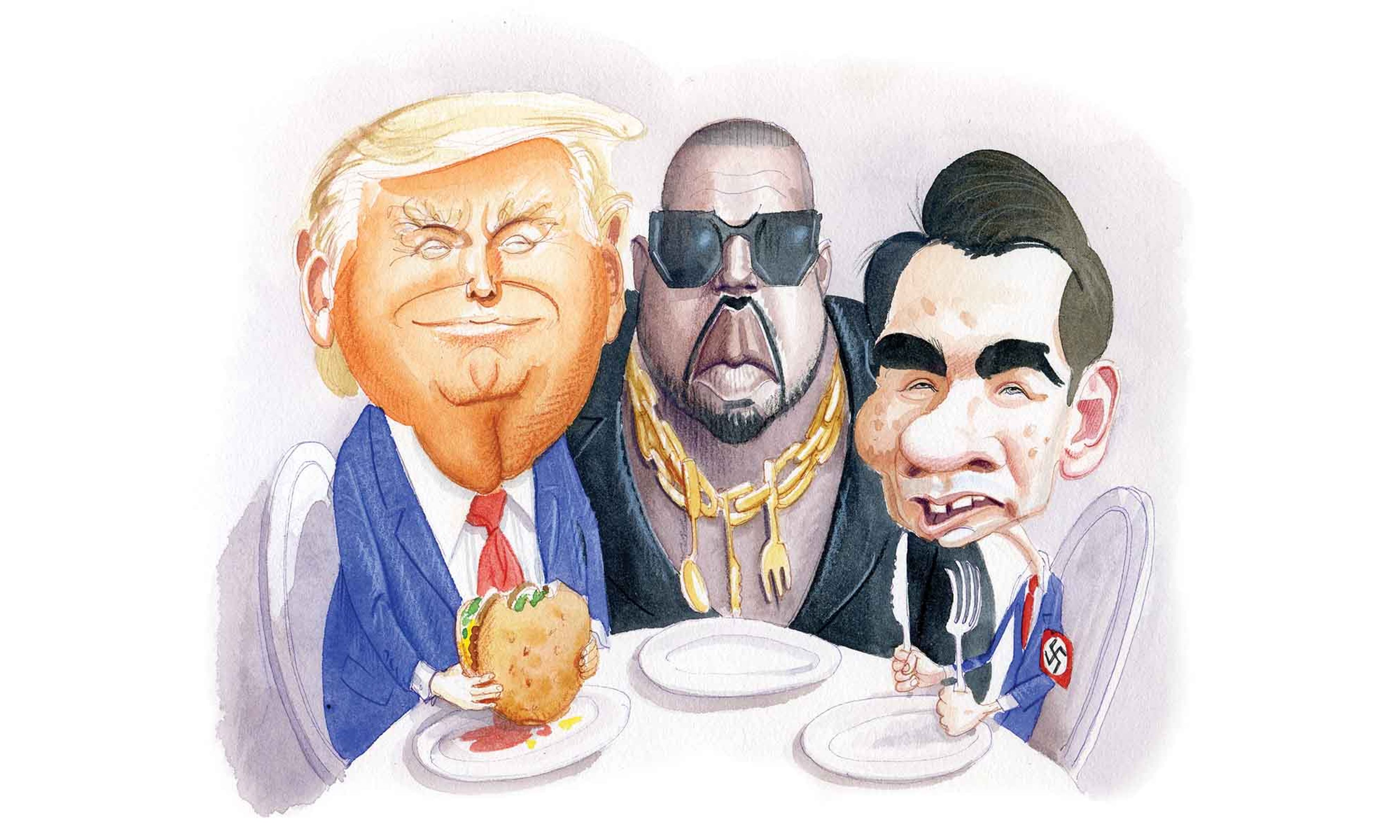
• When JFK hosted a dinner for Nobel Prize winners at the White House, he called them the most extraordinary collection of talent to gather there since Jefferson dined alone. When Donald Trump hosted Ye (formerly Kanye West) and Nick Fuentes at Mar-a-Lago, it was the most extraordinary collection of vanity and folly since his last midnight snack. Ye has lately gone from being a talented crazy man to a straight-out antisemite, vowing to go “death con 3” on Jews and proclaiming that blacks are the real Jews. Fuentes is a giggling 24-year-old who bids for attention by pushing DYI Nazism: He asks Jews “to get the f*** out of America” and thinks the Holocaust yielded “maybe 200,000 to 300,000 cookies” (that is, those baked in ovens). He also loves Putin. After catching flak, Trump said he was only trying to give a celeb in need (Ye) some help and denied knowing who Fuentes was. Trump is so careless of things that do not interest him that it is quite possible he didn’t know the lad. When he is interested, e.g., in praise of himself, he is keen, and his guests bathed him in it. As the adults who shepherded Trump through his first term flee his obsessions, he is left with lunatics and fellow losers. As for his guests’ Jew-hatred, we might be tempted to laugh it off. But Ye is still a megastar, and Hitler himself was once a punk.
• In Arizona, two Republican candidates — Kari Lake, who ran for governor, and Mark Finchem, who ran for secretary of state — still refuse to concede their races. They are playing the now-familiar game of crying “Rigged!” Meanwhile, the Maricopa County supervisor who oversees elections has had to go into hiding, owing to threats of violence against him. He is Bill Gates, and a Republican, incidentally. He also has to be protected by armed security. Is it necessary to say that this ought not to happen in the United States? It is, and we say it.
• Those who want to shift blame for the election defeats away from Trump picked Senator Mitch McConnell (R., Ky.) as a substitute. But blaming McConnell for the election debacle is sort of like bringing a totaled car to the mechanic and then blaming him for not being able to repair it. Trump had much more influence over the selection of candidates. McConnell raised money and poured $360 million into the midterms, making judgments about where the money would best be spent (this involved abandoning New Hampshire, where MAGA nominee Don Bolduc wasn’t even close). Being the Republican leader is not a lifetime appointment and it’s perfectly reasonable to discuss a McConnell-succession plan. But Florida senator Rick Scott’s effort to challenge McConnell was unconvincing. As chairman of the National Republican Senatorial Committee, he had the job of helping Republicans win Senate seats. And while it’s fair to criticize McConnell for not presenting a clear agenda, Scott had one that was unvetted and served only as fodder for Democratic attack ads. No surprise that Scott got only ten votes.
• Representative Nancy Pelosi (D., Calif.) stepped down from her leadership of House Democrats following the Republican takeover of the chamber. Born to politics — her father was a congressman and a mayor of Baltimore — Pelosi worked through the Democratic-caucus ranks in the 1990s to become the party’s whip, minority leader, and then, after the Democrats’ 2006 Iraq War–backlash wave election, the speaker of the House. When Barack Obama won the presidency and brought unified Democratic control to Washington, Pelosi enjoyed a massive majority, which she used to pass a flurry of bills culminating in Obamacare. But thanks to two elections largely fought on the grounds of opposition to Obamacare (2010 and 2014), Democrats went from 257 House seats to 188 before retaking power under Trump. During the Biden administration, Pelosi has held narrower majorities and had more difficulty wrangling votes in a party that has moved decidedly to the left. Pelosi advanced its policies and priorities, but she was more pragmatic than many younger, more extreme members of her caucus. We don’t mourn her stepping down but do suspect that, without her at the helm, Democrats will have even fewer guardrails against their party’s radical lurch. We wish her well, and wish her husband, Paul, a complete and speedy recovery from the recent attack on him.
• When voters give a minority party one house of Congress, its chief mandates are to restrain the president’s party from excess and to hold it accountable. Congressional oversight grows in importance as the executive branch asserts ever-larger powers to shape domestic policy by presidential decree and the press remains supine. House Republicans have much to investigate, but they should proceed strategically. Thus, they should not waste time impeaching Biden or playing defense lawyer for Trump or the January 6 rioters. Nor should they obsess over Hunter Biden’s dissoluteness. But they should not shrink from examining his peddling of foreign influence or the question of what the president knew and whether he benefited. There should be serious probes into Covid policy, from the origins of the virus to the disaster of extended school closures. The House should look into government pressures to turn private businesses into woke auxiliaries of the state, starting with social-media giants. Congress should track down money wasted abroad; cast a spotlight on overly creative legal theories from the Department of Justice, the SEC, and the FTC; consider Russiagate once John Durham issues his report and, more broadly, the reform of the FBI; and grill cabinet secretaries who refuse to enforce the law or illegally arrogate to their department the power to act as the nation’s doctor, landlord, or forgiver of loans. Congress should bring sunlight to the administration — and stand up for its primacy in lawmaking.
• Attorney General Merrick Garland appointed veteran prosecutor Jack Smith as a special counsel. Smith has taken over the two most prominent Department of Justice investigations of former president Donald Trump, involving the alleged retention of top-secret intelligence at Trump’s Mar-a-Lago estate and the plot to derail the counting of electoral votes in 2021. Garland rationalized that once Trump announced his 2024 candidacy, DOJ conflict-of-interest regulations made a special counsel necessary. But special counsels are a weak attempt to insulate investigations from politics. Smith will report to Garland and, as special counsel, will wield executive power — in essence, he is Biden’s delegate. The potential Trump conflict, moreover, pales in comparison with the neon-blinking conflict presented by the DOJ’s investigation of Hunter Biden, in which the president is implicated. Yet Garland insists no special-counsel appointment is required for the Biden probe. The Trump investigation is unavoidably political; the Biden Department of Justice is political by choice.
• The Respect for Marriage Act, which had already passed the House, was approved by the Senate. The bill, though it gestures toward the First Amendment and Religious Freedom Restoration Act, offers no meaningful new protections for religious freedom. Already, conscientious objectors — bakers, florists, Web designers — have had to spend years and fortunes trying to defend their right not to celebrate same-sex marriages. The bill does not protect nonprofit social services, nor does it address concerns over nonprofits’ tax-exempt status. The root problem is that same-sex marriage is based on the idea that the traditional conjugal notion of marriage has no justification in principle and must therefore yield to the newer notion based exclusively on an emotional commitment. If that’s right, then support for the former is simply irrational bigotry. Intolerance of traditionalists is a consequence that would be difficult to arrest, and lawmakers are, evidently, unwilling to try.
• President Biden called for Congress to pass legislation to prevent a freight-rail strike. He was right to do so, and the rail sector is long overdue for this conflict to be resolved. The Railway Labor Act, which governs railroads and airlines, gives Congress the power to impose a contract once every other option under the law is exhausted. Unions have exhausted every other option. They asked for mediation, and then asked to be released from mediation. They asked for a board of independent arbitrators to make recommendations, and then they rejected the recommendations. They dragged out negotiations to the brink of a strike and got a White House–brokered deal in September, and then some of them rejected it in ratification votes. Railroads have not been particularly happy with any of this, but they have made concessions in line with the various tentative deals that have been struck, and they have kept their word with the eight (of twelve) unions that ratified agreements. Biden is calling for Congress to force the September agreement his administration brokered. Congress should get moving.
• The Centers for Disease Control and Prevention shouldn’t be a border-control agency. Yet its public-health powers have become the crutch for enforcement at the southern border. The Biden administration is still using the CDC’s so-called Title 42 order to exclude migrants from the United States, but a judge says the order has to go in several weeks. Estimates are that up to 18,000 migrants a day could begin arriving at the border if Title 42 is lifted, a shocking number that would overwhelm a system that is already overtopped by the current historic flow. The proper response to all of this is simple. The Biden administration should revive Remain in Mexico and all the other Trump policies it inherited that emphasized returning migrants home as soon as possible. Meanwhile, Congress should untangle the legal and policy morass that has made it so hard for us to embrace a commonsense approach of excluding illegal migrants.
• FTX, a cryptocurrency exchange founded by Sam Bankman-Fried, turned out to be a sham. It was supposed to save the world. Bankman-Fried was a devotee of “effective altruism,” a rationalistic utilitarian approach to charitable giving that emphasizes accumulating wealth to give it away efficiently. Somehow, “efficiently” included being the second-largest individual donor to Democratic politicians in 2022, which Bankman-Fried was. As for the accumulating-wealth part, FTX appears to have been investing customer deposits in other crypto firms, with a large chunk of its “assets” being stored in crypto tokens that it had itself created. When the market caught on, the value of those tokens vanished, as did the collateral for FTX’s borrowing, which sent the company into an immediate death spiral. Now we know from bankruptcy filings that it hardly kept ordinary financial records at all, and billions of dollars may now be lost entirely. Maybe instead of saving the world, companies should provide products to paying customers and leave the charity to charities.
• In late November, Disney shocked the world by firing CEO Bob Chapek and bringing back his predecessor, Robert Iger. Some voices on the right chose to interpret the move as Disney’s moving away from woke politics, but a close look at both executives’ records indicates the opposite. Chapek seemed like a CEO who would have preferred that his company stay quiet after his clash with Ron DeSantis in Florida over the Parents’ Rights in Education Act backfired; in his first public comments on the matter, he declined to take a stance. He had reached out to Republicans after that controversy. Meanwhile, Iger is more or less the walking embodiment of woke capitalism. He was much more outspoken about the law. For a little while, President Joe Biden was contemplating making him the new U.S. ambassador to China. Disney’s sliding profit margins and the challenges of launching Disney+ are the primary reasons for the change of leadership. But to the extent the company is sending a signal about wokeness, it’s not a good one.
• For the first time in recent memory, the tech sector is facing trouble. Google parent Alphabet, Facebook parent Meta, Microsoft, Amazon, and Apple have all laid off workers in the past six months and have all announced hiring freezes. Twitter, for somewhat different reasons, has cut a majority of its staff. After years of rapid expansion and massive hiring, these leading American businesses are having to tighten their belts. There’s plenty of fat to lose. Tech companies have been at the leading edge of corporate DEI, with large internal bureaucracies enforcing progressive pieties in the workplace. They have expansive corporate campuses with amenities that, in the age of remote work, go largely unused. They have large teams of programmers working on projects that a competent handful could complete just as well. For years, politicians and activists on both sides of the aisle told us that these companies were invincible and required a new regulatory regime to prevent them from overwhelming the American economy. Turns out they are susceptible to the same complacency and bloat as large companies throughout history, and that they now face rising interest rates and slowing growth like everyone else.
• The New York Times tells us that the Reverend Rob Schenck, a former pro-life activist, has renounced his anti-abortion views and is “trying to re-establish himself now as a progressive evangelical leader.” And he is now saying that Justice Samuel Alito or Alito’s wife leaked in advance the outcome of the Supreme Court’s 2014 Hobby Lobby decision. According to Schenck, Gayle Wright, a donor to the nonprofit Schenck then oversaw, had a private dinner with the Alitos, after which she told him how the case would come out. We are skeptical: The Times could find no documentary evidence of a leak; Wright and Justice Alito have denied the report; and it is hard to see what difference it would have made. The claim seems calculated to obfuscate justified anger at the still-unattributed leak of the entire opinion in Dobbs. That leak led to protests and threats aimed at the justices and enabled defenders of legal abortion to rally earlier in the election cycle. Schenck also details an ethically dubious effort in which he was involved to influence the justices through social contacts, but even the Times concedes that “it is unclear if Mr. Schenck’s efforts had any impact on legal decisions.” Which raises the question of why the Times put it on the front page — or would, if we did not have a strong hunch about the answer.
• General Frost was a character in a British cartoon mocking Napoleon’s retreat from Moscow in 1812. Putin hopes to enlist him again as his invading army attacks Ukraine’s power plants. The United States and NATO allies have been supplying generators to make up the gap. The beleaguered Ukrainians have been supplying good spirits: “NO HEAT NO LIGHT NO RUSSIANS” is a theme of defiant online posts. Russia’s anti-humanitarian offensive is both an outlet for vengeance and an effort to chip away at Ukrainian morale. Russia’s strictly military goals over the coming season will be to consolidate defensive positions behind the Dnipro River. Ukraine, with American and NATO help, is good at targeting behind-the-lines ammo dumps. To blunt these capabilities, Russia would have to achieve air superiority, something it has failed so far to do. An ageing Putin expected a swift, career-capping victory, not an endless wintry game of cat and mouse. So did his advisers and his underlings. When will the yes-men begin to think, Maybe not . . . ?
• Take a look at any chart showing the growth in human wealth over the centuries: Now there is a hockey stick. It shows a dramatic takeoff after epochs of stagnation, beginning with the Industrial Revolution but accelerating so sharply that the curve is almost vertical. Fossil fuels provided the cheap energy that transformed human ingenuity from clever ideas in one corner of Europe into a continuing process of innovation and development that has led to an astonishing growth in human flourishing across our planet. At the recent COP27 climate conference, it was agreed that a fund should be established to pay “reparations” for the damage supposedly caused by the climate change triggered by this great surge in growth. How this fund will be financed remains unclear. But it is the West — and the West alone — that will be paying. There is, of course, nothing intrinsically objectionable about the world’s helping countries that can truly be shown to be being seriously affected by climate change, but for the West to accept even the language of reparations is to submit to a dark logic that makes crimes out of growth, prosperity, and inventiveness. That the Biden administration went along with this insult to history and to humanity is yet another own goal.
• Senator Marco Rubio (R., Fla.) and Representative Mike Gallagher (R., Wis.) announced their plan to introduce a bill that would ban the app TikTok in the U.S. Writing about their anticipated bill in the Washington Post, they recapitulated familiar national-security concerns about TikTok, which is owned by ByteDance, a Beijing-based tech giant with links to the Chinese Communist Party. In addition to the app’s propaganda potential, it could hoover up information, such as smartphone users’ locations, their internet-browsing data (even when not using the app), and every keystroke entered into a device, sending it all back to the CCP. The Rubio–Gallagher legislation stands a significant chance of passing a GOP-controlled House in the next Congress. The Senate might even come around; some Democrats, including Senate Intelligence Committee chairman Mark Warner, have gotten vocal about the TikTok threat. With the Biden administration reportedly poised to reach a deal with TikTok that might permit the app’s continued operations on U.S. soil, Congress should jump in. The risks are too great to do otherwise.
• For a little while, it looked as if the Chinese government’s draconian and seemingly endless zero-Covid policies had brought the regime to its greatest crisis of credibility since the Tiananmen Square massacre. At press time, protests that began in Xinjiang and spread across China to cities including Beijing, Nanjing, and Shanghai had largely ground to a halt after the weather grew colder and President Xi Jinping sent security forces into the streets to crack down on the newly enflamed opposition. In a statement, President Biden glossed over the sheer human suffering that the zero-Covid policies have caused and did not credit the ingenuity and bravery of the protesters. The Chinese government is stuck not only with political discontent but also with a population that, thanks to its own policies, has little immunity to a disease much of the world has put behind it. For a time, some Westerners looked on the Chinese government’s pandemic measures with envy. But these measures are now being revealed as the folly they always were, for all the world to see.
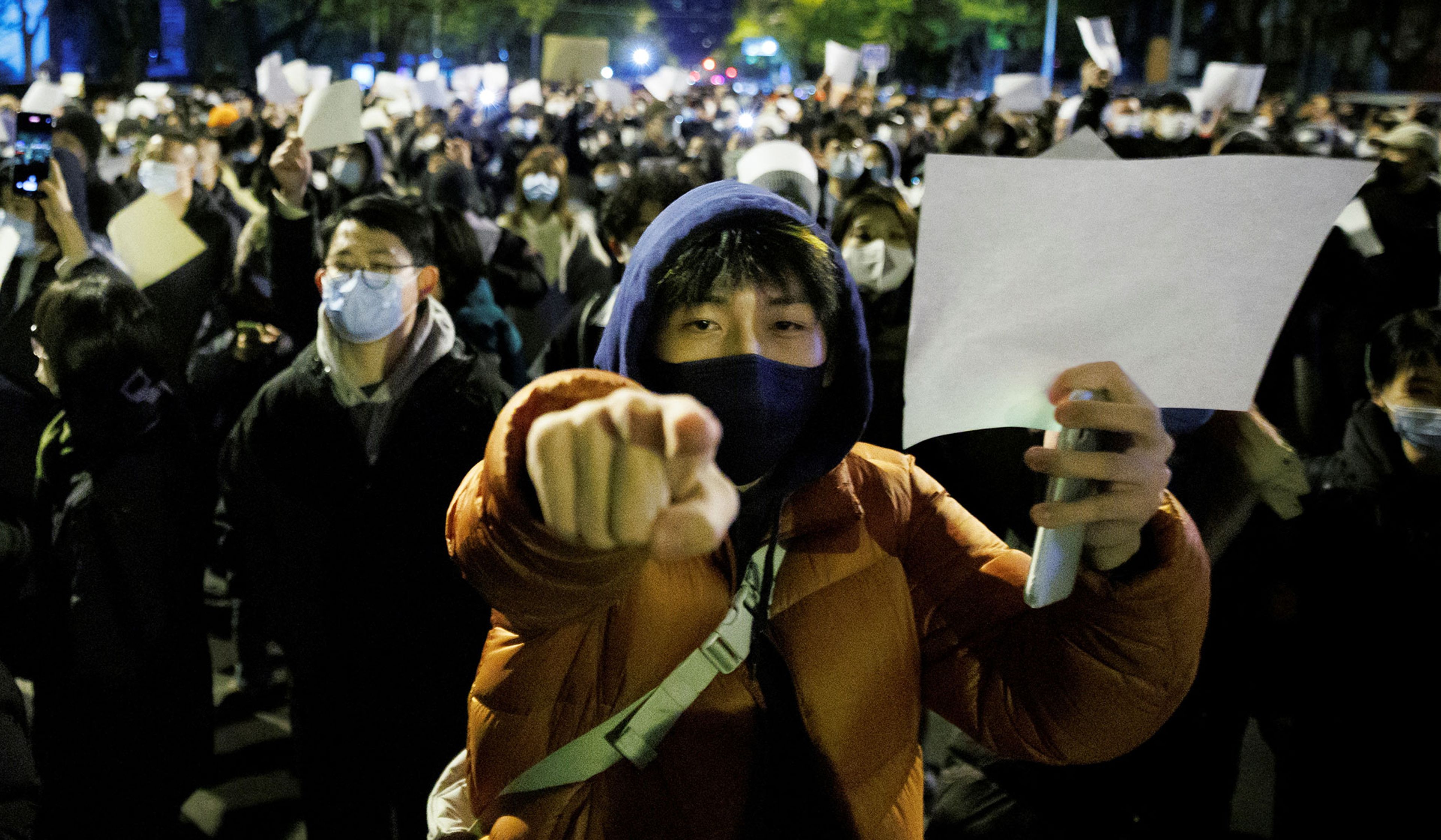
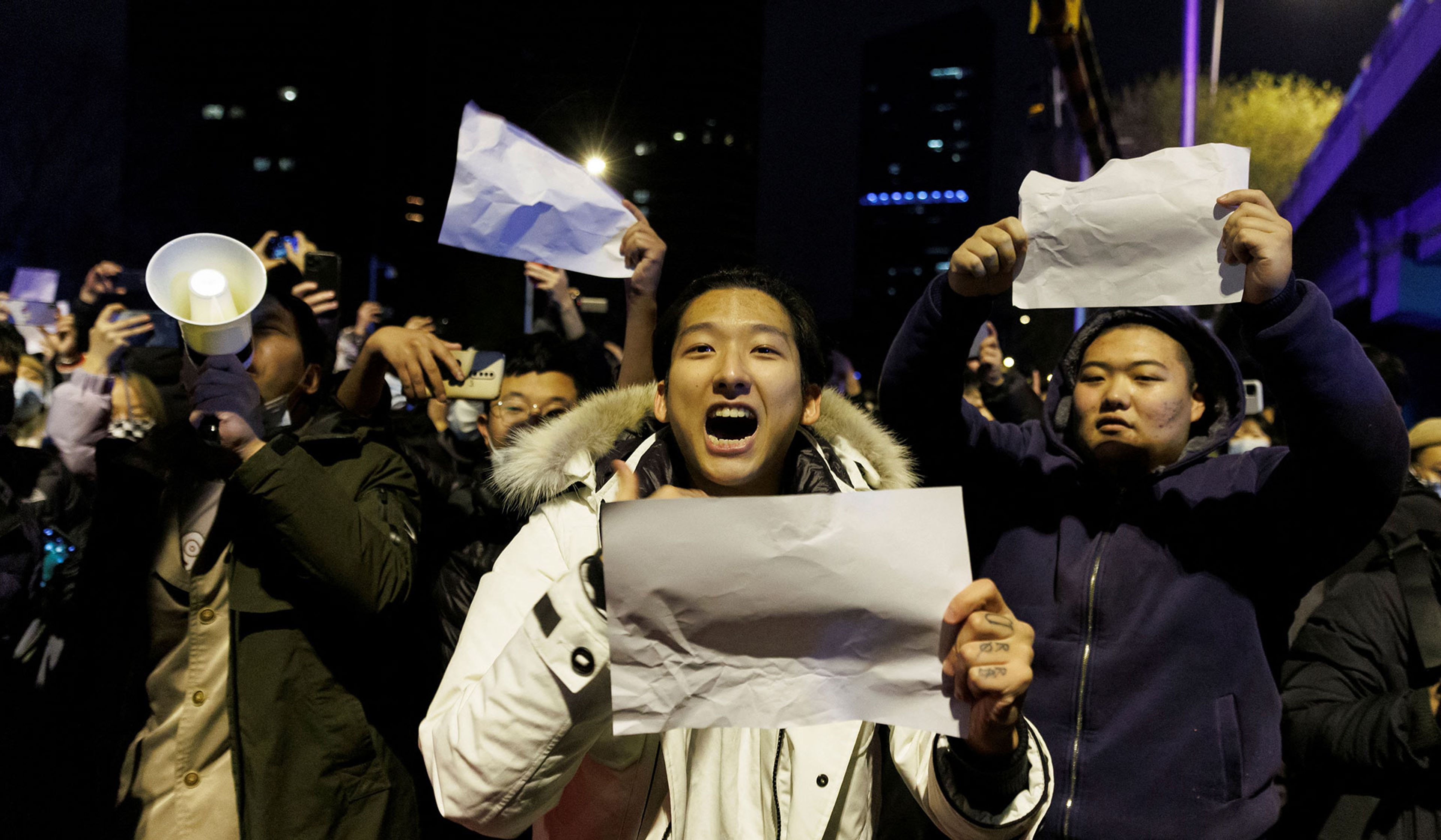

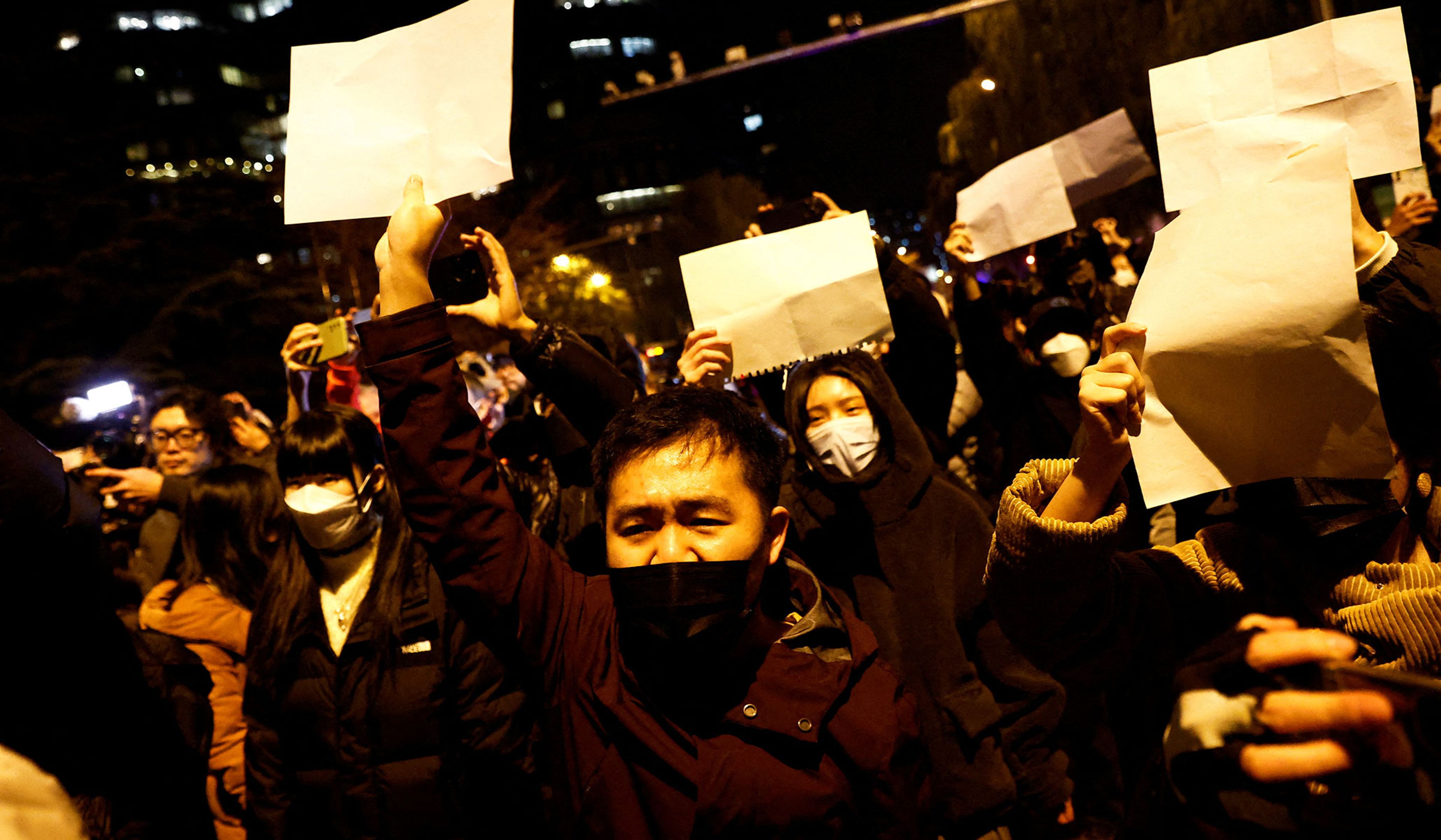
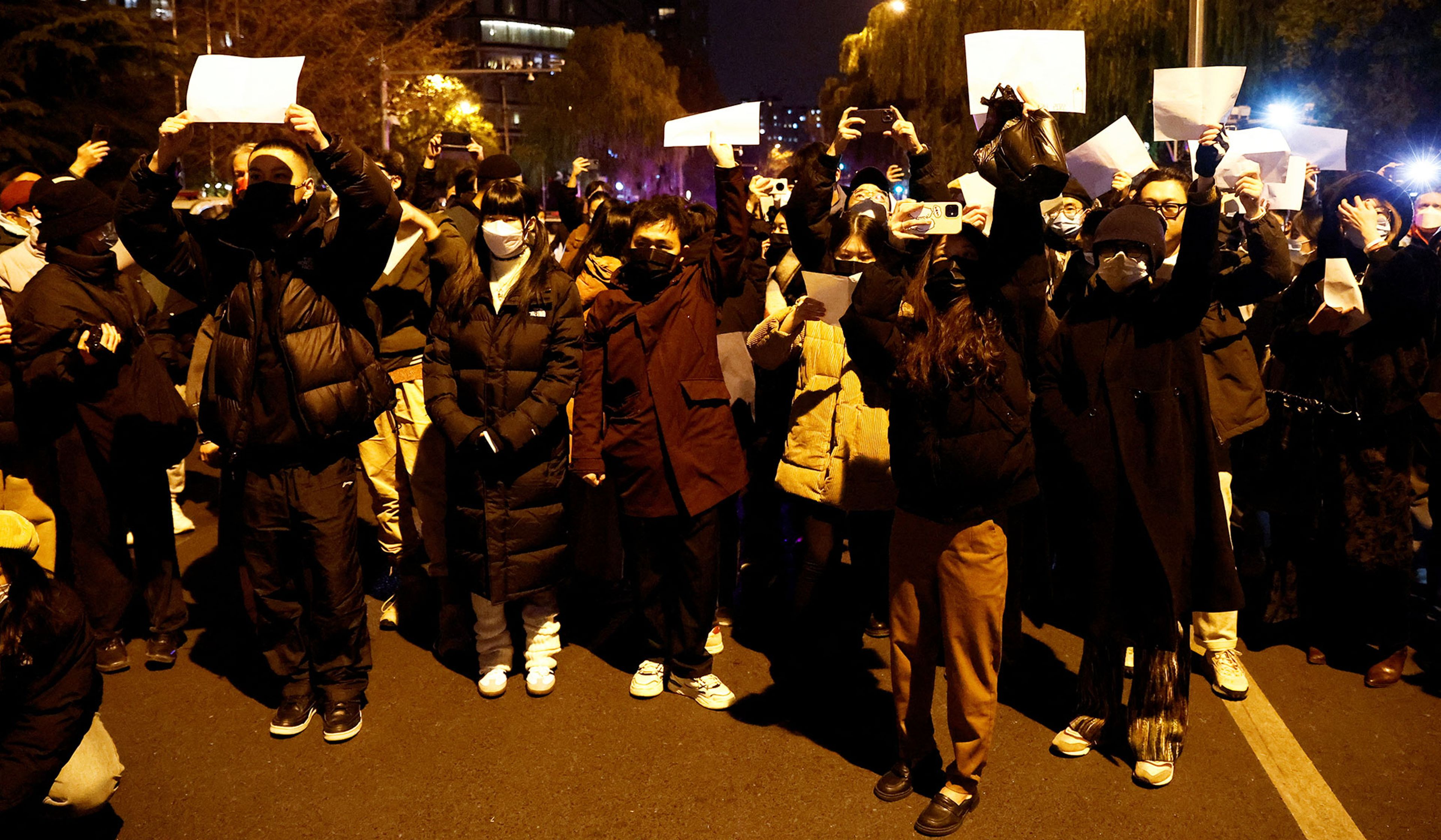
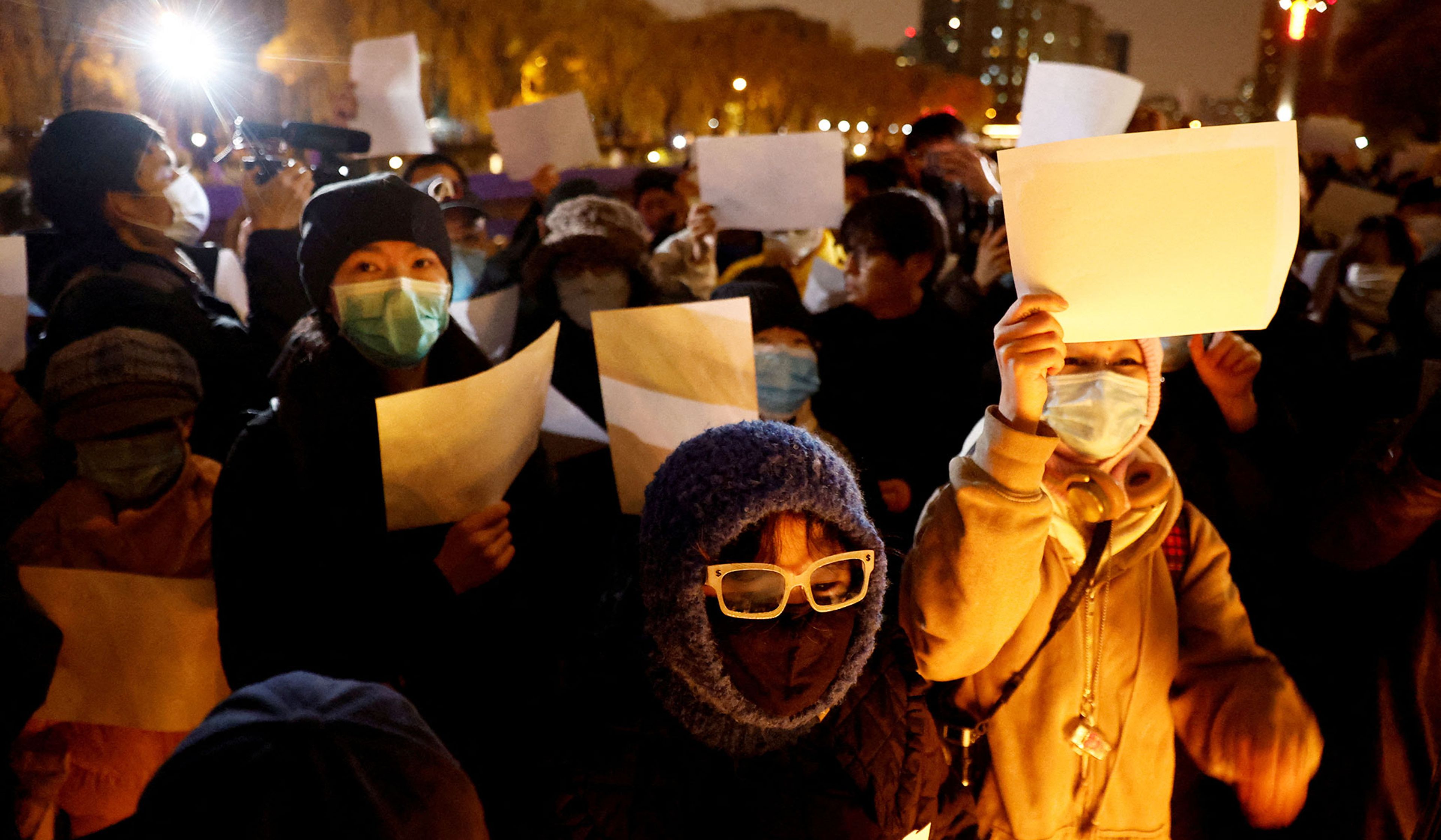

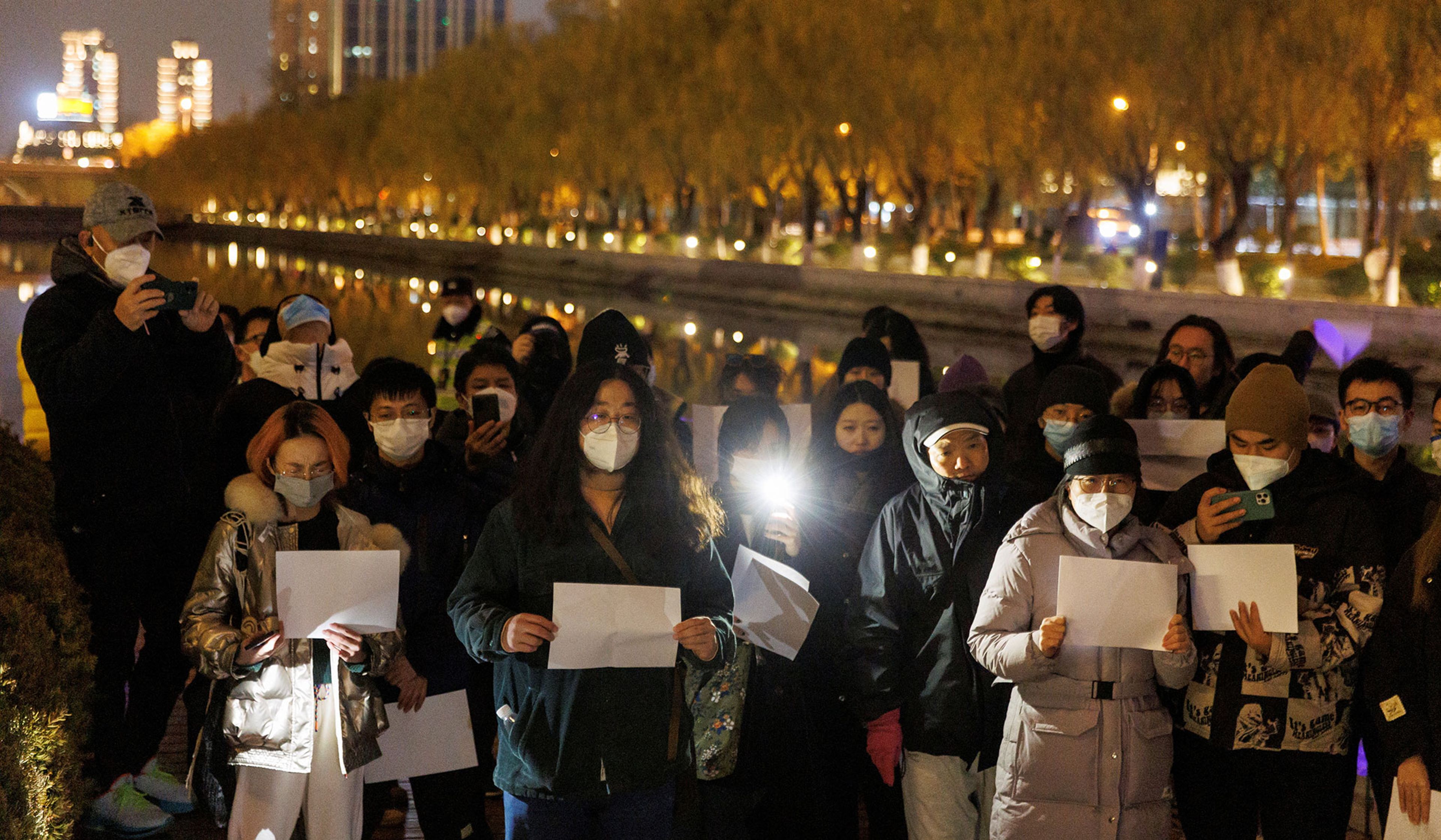







People hold white sheets of paper in protest over Covid restrictions after a vigil for the victims of a fire in Urumqi as Covid outbreaks continue in Beijing, China, November 27, 2022.
Thomas Peter/Reuters
• Chinese authorities arrested Bishop John Peng Weizhao in 2014 for leading a Catholic diocese not recognized by the government. Since the Vatican and the Chinese government signed their agreement in 2018, Beijing has escalated the pressure on Peng and other “underground” Catholics to cooperate with the Catholic Patriotic Association, controlled by the Communist Party. In November, Peng joined the CPA in a ceremony at which he was installed as the auxiliary bishop of a diocese not recognized by Rome — which fired off a statement declaring its “surprise and regret,” noting that the event breached “the spirit of dialogue” between Rome and Beijing and that it violated their agreement. The day before, the Vatican reported that a court in Hong Kong had convicted Cardinal Joseph Zen, a sharp critic of the agreement, on charges related to his role in a relief fund for pro-democracy activists. Groundwork for the Vatican–China deal was laid gradually, beginning many years ago, when the hope for some thaw in Beijing’s hostility to religious freedom was less unreasonable. The good news is that the Vatican finally shows some sign of suspecting that a reassessment of its relations with the increasingly tyrannical regime is overdue.
• As we go to press, the World Cup is unfolding in Qatar. There have been many controversies surrounding the event, which is natural, given that Qatar is a dictatorship — a nasty police state — and a lot of people don’t like that. The Cup, like the Olympic Games, should not be held in police states. Iranian fans have been evicted from the stadiums this year, or prevented from entering the stadiums in the first place, for wearing shirts and other gear supporting protests back home. The Iranian team pointedly did not sing the national anthem before a match. Iranian-government agents made clear to team members that if they persisted in such sullenness, their families would be in trouble (i.e., tortured). Iranian agents arrested a former player, Voria Ghafouri, for his criticisms of the government. So, amid the games, the ghastliness of the world is present at the World Cup.
• William James, musing on the almost incomprehensible diversity of humanity, wrote that we, meaning people like William James, would of course like there to be a few Chinese for variety: But, so many? There are indeed many Chinese. And Indians. And Africans. And even Americans who are not Harvard professors like William James. Demographers at the United Nations announced that as of November 15 there were 8 billion of us altogether. Pessimists have been prophesying doom from overpopulation since at least the days of Thomas Malthus. Yet humans are, as the economist Julian Simon put it, the ultimate resource. Human ingenuity has managed to sustain human numbers. Let us determine that it continue to be so. If we make up our minds to it, our minds will find a way. Glory be to God for dappled things.
• Michael Gerson had a beautiful pen, which expressed many beautiful thoughts. He was the epitome of the “faith-based conservative” or the “compassionate conservative.” He served as chief speechwriter to President George W. Bush and was his close adviser. Later, he was a columnist for the Washington Post. He graduated from Wheaton College, in philosophy and biblical studies. He worked for Charles Colson, the ex-Nixonite who founded a prison ministry, and then Senator Dan Coats (R., Ind.). The issue that made him a Republican was abortion, to which he was strongly opposed. Underlying his politics was a burning desire for justice — especially for the poor and vulnerable. Mike Gerson has died at 58. R.I.P.
• Ned Rorem was an American composer, known especially for his songs. He was also a writer, known especially for his diaries, which were heavy on the sex. He was a very smart and gifted man. Twenty years ago, he spoke with our Jay Nordlinger, gloomily, or maybe realistically. “The general public has no notion of what it is we composers do. We’re a despised minority. Actually, we’re not even that, because we don’t even exist, and to be despised, you have to exist.” He went on to say, “Intellectuals in America might know about painting past and present, and about literature, but if they know music today, it’s pop music, and I and my brothers and sisters are not part of their ken.” Regardless, Ned Rorem left a mark. He has died at 99. R.I.P.
• Hogan’s Heroes debuted in 1965, to some unease. Were we, with millions of veterans and thousands of refugees from a war only 20 years old, ready for a sitcom about POWs? We were, because the show smartly skewered Nazi rigidity while highlighting Allied pluck. Its creators were no doubt aided by the presence in their cast of several Jewish escapees from Hitler’s Europe and one survivor of his concentration camps. Robert Clary, né Robert Max Widerman, was a teenage entertainer when the Wehrmacht defeated his native France. His parents and ten siblings perished in Auschwitz; he survived Buchenwald because the songs he managed to sing for his fellow prisoners also diverted the guards. Post-war he moved to America, where he worked in movies and television, as he would continue to do after Hogan’s Heroes. But the role of his life was Corporal Louis LeBeau, whose culinary arts ensorceled the prison camp’s sergeant. The experience of playing him freed Clary to speak of his years in hell, bearing witness and confuting deniers. Hollywood fun fact: He married Eddie Cantor’s daughter. Dead at 96, R.I.P.
• In 1967, Mitchell Rosenthal, a psychiatrist, started a place called “Phoenix House” in New York City. This was a place designed to help drug addicts — people whose lives were nearly destroyed, owing to the bondage and hell of addiction. Eventually, there was a network of Phoenix Houses. Dr. Rosenthal devoted his life to helping people who often feel helpless, and providing hope to people who often feel hopeless. A noble way to spend a life. Mitchell Rosenthal has died at 87. R.I.P.
• Guys who in their early 20s fought in World War II are now dying in their early 100s. Samuel Folsom has died at 102. He was a Marine fighter pilot, duking it out with his Japanese counterparts above Guadalcanal. He was injured three times. His performance was heroic. Folsom was born in Quincy, Mass., and grew up 30 miles north, in Peabody. In later life, he lived in New York City, where he volunteered at the Intrepid museum. “He made headlines in 1998,” the New York Times noted, “when at 77 he entered a bank on the Upper West Side and found a robbery in progress. He ran out, alerted two police officers and helped them subdue the suspect, pinning his arm so the officers could handcuff him.” No single generation can be the greatest, but the sobriquet “Greatest Generation” is perfectly understandable. R.I.P., and thank you.
No
To paraphrase Voltaire after he attended an orgy, once was an experiment, twice would be perverse.
A bruised Donald Trump announced a new presidential bid shortly after the midterms, an invitation to double down on the outrages and failures of the last several years. Republicans should reject it without hesitation or doubt.
To his credit, Trump killed off the Clinton dynasty in 2016, nominated and got confirmed three constitutionalist justices, reformed taxes, pushed deregulation, got control of the border, significantly degraded ISIS in Syria and Iraq, and cinched normalization deals between Israel and the Gulf states, among other things. These are achievements that even his conservative doubters and critics can acknowledge and applaud.
That said, the Trump administration was chaotic even on its best days because of his erratic nature and lack of seriousness. He often acted as if he were a commentator on his own presidency, and issued orders on Twitter and in other off-the-cuff statements that were ignored. He repeatedly had to be talked out of disastrous ideas by his advisers and Republican elected officials. He turned on cabinet officials and aides on a dime. Trump had a limited understanding of our constitutional system and, at the end of the day, little respect for it. His inability to approximate the conduct that the public expects of a president undermined him from beginning to end.
The latter factor played an outsized role in his narrow defeat to a feeble Joe Biden in 2020 in — a winnable race. Of course, unable to cope with the humiliation of the loss, he pursued a shameful attempt to overturn the result of the election. He didn’t come close to succeeding, but it wasn’t for lack of trying. The episode ended with Trump, in a grotesque abuse of his powers, trying to bully Vice President Pence into unilaterally delaying or changing the count of electoral votes on January 6, and with an inflamed pro-Trump mob storming the Capitol while the president gave no indication that he particularly minded.
In the midst of this, he threw away two Georgia Senate seats in a fit of pique over the refusal of Governor Brian Kemp and Secretary of State Brad Raffensperger to bend to his will. The resulting change of Senate control allowed Biden to get trillions of dollars in spending that he wouldn’t have gotten otherwise, and to confirm large numbers of progressive judges.
Since then, Trump has maintained his grip on the party and done all he can to force it to accept his delusions and lies about the 2020 election — boosting conspiracy theorists and fanatics and targeting for defeat, with considerable success, anyone pushing back too hard against him or his obsessions.
Trump’s success in imposing his fixations and candidate choices on the GOP played a large role in the GOP debacle in the midterms. This political backdrop raises the possibility that his low-energy announcement speech may be a damp squib.
Certainly, GOP voters should give up on the idea that Trump is a winner. After securing the GOP nomination with plurality support in 2016, Trump didn’t exceed 47 percent in either of his campaigns, winning in 2016 with 46.1 percent and losing in 2020 with 46.8. This is, to say the least, a very narrow electoral path, and one must assume that with all that’s transpired since 2020, Trump is weaker than in his first two races.
A lesson of the midterms was that association with Trump and “stop the steal” were liabilities, and no one is more associated with both of those things than Donald Trump himself. Democrats helped choose MAGA candidates who were eminently defeatable in GOP primaries this year. To nominate Trump — whom Democrats are pining to run against again — in 2024 would replicate this experience on a much larger scale.
Needless to say, Trump is a magnetic political figure who has managed to bond countless millions of Republicans to him. Many GOP voters appreciate his combativeness and hate his enemies, who so often went to excess in pursuit of him. Once he won the nomination in 2016, they understandably voted for him in 2016 and 2020, given the alternatives. But the primaries won’t present a choice between Trump and progressives with calamitous priorities for the nation, but rather one between Trump and Republicans who aren’t monumentally selfish or morally and electorally compromised. (And, it should be added, who won’t be 78 years old if elected and ineligible to serve two terms.)
It’s too early to know what the rest of the field will look like, except that it will offer much better alternatives than Trump.
The answer to Trump’s invitation to remain personally and politically beholden to him and his cracked obsessions for at least another two years, with all the chaos that would entail and the very real possibility of another highly consequential defeat, should be a firm, unmistakable no.












Comments