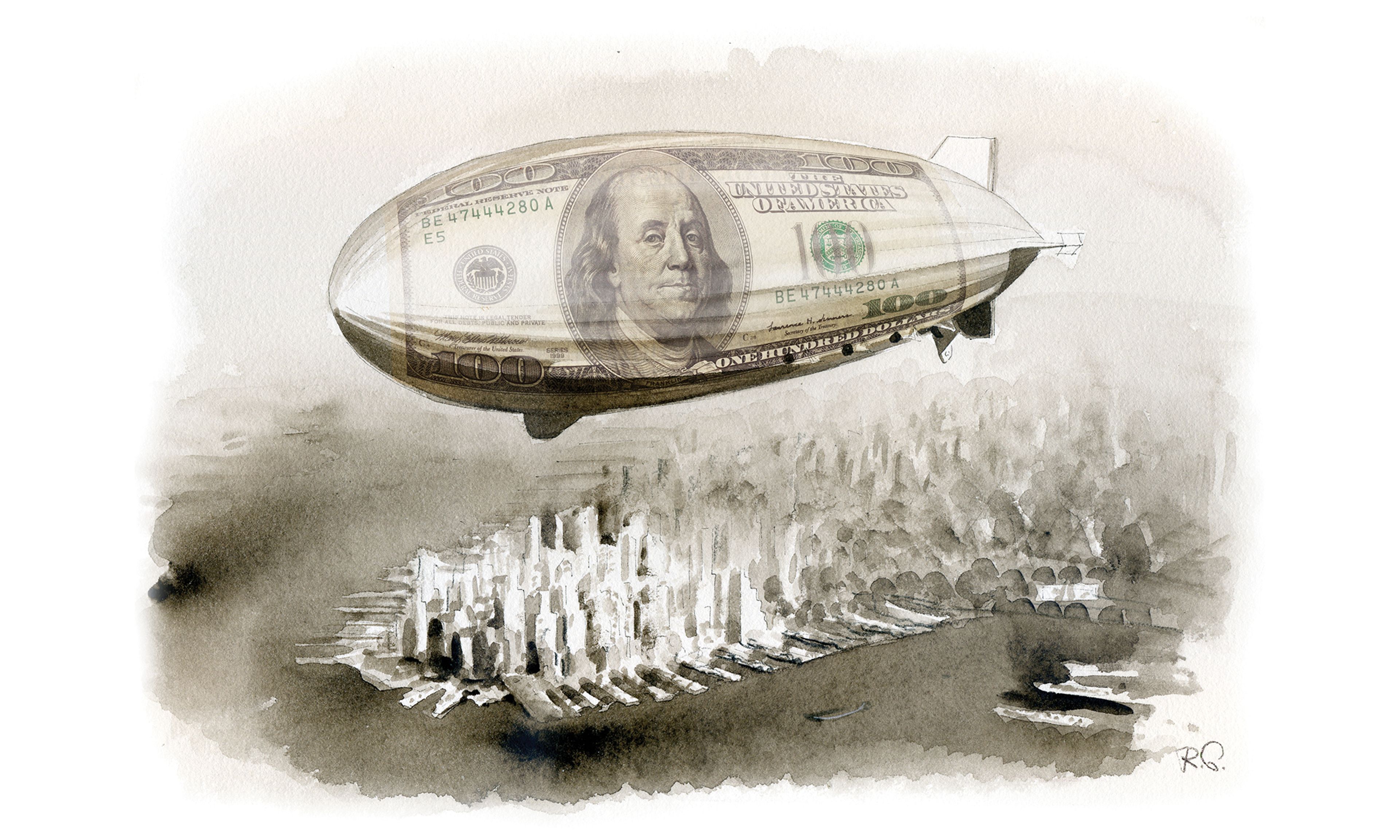
You may have noticed things are getting a little pricier. How’d we get here?
The most basic equation in monetary economics is MV = PY. The money supply (M) times the velocity of money (V) equals the price level (P) times real GDP (Y). It’s based on accounting identities and is always true mathematically. Let’s look at each part in context of the pandemic and see what’s going on.
The Federal Reserve learns of the pandemic. The only variable in the equation that the Fed directly controls is M, the money supply. The Fed increases it to counteract the impending economic doom.
The pandemic will upend all normal economic activity. That means the velocity of money, the rate at which money exchanges hands, will go down. That will counteract the inflationary effects of jacking up the money supply.
Let’s look at the PY side of things. No matter what the Fed does, real GDP is going down. A pandemic will negatively affect GDP no matter how much money is in the economy. Some things, alas, are beyond monetary policy.
Assuming the increase in the money supply was successful at counteracting the drop in velocity (a big assumption, to be sure, and one we will return to later), the decrease in Y means that P, the price level, must go up. The word for the price level going up is “inflation.”
The data back up this story. The velocity of money experienced its largest single-quarter drop on record from the first quarter to the second quarter of 2020. M2 is the Fed’s go-to measure of the money supply and includes cash, deposits, and things that can quickly be turned into cash, such as money-market accounts. The year-over-year growth rate of M2 skyrocketed to 27 percent, the highest rate on record. GDP took a huge hit, declining the most it ever has in a single quarter. And, of course, we have higher-than-normal inflation.
The version of MV = PY that matters more is the calculus one, since each of those variables is moving at any given time. There will be no calculus in these pages. Think of it this way: There are two ways for the inflation rate to come down. The money supply, M, grows less fast, or real GDP, Y, grows faster. The United States should pursue both of those goals.
The year-over-year growth rate of M2 went from 7 percent in February 2020 to 22 percent in May. If the velocity of money had been constant, that growth of the money supply would have caused massive inflation immediately, but it didn’t because the simultaneous drop in velocity counterbalanced it. In fact, inflation decreased significantly from February to May 2020, from 2.3 percent to 0.2 percent.
According to the National Bureau of Economic Research, the COVID recession was only two months long, from March to April 2020. The Fed continued its breakneck expansion of the money supply well into 2021, however. The M2 growth rate peaked in February 2021 at 27 percent, and in September it was 13 percent (still high). Since the second quarter of 2020, the velocity of money has been steady. Without the simultaneous decrease in velocity that happened from February to May 2020, the money-supply growth has the potential to be inflationary.
It’s time for the Fed to turn the page on the pandemic, but it’s been very vague on how it will do so — and the money supply keeps rocketing up in the meantime. In a September 2021 paper, Peter Ireland and Mickey Levy of the Shadow Open Market Committee argue that the Fed was caught off guard by the speed with which the economy has recovered. Maximum employment, the other part of the Fed’s dual mandate, is looking good. (In fact, our problem at present is that we have too many jobs and not enough workers, the opposite of the problem following the Great Recession.)
Ireland and Levy write that the Fed’s measures of progress towards its monetary-policy goals are too subjective. In its statements the Fed talks of “substantial progress,” as measured by a wide variety of economic indicators, towards nebulous goals. Ireland and Levy argue that instead the Fed needs to pick one economic measure, such as nominal GDP, and make clear that it will raise rates and taper its asset purchases when that measure hits a target level. Rather than argue about whether inflation is transitory or persistent, they say the Fed has the power to decide whether it will be transitory or persistent by clarifying its framework.
That’s sound monetary policy, but it would be difficult to enact. Not because the Fed is incapable of enacting it, but because the federal government’s fiscal policy in the last few years makes raising rates especially perilous. With the country’s debt-to-GDP ratio over 120 percent, even small increases in interest rates would add large amounts of money in debt service to the already bloated federal budget. The last time the Fed raised rates to counteract inflation, under chairman Paul Volcker in the late ’70s and early ’80s, debt-to-GDP was around 30 percent.
It’s widely expected that the Fed will taper its asset purchases and raise rates next year as the country returns to normal economic activity post-pandemic. It’s important that the Fed do that at the right time, based on actual economic performance, to avoid overshooting and setting the country up for a future recession. The other variable, real GDP, is where elected officials can make a difference, mostly by getting government out of the way.
The economy does not suffer from lack of demand. In fact, households are doing quite well, with increased savings and increased demand for consumer goods. We don’t need any more stimulus. The stimulus already passed was poorly targeted, and about $1 trillion of the COVID relief that Congress appropriated is still waiting to be disbursed.
The United States is blessed with natural, industrial, and human resources beyond any other country on earth. This, combined with our dominant position in the global marketplace, suggests that the supply side should rarely be the problem. In a country like ours, as Samuel Hammond, Daniel Takash, and Steven Teles have written in the New York Times, “constrained supply ultimately results when providers use their political power to insulate themselves from the market forces that drive innovation and cost reductions in the long run.”
Many of the problems we face weren’t caused by the pandemic; it merely exposed vulnerabilities that were always there. That’s why we’re in a supply-chain crisis now, even though we have safe and effective vaccines against COVID that have made the virus a small concern to most people’s health.
The Bank for International Settlements found in a study that transportation bottlenecks in America have contributed to our inflation being higher than Europe’s in the past few months. Our transportation sector has not gotten the attention it needs.
Our tech sector, which has prospered unbelievably, can help with innovations such as port automation. There’s no reason that the country that is home to the world’s greatest tech companies should have ports stuck in the past. But we do, because of labor unions. The longshoremen’s unions on the West Coast are extremely powerful, and they both limit the supply of longshoremen and oppose automation. That results in highly paid longshoremen (to the tune of $171,000 per year, on average) and incredibly inefficient ports. Rarely are concentrated benefits and dispersed costs so clearly on display.
Our environmental regulations often prevent us from building the capacity we need to transport more goods. Since 2005, BNSF has been willing to put up $500 million of its own money to build a new intermodal rail yard near the Port of Long Beach, but California’s environmental regulators have stood in the way. That’s but one example of countless projects that spend more time in environmental review than they do in construction. Those delays are ridiculous in ordinary times, but in times like the present, they can also be harmful.
It’s not because we don’t spend enough money on infrastructure, either. In fact, we spend too much relative to what we get. For one-quarter the cost per mile it will take the U.S. to replace the existing Baltimore and Potomac Tunnel on Amtrak’s Northeast Corridor, which is only ever a few dozen feet underground, the Swiss were able to bore the deepest tunnel in the world, the Gotthard Base Tunnel, through the Alps. President Biden’s infrastructure plans only feed more money into a broken system.
Of course, nothing in the economy works without people, and our worst shortage right now is labor. Not only do we have more vacant jobs than unemployed people, but in almost every industry people are also quitting their jobs at the highest rates on record. In National Affairs last year, Arnold Kling wrote about how the pandemic recession represents “a disruption of patterns of specialization and trade” that will result in people changing their behavior. He wrote, too, that “these behavior changes may be permanent.” One such may be a change in career. Many people worked from home for the first time during the pandemic, and many others worked longer hours in person than they ever had before. Both of those experiences might cause people to re-evaluate their careers and make changes.
With sound monetary policy and reforms that allow us to better utilize our vast resources, the inflationary period we are now facing has the potential to be the birthing pains of a new economy, one where the pandemic is behind us, more people are satisfied with their careers, and the inefficiencies currently causing price increases are eliminated so that they won’t affect us again. But mistakes from the Fed and more government intrusion into the economy could mean we’re headed for a ’70s redux, and the pain we’re feeling now will become chronic. Things have the potential to go either way, depending on what the Federal Reserve and the federal government do next.










Comments