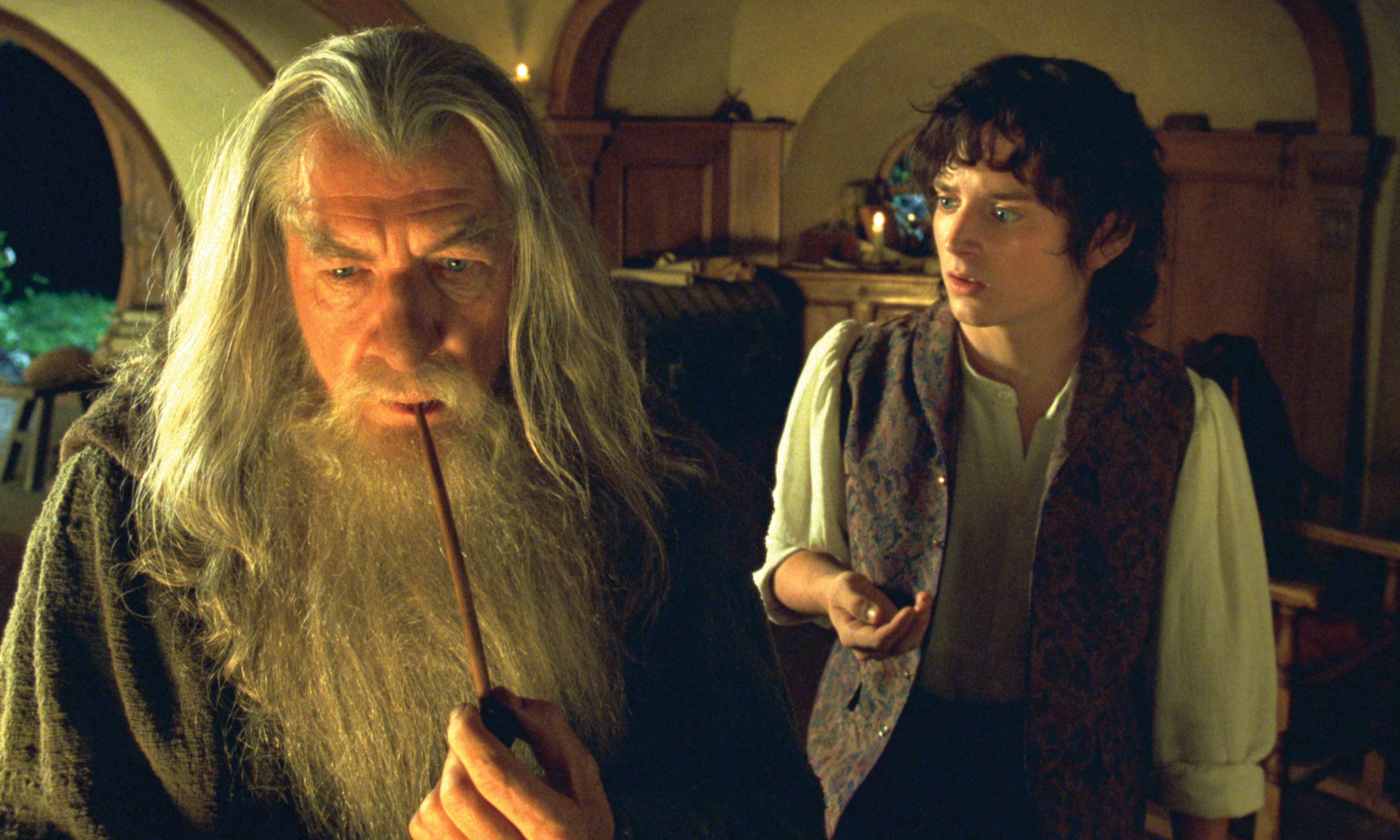
‘It would be easier to film the Odyssey,” the late Oxford philologist John Ronald Reuel Tolkien once said of his most famous work, the high-fantasy novel The Lord of the Rings. “Much less happens in it. Only a few storms.” And it did end up being something of an odyssey to get Tolkien’s epic onto the big screen.
That wasn’t because The Lord of the Rings (Tolkien understood it as one work, though it was published in three volumes) was some obscure tract. It is among the best-selling books of modern times. Its story is, by now, well known. In the fantastic world of Middle-earth, Frodo Baggins, one of the diminutive humanlike creatures known as “hobbits,” comes into possession of a mysterious ring. He soon learns that it is the One Ring, a powerful tool forged by the Dark Lord Sauron. Sauron has long sought dominion of Middle-earth, having made the Ring to enhance his own power and suborn other wielders of lesser rings to his will. Separated eons ago from his Ring, Sauron enlists a vast array of servants in an attempt to regain it and to conquer Middle-earth once and for all. Frodo seeks to destroy the Ring, while others allied against Sauron contest his various evil schemes against them.
Tolkien’s vast world has its own history, geography, and groups of inhabitants with unique cultures. No wonder so many attempts at adaptation foundered after Tolkien signed away the film rights in 1968. Among the abandoned efforts are a version that was supposed to star the Beatles and be directed by Stanley Kubrick (yes, really) and an abortive John Boorman–spearheaded production that ultimately inspired Boorman’s 1981 Arthurian epic Excalibur. There were also versions that did make it to the screen, such as Ralph Bakshi’s 1978 animated film, which covers about half of the three volumes, and a long-forgotten Soviet adaptation of The Fellowship of the Ring that resurfaced earlier this year.
Then, 20 years ago, an obscure New Zealand director, Peter Jackson, released the first entry of his Lord of the Rings trilogy. The making of the film was difficult and risky, beset by production uncertainties. The project, hopping from studio to studio, at one point was almost forced, at the absurd behest of Harvey Weinstein, then head of Miramax Films, into one film directed by Quentin Tarantino. Filmed back-to-back, on a budget of about $100 million each, the Jackson trilogy could easily have destroyed New Line Cinema, the studio that eventually housed the project. It could have also ruined its director, who had at that point directed only one major Hollywood feature: The Frighteners (1996), which critics generally admired but audiences mostly ignored.
Jackson viewed the adaptation as a “challenge,” he told a reporter for the Los Angeles Times in 1998. Fantasy, after all, was “the one genre that’s never been done especially well,” he noted. “After 100 years of cinema, there’s not a lot of new ground for storytelling. We can all point to great musicals or horror films, but no one’s ever really nailed fantasy.” He wanted to see whether he could “pull it off.”
That L.A. Times story was headlined “New Line Gambles on Becoming Lord of the ‘Rings.’” The gamble paid off handsomely. The first film was the second-highest grossing of 2001, bested only by Harry Potter and the Sorcerer’s Stone. The next two were the highest grossing of 2002 and 2003, respectively, with The Return of the King becoming only the second film ever to make more than $1 billion worldwide (after Titanic). Each entry in the trilogy was rapturously reviewed upon release. On RottenTomatoes.com, a movie-review-aggregation website, they all earn 90 percent critical approval (albeit with some more recent reviews included). The series garnered 17 Academy Awards, including Best Picture for The Return of the King, and ended up grossing nearly $3 billion worldwide. If gambling were always so lucrative, casinos would never have existed.
Two decades provide enough remove to ask whether the critical and commercial success was merited and, more important, whether Jackson and his team captured the spirit of Tolkien’s work.
Does the trilogy hold up as cinema? Rewatching it recently, I found that the answer is obviously yes. The casting is, for the most part, impeccable. The scenery, much of it filmed on location in New Zealand and augmented as needed with sets, models, or CGI, feels simultaneously fantastic and lived in.
The special effects are good enough that this enchanted world requires little suspension of disbelief. Visually, the film has aged much better than many other works from that unfortunate early-2000s period, when film studios overused new technology and gave things a video-gamey sheen. Howard Shore’s score is one of the greatest ever; including over 100 themes, it is transportive, evocative, and lush, alternating, like the film itself, between intimate moments of quiet grace and dramatic cues appropriate for gigantic battles and titanic struggles. The entire production takes itself seriously without feeling leaden; it simply feels credible. Jackson wanted those involved “to think that Lord of the Rings was real,” that the events depicted in the films were historical and that their job was simply to re-create them. This was consistent with Tolkien’s understanding of The Lord of the Rings, which he presented not as a fictional tale but as a chronicle of the distant past. Both were fictional conceits, but intended to help make the unbelievable believable.
It is widely acknowledged that there are many serious differences between Jackson’s adaptation and Tolkien’s novel. Answers vary, however, to the question whether Jackson’s work maintains Tolkien’s spirit or ruins it. Ian McKellen, who plays the noble wizard Gandalf, has remarked that “the enthusiasts who have read the novels over and over may notice every change but in doing so they will miss the point.” On the other hand, Christopher Tolkien, the author’s son and literary executor, complained that Jackson and his crew had “eviscerated the book by making it an action movie for young people aged 15 to 25.”
Who is right? Both — and neither. Some of Jackson’s innovations do make sense, at least when considered in light of the exigencies of filmmaking. In Tolkien’s Fellowship, for example, 17 years elapse between Frodo’s receiving the Ring from his uncle Bilbo and his setting out on his quest. “The narrative of film could not cope with such a roundabout and leisurely unrolling,” wrote Tolkien scholar Tom Shippey, who also consulted on the production. There is a similar argument to be made in favor of the way Jackson ended Fellowship, with a suitable climax and resolution, as opposed to Tolkien’s cliff-hanger.
Other of Jackson’s changes are blatant concessions to Hollywood blockbuster sensibilities. The elevation and expansion of Arwen, the half-elfin love interest of Aragorn, a human of kingly heritage and destiny; the transformation of hobbits Merry and Pippin into comic relief for teenagers; and some of the more improbable stunts of the elf Legolas. And though the CGI effects are subtler than those of many contemporary films, they become more prominent as the trilogy advances.
There are also some fairly egregious changes to certain characters. Writing for National Review just after the release of Jackson’s Return of the King, Tolkien expert Joseph Pearce identified the transformation of the wise elf Galadriel, originally a Marian figure, into “a disturbed and disturbing witch, or an electrifying and electrocuted wench.” There is also the distortion of Faramir, brother of the corrupted yet redeemed man Boromir. In Jackson’s The Two Towers, Faramir is corrupted by the Ring but saved by Frodo’s companion Sam from going down his brother’s path. Faramir is quite different in Tolkien, who makes him nobly immune to the Ring’s temptations.
Even more notable is the mutation of Aragorn. Jackson’s version is unsure whether he is worthy of assuming his kingly destiny. His story becomes much more a standard hero’s journey. Tolkien gives Aragorn the occasional stumble, but he is largely intent on his destiny from the moment we meet him. Jackson’s alteration of Aragorn partly recenters the movies on him and his internal conflict, somewhat shortchanging Frodo and the hobbits in their respective journeys.
One could make many other quibbles. Bradley J. Birzer, a Tolkien scholar and professor of history at Hillsdale College, believes that Tolkien would not have approved of the films. “They’re too violent and have too much action with not enough focus on the philosophical elements of the books,” Birzer has said. There is some truth to that observation, too. Some of the thematic depth of The Lord of the Rings, such as what Tolkien called its “fundamentally religious” (Catholic) nature, is mostly (though not entirely) subdued in Jackson’s trilogy.
But Jackson did not imagine that his adaptation would be definitive. “Remember, . . . it’s just my interpretation,” he told an interviewer during production. Whatever the flaws of Jackson’s films, they captured Tolkien’s spirit and much of the work’s philosophical core. As Shippey put it, they preserve some of Tolkien’s more important themes, such as “the need for pity as well as courage, the vulnerability of the good, the true cost of evil.”
Even an imperfect representation of that essence puts Jackson’s Lord of the Rings trilogy leagues above much of the dreck that Hollywood produces today. I think of the soulless comic-book or action films whose elevation of spectacle over substance sells easily to audiences worldwide without doing much to elevate them. Those behind such films, despite having more money and more advanced technology than Jackson did, manage to convey less.
Did the success of Jackson’s trilogy contribute to that development? Perhaps marginally, by showing what technology could accomplish. But so many of the big-budget spectacles that followed (and still follow) in the trilogy’s wake forget the human core that must be at a film’s center if viewers are not to sit numbly as waves of CGI wash over them. Jackson himself forgot it a decade after The Return of the King, with his much-inferior Hobbit prequel trilogy. But whatever complaints one may have about it, the deserved and enduring popularity of his original trilogy will continue to point new generations of readers to Tolkien’s work. And that will remain a virtue in itself.












Comments