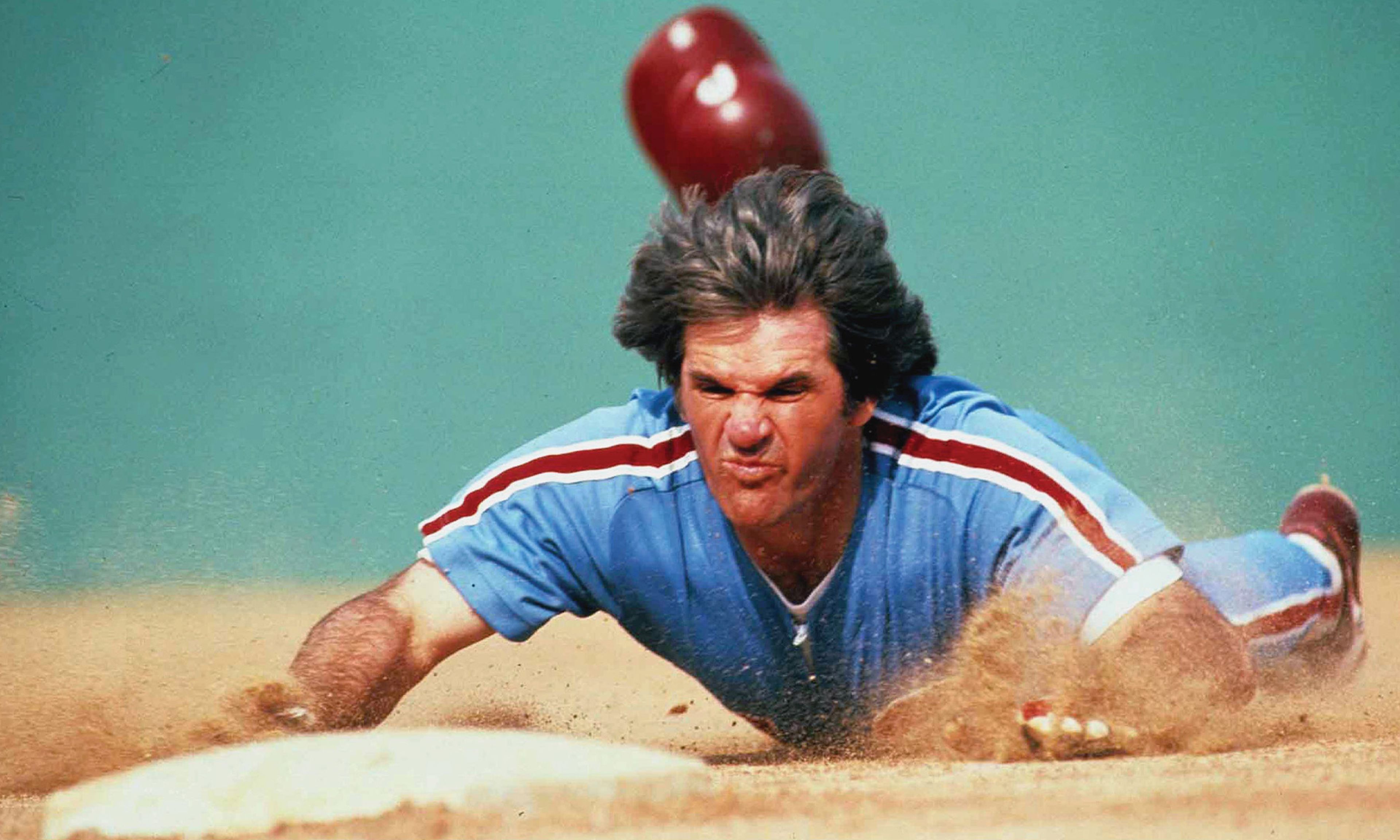
If you were a New York Mets fan in the 1970s, as I was, growing up on Staten Island, Pete Rose was already infamous, a certified outlaw, long before he was banned from baseball, in August 1989, for betting on games and lying about it.
It wasn’t just the gratuitous, jaw-dropping attack on Mets infielder Buddy Harrelson in the 1973 National League playoffs, where a bully flashed his eagerness, as Rose boasted, to “bust up double plays — and shortstops.” It was Rose’s everyday style of play: aggressive, inelegant, dirty. He was great and exciting — but ugly — to watch.
Next to the hometown hero of the era, Tom Seaver — a.k.a. The Franchise, Tom Terrific, the Thinking Man’s pitcher, handsome, well spoken, poetry in motion on the mound — Rose, with his squat frame, untamed stubble, and caveman affect, appeared downright beastly, the Frazier to Seaver’s Ali.
That Rose became Major League Baseball’s all-time hits leader, surpassing Ty Cobb in 1985, reflected Rose’s “Charlie Hustle” work ethic. It was left to the statisticians to point out that Cobb posted a higher career batting average and on-base percentage and, playing under much tougher conditions — a higher mound, more rule-breaking, spartan travel accommodations — remained great to the end, while Rose limped to the record, exploiting his role as manager of the Cincinnati Reds, the team that made him famous, to prolong his playing career.
When banishment came — an unappealable thunderbolt from baseball commissioner A. Bartlett Giamatti, swiftly followed by Rose’s guilty plea for tax evasion and then a five-month prison term — those of us who had always regarded Rose as unsavory, an unworthy ambassador for the sport he led, were not surprised.
Rose’s acknowledgment that he had bet on games, offered 15 years after the Dowd report had, in forensic detail, established as much, rang hollow. It will be interesting to see whether death — the ultimate sacrifice bunt from the old switch-hitter — will earn Rose some form of posthumous induction into the Hall of Fame.
My lone interaction with the man confirmed everything I believed about him as a kid. It was 1994, and I was attending a friend’s wedding in Boca Raton, where Rose owned a sports bar. The groom had arranged for us groomsmen to have the place to ourselves for an afternoon, with an open bar, hors d’oeuvres, and free access to the foosball table, air hockey, and other games.
Two admonitions obtained. The first came from the outdoor sign, impossible to miss, informing all ye who enter here: PETE WILL NOT SIGN ANYTHING FOR LESS THAN $25. The second admonition, even sterner, came from the groom: “Do not approach Pete. If you see him, just stay away. He likes his privacy.”
And there The Legend sat, alone at the bar, watching college football and crunching mixed nuts with his front teeth. That money was riding on the game seemed certain; Rose’s forward-leaning hunch bespoke interest beyond fandom.
A budding reporter, I had no intention of leaving Rose alone. I broke away from the guys and pulled up the seat immediately to his right. This drew his side-eye, understandably; it was as if I had reached an empty airport gate and chosen to sit right next to the lone passenger waiting there.
My greeting was met with silence and fixation on the TV screen above us. So I dove in.
“When Ringo Starr got out of rehab” — that got his attention — “he appeared on the cover of People magazine [August 28, 1989, edition] and described how he had been mixed in with all ordinary people — no celebrities.
“And he said that, in the interest of getting along, ‘Everybody got their One Beatles Question.’”
More nuts, more crunching.
“So I was wondering if I could have my One Baseball Question.”
More side-eye.
“My baseball hero growing up” — a calculated gambit on my part, successful, as Rose’s ears pricked up, like a terrier who’s heard the owner’s car pulling in — “was Tom Seaver.”
I knew it would hurt. Besides the stark differences in their personas, the two players had battled fiercely on the diamond, with Rose compiling a so-so .289 career batting average against Seaver, who struck out Charlie Hustle 21 times: roughly 15 percent of their encounters. On the other hand, Rose homered off Seaver in the ’73 playoffs.
After the Mets, unconscionably, traded Seaver to the Reds, in 1977, he and Rose spent one and a half seasons as teammates. When Seaver threw his only career no-hitter, a 4–0 win over the St. Louis Cardinals on June 16, 1978, Rose hit a two-run double. But by then the “Big Red Machine,” dominant earlier in the ’70s, had stalled out.
At the bar, Rose’s deflation was palpable. This punk was asking about @#**ing Seaver? The buzz-off vibe returned. I plowed forward.
“Seaver had a reputation of being Mr. Clean on the road: never touched drugs or alcohol, didn’t chase women. Was that accurate?”
Now, at last, The Legend spoke. He looked at me and sneered: “Why the hell should I tell you?”
I stuck out my neck, half-questioning: “It would make my day?”
“Well, I ain’t Clint Eastwood!”
The contempt! The disrespect!
I hadn’t expected a Dirty Harry reference, nor the sheer surliness I had encountered. Had I forgotten Bud Harrelson so soon?
I decided to employ the same approach I had used, successfully, with bullies in grade school: a kind of Civilized Man pose, soft rebuke for the other fellow’s antisocial behavior. The Civilized Man pose can take many forms: a raised eyebrow, upturned palms, even a direct question such as “Why on earth are you behaving this way?”
Here I opted for a Tony Randall–style looking away with a slight sigh, more in sorrow than in anger.
It did the trick. Jolted into propriety by a small dose of Jewish guilt, Rose, with his trademark shrug, resumed speaking.
“Yeah, Seaver lived clean. He was clean.”
I opened my eyes wide, cocked my head, said “Thank you,” and retreated. The Legend — approached in his own bar! — grunted and resumed crunching.
Charlie Hustle wasn’t such a tough nut to crack, after all.
Looking back on the encounter now that Rose is gone, at 83, I wondered about the protracted campaign to bring the compulsive gambler to heel, make him admit his misdeeds, express contrition, come clean — as clean as Tom Terrific on the road — and whether, in all the investigations, depositions, and proceedings, Bart Giamatti or anyone else ever tried the Civilized Man approach.
Editor’s note: Since its original publication, this article has been corrected to indicate that Rose and Tom Seaver were teammates for one and a half seasons (not five).












Comments