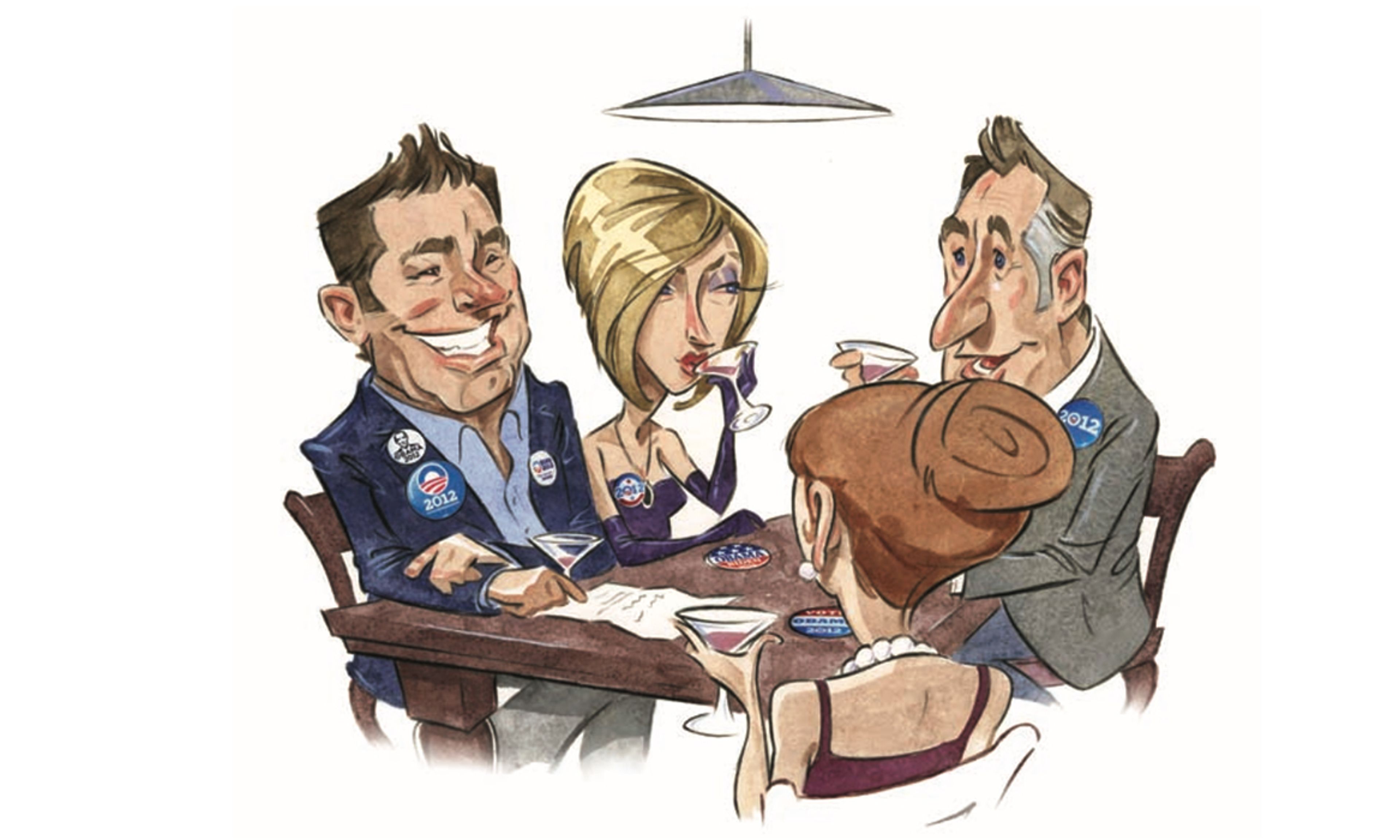
Pity Mitt Romney. He couldn’t get even the 1 percent.
Not only did President Obama carry eight of the nation’s ten richest counties as measured by average annual household income; he carried them by a margin greater, CNBC reported, than that in the overall vote.
Things have changed since the days when swells in evening clothes went down to the Trans-Lux to hiss Roosevelt.
I should have had an inkling of this when, on the Monday before the election, I was hanging out with a dozen guys in my town in northern Westchester County, N.Y., which the Census Bureau identifies as the poorest of the country’s ten priciest counties. Like Fairfield County, Conn., and Morris County, N.J., Westchester was once a Republican redoubt, home to people who’d done well under free enterprise and could be expected to resist Washington’s efforts to tamper with it. But when, that Monday, a quantity of Bushmills had been consumed and talk turned to the election, a show of hands revealed an 8–3 majority for Obama.
What happened?
It’s not news that the Republican party puts off a lot of people in places like Westchester. In an interview with Bob Woodward, President Obama dismissed House speaker John Boehner as “a golf-playing, cigarette-smoking, country-club Republican.” Such rare birds may still be extant in the Ohio Valley, but they are virtually extinct east of the Alleghenies, where the Thurston Howellses of today’s yacht clubs and golf clubs associate the GOP with Bible-thumping yokels in the sticks.
Coastal elites have, as a rule, little firsthand knowledge of the flyover counties where such strength as the Republican party retains is concentrated; they imagine it a sinister, hick world of tattoo parlors and trailer parks, part Deliverance, part Children of the Corn, where, to the muezzin music of the rebel yell, Evangelical hillbillies clinging to guns and religion interbreed with the spawn of banjo-strumming rednecks formed on the model of G. W. Harris’s Sut Lovingood, the backcountry cracker who says that if “ever yu dus enything to eny body wifout cause, yu hates em allers arterwards, an’ sorter wants tu hurt em agin.”
It was just possible, before the election, to imagine that the broken economy would incite the white-collar coastal squirearchy to put down the glass of Merlot and join forces with toothless Appalachia itself to restore fiscal sanity in Washington. But cultural style trumped economic substance in counties like Westchester, where well-heeled voters affected to take President Obama at his word when he said that he was a free-enterprise man who believed in “self-reliance and individual initiative and risk-takers’ being rewarded.”
Naïveté in higher suburbia? To be sure. But before casting judgment on a man, drive a mile in his Range Rover. If, in your 25,000-square-foot McMansion with a carbon footprint the size of Liechtenstein’s, your leisure is absorbed in anxiety about subsidized contraceptives for the masses and the integrity of the ecosystem, you have little time to keep track of the various trillions being promiscuously squandered in Washington. And whyshould you keep track of them, when the most respectable oracles of the coastal suburbs — the New York Times, PBS, Diane Sawyer, Andrea Mitchell, David Letterman, et alia — readily assure you that under President Obama “it’s all good”?
Of course, voting for a politician on account of free condoms for the proletariat or the well-being of the stubfoot toad is a luxury if you are having a hard time keeping your family fed. Counties like Westchester, however, have been insulated from the worst effects of the underperforming economy. The unemployment rate here was 7.3 percent in September (the national rate was supposedly 7.9 percent), and in suburban Westchester the rate was almost certainly lower still. (Yonkers, the most populous city in the county, has an unemployment rate of 9 percent and drives up the county’s numbers.) Wrapped in the protective membrane nurtured by President Obama’s policies — the placenta of the privileged — the Westchester and Fairfield and Morris counties of America are splendidly isolated from the reality of President Obama’s America. Herein lies a clue to the mystery of the president’s reelection.
Few or no politicians on either side of the aisle are innocent of the art of using pork to coddle favored constituencies. But today’s Democrats have simultaneously degraded the art into a trade and elevated it into a science. For four consecutive years the president has run up trillion-dollar deficits to succor voting blocs essential to his reelection. Public-sector unions rejoice in policies that promise to nurse thousands of new tax gatherers and health-care clerks at the public teat. The president bailed out Chrysler and General Motors on the taxpayers’ dime; women are promised free birth control as part of Obamacare, which also spares the plaintiffs’ bar fee-killing tort reform.
In like spirit, the administration took care to ensure that its economic incompetence would not drive America’s prosperous, blue-leaning suburbs into the red camp of Republicanism. Three initiatives go far to explain how the president has kept not only Range Rover moms but also BMW dads in the Democratic fold:
1. The Dodd-Frank Wall Street Reform Act makes Washington’s tacit policy of “too big to fail” the law of the land, freeing money mavens from the fear that once tempered their avarice — that of losing their shirts. In prosperous suburbs that depend on the big banks for the weekly caviar klatsch, voters are pleased that, thanks to Washington’s promise to continue subsidizing failed risk-taking, the good times will go on . . . and on, until the American Republic goes the way of the Roman one.
2. Like the functionaries in Dickens’s Circumlocution Office, Washington’s potentates are all but incapable of calling things by straightforward names. Considered merely as slogans, “printing money,” “going Weimar,” and “fantasy dollars” are not as verbally attractive as that vague but comforting formulation, “quantitative easing.” Who in this fallen world would not be eased? Actually, the Fed itself calls quantitative easing by an even more opaque name — “policy accommodation,” the effort to promote growth through purchases of securities from banks to the tune of $85 billon a month. (The fiat cash is electronic now, so you don’t need wheelbarrows to cart it around.)
Anthony Randazzo, writing in Reason, points out that quantitative easing is “a regressive redistribution program” that boosts “wealth for those already engaged in the financial sector or those who already own homes.” It passes “little along to the rest of the economy” and is a “primary driver” of income inequality and crony capitalism. Mitt Romney’s promise to get rid of Ben Bernanke, whose policies are driven by the president’s own, probably hurt Republican chances in Richtopian America as much as anything else.
3. The American Action Forum recently found that the Obama administration has added “more than $488 billion in regulatory costs since January 20, 2009 — $70 billion in 2012 alone.” The AAF observes that $488 billion is only the cost floor, not the ceiling, and that it is “a tremendous burden on private entities and local governments,” amounting to “more than U.S. GDP growth from the past three quarters ($442 billion).”
Regulatory compliance is a drag on the economy, but it’s good for lawyers, who are disproportionately represented in upper suburbia. They were hit harder in this recession than previous ones, in part because law schools have graduated too many of them. President Obama promises to correct the problem. The Roman lawyers in the age of Constantine, Gibbon said, had “an inexhaustible supply of business in a great empire already corrupted by the multiplicity of laws, of arts, and of vices.” The same will soon be true of American lawyers in the age of Obama.
The very people who used to provide the Republican party with crucial electoral support are being corrupted by the president, who is turning them into wards of the state. He steadily resists letting them do the one thing they are really good at: enlarging the economy through investment. The one perk the president doesn’t want the well-off to have, a low capital-gains tax, is precisely the one that encourages those who have capital to share it with the rest of us by bankrolling new enterprise.
The Democrats have long had a lock on the votes of the poor, the unions, the public-sector workers, and the academic-media clerisy. But the prosperous suburbs, although they have been trending blue for years, did not seem a lost cause to the Republicans. Until now. The gender gap once offered the GOP a ray of light in these jurisdictions — surely the most successful white-collar men would break for the Republican nominee in a year when the Democratic incumbent had badly botched things. But men themselves are changing. Their sense of liberty, as Gibbon wrote in a similar context, has become “less exquisite.” The Left has a monopoly of the nation’s schools, and its program of “socializing” the individual — that is, reducing him, in Hannah Arendt’s words, to “the level of a conditioned and behaving animal” — has succeeded in taming even the recalcitrant male of the species, and has gotten him, if not to love, by no means altogether to hate Big Brother.
Gibbon said that the Romans in their last decay “were incapable of discerning the decline of genius and manly virtue, which so far degraded them below the dignity of their ancestors; but they could feel and lament the rage of tyranny, the relaxation of discipline, and the increase of taxes.” If only our brightest suburbs could feel the relaxation of fiscal discipline and the increase of taxes. The cunning prodigality of the president has (temporarily) preserved them from the reality.











Comments