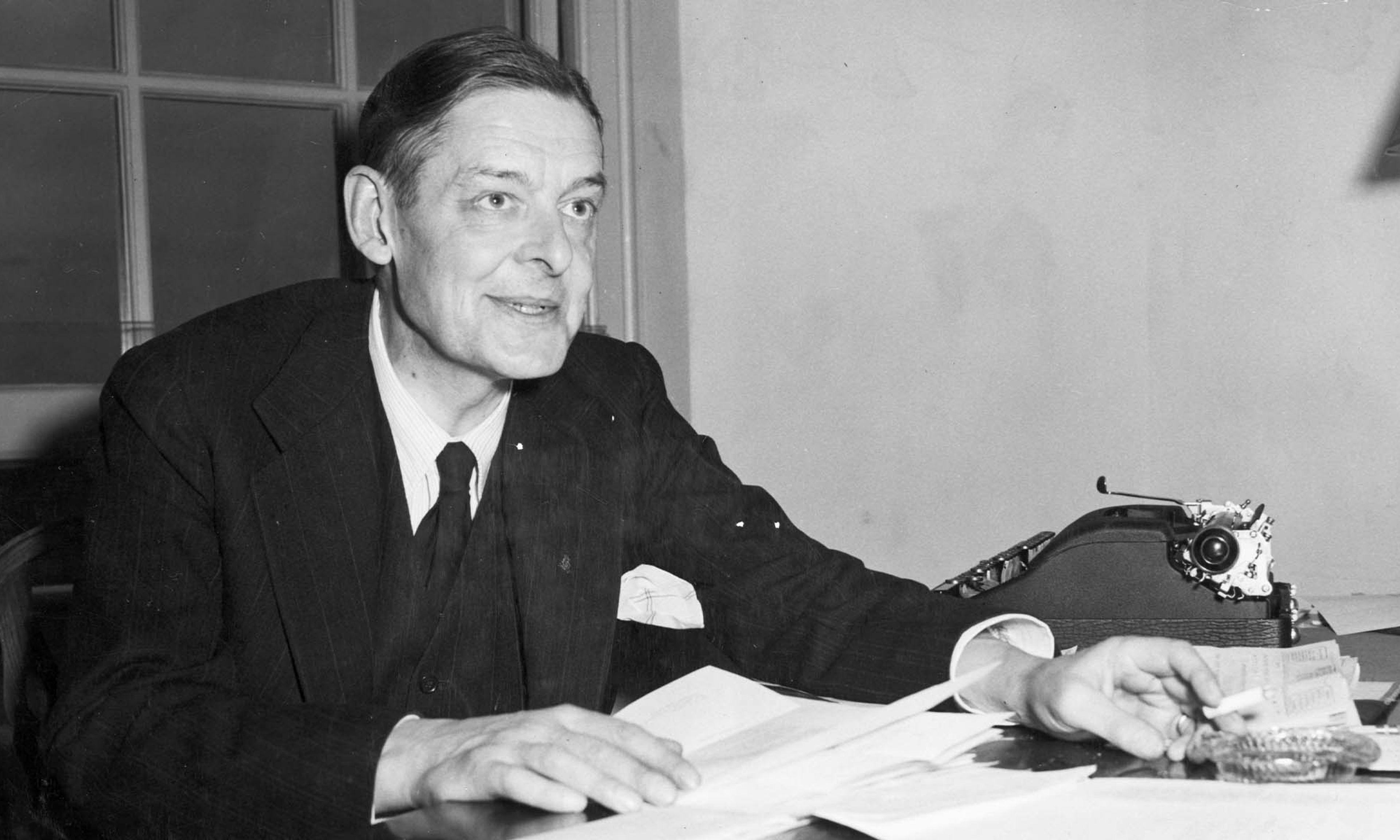
It is almost impossible today to appreciate the authority that T. S. Eliot exercised over English letters at the height of his fame. On either side of the Atlantic, poets felt his sway: “I have to keep away from Eliot or I wouldn’t have any individuality of my own,” said Wallace Stevens in 1943. To Ted Hughes, he was “the master of masters.” For some, he was a demon that had to be exorcised: “Eliot was such a great genius he set American poetry back thirty years,” William Carlos Williams groused.
Likewise, Eliot’s critical judgments, and the “New Criticism” that took its bearings from certain of his essays, were an establishment that successors aimed to throw off. Thus Harold Bloom, suffering under his own anxiety of influence: “I confess a lifelong hostility to T. S. Eliot, whose literary criticism did real harm, and whose cultural criticism showed, at times, a vicious proto — Fascism.” In time, the monument was well and truly toppled. When Cynthia Ozick launched her notorious broadside against Eliot in the New Yorker in 1989, Hilton Kramer remarked in the New Criterion on the choice of target: “Could one point to a single significant writer under the age of forty whose poetry or criticism could be said to reflect his direct influence — or even an awareness of his existence? . . . For decades Eliot had bestrode the literary world as a colossus, but now he had disappeared from that world almost without trace.”
So it is perhaps odd to find ourselves in boom times for T. S. Eliot. The year 2015 marked the centenary of the first of Eliot’s great poems, “The Love Song of J. Alfred Prufrock,” he of stair-shuffling, peach-regarding fame, and saw the arrival of the complete Poems, in two volumes, edited and annotated by Christopher Ricks and Jim McCue, the culmination of a nine-year scholarly enterprise. In 2020, the Princeton University archive containing some 1,000 letters from Eliot to Emily Hale, sealed for 50 years after Hale’s death in 1969, was made available to scholars for the first time. Eliot and Hale, muse and longtime object of his unrequited affections, exchanged letters for nearly three decades after meeting at Cambridge in 1912. The complete Prose, in eight critical volumes, appeared in 2021, bringing to publication more than 800 prose compositions uncollected at Eliot’s death in 1965.
This year, a wave of biography: Robert Crawford’s Eliot after The Waste Land, completing the two-volume chronicle begun in 2015 with The Young Eliot; Lyndall Gordon’s The Hyacinth Girl: T. S. Eliot’s Hidden Muse and Mary Trevelyan’s Mary and Mr. Eliot: A Sort of Love Story, both about Eliot and influential women in his life; on the poetry, Matthew Hollis’s The Waste Land: A Biography of a Poem and Jed Rasula’s What the Thunder Said: How The Waste Land Made Poetry Modern. Nine volumes of Eliot’s letters, covering the period through 1941, are also now available, with several more to come, including a volume with the letters to Hale.
The revival of interest in Eliot is, in part, the fruit of a heroic labor: With her husband’s deathbed blessing, Eliot’s second wife, Valerie, undertook to collect, transcribe, and edit her husband’s body of work in its entirety, which she did for more than four decades, with the eventual help of a select team of scholars, until her late years of failing health and her death in 2012. But it is more than that. We are not quite at that point where “these men, and those who opposed them / . . . are folded in a single party” (Four Quartets), but as we gain distance from the bitter contests over literary reputation, something is beginning to become clear: T. S. Eliot is a monumental fact of our literature, a figure whose work is not only, as Eliot wrote of Ulysses in 1923, “so significant in the history of the English language that it must take its place as part of the tradition of that language,” but significant in the ways we associate with writers of abiding greatness: Chaucer, Shakespeare, Milton, Coleridge. Eliot marked out new and permanent territory on the map of English letters, and we will continue to return to that place, again and again, finding something new there each time, as we return to Elsinore Castle and fair Verona and Xanadu.
The Waste Land, which turned 100 in October, is the most famous of Eliot’s territories. Endlessly annotated, parodied, and puzzled over, it resists recreational travelers. Basic questions remain unresolved: Who speaks the poem — one person or many? Does the poem aim to uphold certain values, or is it a lamentation for the loss of all values? Eliot’s letters to Hale seem to confirm that she inspired the “hyacinth girl” of the first part, but what sort of love poem is this, to the extent that it is a love poem at all? Is the poem’s ending — the fragments shored, the threefold “shantih” — a promise of peace, or of permanent dissolution (“London bridge is falling down falling down falling down”)? And what is a reader to make of “red sullen faces [that] sneer and snarl / From doors of mudcracked houses,” or “bats with baby faces in the violet light”? Because of Eliot himself — and Joyce and Pound and Woolf and Beckett &c. — we may not feel quite the shock of Eliot’s first readers, brought up on Wordsworth and Tennyson; certain of The Waste Land’s lines may have become the familiar offscourings of an undergraduate education (“April is the cruelest month,” “I will show you fear in a handful of dust”); certain dubious interpretations of the poem’s meaning may have congealed into conventional wisdom (e.g., “that I had expressed ‘the disillusion of a generation,’ which is nonsense,” as Eliot remarked in 1931): But we are still wrestling with the words and meanings.
The Waste Land was composed, like most of Eliot’s long poems, by bits and pieces, some as early as 1915, which he subsequently revised and arranged into a single work. Jed Rasula describes the method as “collage,” analogous to what revolutionary visual artists were doing at the same time. Eliot’s comment on the Pensées of Pascal is relevant: “He who reads this book will observe at once its fragmentary nature; but only after some study will perceive that the fragmentariness lies in the expression more than in the thought. . . . We cannot quite understand any of the parts, fragmentary as they are, without some understanding of the whole.” The challenge to the reader of The Waste Land is to identify the method by which Eliot unifies apparently disparate elements and establishes the “pattern” of the whole.
For a sense of how the poem works, consider a few select lines from the first part, “The Burial of the Dead”:
Unreal City, Under the brown fog of a winter dawn A crowd flowed over London Bridge, so many, I had not thought death had undone so many. Sighs, short and infrequent, were exhaled, And each man fixed his eyes before his feet.
The image — of a mass of clerks and functionaries trooping to work on a weekday morning — is clear enough, as is the mood. But the full effect of the passage is in its meticulous arrangement of sound, source, and sense to create a compact unit.
The subtle formal interaction of the lines — “Un-real” / “Un-der” / “Lon-don” / “un-done,” “so many” / “so many” — brings to mind Ted Hughes: “Take any passage of The Waste Land. . . . Every word [there] is as formally fixed, as locked into flexible inner laws, as words can be.” But the lines also interlock thematically, below the surface. Eliot offers guidance in his famous “Notes” (appended in December 1922, when the poem was published in book form). “Unreal City,” which appears again in Part Five, is a version of the opening words of Charles Baudelaire’s “Les sept vieillards” (“The Seven Old Men”): “Teeming city, city full of dreams / Where the ghost in daylight pulls at a passing sleeve.” The poem is part of a sequence of “Parisian Scenes” that Baudelaire included in Les fleurs du mal (1857), so we are licensed to meld London, shrouded in “brown fog,” with Paris wrapped in “a foul yellow fog”; the “Unreal City” is every city.
The fourth, fifth, and sixth lines are borrowings, too, this time from Dante. In Inferno III, just inside the Gates, Dante spots a train of people in tow behind a flapping ensign. They are the countless many who in life refused to commit themselves either to or against God, the “lukewarm” of Revelation 3:16; they reside on the outskirts of Hell, not worthy even of the decisiveness of damnation. “I had not thought death had undone so many,” says Dante, looking on. In the following canto, he passes through Limbo, where reside the Virtuous Pagans, such as Vergil, excluded from salvation on account of being born before Christ, and the innocent but unbaptized. Accident of birth, not wrongdoing, was their doom. It is their “sighs” that Dante hears and that Eliot adapts. So the interaction of the sources gives the theme: The “death” of those flowing over London Bridge is a death-in-life, the rejection, semi-conscious, of any course of action that would demand more than the sad daily routine (“‘What shall we do tomorrow?’ / . . . / The hot water at ten. / And if it rains, a closed car at four.”); the “Unreal City” is populated not by human beings, but by daytime ghosts.
As Eliot would write in his 1930 essay on Baudelaire: “The worst that can be said of most of our malefactors, from statesmen to thieves, is that they are not men enough to be damned.” And, in After Strange Gods (1933): “Most people are only very little alive.” The quest to restore the waste land, then, is the quest for true life, a life that is no longer subject to death. The paradox, made clear in subsequent lines, is that this life may be available only by a passage through death: “‘That corpse you planted last year in your garden, / ‘Has it begun to sprout? Will it bloom this year?’” All to gain, but all to lose, and no way to know, when we risk “the awful daring of a moment’s surrender,” which it will be. Except a corn of wheat fall into the ground and die . . .
In an essay the year before The Waste Land appeared, Eliot offered an implicit apologia for his own work: “We can only say that it appears likely that poets in our civilization, as it exists at present, must be difficult. . . . The poet must become more and more comprehensive, more allusive, more indirect, in order to force, to dislocate if necessary, language into his meaning.” If The Waste Land’s allusiveness and evasiveness, its ambiguous voices, its combination and recombination of images, place an extraordinary demand on us, perhaps it is because we remain very little alive — and how else is the poet to make himself heard? If The Waste Land retains its power to unsettle, it is because we might still be made to bloom. “‘You! hypocrite lecteur! — mon semblable, — mon frère!” Yes, you.












Comments