
• This magazine has always believed that fusion can work.
• Shortly after the last race of the midterms secured a 51–49 Senate for the Democrats, that Democratic majority shrank ever so slightly, when Senator Kyrsten Sinema of Arizona left the Democratic Party. In an Arizona Republic op-ed announcing her decision, Sinema cited the immense demands of partisanship, which she says pull members to the extremes and leave many Americans unrepresented. She was likely thinking of her own party, which repeatedly badgered her on such matters as the filibuster, which she supports, and Build Back Better, which she opposed. A heterodox figure, and an occasional ally of Republicans, Sinema is no conservative; her positions on abortion and other issues hardly endear her to the Right. Moreover, practically speaking, her decision is unlikely to affect the Senate much. Though she hasn’t announced whether she will caucus with the Democrats, as the Senate’s two other independents currently do, she is expected to keep her committee assignments in the Democrat-controlled Senate. One thing not to expect: any second thoughts from the activists who chased Sinema all the way out of their party.
• Going into the final weeks of the lame-duck Congress, Senators Thom Tillis (R., N.C.) and Sinema have made a last-minute push for an immigration deal. The pitch, in short, is that immigration doves would get a pathway to citizenship for “Dreamers” — the 2 million or so people who arrived illegally while minors and whose eligibility for deportation was waived by the fiat of President Obama — while border hawks would receive more resources for border security and at least one more year of Covid-based border controls. There may be a time and a place for a compromise on immigration, but as a political matter, there’s no reason Republicans should be making these kinds of concessions when their return to a majority in the House is mere weeks away. And in the event that they do try to hammer out some kind of deal that includes amnesty on the scale in question, they ought to hold out for a lot more, and longer-lasting, immigration control than the Tillis-Sinema compromise provides.
• Twitter’s new owner, Elon Musk, has allowed journalists Matt Taibbi, Bari Weiss, and Michael Shellenberger access to what he calls the “Twitter files.” The initial reports reveal how Twitter’s previous top executives decided to ban the sharing of the New York Post’s Hunter Biden laptop story before the 2020 election and how it decided to ban Donald Trump from the platform in the days after January 6, 2021. The reports also show that, contrary to Twitter’s congressional testimony, the social network did “shadow ban” unwelcome conservative voices, albeit using different terms. It was an invisible penalty; users who suffered it could only guess at the cause for their smaller reach and could not appeal. Musk has promised further revelations, including details of how Twitter worked with public — health bodies during the pandemic to suppress dissenting voices on lockdowns and vaccine efficacy. The overall picture is of a former CEO, Jack Dorsey, who was completely out to lunch while the rest of the executives worked desperately to make the application of Twitter’s policies amenable to progressives in and out of the company. We hope it will become clearer just how much influence the FBI and other intel agencies had, whether through their briefing meetings with executives or by way of former employees who moved to Twitter. Whether or not Elon Musk can make Twitter a business success, he’s shown an admirable impulse to push back against and expose the forces that made Twitter a tool of the progressive blob.
• A nationwide freight-rail strike was averted — for real this time. As it did not in September, when the headlines said a rail strike had been averted and Biden was in the Rose Garden celebrating a deal his administration had brokered, this time Congress implemented the labor contract with overwhelming bipartisan majorities in both chambers. Biden’s signature made it official under the Railway Labor Act. Though the president did the right thing in the end, the process was unnecessarily arduous because of the unions and their progressive political allies, very much including Biden. At each of the numerous steps over the preceding three years of negotiation, unions rejected opportunities to make a deal even as the railroads compromised on wages, health care, and eventually, in the deal brokered by Secretary of Labor Marty Walsh, sick leave. But the unions kept moving the goalposts, and their political allies kept accommodating them. The deal that Biden signed includes the largest wage increase in the history of national bargaining — 24 percent over five years and $1,000 annual bonuses — and raises average annual compensation, including benefits, to about $160,000. It’s a deal that eight of the twelve unions ratified, and a majority of the workers who voted in ratification elections across all twelve approved of it. Those who suggest that its passage was “anti-worker,” including a few Republican senators, fail to consider the American workers in sectors other than freight rail who would have been harmed by a strike, i.e., nearly all of them.
• In case you were wondering whether Biden is still in the tank for organized labor after the freight-rail settlement, he made it clear the very next week that he is. The administration bailed out the Teamsters’ Central States Pension Fund, a multiemployer retirement fund for about 350,000 union members, to the tune of $36 billion. He did so using money from the American Rescue Plan Act, the $1.9 trillion Democrats-only spending bill passed in March 2021 that likely contributed to inflation. Workers covered by the pension can retire at the age of 57, and rather than reforming the plan to make it more financially sound, it has simply been bailed out with taxpayer money, which will likely keep it afloat in its current form for decades longer. Look for other pension funds that can’t pay their beneficiaries (New Jersey, Illinois, Connecticut, Kentucky, to name a few) to come begging you, the taxpayer, to bail out their poor management and decision-making as well.
• One of Nancy Pelosi’s last acts as speaker of the House was to have taken the floor on behalf of the Uyghur Policy Act. At the beginning of her remarks, Pelosi remembered working for decades on human-rights concerns with two Republican congressmen devoted to such concerns: Chris Smith (N.J.) and Frank Wolf (Va.). (Wolf retired from Congress in 2015, after 34 years.) The current legislation, Pelosi said, is part of the “continued work” of Congress to “counter the genocide of the Uyghur people.” It is “often said,” she noted, that “the most sinister and cruel form of torture employed by authoritarian regimes is to tell the oppressed, ‘Nobody even remembers you.’” Yet Congress, she said, “remains bipartisan, bicameral, unbreakable in our commitment to shining a bright light on the persecution of the Uyghurs.” On this occasion, we will not only give her credit but also join in her hopes.
• When Mel Brooks was promoting some iteration of The Producers, a talk-show host, operating at the highest level of dark comedy, asked him, “What have you got against Hitler?” The question was so mind-blowing that even Brooks had to pause a split second before saying something funny in reply. The problem with Kanye West, a.k.a. Ye, is that he thinks it is a serious question. West can no longer plead insanity in self-defense. Ignorance, inattention, and ego have crossed the line into malice and vice, enabled by the fame whores and grifters who have fastened themselves to him like remoras. A famous man’s fall enables others to publicly share his infamy. Elon Musk was right to boot him a second time from Twitter.
• Donald Trump’s ongoing ungrateful-Jews series has released a new episode, with the former president lamenting the disloyalty of Jewish Republicans who, while praising his record on Israel, had the temerity to suggest that maybe he should avoid dining with antisemites and neo-Nazis in the future. “How quickly Jewish Leaders forgot that I was the best, by far, President for Israel,” Trump fumed in a posting on Truth Social. “They should be ashamed of themselves. This lack of loyalty to their greatest friends and allies is why large numbers in Congress, and so many others, have stopped giving support to Israel.” While he has in the past complained that American Jews insufficiently appreciated his support for Israel, he has not previously floated the idea of that support’s receding. There has been no reduction in support for Israel among congressional Republicans. But the statement may be a warning that if Jewish Republicans criticize Trump, they will join the long list of friends turned enemies.
• Perhaps what’s most frustrating about the final years of Dr. Anthony Fauci’s government service is that it didn’t have to end this way. Fauci doubtless brought a great deal of intellect, dedication, compassion, and hard-earned experience to his career, and the controversies since 2020 do not erase those qualities. But becoming a celebrity — -with his own prayer candles, action figures, and associated merchandising — unleashed his worst instincts. From his initial comments discouraging the wearing of masks to his highly misleading statements about U.S. funding of gain-of-function research, it became increasingly clear that Fauci’s public pronouncements were based on what he thought the public needed to hear, not necessarily on his best reading of the facts. (In an interview with the New York Times, Fauci admitted as much.) By November 2021, Fauci started contending that he had become the walking and talking embodiment of science itself: “It’s easy to criticize, but they’re really criticizing science because I represent science.” Pretending that his judgments “represent science” is, of course, precisely what went wrong in his closing years.
• Maybe, just maybe, the U.S. Department of Energy has discovered real fusion, the kind of breakthrough that changes the world. Across the bay from San Francisco, the Lawrence Livermore National Laboratory has been conducting fusion experiments at the National Ignition Facility, a giant lab the size of a sports stadium that uses lasers to force atoms together. If you smash certain atoms together at exceptionally high speeds, they merge into a new one and in the process release leftover energy, but for decades researchers have been stymied by the challenge of causing a reaction that releases more energy than it consumes. That, reportedly, is what the Department of Energy has done for the first time. As the Financial Times reported: “The fusion reaction at the US government facility produced about 2.5 megajoules of energy, which was about 120 per cent of the 2.1 megajoules of energy in the lasers.” Even if the result can be replicated, there remains the challenge of converting the energy into electricity. Commercial fusion energy is a long, long way from reality — but if it arrives, it will provide a cheap, abundant, and clean alternative to carbon. Let’s hope this is the real deal.
• The inspector general’s report on the prison murder of infamous Boston gangster Whitey Bulger is damning in the extreme. Bulger was bludgeoned to death with a padlock just hours after his transfer to Hazelton Prison in West Virginia in 2018. The IG found negligence in almost every aspect of the case. Prison staff spoke openly in front of prisoners of the upcoming transfer of Bulger, against the policy of the Federal Bureau of Prisons. Prison staff speculated with prisoners about how long it would be until Bulger was murdered. Prisoners began gambling on it before his arrival. Bulger’s medical reports before the transfer falsely made him out to be fit enough to be with the general population of Hazelton prison, known for its violence. Nobody assessed the risk to his safety posed by other Boston organized-crime figures in the prison. It also took hours before guards even noticed the deceased body of Bulger, which was disfigured beyond recognition upon discovery. Few would weep for Bulger, who inflicted horrors even worse upon his enemies. But he was not sentenced to a cruel and violent murder at the hands of other convicts. He was sentenced to life in prison. No justice system worthy of the name can let criminality reign within its penitentiaries.
• The decision by Vanguard, the fund-management giant, to pull out of two financial-sector groupings — the Net Zero Asset Managers (NZAM) initiative and the Glasgow Financial Alliance for Net Zero, the umbrella organization of which NZAM is a part — is as welcome as it is overdue. The proximate cause of this move may or may not have been an arcane — seeming dispute with some Republican state attorneys general, but that dispute is related to a far broader point. To what extent is the commitment by Vanguard and NZAM’s other members to work toward net-zero greenhouse emissions by 2050 across their business (including within the portfolios they manage) consistent with the duty they owe their clients? Al Gore has described Vanguard’s move as “irresponsible and shortsighted.” In other words, Vanguard has done the right thing.
• New York State’s Social Media Hate Speech Accountability Act, which just went into effect, grossly violates the First Amendment. Under the law, any website that can be plausibly classified as a “social media” network — which, in effect, includes any website with comments — is required not only to publish a plan for dealing with user-generated speech that serves to “vilify” or “humiliate” any “race, color, religion, ethnicity, national origin, disability, sex, sexual orientation, gender identity or gender expression,” but to respond directly to any complaints that users make about content they find objectionable. In essence, New York has deputized the internet’s web hosts to serve as state-sanctioned hall monitors. Private speech that “vilifies” or “humiliates” people on the basis of “race, color, religion, ethnicity, national origin, disability, sex, sexual orientation, gender identity or gender expression” is, however, almost always protected under the Constitution. Moreover, disagreement over what constitutes humiliating speech must itself be a protected topic of debate. If they so wish, websites that serve users in New York may moderate any speech that they find distasteful. But they may not be obliged to — and we suspect it will not be too long until a judge makes this clear.
• “The subway system is not a place for people who need medical and psychiatric assistance,” said New York mayor Eric Adams. Finally, a man in authority in New York City has said the obvious! While explaining why New York City would begin removing mentally ill people from the city streets even if they posed no obvious threat to others, Adams said that we had a “moral obligation” to help them. He’s right. Decades of neglecting this moral obligation, which became acute under former mayor Bill DeBlasio, made the city streets more disorderly and intimidating for residents, tourists, and businesses. The new protocols will allow the mentally ill who are incapable of taking care of themselves to be hospitalized, and will mandate that hospitals discharge them only when there is a plan for their ongoing care. So far, though, the mayor’s plans anticipate an expansion of the number of available psychiatric beds in New York City hospitals by a woefully insufficient 50. Providing ongoing care to mentally ill and homeless New Yorkers will require the expansion of existing inpatient and outpatient psychiatric facilities around the city. Decades of neglect cannot be reversed overnight. But the best time to reverse a mistake is right now.
• Can the state compel dissenters from official orthodoxy to affirm a message with which they disagree? The Supreme Court heard arguments in 303 Creative v. Elenis on whether Colorado may compel Lorie Smith, a Christian web designer, to create websites for same-sex weddings. The case is a sequel to Masterpiece Cakeshop, a 2018 case in which the Court ducked the religious-liberty and free-speech questions by ruling 7–2 that Colorado’s Civil Rights Commission itself discriminated against cake-baker Jack Phillips by expressing anti-Christian sentiments. This time, with a more conservative Court and the case brought on a clean factual record, the Court is considering only the free-speech question, and there is no evading it. Colorado argues that the dignity of same-sex couples is offended if anyone can refuse to affirm the state’s belief that same-sex marriage is marriage. The dignity of those who are compelled to affirm something against their own beliefs is, to Colorado, no such concern. The federal appeals court that ruled against Smith argued that it didn’t matter that she is just one vendor of many: She has a monopoly on herself, and the state can coerce her in order to regulate that market. By such reasoning, the dissenting individual cannot be allowed to speak — an example of what the Left calls “erasure” when the cast of characters is different.
• Brittney Griner’s ordeal at the hands of a mafia state ended in a prisoner swap on a tarmac in Abu Dhabi. Yet to celebrate Griner’s return does not require shrugging off the unintended consequences that will likely follow from the way in which the White House secured her release. The swap is liable to provoke the wrongful detention of more Americans around the world and even, potentially, to aid the Kremlin’s war effort in Ukraine. It was not an exchange of remotely similar prisoners. Griner had been ludicrously sentenced to nine years for possessing two vape pens filled with hashish oil, while Viktor Bout, whom Washington released, was one of the world’s biggest dealers in illegal arms. And Paul Whelan, a former Marine held for four years in Russia on espionage charges, remains in prison. Returning Bout, given the nature of his crimes, should have been a nonstarter. The Biden administration didn’t have great options. But it has made the market for hostages better for sellers.
• Russia is settling into its winter-war strategy in Ukraine: holding the defensive in Crimea and behind the Dnipro River, daring Ukraine to expend as many lives and resources as possible in attempting to attack. Meanwhile Russia rains missiles on Ukraine’s cities and infrastructure. In response, Ukraine strikes — whether by drones or by agents, no one knows — bases and facilities deep in Russian territory: pinpricks, but designed to degrade Russia’s already creaky logistics. Meanwhile, in Oslo, a trio of human-rights crusaders, one each from Russia, Belarus, and Ukraine, accepted shares of the Nobel Peace Prize. All denounced Putin’s war. Jan Rachinsky of Memorial, the group proscribed for telling the truth about the Soviet past and Russia’s present, condemned “the insane and criminal war against Ukraine.” Natallia Pinchuk spoke for her imprisoned husband Ales Bialiatski. “I know exactly what kind of Ukraine would suit Russia and Putin — a dependent dictatorship. The same as today’s Belarus.” Oleksandra Matviichuk of Ukraine’s Center for Civil Liberties touched the paradox at the heart of the Peace Prize. “Peace cannot be reached by a country under attack laying down its arms. This would not be peace, but occupation.” Hard words, a harder road ahead.

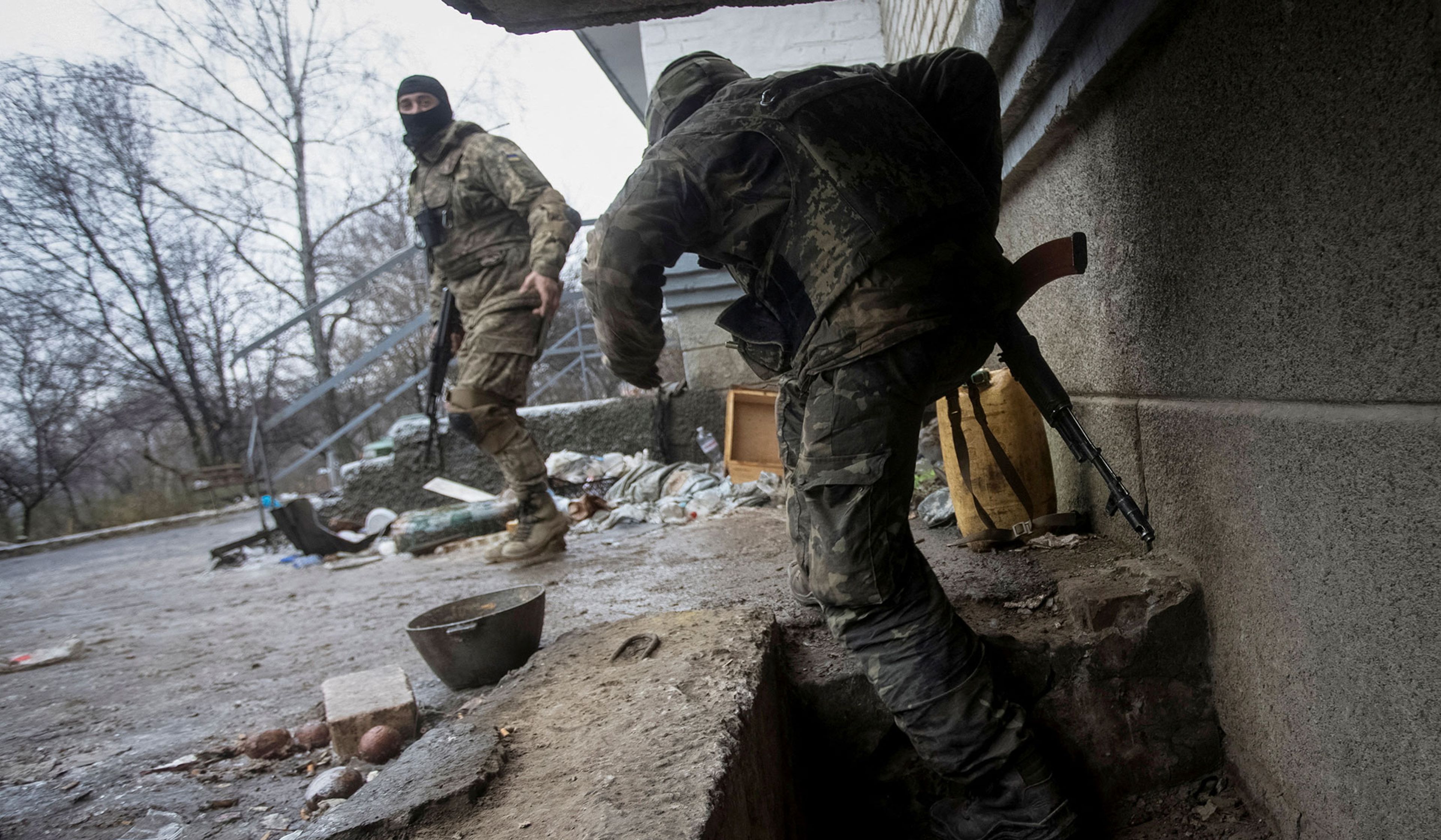













Servicemen of the Carpathian Sich Battalion at their positions on a frontline near the town of Lyman, Donetsk Region, Ukraine, December 8, 2022.
Viacheslav Ratynskyi/Reuters
• Various Chinese cities and provinces are setting up police stations in locations across the globe — including four U.S. sites. The latest revelations, from a report published recently by the human-rights watchdog Safeguard Defenders, identified a total of 102 such stations. The four U.S. facilities include two in New York, one in Los Angeles, and one at a location that Safeguard Defenders could not ascertain. Chinese officials have claimed that the purpose of these outposts is to help Chinese citizens abroad process administrative documents such as driver’s licenses. That’s a patently absurd claim, given the existence of consulates and embassies. In any case, the arrangements for these stations are not made in coordination with the host countries, which violates China’s diplomatic obligations. Worse, Safeguard Defenders has linked them to various operations to target dissidents and other wanted individuals abroad. The FBI says that it is aware of the situation, and director Christopher Wray called the existence of the stations “outrageous.” Law enforcement and counterintelligence officials need to dismantle this system root and branch, and expel China’s spies.
• The Hong Kong “justice” system delivered another sham decision targeting Jimmy Lai. The newspaper magnate received a five-year sentence after a judge ruled that he violated the terms of a lease for office space for his media company by giving a fraction of it to his personal consultancy. Lai faces another test next fall, when another set of charges — pertaining to his alleged violations of Beijing’s national-security law for Hong Kong — will be put on trial. After the Hong Kong courts ruled that he could use a British lawyer, authorities appealed to Beijing and deported the lawyer. Washington and others need to do more for Lai’s brief; the government of Rishi Sunak, for instance, has failed to react appropriately to the harassment of Lai, a British citizen. Hong Kong is now a Chinese city, subject to the same totalitarian repression as any other.
• It apparently took a riot at a key plant and a draconian Covid crackdown to persuade Apple to speed up efforts to reduce the company’s reliance on China as a manufacturing base (China accounts for 95 percent of iPhone production). That throws an unflattering light on its management’s business judgment and, given Apple’s preachiness in the West, its hypocrisy. While Apple has reduced (somewhat) the dependence of other parts of its supply chain on China, it is now running to catch up with the reality that the nature of China’s government means that locating so much of the company’s operations there is a dangerous gamble. Making matters worse, Apple’s failure to nurture a manufacturing base elsewhere means that its short-term ability to move production outside China is limited. An additional twist comes from its immensely profitable business selling to consumers within China, a business that Beijing will almost certainly crush should Apple move too much production out of the country. Despite the headlines, most of Apple’s supply-chain diversification will be within China for now, meaning that its dependence on the goodwill of the Chinese Communist Party will continue, as, doubtless, will CEO Tim Cook’s carefully selective sermons.
• In the days following Russia’s invasion of Ukraine in February, German chancellor Olaf Scholz, stung by the Kremlin’s aggression and violation of the long general peace in Europe, announced a Zeitenwende — a sea change — in German defense policy. In a move hailed on both sides of the Atlantic for its seriousness and resolve, Scholz’s government would now commit to spending 2 percent of GDP on defense, in line with the NATO standard, and it would immediately establish a hundred-billion-euro fund to quickly recapitalize and modernize the German military. Nine months on, Germany’s seriousness and resolve have proven themselves once again to be weak and mercurial. Scholz’s government may now spend 2 percent of GDP on defense by 2023. Or maybe it won’t. Chief spokesperson Steffen Hebestreit’s “cautious expectation” is that Germany will meet the 2 percent target within this legislative period, which ends in 2025. If a land war in Europe won’t cause Germany to rearm and retool, nothing will. America should look to Britain and NATO’s eastern flank for further investment, basing, and security cooperation.
• Agents of the German security forces arrested 25 people accused of plotting to overthrow the government violently. What gave a Ruritanian flavor to the scheme was the presence, as its figurehead, of Heinrich XIII, Prince of Ruess, a 71-year-old real-estate broker who belongs to an old Thuringian noble family. But his compeers had arms, satellite phones, and kill lists (among the targets was the chancellor of the republic), and included veterans of the police, the army, and right-wing politics. Their notion was that German legitimacy was extinguished after World War II and that only a monarchy could revive it. They partook of a continental revival of far-right politics. They sprang up in the formerly communist east of Germany, where totalitarian nostalgia lingers. The plotters evidently expected recognition and help from Russia — not that Putin’s Russia would ever really take that risk; but stirring up trouble using right-wing sock puppets is something it very much does.
• Thousands of Afghans who assisted the U.S. mission in Afghanistan — and for whom life under a theocracy would be intolerable and perilous — are now likely to be denied a way out. A provision for extending the Special Immigrant Visa (SIV) program, available to Afghans who could be targeted by the Taliban for their collaboration with the U.S. government, has been struck from the Senate version of the National Defense Authorization Act. Unless otherwise extended by Congress, the program will lapse at the end of 2023. Our labyrinthine immigration system doesn’t need any more semipermanent carve-outs: Programs such as the SIV should have expiration dates. But titanic backlogs for asylum petitions (and the unavailability of State Department personnel in Kabul since August 2021) means that doing away with the program now will leave Afghans already in the United States stuck in other, more precarious arrangements such as humanitarian parole, possibly for years. Their compatriots back home may be stuck, period. These individuals enabled, however they could, a life for Americans in their country; we ought to at least try to return the favor.
• On December 21, 1988, Libyan agents blew up a Pan Am flight, killing all 259 people on the plane and eleven more on the ground. The plane blew up over Lockerbie, Scotland, so we know this act of mass murder as “the Lockerbie bombing.” One agent, Abdelbaset al-Megrahi, was convicted. Others were involved in the atrocity, however. U.S. authorities now have in their custody Abu Agila Mohammad Mas’ud, suspected of having made the bomb. A Reuters report said that when he appeared in court, he “complained of flu symptoms as he clutched a tissue.” The government will not be seeking the death penalty, as this penalty was not available at the time the bombing was committed. Instead, the government will be seeking life in prison. Mas’ud is now 71. Let justice be done, to the extent it can.
• Euthanasia regimes, by their nature, kill the most vulnerable and marginalized members of society. That reality has become harder to deny lately in Canada, which has adopted perhaps the world’s most permissive assisted-suicide laws. Take the case of Les Landry, who is in a wheelchair and has several treatable medical conditions, including epilepsy and diabetes. Landry told the Daily Mail in December that he was in the process of obtaining permission for “medical assistance in dying.” He said that he told a doctor reviewing his request that he did not want to die but was no longer able to make ends meet and feared becoming homeless and living in poverty. The doctor signed off. Landry now needs one more doctor’s approval of his death (he plans to shop around to secure it) and his government will facilitate his killing. This is not death with dignity; it is bureaucratically enabled barbarism.
• Senator-elect John Fetterman (D., Pa.), he of the hoodie and board shorts, has been named to the New York Times’ list of the 93 most stylish celebs of 2021, but we’ll wait to make our call until Sam Brinton steals his suitcase.
• Balenciaga, a high-end fashion brand, put out a holiday ad campaign featuring photos of children holding handbags designed as teddy bears dressed in BDSM gear. Disgusted online viewers of the ads unearthed other recent campaigns from the brand featuring disturbing imagery, including one in which the text of a Supreme Court case dealing with child — pornography laws figured as a prop. In response, the brand issued a series of blame-deflecting apologies and announced internal investigations, as well as a lawsuit (since dropped) against the company that provided props for one of the photo shoots. To the New York Times, what was objectionable in all this was the fact that the story spread on social media and was picked up by right-wing outlets; under the headline “When High Fashion and QAnon Collide,” the Times in effect dismissed Balenciaga’s critics as conspiracy theorists. They missed the better headline: “When High Fashion and Lowlifes Collide.”
• Popular doll company American Girl has published a children’s book promoting transgender ideology. American Girl’s parent company, Mattel, had already released a transgender Barbie doll. Full of sentences such as “You can appreciate your body for everything it allows you to experience and still want to change certain things about it” and “If you haven’t gone through puberty yet, the doctor might offer medicine to delay your body’s changes, giving you more time to think about your gender identity,” the book also lists transgender support groups to contact “if you don’t have an adult you trust.” Parents should now know whom to add to their list of adults not to trust.
• OpenAI, the artificial-intelligence company, has debuted a chatbot that will answer questions, write term papers and ad copy, compose jokes and limericks, all in disturbingly good human-speak. We’re not worried at NR until it can match Willmoore Kendall’s editorial para on the failed CIA plot to assassinate the left-wing Indonesian leader Sukarno. “It was a typical CIA operation. Everyone was killed except Sukarno.”
• “Life is an adventure, and I’m an adventurer,” said Joseph Kittinger. He sure was. He continued, “You just have to go for it. That’s the American way.” Kittinger was born in 1928 and grew up in Orlando, pre-Disney World. He joined the Air Force in 1949. He was a key figure in experimental programs over the New Mexico desert: How high could men fly up in a balloon? When and how could they jump out of their gondola? Would they survive? This paved the way to manned space exploration. Kittinger set several records, including one for the longest free fall: 16 miles. (Fifty-two years later, he helped direct the project in which another man, Felix Baumgartner, set the current record of 24 miles.) Soon came the Vietnam War, in which he flew 483 missions. Eventually he was shot down and taken prisoner, at the Hanoi Hilton, for eleven months. In 1984, he made the first solo balloon flight across the Atlantic Ocean. The world hath need of such men — such adventurers, such brave and daring souls. Always has, always will. Joseph Kittinger has now died at 94. R.I.P.
• John Corry had an impish grin and an Irish sense of humor (life sucks, now isn’t that a funny thing?). His memoir, My Times: Adventures in the News Trade, described an old — fashioned reporter’s life at the old-fashioned Gray Lady before standards slipped. Among his peak moments was the night he attended, as an off-duty theatergoer, the premier of the Broadway musical 42nd Street. At the curtain call, producer David Merrick strode before the cast and announced that director Gower Champion was dead. Champion had died before showtime, a fact Merrick hid from everyone so that the show could go on. Corry walked to the Times building where editor Abe Rosenthal gave him a hole on page 1. He sat at a desk and wrote it all up at the speed of typing. It was what journalists live for, recounted as memoirists live for. After leaving the Times he wrote for years for the American Spectator. Dead at 89. -30-
Trump’s Descent
Will the political world that Donald Trump made end with a bang or a whimper?
After America learned more, thanks to Elon Musk and Matt Taibbi, about how Twitter executives in the homestretch of the 2020 election muted the discovery of Hunter Biden’s laptop, the former president left a blast on his homemade Twitter, Truth Social. “. . . with the revelation of MASSIVE & WIDESPREAD FRAUD & DECEPTION . . . do you throw the Presidential Election Results of 2020 OUT and declare the RIGHTFUL WINNER, or do you have a NEW ELECTION? A Massive Fraud of this type and magnitude allows for the termination of all rules, regulations, and articles, even those found in the Constitution.”
Less than a week later, Representative Marjorie Taylor Greene (R., Ga.), who aspires to be Trump’s Mini-Me, gave a speech to a Republican group in Manhattan at which she scoffed at the notion that she and Trump guru Steve Bannon had organized the January 6 riot at the Capitol. “I gotta tell you something: If Steve Bannon and I had organized that, we would have won. Not to mention, it would have been armed.”
Terminating the Constitution and redoing January 6, only more violently, certainly sound like bangs, but their decibel level was muted by the denials of the two artillerists. Greene explained immediately that she was just joking — rimshot! — while Trump complained that “Fake News is actually trying to convince the American People that I said I wanted to ‘terminate’ the Constitution . . . What I said was that when there is ‘MASSIVE & WIDESPREAD FRAUD & DECEPTION,’ as has been irrefutably proven . . . steps must be immediately taken to RIGHT THE WRONG.” But since there was no wrong — Biden won the most votes in the states that cast a majority of electors — -and the Constitution makes no provision for mulligans, Trump’s respect for the rules of the game seems unproven.
Trump has relied on this technique for years: tossing a firecracker, then tossing a slightly different one, then often going back to retoss the first. The multiplicity of blasts obscured each individual one, leaving only an atmosphere of ferment that delighted friends and provoked enemies in equal measure.
The technique is getting old. Worse, it now plays out unaccompanied by tangible results. Trump promised to be such a winner that the GOP and conservatives would get tired of winning. And for years, win he did: the nomination and the White House in 2016, then several notable policy accomplishments during his administration. But there were losses too — shortfalls on trade and border control, the 2018 midterms. Since November 2020 there have been only losses, magnified by Trump’s insistence that the losses were somehow fake. If his tone is not a whimper, it is certainly a whine.
Herschel Walker, the last of Trump’s handpicked candidates to lose in the 2022 cycle, gave his patron a lesson the night of the Georgia runoff election. Unlike Trump, Walker gave a gracious concession speech, and in it he delivered, intentionally or not, a dig. “I don’t want any of you to stop believing in America. I want you to believe in America and continue to believe in the Constitution and believe in our elected officials most of all.”
For four years, Trump was first among elected officials. His unwillingness to accept the possibility that that could change is narcissistic, tiresome, and futile.
Editor’s Note: The next issue of National Review will appear in three weeks.












Comments