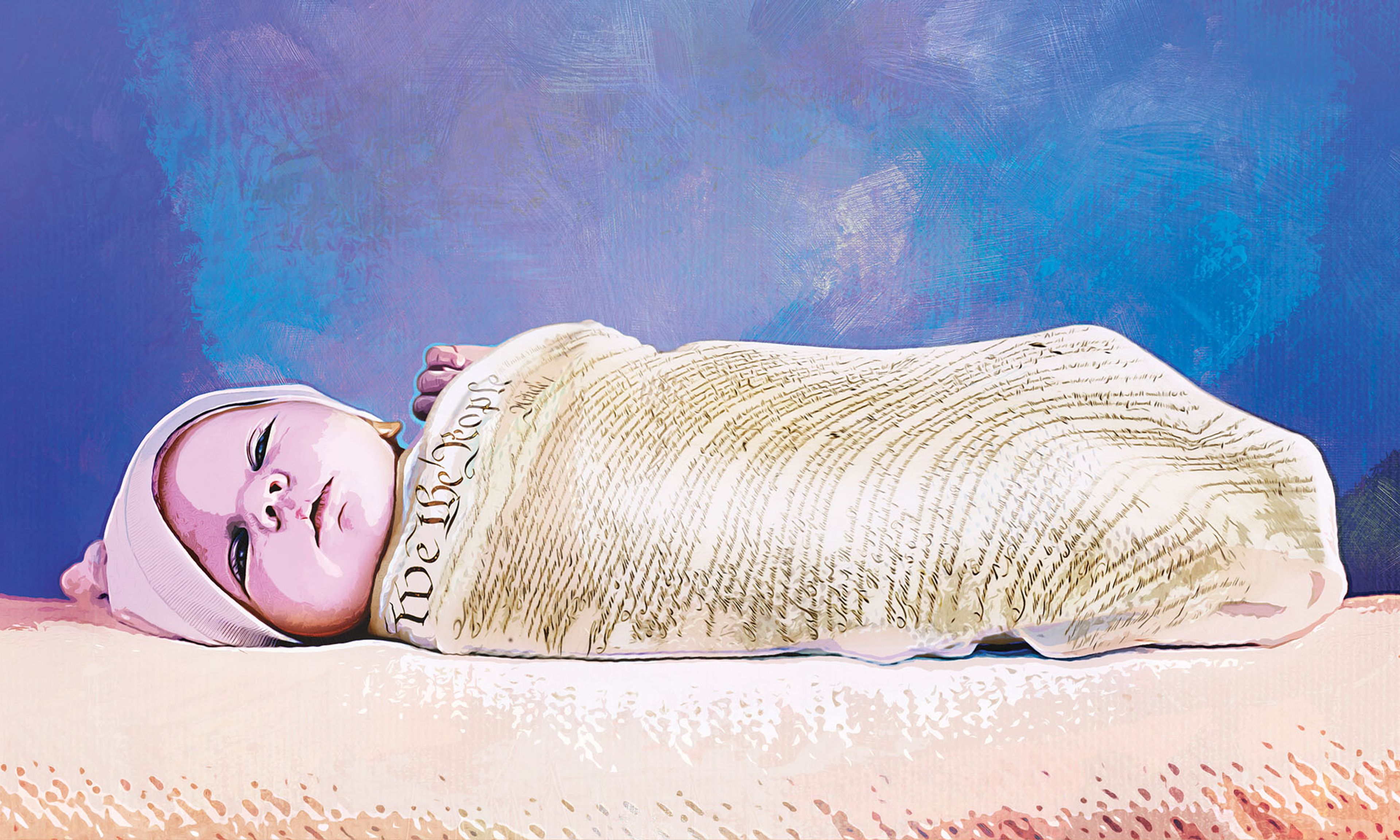
Last summer, in Dobbs v. Jackson Women’s Health Organization, the U.S. Supreme Court overruled Roe v. Wade and its creation of a federal constitutional right to elective abortion. In more than a dozen passages in its opinion, the Court decisively sent the abortion issue back to the people and their elected representatives, even if statutory or regulatory issues involving abortion will still be litigated in the state or federal courts.
The Court’s opinion also makes clear that one strategy that has been urged on the Court for 50 years should now be recognized as exhausted: a Supreme Court declaration that the unborn child is a “person” protected by the 14th Amendment.
There is simply no reason to believe that a majority of the justices will adopt that proposition in the foreseeable future, and there are compelling reasons why the justices might reject it. Given those realities, pro-life leaders and organizations should focus their energy and resources on the hard work of persuading Middle America and changing public sentiment in the states, where the issue will be contested.
Pro-lifers have urged constitutional personhood on the Supreme Court since the first modern abortion case, United States v. Vuitch (1971), and through dozens of briefs filed in dozens of abortion cases since. Indeed, constitutional personhood is likely the legal issue most frequently briefed for the justices in abortion cases.
Without rebuttal and yet to no avail. Justice John Paul Stevens pointedly declared in a 1986 concurring opinion that no justice had ever supported constitutional personhood, and Justice Brett Kavanaugh asserted the same in his concurring opinion in Dobbs (“No Justice of this Court has ever advanced that position”).
And it’s pretty clear that the justices again unanimously rejected constitutional personhood in Dobbs. It was expressly raised during oral argument, when Justice Kavanaugh asked Mississippi’s solicitor general to confirm that Mississippi was asking the Court to overrule Roe on a federalist basis, not a personhood basis. The solicitor readily confirmed that.
The personhood proposition was, once again, urged on the Dobbs Court by numerous amicus briefs, including one by two eminent and internationally respected legal philosophers, John Finnis and Robert George. The three dissenters in Dobbs obviously rejected it since they would have preserved Roe as written. Chief Justice John Roberts obviously rejected it by writing that he would not overturn Roe and by proposing that a constitutional right to early abortion might be plausible. Justice Samuel Alito’s majority opinion for five justices made more than a dozen statements that are incompatible with constitutional personhood. And Justice Kavanaugh, the necessary fifth vote to overturn Roe, not only joined Alito’s opinion but wrote his own separate opinion to argue that the Constitution was “neutral” on abortion, indicating that he understood the majority opinion to be consistent with his own.
One reason even the anti-Roe justices have hesitated to adopt constitutional personhood is almost certainly the Court’s searing experience after having centralized the abortion issue in itself through Roe. The justices have become a national focus of abortion politics for decades, and they’ve been subjected to political intimidation as well. At a pro-abortion political rally on the steps of the Supreme Court on March 4, 2020, Senate Minority Leader Chuck Schumer harangued the pro-life justices with a direct threat: “I want to tell you Gorsuch, I want to tell you Kavanaugh: You have released the whirlwind, and you will pay the price. You will not know what hit you if you go forward with these awful decisions.”
As will be seen, however, the constitutional-personhood proposition is not a simple question. The notion that the 39th Congress, by the use of a single word “person” in the 14th Amendment, created federal authority over the abortion issue and centralized control in the Supreme Court to supervise state abortion laws calls to mind one of Justice Antonin Scalia’s most influential opinions. In 2001, the Supreme Court examined the federal Clean Air Act to see whether Congress delegated legislative power to the Environmental Protection Agency. In Whitman v. ATA (2001), Justice Scalia wrote, “Congress, we have held, does not alter the fundamental details of a regulatory scheme in vague terms or ancillary provisions — it does not, one might say, hide elephants in mouseholes.” If through the word “person” in the 14th Amendment the 39th Congress had subjected the abortion laws of the 50 states to the supervisory power of the Supreme Court, it would have hidden an elephant in a mousehole.
The Court’s supervision of abortion regulations for 50 years has been from the perspective of whether they’re too strict. What would the practical implications of constitutional personhood be? The Court would no longer decide whether laws were too strict in limiting abortion; instead, it would have to determine whether laws were too loose in allowing abortion. Professors Finnis and George have said that constitutional personhood would mean that “elective abortion” — all abortions except to save the life of the mother — would be prohibited in all 50 states. Constitutional-law scholar Lee Strang has written that “states allow[ing] abortion beyond instances of danger to the life of the mother” would be “fundamentally inconsistent with the full constitutional personhood of unborn human beings.”
Obviously, the proposition is not simply slipping the unborn into one word, “person,” in the 14th Amendment. It’s an elephant in its legal, institutional, and political implications.
Is it imaginable that any Supreme Court in the next half century will take the country, by judicial edict, from abortion on demand to no abortion, in any state, even for rape or incest? It is clear from decades of Gallup polling data that no more than 15 percent of the public supports such a policy, in contrast with the (arguably) majority support for returning the abortion issue to the people in the 50 states, as the Court did in Dobbs.
To take upon itself the power of supervising every abortion regulation from a life-preservation perspective and risk the political backlash — which could take the form of impeachments or court-packing — the Court would have to rely on irrefutable evidence that the framers of the 14th Amendment intended to give the Court that authority. Only irrefutable evidence would persuade a majority of justices to assert such power and convince the states to accept it; only irrefutable evidence would prevent a split in the conservative legal movement; only irrefutable evidence would garner sufficient public support to enable the Court to survive as an institution in the face of the anticipated political backlash by “progressives.”
There are several reasons why this irrefutable evidence cannot be found.
The first is the complete silence of the legislative history of 1865–66. It is fairly conceded that the framers who drafted the 14th Amendment, and the 39th Congress that debated it, were not concerned about the abortion issue. As Professor Finnis has written, “the evidence is that neither corporations nor the unborn were discussed in the Committee that drafted, or the Congress that debated, the first section of the 14th Amendment.” Indeed, no data — no legislative history, no committee reports, no speeches, no newspaper articles, no memoranda, no personal papers, no letters — have ever been cited to suggest that the sponsors mentioned abortion or the unborn child at any time during the discussion of the 14th Amendment. William Barnes’s History of the Thirty-Ninth Congress (1868) and Benjamin Kendrick’s The Journal of the Joint Committee of Fifteen on Reconstruction (1914), for example, never mention abortion or the unborn child.
James Madison once argued that the analysis of the Constitution’s original meaning should look to “the sense attached to it by the people in their respective State Conventions.” There is no evidence that state legislators ever mentioned abortion or the unborn child when they ratified the 14th Amendment. There is a compelling reason for this: The states were actively adopting legal prohibitions of abortion, and the 39th Congress was focused on the freedmen.
Proponents of constitutional personhood counter with general statements, made by supporters of the amendment in the 39th Congress, that “person” includes all “human beings.” Every one of the statements about “human beings,” however, was made to support racial, not biological, inclusiveness. It was as if a freedman had been standing next to the supporter when those statements were made in Congress. Michael Stokes Paulsen, professor of law at the University of St. Thomas and another eminent supporter of constitutional personhood, has acknowledged that “the framers appear not to have had abortion in mind at all when writing the amendment.”
Numerous advocates have compiled historical data that tend to show that the prenatal child was increasingly protected by state law as a legal person in the decades before the 1860s. There is no connection, however, between what the states were doing and what the 39th Congress was doing. Advocates cite statements invoking Sir William Blackstone’s Commentaries on the Laws of England made in support of the Civil Rights Act of 1866, which the 14th Amendment was intended to protect constitutionally. But no one has ever claimed that the Civil Rights Act of 1866 was intended to address abortion or encompass the unborn child. How are general statements made to support the 1866 act, which never mentions abortion or the unborn child, relevant to the 14th Amendment, which was intended to protect the constitutionality of the 1866 act? How can its “original public meaning” include the unborn if the original congressional meaning clearly did not?
This silence, by itself, undermines any confidence in the constitutional authority of the Court to adopt the constitutional personhood of the unborn child and impose it on the 50 states.
Second, the notion of constitutional personhood for the unborn in the 14th Amendment would have been a solution in search of a problem in 1866. The amendment prohibits action by the states. But the states didn’t present an abortion problem in 1866. They were, in fact, the focal point of anti-abortion activism and legal protection. All of the states’ legislative proceedings — and contemporary secondary materials such as dictionaries and treatises — reinforce the sufficiency of state legislative action in 1866 regarding abortion and make incredible any supposed impulse for Congress to draft an amendment to take the issue away from the states.
As Professor Finnis has acknowledged, “every state by common law and/or statute already prohibited everyone from denying persons some if not all of their prenatal rights.” This is now officially confirmed by all the state data compiled by the Supreme Court in Dobbs and laid out in the two appendices attached to the Court’s opinion.
Given that the states were enacting protective legislation for decades before 1866, why would the framers of the amendment, or those in the states who ratified the amendment, want — as Professor Finnis has phrased it — to put such matters “beyond the powers of the legislators of any state”? The problem of states’ legalizing abortion a century later was unimaginable.
Third, the abstract, ontological term “person” in the text of the amendment is inadequate to provide specific, effective legal protection for the prenatal human being throughout pregnancy. What is necessary for effective law enforcement is concrete specificity by a more detailed definition of the term “human being,” which is used in the definition of homicide, to mean an individual member of the human species from fertilization. Then, it would be necessary to specifically define abortion and the state of mind (intent) to be prohibited. The fact that the framers of the amendment used “person” instead of “human being,” specifically defined, is further evidence that they were not dealing with prenatal human beings. Besides, “person” is wholly undefined in the amendment.
Advocates rely on treatises and dictionaries to read the unborn child into the word “person” in the amendment. Curiously, they disregard the law as applied in the 1860s. The born-alive rule — for which courts cited Sir Edward Coke and Blackstone as authorities — prevented the application of homicide law to the unborn child. Under that rule, no killing of an unborn child could be counted as a homicide (the killing of a human being) unless the child had been born and had died outside the womb. Today, because of modern medicine, we understand the born-alive rule to be an evidentiary rule. But until well into the 20th century, many considered it to be a substantive rule of homicide law that the prenatal entity was not a human being until birth.
Fourth, while focusing almost uniformly on the single word “person,” proponents of constitutional personhood have virtually disregarded the context and structure of the 14th Amendment, which confirm that it was drafted to address not abortion but the ways in which the Southern states were discriminating against freedmen. The amendment targeted state action in detailed ways that precisely tracked how the Black Codes in the South operated to deny rights to blacks. As a 1972 review put it, the states “perpetuated or created many discriminations in the criminal law by applying unequal penalties to Negroes for recognized offenses and by specifying offenses for Negroes only.” These included “a series of restraints on their business dealings,” “sharp limitations” on the right to “acquire property” or “contracts for personal service,” and “specific enforcement of labor contracts against freedmen.”
Hence, the second sentence of section one of the amendment requires “due process” by courts (the judicial branch of government) and “equal protection” (by the executive branch). It is government and not individuals who provide (or deny) due process and equal protection. The amendment targeted what the southern states were doing — denying rights to the freedmen — and how they were doing it through each branch of government. Contrary to what advocates contend, the “equal protection of the laws,” plural, shows why the text of the amendment effectively addressed the situation of the freedman but not that of the unborn child. The freedmen were being deprived of their rights under property, contract, employment, and many other laws. The vulnerable prenatal human needs the enforcement of one law, homicide law — not to be killed.
Fifth, there’s no post-ratification evidence that the amendment covered or was ever imagined to cover prenatal human beings. No evidence exists that the amendment was ever interpreted as supervising state abortion laws between 1868 (when it was ratified) and 1968 (when lawsuits challenging the constitutionality of state abortion laws were first contemplated). Numerous issues arising from state abortion laws drafted before or after 1866 could have been challenged under the amendment. There is no instance between 1868 and 1968 of any federal or state court inquiring whether a state abortion law met the standard of equal protection or due process under the 14th Amendment. Why the utter silence on the 14th Amendment’s application to abortion from 1868 to 1968?
To have democratic and constitutional legitimacy, the Court, to repeat, would need to show irrefutable constitutional authority in declaring the constitutional personhood of the unborn, win compelling public support, coerce the dissenting pro-abortion states, and survive the court-packing by “progressives” that would likely ensue. In a March 2023 lecture, Kurt Lash of the University of Richmond School of Law, in an explication of originalism and the 14th Amendment, emphasized that “public acceptance of the legitimacy of the Court’s decisions requires a convincing account of how those decisions reflect the actual sovereign will of the people.” No such account could be given today for a novel Supreme Court declaration of constitutional personhood for the unborn based on an amendment drafted in 1866 to protect the freedman, with a legislative history in which its supporters never spoke of the unborn child or abortion.
There are many roads forward for the pro-life cause after Dobbs. Some will be more fruitful and productive than others. But in Dobbs, constitutional personhood has reached a dead end. Given the text and tone of the Court’s opinion, there is no reason to think that it will save the cause for life from the risks of democracy and republican government. If the cause for life wants constitutional protection for the prenatal human being, it must take democratic action to pass a constitutional amendment ratified by 38 states. That could be the natural consequence of a process of building 38 pro-life states. The constitutional authority to curtail any remaining pro-abortion states would then be clear. But even then, supporters of a constitutional right to life for the unborn should consider the model of the 13th Amendment, which prohibited slavery, rather than that of the 14th Amendment, which centralized power in the justices.
Editor’s Note: Josh Craddock responds to this essay in “Our Pro-Life Constitution” in the February 2024 issue of NR.












Comments