I was at the Gaza airport on the day Yasser Arafat returned from the 2000 Camp David Summit. This was a mere coincidence. My Gazan friends were taking me on a tour of the Strip’s most noteworthy sights. They were quite proud of that airport; I still remember their excitement as they showed off their single baggage scanner. Leaving, we saw a cluster of young girls in frilly dresses, practicing a song. Their arms were full of flowers. It was Arafat’s welcoming committee, preparing to greet their leader. This memory is excruciating today.
Some context may be in order here. In the year 2000, as a college undergraduate, I spent seven months living in Israel and the Palestinian territories. Originally I came to participate in a study-abroad program, whose appeal had everything to do with the Bible and little to do with politics. That changed somewhat as I took classes at Bethlehem and Hebrew Universities, but at age 20, I still took adventure to be my prime directive. For a class, I did a research project on the Palestinian-refugee situation, so as the semester ended I thought I might persuade my university’s social-justice center to fund a volunteer project in Gaza. It worked, and a friend was willing to join me. Accordingly, one morning we turned in our final term papers, hopped into a van, and presented ourselves at the Erez checkpoint in the north of Gaza. I still remember dragging my suitcase along a dilapidated stretch of road, wondering how long we’d have to walk before reaching the taxis.
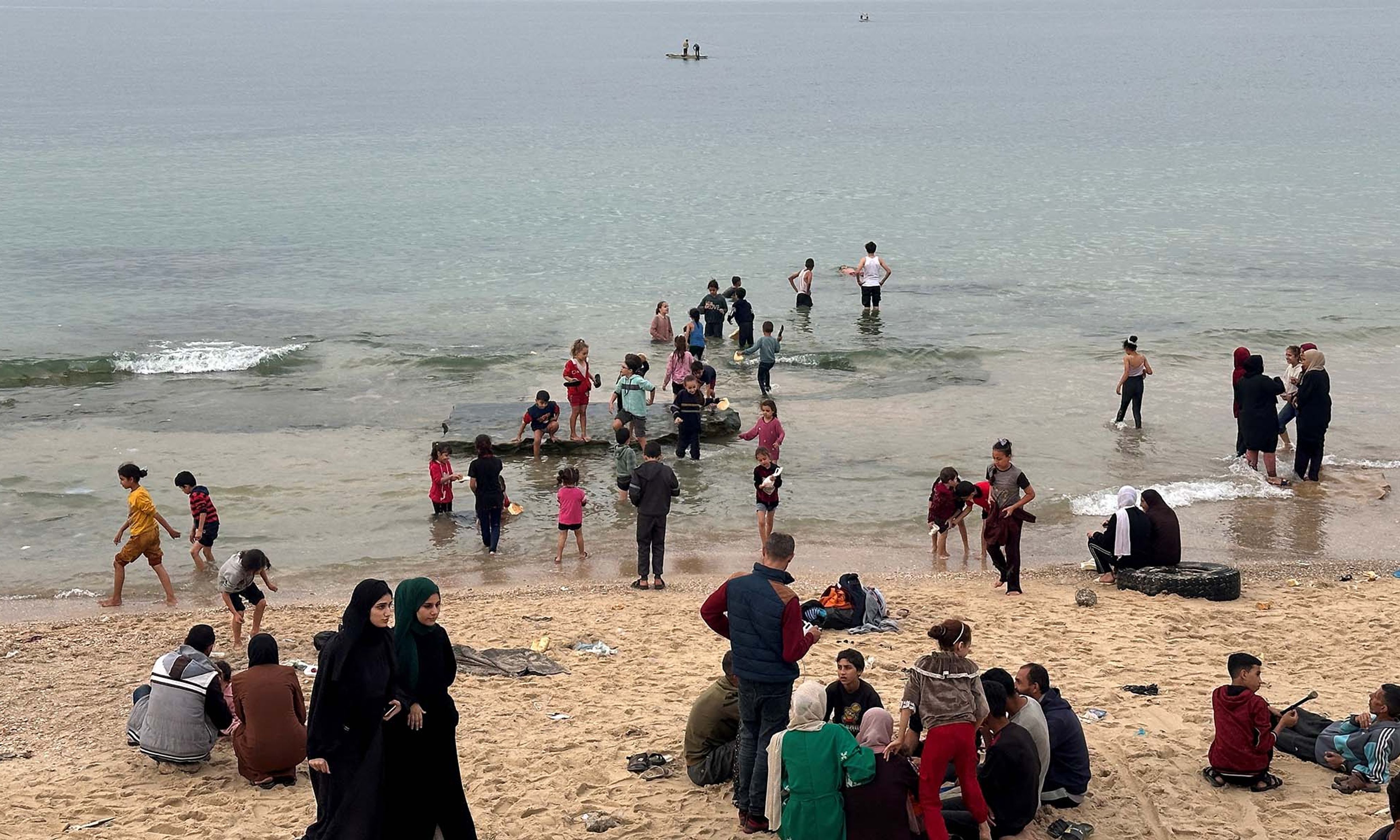
These past few months, my mind has worked relentlessly over the memories of that summer. It’s hard to get perspective. It’s clear enough that my younger self was not really mature enough to grasp all the social and political realities I was encountering. But I did know Palestinians, as so few of our Western commentators seem to have done; I threw myself into Gazan life with the enthusiasm of the amateur anthropologist. This was easy. Gaza is a makeshift concrete city, crowded with bored people, so novelty draws a crowd. My friend and I were swept up in a whirlwind of human interaction, attending weddings and parties, building sand castles and playing catch with crowds of children, drinking tea with the Bedouin. I swam in the Mediterranean and got stung by jellyfish. I rejected two marriage proposals in a single afternoon. I was sexually harassed virtually every time I stepped out of doors.
How does one properly juxtapose those human memories against the frenzied political opinions, the death and destruction, and the unassailable confidence of activists on all sides? So many people seem certain that they know exactly what the Gazans believe and want. I wish I had that kind of clarity.
The reality is that people’s views on Palestinians rarely have much to do with Palestinians. In the West, a person’s views on Israel are a very strong predictor of his views on Palestinians. Arab nationalism would be more relevant in some places, or “colonialism.” Meanwhile, the Palestinians wait there in Gaza for some kind of resolution, trapped between real nations, defined by thorny geopolitics that our greatest statesmen still struggle to understand. Even in the midst of starvation and air strikes, with activists across the world protesting on their behalf, it is somehow widely accepted that they cannot really be moved. They are a purgatorial people. They must stay.
I discussed politics with scores of Palestinians during my summer in Gaza. I was nobody in particular, but it didn’t seem that way to them. To them I seemed like an emissary from the West, offering a glimmer of an opportunity to influence U.S. policy. Being something of a contrarian, I ended up in a lot of arguments, and I have surreal recollections of heated discussions that took place on beaches, with hulking concrete buildings behind me and idyllic blue waters in front. Those beaches felt like a lifeline on blistering Gaza afternoons.
What really comes back, with a raw and throbbing intensity, is the desperate demand I felt from the Gazans for a better explanation of their situation. I remember people walking up to me on the street and asking point blank, without introduction or preamble, “Why does the United States support Israel? Why don’t they want us to have a home?” I believe my stock answer was that my president was, in fact, hosting peace talks that very summer, trying to bring a Palestinian state into being. That usually opened the door to an interesting conversation. But over time it became clear that there was a deep asymmetry in the situation, which I didn’t know how to address adequately. The Jews are a remarkable people. The creation of Israel was one of the truly extraordinary developments of the 20th century. What did the Palestinians have going for them in comparison? They had never built a great civilization. There is no Palestinian Caesar or Alexander. Their greatest historical figure was Goliath, and we all know what happened to him.
I zealously promoted the two-state solution. My interlocutors had a range of views on this, but in general the Gazans were skeptical. They tended to see negotiations with Israel as a dead end, and possibly a trap. Israel, they assured me, would break any agreement they signed, probably with American support. They were familiar with soldiers, or residents of settlements, who, among all Israelis, were probably the least kindly disposed towards them. Trust was low. Over the years some Palestinians had been employed as day laborers in the kibbutzim bordering Gaza, where people viewed them more benevolently, but those workers were also a regular reminder of the hard reality that Gazans were for the most part consigned to work others’ land.
On the other hand, different paths to freedom seemed more hopeful in their eyes. Older people were still hanging on to the possibility that the Arab states would finally liberate them, as they had long promised, while younger Gazans seemed to favor the United Nations as the more promising rescuer. I myself developed a pronounced antipathy for that organization over the course of the summer. It was mainly rooted in the way that Resolution 194, passed in 1948 shortly after the Arab–Israeli War, seemed to have inflamed the minds of young Palestinians. I saw “194” graffitied on buildings through the West Bank and especially Gaza. This document declared, among other things, that “refugees wishing to return to their homes and live at peace with their neighbors should be permitted to do so.” Those words were quoted to me constantly, as people assured me they would be most happy to live alongside Jews if only they could “go home.” The strength of their attachment was stunning. Many people still kept house keys or other mementoes of homes vacated by ancestors decades before. For a footloose college sophomore, that kind of yearning was very hard to grasp, and the best touch-point my mind could find ironically came from the Psalms: “By the rivers of Babylon, there we sat down, yea, we wept, when we remembered Zion.”
The United Nations was not going to save them. I tried to make that case on the ground, but it was a hard sell. Gazans were well aware that a different U.N. resolution had originally brought the State of Israel into being. Why should one resolution be held sacred and not the other? The lingering hope for repatriation soured Gazans on the Camp David negotiation, which indeed did not offer much by way of resettlement opportunities or restitution for refugees. I realize of course that I court controversy even by using the term “refugee” in this context, and I have no real interest in fighting for terminology, but it’s difficult to find an adequate substitute. Shall we call them “unwilling residents” of Gaza? They are not properly “citizens” of anywhere, which is indeed part of the problem. The Gazans wanted more freedoms, and a path to a better future. But what, realistically, was the best-case scenario for them, even in 2000? The two-state solution seemed like the only possible answer; even now, I can see no other way forward. But it was clear that their history and culture would make it hard for them to lay the foundations for legitimate representative government. The nakba loomed large over their collective identity, and victimhood had increased their sympathy with a range of malignant ideologies, from wokeism to Islamic fundamentalism. Meanwhile, the political situation had given them very little occasion to develop the paradigms and practical habits of good citizenship.
There has been considerable discussion of late of growing Palestinian support for Hamas, and of the work of writers such as Ayaan Hirsi Ali who see antisemitism as a driving force within the Arab world. This is interesting to me, because I of course believe the terrible stories of Hamas fighters bragging about rape and murder and of crowds cheering as they returned. I am haunted by the memories of children I knew in Gaza, wondering which might have participated in the slaughter. But I never personally saw that kind of virulent antisemitism. People could have prudently chosen to conceal those ugly sentiments in our conversations, rightly guessing that they would alienate me. What I mostly perceived, however, was a frustrated yearning for better answers, better opportunities, and more freedom.
The people I remember most fondly are those who tried hard to create opportunities even in the Gazan concrete jungles. One friend started a fast-food joint that July, the only thing of its kind in the Strip. We went to the grand opening and were astonished to find that the entire town center was packed with people, dancing and cheering for hours. The hamburger party seemed much larger and more joyous than Arafat’s homecoming celebration. We tried to do our part by teaching the cashiers to ask in English, “For here or to go?” After that, people sometimes called the phrase at us as we walked down the street. It was the silliest thing, but for me the words began taking on whole new layers of significance.
Not everyone wanted to be a victim. One day a woman came to me with a promotional video she had made, advertising Gaza as a prospective tourist destination. There was a lot of footage of beaches. After watching we were asked: Could we think of other attractions that might make Gaza a vacation destination for Westerners? We sat awkwardly. Finally, desperate to say something, I observed that people might like to get a firsthand look at the political situation in Gaza. Disaster tourism seemed to me like her strongest bet, but the suggestion was firmly rejected. She didn’t want people to associate Gaza with poverty and war.
Things change. The airport has long been closed, and I’m guessing it’s been a while since a Gazan could get a burger “for here or to go.” People definitely associate Gaza with poverty and war. In that sense, things have stayed exactly the same, which is the worst thing of all. The Palestinian cause is now celebrated worldwide, even as Gazans move around their 140-square-mile space trying not to be hit by air strikes. Though the Israeli settlements were removed in 2005, there are still very few Gazans who can harbor realistic hopes of ever working their own land.
It is tragic that Arafat was unable or unwilling to negotiate a peace in the summer of 2000. Both his own people and Israel’s have paid a terrible price for that failure. But they still deserve a chance at freedom, because all people do. Destroying Hamas is a worthy goal, but Palestinians will remain vulnerable to destructive ideologues until they can see pathways to a better, freer life. I do not really believe that most Gazans are obsessed with destroying the State of Israel. I do think that people can make questionable political decisions when given a very poor slate of options.
If I ever return to Gaza, I hope to stand on those beaches again, with sparkling blue waters in front of me and something beautiful behind. Their world has been reduced to rubble. Somehow, we have to build something better.












Comments