North Jersey — The highway taking me through post-industrial cityscapes to 14 Aspen Drive, the real address marking the fictional residence of Tony and Carmela Soprano, is sponsored by the Knights of Columbus. Playing “Woke Up This Morning” — the show’s theme song, written and recorded (oddly enough) by a British band — through my car’s speakers, I make my way to the house, my first stop on a pizza-fueled journey through the geography of The Sopranos.
New Jersey’s indelible culture — never mind that outsiders might mistake the northern part of the state for a New York facsimile — is historically and indisputably connected to the Italian-American experience. That culture began to permeate the popular consciousness 25 years ago, on January 10, 1999, when The Sopranos premiered on HBO.
It wasn’t just the American people’s idea of New Jersey that the show transformed but television itself. The premiere ushered in what is now called “Peak TV,” or the medium’s Platinum Age (the Golden Age having taken place from the immediate aftermath of the Second World War through Playhouse 90, the quiz-show scandals, and the 1960 writers’ strike), which is only now coming to a close. Though it is possible to trace Tony Soprano’s lineage through characters like NYPD Blue’s Andy Sipowicz, and the show’s cinematic presentation through highly stylized programs like Miami Vice, the first time the needle dropped on the theme song and Tony drove out of the Lincoln Tunnel and down the New Jersey Turnpike, a new era had dawned. As many have observed, without Tony Soprano, played by the late James Gandolfini, there could have been no Don Draper, no Omar Little, no Walter White.
But to residents of this area, the show was something more intimate: a homage to their home, a celebration of it, or perhaps a parody.
Tony and Carmela’s house looks entirely as it did in the pilot episode 25 years ago. I get out of my car to look around, and it seems like Tony might still be grilling sausages in the backyard or throwing bread to the ducks in the pool. What’s striking about it is that this is a normal upscale suburb — a place where you’d expect a successful lawyer or doctor to live. Part of what made The Sopranos resonate with its audience was this sense of the Mafia amid the mundane.
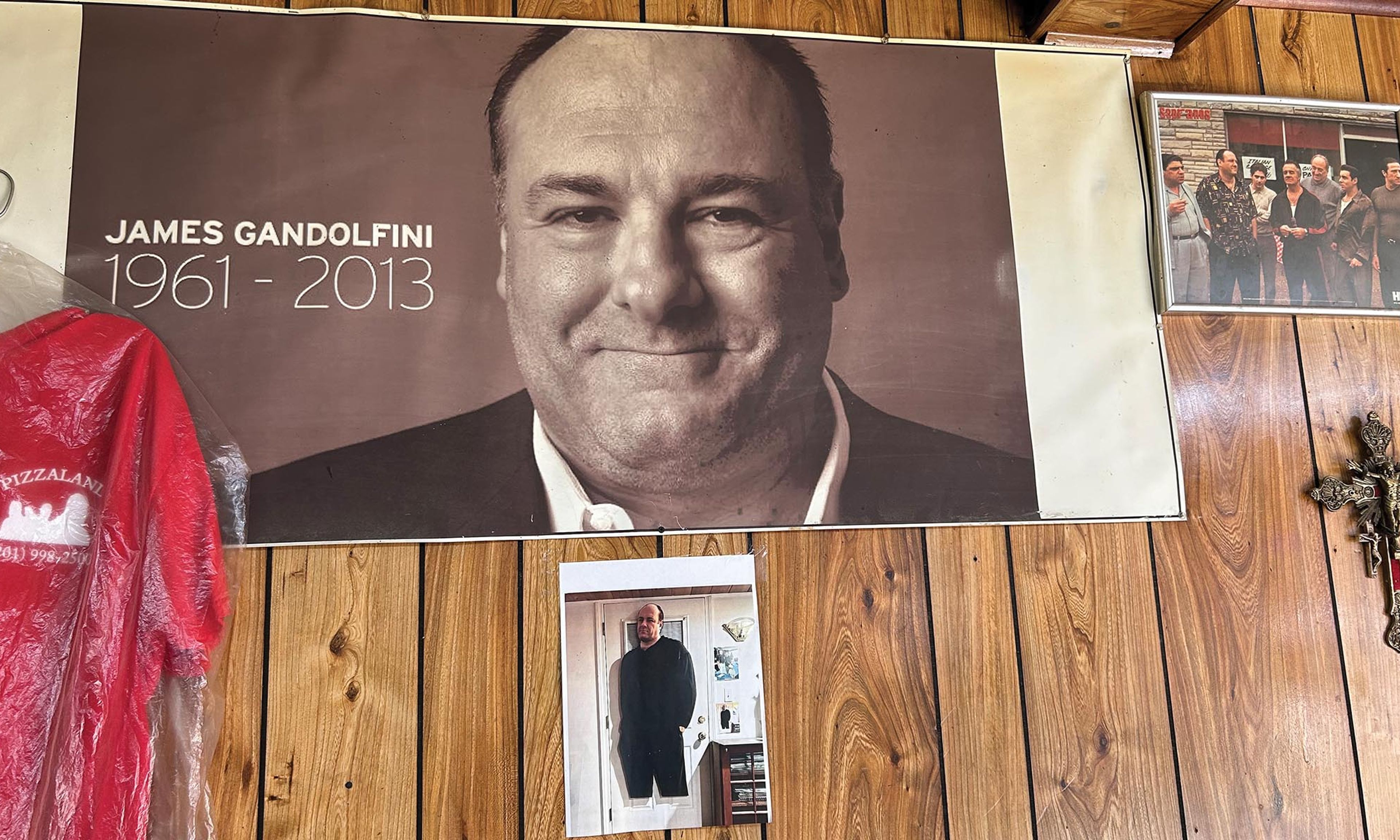
My next stop is Pizza Land, which is exactly what it sounds like. A hole-in-the-wall joint in North Arlington, it’s featured in The Sopranos’ iconic title sequence, which takes the viewer on a trip from the glamour of New York City into Tony’s stomping grounds across the Hudson River. The walls bear photos of the cast and a New Jersey license plate that reads “SOPRANOS.”
The manager on duty when I arrive, a man by the name of Ned who does not tell me his last name, was not a Pizza Land employee when the show aired. That doesn’t mean he can’t feel the impact it had on his workplace. After treating myself to a slice — Pizza Land turns out to be one of the better pizza places I’ve eaten at — I ask Ned how many customers come into the restaurant because of the show.
“Too many,” he says. “Every day, a lot of them. It’s like 75 percent of the people who come in here. They take some pictures, take a video, and take some pizza.”
Pizza Land is a stop on a long-running Sopranos bus tour, essentially the same route I took myself. Though many of the establishments in the show — including the restaurant that Artie Bucco’s Vesuvio was based on, and the diner outside which (spoiler alert) Matthew Bevilaqua and Sean Gismonte unsuccessfully attempt to whack Christopher Moltisanti — no longer exist, others are both working businesses and time-honored North Jersey sites. One is Satin Dolls, on Route 17 in Lodi, otherwise known as the Bada Bing. A “gentleman’s club,” Satin Dolls played host to some of The Sopranos’ more pivotal scenes and has capitalized on that history.
“Home of the Original Bada Bing!” reads the sign as you get off the highway. As I walk inside, pondering the likelihood that I am the first guy to enter the premises in a cardigan, I’m met with the overpowering scent of perfume. The first thing I see on the wall is another sign advertising the club’s connection to the show. The manager has no wish to speak with me, though, and tells me to come back the next day. When I do, a different manager says the same.
Although any New Jerseyan has to admit some similarities between the TV series and its real-life setting — in the midst of Senator Bob Menendez’s foreign-influence scandal, the thought of public corruption certainly springs to mind — the show’s representation of the state sparked controversy among its residents. But any negative consequences of being depicted as a Mafia haven are outweighed by the economic boost local businesses have enjoyed.
One of the more famous — or, depending on how one feels about the series finale, infamous — locations in The Sopranos is Holsten’s Ice Cream, Chocolate & Restaurant, a diner-and-dessert operation in Bloomfield that served as the site of Tony’s possible assassination (hinted at by a final cut to black). Holsten’s, which opened in 1939, is now decked out in framed photos of the cast and sells T-shirts referencing its role in the show. The napkin holders bear a logo in the shape of a handgun.
Just like Tony, I sit down in the booth in the middle of the restaurant and order the onion rings. The tabletop jukebox on which Tony played “Don’t Stop Believin’” is still there, and a “reserved for the Soprano Family” plaque commemorates the booth’s history. Chris Carley, who has run the place since 1980, sits down across from me and professes his gratitude to showrunner David Chase and HBO.
“The day after the episode aired — that was a Monday, it aired on a Sunday — we came in, and before we even opened, there was a line of people waiting,” he tells me. “And that ran crazy for a good four months. People just kept coming and coming and wanting to sit in the booth, take pictures, and business just went through the roof.”
Holsten’s had always done well, Carley says, but the show gave it a boost. The Sopranos-driven traffic has waned in the years since the post-finale rush, but fans still show up to see the place where the show, and possibly Tony Soprano, came to an end.
“Percentage-wise, maybe 10 to 15 percent of the people who come into the store will ask to sit in Tony’s booth or ask, ‘Where was the booth? Which booth was it?’ They’ll look at the pictures on the wall. You know, some people know, on Saturday, don’t come in between 12:30 and one because that’s when the tour buses are here.”
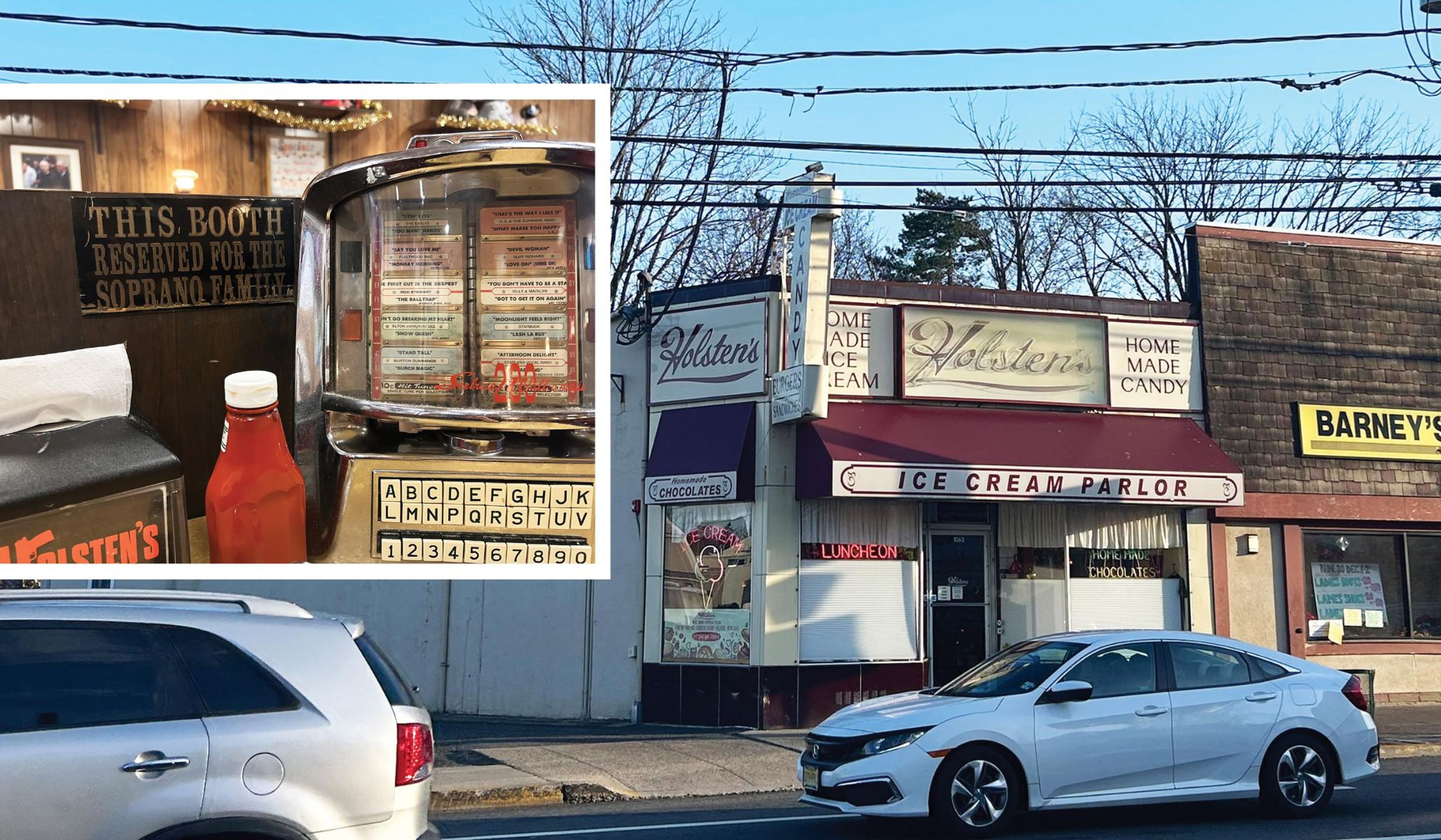
When Gandolfini died in 2013, fans of the show turned Holsten’s into something of a shrine to their favorite TV mobster. “This booth was closed for two weeks,” Carley says. “People put notes and brought flowers. There were a lot of handwritten notes and stuff like that, which I wound up giving to James Gandolfini’s son when he came in here. He still does every now and then.”
But not everyone in Bloomfield had been happy to learn that Holsten’s would be featured in the show. Some residents protested, expressing discomfort with the program’s portrayal of Italian Americans.
“The town fought us in the beginning,” Carley says. “They approved the permit to shoot, and then some people who had their voice into the town council were like, ‘This doesn’t depict Italian Americans well,’ things like that, and they rescinded the permit. And there was a whole hubbub and we had TV crews from all over the place come ask what we thought, ‘Why did this happen?’ You know, so forth and so on.”
Carley disagrees with the idea that The Sopranos casts New Jersey’s Italian Americans in an unflattering light.
“I’m part Italian, my mother was Italian, I grew up in an Italian family. I didn’t see it. I mean, I was a fan of the show from the first day, you know? It was a great show.”
Michael Centanni, who since 1960 has run Centanni’s Meat Market in Elizabeth (the shop was founded by his grandfather in 1928), agrees with that assessment. Sitting in his back office, which was the site of Christopher Moltisanti’s killing of a Czech rival of the show’s crime family, he tells me that the Archdiocese of Newark, of all things, sent someone to complain to him after the pilot had aired and HBO had broadcast Centanni’s storefront into 3.45 million American households.
“The church came and told me I shouldn’t have let them film in the store,” Centanni says. “They said it was bad for Italian Americans, a bad portrayal of us. I don’t know. You’ve seen The Godfather, you’ve seen Goodfellas. Those are about Italian Americans in the mob, and those are great movies. I didn’t even know this show was going to be as good as it was, but look what happened.”
He said the featuring of his store in the pilot was a boon to business, though it was perhaps not as life-changing as for Holsten’s. HBO eventually decided that Centanni’s street was too busy and instead chose an abandoned storefront in Kearny that crews turned into the fictional Satriale’s Pork Store. But the brief exposure “was good for us,” Centanni says. “Channel 2 came to cover it, and a lot of people came for the 20th anniversary. We met all the people in the cast, and it got a lot of publicity…. People came to the store from all over the world. But… people have always known Centanni’s.”
I ask my father, who grew up in Bayonne, about that, and he agrees. People had always known Centanni’s. But as with the other businesses featured in the show, its walls are now covered end to end in cast photos. It may never separate itself from The Sopranos. But why would it want to?
Since The Sopranos’ run, which ended in 2007, New Jersey has appeared in several more TV series. Boardwalk Empire, which follows Prohibition-era mobsters in Atlantic City, was another iteration of the state’s pop-culture connection to organized crime. Jersey Shore, the reality show whose cast members were largely from Staten Island, was ersatz Jersey. As an emblem of Jersey culture, for better or worse, The Sopranos remains in a class of its own.











Comments