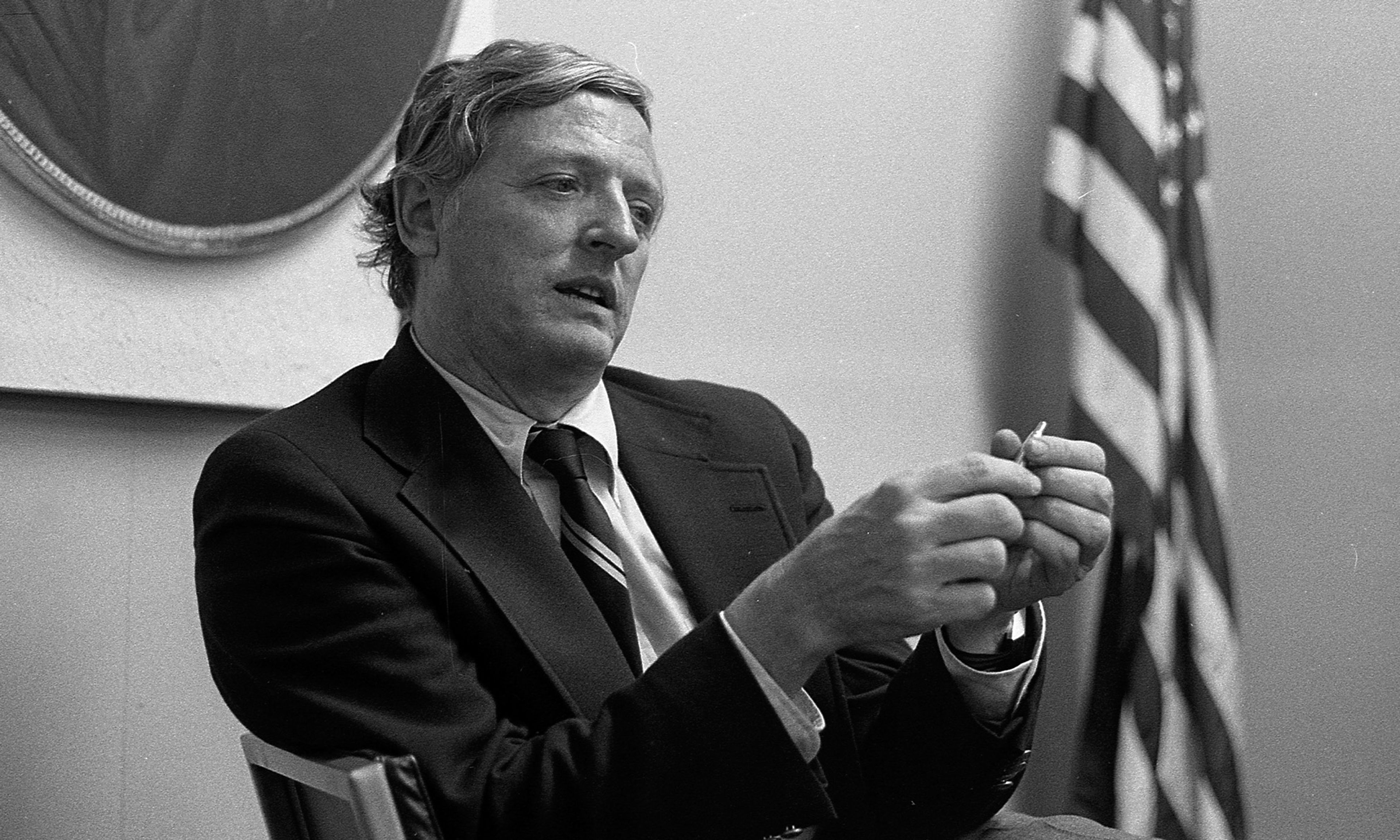
William F. Buckley Jr. was a man of many unshakable convictions. He also held some firm beliefs that he later reconsidered. What was less common in Buckley’s thought was ambivalence. But few things provoked a more consistently ambivalent posture from Buckley than populism.
This is not to say that his approach to populists and populism was incoherent or inconsistent. It was, like so much of his work, analytically nuanced and considered. But Buckley was never fully either pro- or anti-populist. He regarded populism, properly, as a powerful animal spirit, useful and sometimes necessary for good but volatile and dangerous and in need of thoughtful leadership rather than followership and demagogy. “Populists,” he wrote in 1969, “should be not only expert but enthusiastic at reasoning through to the justification of the people’s demands.” Yet he warned in 1951 that “a democracy can itself be as tyrannical as a dictatorship, since it is the extent, not the source, of government power that impinges on freedom.”
After the 1972 Nixon landslide, National Review’s editorial cast a cold eye on the arguments of Kevin Phillips in The Emerging Republican Majority that the Republican future would be populist:
Phillips defines his emerging majority as “conservative” and “populist,” and considers populism as a conservative movement. But what is populism in one man’s eye is apt to be dangerous radicalism in another’s. It is not easy to see just how traditional Republican businessmen are going to lie down peacefully, for very long, with populist-minded trade unionists, lower-middle-class ethnics and poor whites.
“If a Republican majority is actually going to emerge into history,” the editorial concluded, “a good deal more creative political thought is going to be required than Republicans have been accustomed to producing.” This is as true in 2024 as it was in 1972.
If Buckley was a skeptic of populism, he was even harder on elites and elitism. His most famous anti-“expert” remark appeared in his 1963 book Rumbles Left and Right: A Book about Troublesome People and Ideas and became a staple of his 1965 campaign for mayor of New York City: “I am obliged to confess I should sooner live in a society governed by the first two thousand names in the Boston telephone directory than in a society governed by the two thousand faculty members of Harvard University.” Buckley seems to have originated the line in a 1960 column for the Long Island newspaper Newsday, in which he referenced “the first two thousand names in the Garden City telephone directory” — rather a less populist sentiment, given that posh neighborhood. He explained why:
Not, heaven knows, because I hold lightly the brainpower or knowledge or even the affability of the Harvard faculty but because I greatly fear intellectual arrogance, and that is a distinguishing characteristic of the university. . . . In the deliberations of two thousand citizens of Garden City I think one would discern a respect for the laws of God and for the wisdom of our ancestors which would not equally characterize the deliberations of Harvard professors — who, to the extent that they believe in God, tend to believe He made some terrible mistakes which they would undertake to rectify.
There’s the rub: not a quarrel with elites or with expertise as such but a suspicion of their inherent limits, a concern with giving them too much power at the expense of the common sense of the individual (especially on matters of culture and faith), and an insistent demand that they live up to the excellence that ought to justify their position and their pretensions.
Worst of all were elites masquerading as populists. Apropos his nemesis Gore Vidal, he wrote in 1969: “There is a strain of populism. But populism, after all, should be popular.” In Vidal and John Kenneth Galbraith, he found instead “cultural elitism,” “intellectually aristocratic habits,” and “sexual singularity.” National Review’s 1972 election postmortem concluded that “from start to finish the McGovern campaign produced an eerie double-focus effect, rather as if a college faculty meeting had somehow reconstituted itself as a national party and run one of its own for President,” which left his supporters in denial that “their ‘populist’ analysis of the nation’s needs has been rejected, not surprisingly, by the populace.” In 1951, attacking collectivist economics texts that claimed to follow popular sentiment, he demanded, “By what authority do you offer yourself as a spokesman for ‘majority opinion’ in this matter?”
Buckley seemed born to be an anti-populist. He was moneyed and conspicuously erudite, and his style and tastes were those of the upper classes, from classical music to sailing. With his languid posture, droll demeanor, and ten-dollar words, he practically embodied the very WASP elite that scorned him in his early career. His television show even ran on PBS.
His mayoral campaign became a populist cause by default because of the blind spots of the city’s elites. He expected no popular groundswell, quipping that if elected, he would demand a recount. Yet he tapped into an unmet demand for crackdowns on crime and disorder. Blue-collar resentment at layabouts found voice in his formulation for welfare recipients: “No workee, no dolee.”
As Neal Freeman, who managed the campaign, wrote, “I was expecting our supporters to be National Review types — car dealers, academic moles, literate dentists,” but the people who actually came to Buckley’s events showed that he “was speaking for the people who made the city go — corner-store owners, cops, schoolteachers, first-home owners, firemen, coping parents.” He spoke to working-class concerns and needled the elites who ignored them but did so in the Buckley style, and with the intellectual depth to match. It was his effort to provide a model of how to harness populist energy with leadership rather than with pandering. And it pointed the way to the sorts of coalitions that Phillips and other pundits have been forecasting for the Right ever since.
Buckley’s suspicion of populism appears in his work from beginning to end, side by side with his critiques of elites. His first book, 1951’s God and Man at Yale, launched his career. The choice of an intra-Yale argument about the curriculum and atmosphere on the tony campus was the furthest thing from a populist subject matter. Buckley never questioned the usefulness or importance of Yale’s role in shaping the nation’s elites. Indeed, his belief in that role animated his writing of the book. A spectator observing the debates of the Yale Political Union, Buckley remarked, “can get a vivid, dramatic picture of the short, short path between the classroom and the national legislature.”
Likewise, he never questioned the need for expert faculty to guide students through Yale: “Even the most frivolous student has respect for expertise, and it is to his professors and to his books that he turns for expertise. It is to the faculty that he looks for the frank of authority for a field of learning, for a set of values.” To the contrary, he criticized faculty members whom he found “blatantly unintellectual” in their biases. As he wrote in 1967, arguing that Ronald Reagan should refine his critique of funding the University of California, “Intellectual curiosity is a very good thing; intellectual frivolity is not.”
Buckley’s own elitist side — then and throughout his career — is most apparent in addressing economics. Confronted with textbooks discussing the popular theories of the day, he dared them to ask: “Is what most Americans want sound economics?” He never lost that scorn for economic populists. In 1979, he groused that Ted Kennedy’s “public life and attitudes are dominated by all the reactionary slogans of populism. . . . These we will always have with us, even as we will always have with us somebody who believes that Rothschild and the Banks are responsible for American foreign policy.” In 2007, he explained the appeal of John Edwards thus:
There is this to be said for populist oratory: it is generally directed against the big fella, and that is attractive to the American who lives in a world in which collectivity threatens all. . . . There are those who, while admitting that the populist approach does not work, nevertheless welcome its occasional appearances on the scene. Because, they will tell you, populism draws attention in a theatrical way to what the free market can ignore — to dissatisfactions that legitimately attract the reformer.
Yet, even in 1951, Buckley offered his own populist riposte to the eggheads, citing how free markets made “a world of little capitalists, the grocer, the dress manufacturer, the newspaper owner, the farmer” and “the log cabin that blossomed” into a spacious modern home. He noted: “It is anti-democratic to take from someone what the people in the first instance decide to give him. . . . In a free economy it is the people who, in their role as ultimate employers, pay the wages” of a well-paid laborer such as Joe DiMaggio.
Buckley’s second book, 1954’s McCarthy and His Enemies, took up the communist-hunting cause of the populist demagogue Joe McCarthy against his dismissive elite critics. Yet, characteristically, the book contains more than five dozen criticisms of McCarthy. When he thought them on the right side, Buckley aimed to save populism from the populists.
In 2000, when protesters tried to obstruct the federal government from (wrongly, but by lawful process) deporting Elián González from Florida to Cuba, Buckley called the burst of civil disobedience “200-proof populism” and cheerily compared “such heady whiffs of independence” to protesters protecting Martin Luther King Jr. or Lieutenant William Calley.
Yet nothing repelled him more than the schoolhouse-door populist demagogy of Southern segregationists, whose tactics compelled him to rethink his own prior complacency about the racial order of the Jim Crow South. He sneered in 1976 that Lester Maddox was “a semi-literate segregationist” who had made common cause with “the fever swamps of the berserk Right.” He said of a 1968 confrontation with former Alabama governor George Wallace that the man “calls himself a populist” but was really an avatar of “state welfarism.” He lampooned Wallace’s rhetorical tics (“there — ain’t — nobody — loves — the — nigra — like — me — an’ — lurleen”) and argued that “sophisticated conservatives believe that Wallace’s passion for states rights derives from the knowledge that that is the only way to administer a segregated state.” As he added in 1972: “John C. Calhoun could speak about the concurrent majority . . . out of a sense of respect for constitutional principle. George Wallace came around to his positions because he wanted a fancy argument for Jim Crow.”
Yet, a year later, Buckley argued that Wallace could still do some good: He could “move Southern Democrats into the Republican Party. It is, of course, where they belong.” Even if Buckley disdained the company and the causes of Wallace, he did not hold it against his supporters. They, too, needed better leadership and better arguments.
In 2000, writing for Cigar Aficionado on “the rampant demagoguery in the present scene,” he found two villains. One was the candidate, such as Bill Bradley, “who promises the voters what are best described as Nice Things,” and who capitalized on how “voters at large don’t naturally intuit economic realities.” The other was the candidate whose only program is “the visionary’s serving as President,” of whom “the most obvious target in today’s lineup is, of course, Donald Trump,” then seeking the Reform Party nomination. He contrasted Trump with Steve Forbes: “Forbes is an evangelist, not an exhibitionist. In his long and sober private career, Steve Forbes never bought a casino, and if he had done so, he would not have called it Forbes’s Funhouse.” Of Trump, he wrote, “Look for the narcissist. . . . When he looks at a glass, he is mesmerized by its reflection. If Donald Trump were shaped a little differently, he would compete for Miss America.”
Buckley did not live to see Trump lead his own supporters into the Republican Party. He would doubtless have shared more pungent observations about the man and his style, but — as ever — not at the expense of his voters or their unmet needs for responsive leadership. He would at the same time have punctured the pretensions of Trump’s elite critics. More than that, we can only speculate. But in a populist age, we can take Buckley’s example. That means demanding more excellence, humility, and popular responsiveness from elites but also more rigor and care from populists. In the end, neither credentials nor popularity is a substitute for being right.











Comments