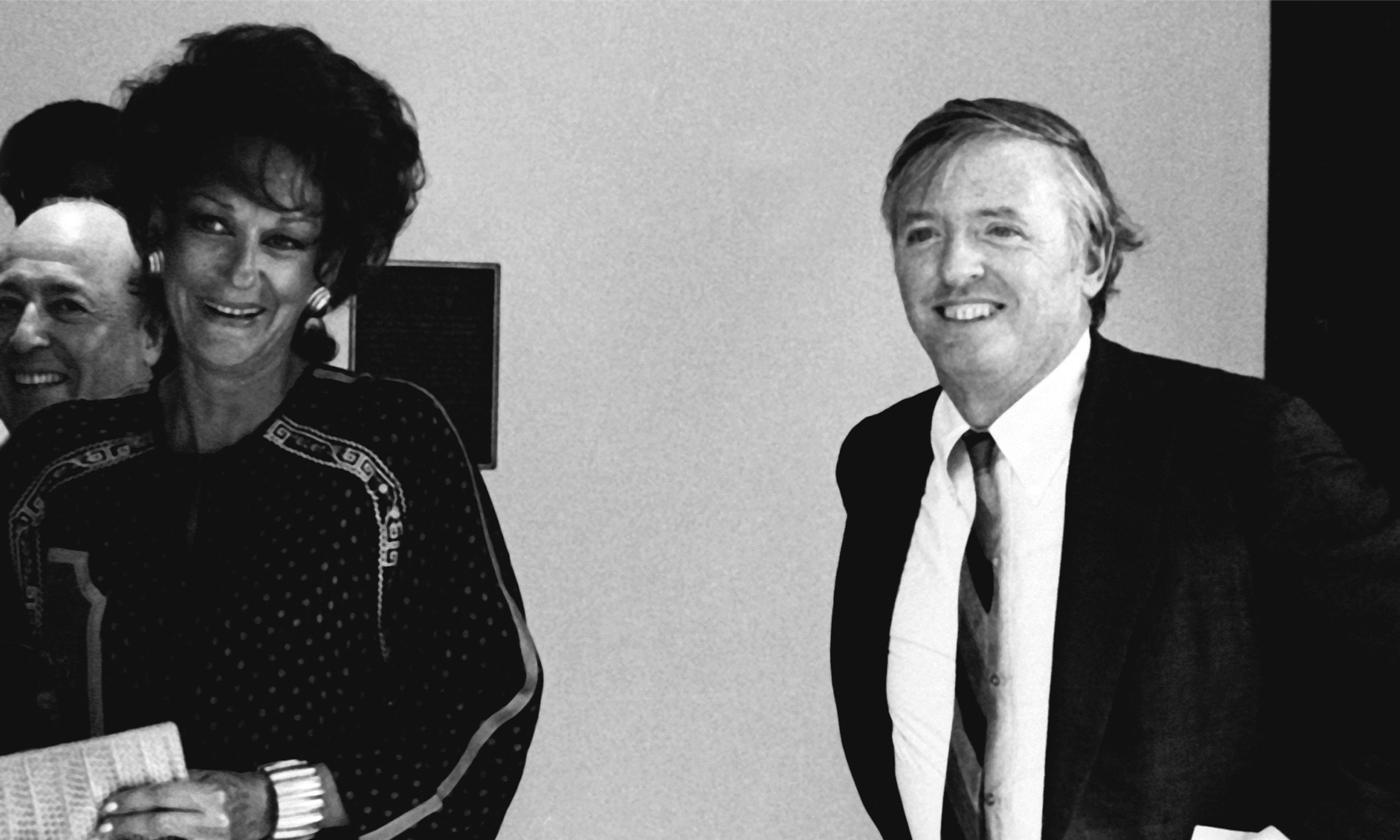
‘I’ve been flogging a new book,” announced Art Buchwald at the top of his syndicated humor column of November 18, 1978. “I have crossed paths with Teddy White, Betty Ford, Irving Wallace, Peter Townsend, Arthur Schlesinger Jr., Robert Kennedy Jr., William F. Buckley Jr., James Michener, Erma Bombeck, Barbara Tuchman, and Ann Landers.”
Think of it: The bold-faced name Buchwald led with, the first celebrity he found it useful to mention for the crass purposes of book floggery, his best shot at the generation of what a later generation would call buzz, was . . . Theodore H. White, the owlish newspaperman and author of the Making of the President series of campaign journalism books. How much more literary or — let’s just say it — literate those times were! Buchwald also reckoned it profitable to mention a Pulitzer-winning historian (Tuchman), a syndicated advice columnist (Landers), and, among still others, William F. Buckley Jr., who transcended all those worlds.
That same year, a reviewer for the Chicago Tribune offered warm praise for Medium Rare, a book of caricatures by Bill Plympton in which the eclectic subjects, as the Tribune noted, included “William F. Buckley, Walter Cronkite, The Fonz, Bob Dylan, Woody Allen, Howard Cosell, and several Carters, Fords, and Nixons.” Once again, what was the godfather of modern conservatism doing in the company of Woody Allen and The Fonz?
Part of it was that WFB’s image had morphed. Americans had come of age with Buckley and saw him, by then, as a constant in changing times, his celebrity softened, and enhanced, by the end of the fiery Sixties.
But WFB had long traveled in such company. He guested on Woody Allen’s 1967 TV special and drew reference, a decade later, in Allen’s Oscar-winning masterpiece, Annie Hall (1977), in which twin discoveries in Diane Keaton’s apartment — of an arachnid intruder and a copy of National Review — prompted Woody’s question: “Why don’tcha get William F. Buckley to kill the spider?”
Bill Buckley was multimedia before the term was commonly used. Savoring only one form of his vast output — just the syndicated columns, say, or just Firing Line, or just the Blackford Oakes spy novels — never conveyed the full measure of his multifaceted genius. Only by knowing how beautifully and amusingly he wrote could you truly appreciate his extemporaneous speaking ability, his command of viewers and situations, by turns allusive, pointed, and comic, never less than persuasive.
Name a medium, and there stood the young WFB — photogenic and connected, ambitious and well financed — athwart the emerging technology, eager to harness it to the mid-century conservative movement he conceived and midwifed. It wasn’t just newspapers, TV, radio, lectures, debates, books — anthologies and original works — but record albums (e.g., A Birthday Party for National Review, released in 1961, or Buckley’s 1984 narration of Peter and the Wolf), PR stunts (think Schlesinger and the donkey), and even, most daring, an election.
Buckley’s 1965 run for the mayoralty of New York City, a merry prankster loose in the world’s No. 1 media market, forever imbued his persona with a pop! sensibility. Presciently virtual, an unprecedented conflation of electronic punditry and the real world of campaigns and elections, WFB’s candidacy was as clever and meta as Warhol’s soup cans or Adam West’s Batman. Indeed, the satirical cast to the enterprise — “Demand a recount,” WFB famously answered when a reporter asked what his first official action would be if he won — only added to the pleasing unreality of it. Was he putting us on? That Buckley alchemized the race into a best-selling memoir, The Unmaking of a Mayor (1966), a play on White, completed his destruction of the fourth wall.
In an hour-long interview at his East 73rd Street maisonette, conducted for Fox News in October 2000, I wondered whether WFB could really have left one world for the other.
Rosen: Having garnered 13 percent, was there any point thereafter where you said to yourself: “Gosh, if I had tried, imagine what I could have done”?
WFB: No, because my inclinations are critical, not political. I’m, I’m — I am a critic, not an actor. And I was asked to run when my brother [Jim] ran [for the U.S. Senate in 1970, and won], and declined, and I’m terribly glad that I did. But my deliberation was about five minutes.
In his first days on the intellectual scene, in the 1950s, Buckley was regarded by the Left as an enfant terrible — nouveau riche, arriviste, and ungentlemanly, for all his Oxford-debate affect. His early positions on civil rights, later renounced, disappointed even his admirers.
By the end of the Sixties, however, WFB was a cultural institution. Conservatism Can Be Fun, read the headline beneath the brilliant David Levine caricature on the cover of the November 3, 1967, edition of Time — six issues after the Beatles, no one’s champions of conservatism, had graced the cover. The success of Cruising Speed (1971), the hilarious diary of a characteristically jam-packed week in the Buckleys’ lives, revealed that the celebrated clash with Gore Vidal on ABC News in August 1968 had done no damage to the Buckley brand; indeed, there was now as much appetite for WFB the man as for his politics. In August 1974, Publishers Weekly described him as “the liberals’ favorite conservative.”
When he published Saving the Queen (1976), the first of the spy novels, Buckley saw his persona expand anew. Though the books brought a conservative voice to spy fiction, it was now possible to see their author in purely literary terms, less dangerous as an ideologue, another celebrity author on The Tonight Show. TV listings showed WFB’s name beside Fonzie’s for seven years before Ronald Reagan became president.
If the Reagan Revolution validated Buckley’s multimedia career to date, the 1980s witnessed the waning of WFB’s cultural influence. The columns and Firing Line episodes continued, but seldom with the crackle of earlier decades; watching the host take on Muhammad Ali and Allen Ginsberg provided greater theater than his explorations with Joe Biden or Allan Bloom. Spy novels, novels about Castro and Elvis, more anthologies, and even a children’s book, The Temptation of Wilfred Malachey (1985), came and went as a new generation of conservative voices took hold. WFB had grown old, no longer the eternally boyish provocateur — but still a voice to be reckoned with, as when he set out In Search of Anti-Semitism (1992), or turned against the Iraq War.
On the 50th birthday of National Review, in 2005, George Will declared of, and to, the magazine’s founder: “Without Bill Buckley, no National Review. Without National Review, no Goldwater nomination. Without the Goldwater nomination, no conservative takeover of the Republican Party. Without that, no Reagan. Without Reagan, no victory in the Cold War. Therefore, Bill Buckley won the Cold War.”
“That’s a very nice abbreviation,” WFB replied. “I hope you will remind historians of it.”
The truth is that Buckley himself was never terribly convinced that he — his causes — had prevailed. Consider his exchange with editor Martin Gross in the July 1975 edition of Book Digest:
Gross: Is there going to be a continued leftward movement over the next thirty years?
WFB: It appears that way.
Gross: And how do you view that?
WFB: I view it with dissatisfaction.
Gross: But do you think it can be stemmed?
WFB: I think there’s an absolute imperative to stem it. But I don’t really have a thesis about any necessary success that we will have with it. . . . The natural gravitational pull of all society seems to be toward getting somebody to relieve people of the anxiety of having to make their own decisions.
When I first met the great man, at the NR offices on September 17, 1991, he had just recorded three episodes of Firing Line: with assisted-suicide advocate Derek Humphry (“no sense of humor whatsoever”); historian Richard Pipes; and Michael Kinsley and Brent Bozell.
I told him: “If there’s any reason to envy a man like you, it’s not because of the trappings that surround you” — although I never tired of visiting the maisonette, which was like traveling back in time to 1968, the year of my birth — “but because you’ve accomplished what you’ve wanted.”
The Berlin Wall had come down, the Soviet Union was in free fall, communism was thoroughly discredited, and Republicans had captured the presidency for more than a decade.
“You’ve won,” I said. “Game over.”
“Except,” he reminded me, “in the sense that there are no final victories.” He was amused to learn that that had been the title of the 1974 memoir by former Democratic National Committee chairman and Kennedy fixer Larry O’Brien. “But essentially, you’re right.”
A decade later, in our interview for Fox News, I probed his view that victories were fleeting, if not wholly surrendered.
Rosen: When would you say was the peak of your controversy as a polemicist?
WFB: I suppose during the Goldwater period. I mean, that was a period in which it was more or less accepted that any literate American would be anti-Goldwater. So that was probably the nadir; but that lasted ten or 15 years, you know . . .
Rosen: It seems to me that during those years, the 1960s, you were more engaged with the forces that you disdained than you would be today. For example, I remember in [Cruising Speed] you talking about going to see the film Gimme Shelter [1970], starring the Rolling Stones at Altamont. It seems to me that you were more engaged with the counterculture, and in trying to mitigate its effects, if you will, than you are today with the hip-hop and the rap culture. . . . Is that true?
WFB: I think it probably is. For one thing, the temperature of public discussions modulated a great deal between, say, 1972 and when I ended Firing Line [1999]. People didn’t sort of scream and yell quite the way they used to. Now this was in part the evolution of the imperative that argues for civility; in part, also, a general acquiescence in certain things that were, at one point, controversial. When I was at college, I didn’t know anybody who was a, quote, homosexual. I’ve got to assume there were some there, but the answer is the question wasn’t even broached. It was inconceivable when I was in college that someone would live off-campus with his girlfriend. Now you can get a little bit indignant about the incidence of these things as the years go by, but at a certain point, you simply recognize that any protest against it becomes purely internalized, because that’s the way things are . . . The cultural changes have asserted themselves in a way that makes any attempt to confute them simply irrelevant, or deliverable only in cloistered circumstances.
Does WFB’s career offer guidance for today’s political actors and activists? The answer is yes — but we are obliged, first, to reject the modern fashion in publishing that always requires historical narratives to offer such vouchers for contemporary use. Doesn’t the portrayal of a consequential life in a given time, well told, offer reward, or parallel, enough?
If “general acquiescence” is the only recourse, however, suffice it to say that the WFB model, which by definition cannot be replicated, carries some important lessons for would-be successors, irrespective of ideology. The “fun” Time headline provided a clue. As Robert F. Kennedy told CBS News’s Roger Mudd during a boisterous campaign stop in 1968, “Half the trick is to look like you’re having fun.”
Multimedia was another key component. Like the Beatles, whose oeuvre WFB initially panned and later embraced, Buckley showed that mastery of a single medium, in postwar communications, was no longer enough. One imagines that if he were still with us, he’d be prolific on X.
Today’s provocateurs should also heed the eclecticism of Buckley’s venues. His willingness to mix it up on Rowan & Martin’s Laugh-In as well as Firing Line, to debate left-wing writers such as James Baldwin and Gore Vidal, and his willingness, occasionally, to admit error — as with civil rights, the Fab Four, and his acknowledgment, in 1989, that Muhammad Ali had been “a victim of the establishment” — showed both courage and a canny insight: Movements seldom make converts inside their own temples.
Asked why the country’s foremost exponent of conservatism wrote for Playboy, WFB never cited the magazine’s peak circulation, in 1972, of 7 million readers; instead he let fly one of his characteristic quips, eyes a-twinkle. Such placement, he said, represented “the fastest way to communicate with my 17-year-old son.”











Comments