Croaker, Va.
If you’re interested in the American presidency, this country has plenty of options for you. Statues and memorials of chief executives past dot the landscape. There are certain areas of presidential concentration. South Dakota has Mount Rushmore, from which the solemn visages of George Washington, Thomas Jefferson, Theodore Roosevelt, and Abraham Lincoln stare out across the fruited plain. Washington, D.C., has the White House itself, where most (though not all) presidents have resided, as well as presidential memorials to Washington, Lincoln, Jefferson, both Roosevelts, and others.
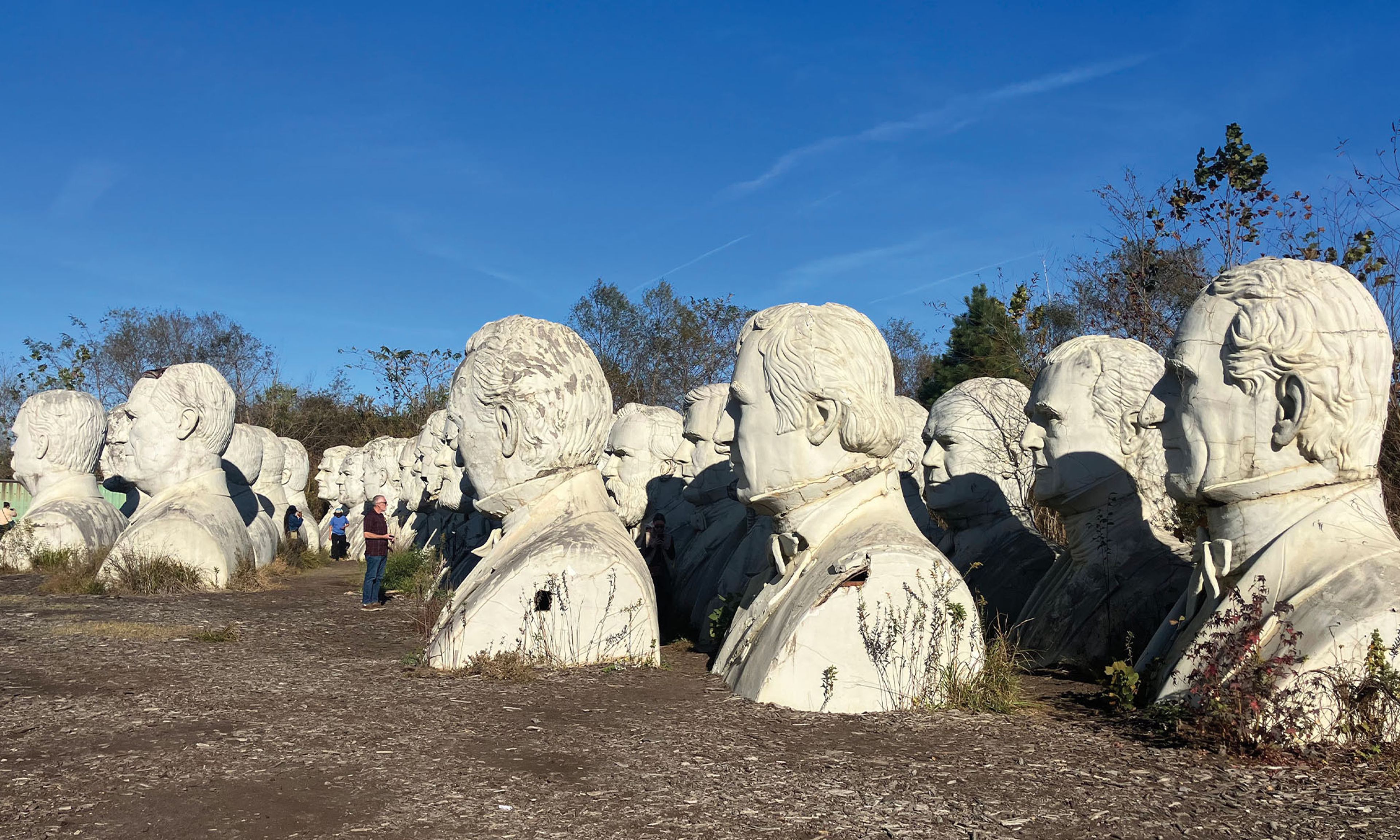
But a few hours south of D.C., in a small, rural Virginia town just outside of Williamsburg, there lies an odd and indelible presidential tribute that deserves special attention. Stowed safely away on private property are 42 massive concrete heads, each in the likeness of a president, from Washington to George W. Bush. On the Saturday before the 2024 presidential election, I traveled to this mysterious collection of crania to find out where they came from, how they got there, and why they endure — for now.
The story of the American presidency is one of a collection of characters. So, too, is the story of the presidential heads. They emerged from the collaboration of Virginia businessman Everette Hale Newman III and Texas sculptor David Adickes. A man obsessed with presidents, Newman was “bothered by the fact that many Americans couldn’t distinguish between a Fillmore and a Buchanan,” according to the book Weird Virginia. To rectify this executive lacuna, he decided to commission the construction of giant concrete heads of every president and open a park to display them all.
Adickes is a Houston-area artist with a storied background (he served in the military at the very end of World War II, spent the night in the White House during the presidency of George H. W. Bush, and claims to have once seen Salvador Dalí naked) and an extensive pedigree (he had already created large sculptures of, among other subjects, Sam Houston). He had visited Mount Rushmore and was “blown away with the beauty and the grandiosity” of it, says John Plashal, an acquaintance of Adickes. But he was “equally as frustrated at how distant of an experience” it was. Adickes’s hope was to create something like it but that patrons could get close to. Land was too scarce in D.C., but Newman (whom Adickes says he met by chance) owned land in the Williamsburg area, which was the next-best thing.
So Adickes got to work. First, he conducted research into the appearance of each president, referring to paintings and photographs to create the best possible facial resemblance and also to get the period clothing and other details right. “I just wanted to do the best likeness of each guy that was the president,” Adickes told Plashal in a podcast interview. Then, over two and a half years, and with the help of two assistants (one of whom was a waitress at a nearby Chili’s he frequented during the process), he sculpted the heads in a Texas studio. Key in the construction were rubber molds used to make facial details as accurate as possible. Each head sits on a base that consists of part of the chest and shoulders of the featured president; Adickes started with these, then worked up to the neck, and finished with the heads. Thanks to the rubber molds, he was able to create two additional sets quickly, one of which went to a separate presidential park in South Dakota (now defunct).
Building the heads was only the beginning. They then had to make their way to Virginia. For that, they were disassembled and placed on flatbed trucks, two at a time. The roughly 20-foot statues would not have made it under highway overpasses otherwise. The local government placed further obstacles in Newman’s way; the heads were a “public display without a permit.” The first heads to arrive sat initially in the parking lot of a Virginia motel Newman owned, then in two separate public parks. Eventually, the local government yielded to the presidents, and Presidents Park, a well-manicured, orderly display of the heads, with informational placards accompanying, opened to tourists in 2004, with Newman (now deceased) initially managing.
Yet Presidents Park is not where you can visit the heads today. It closed in 2010. A victim of the Great Recession, poor marketing, and invisibility from nearby interstates, the park never secured the kind of foot traffic it would have needed to survive. For several years, the land was abandoned, as were the heads residing there. Eventually, a rental-car company bought the lot; the heads were slated for oblivion. Howard Hankins, who owns an area stone-crushing business, was asked to destroy the heads. It so happened that he, also a presidential obsessive, had helped get the park off the ground in the first place and was loath to assist in the heads’ destruction. So he decided to take them onto his own property. “Instead of going to the crusher, I brought them to the farm, and there they are,” Hankins told documentary filmmaker Adam Roffman in the short film All the Presidents’ Heads. “Their new home.”
Their new home was a few miles away from Presidents Park. It took six men, working ten hours a day, at a cost of $50,000, for Hankins to move the roughly 100-ton structures. The statues did not survive the trip unblemished. Hankins gave each of them what Plashal describes as a “minimalistic craniotomy,” drilling a hole in the top of each head to hoist them atop trucks. He did not know that Adickes had already designed the statues with a small hole and internal features meant precisely to facilitate their moving. One statue, of Lincoln, also fell over during the transportation process. The damage had a gruesome historical accuracy: The back of his head fell off. But the rest of him made it well enough, as did the other statues. The president may live in the White House. But the presidents have lived on Hankins’s property since 2013.
You would not know the presidential heads were there unless you were looking for them. Which I was, on that sunny Saturday, when I turned onto a long, dirt driveway. The first indication that I was in the right place was a lone sign reading Presidents Heads Open — Pay Ahead. A single arrow pointed forward. Doing as it said, I eventually came upon a tollbooth (not in use), a parking lot — and a small concrete statue of Barack Obama. This was a maquette, made as a prelude to a never-completed statue of the 44th president before Presidents Park’s closure. And before anyone gets any ideas: I was not trespassing (though some have tried). Plashal and others run a handful of ticketed tours of the heads throughout the year, with Hankins’s blessing.
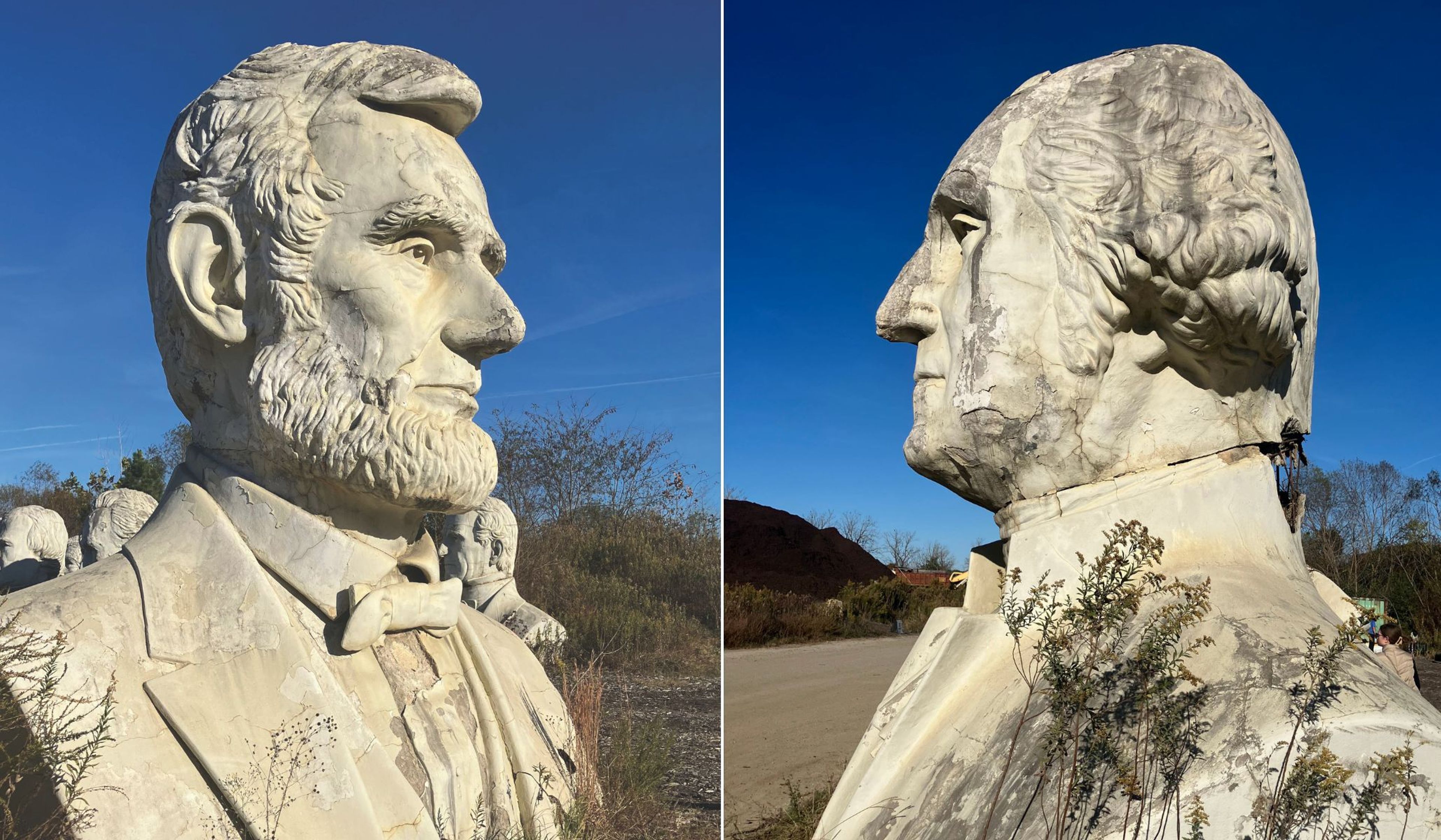
The site of the heads seems otherwise nondescript: a nice but otherwise unremarkable home sits amid trucks, dirt roads, trees and shrubbery, and piles of stone, mulch, and gravel. To get to the heads, you must walk a short distance past these workaday trappings. Then, after passing a pile of muddy rubber boots, you will see before you one of America’s great oddities: the presidential heads. Before I laid eyes on them, I had assumed that they were spread out on a large area of land. Not so: They are grouped together tightly, in several rows. Three — George Washington, Andrew Jackson, and Abraham Lincoln — are set apart from the others. These are three of the seven that Adickes, in consultation with presidential historians, made slightly bigger than the rest in recognition of their greater statures, as ranked by the historians. The other four are Jefferson, both Roosevelts, and Woodrow Wilson.
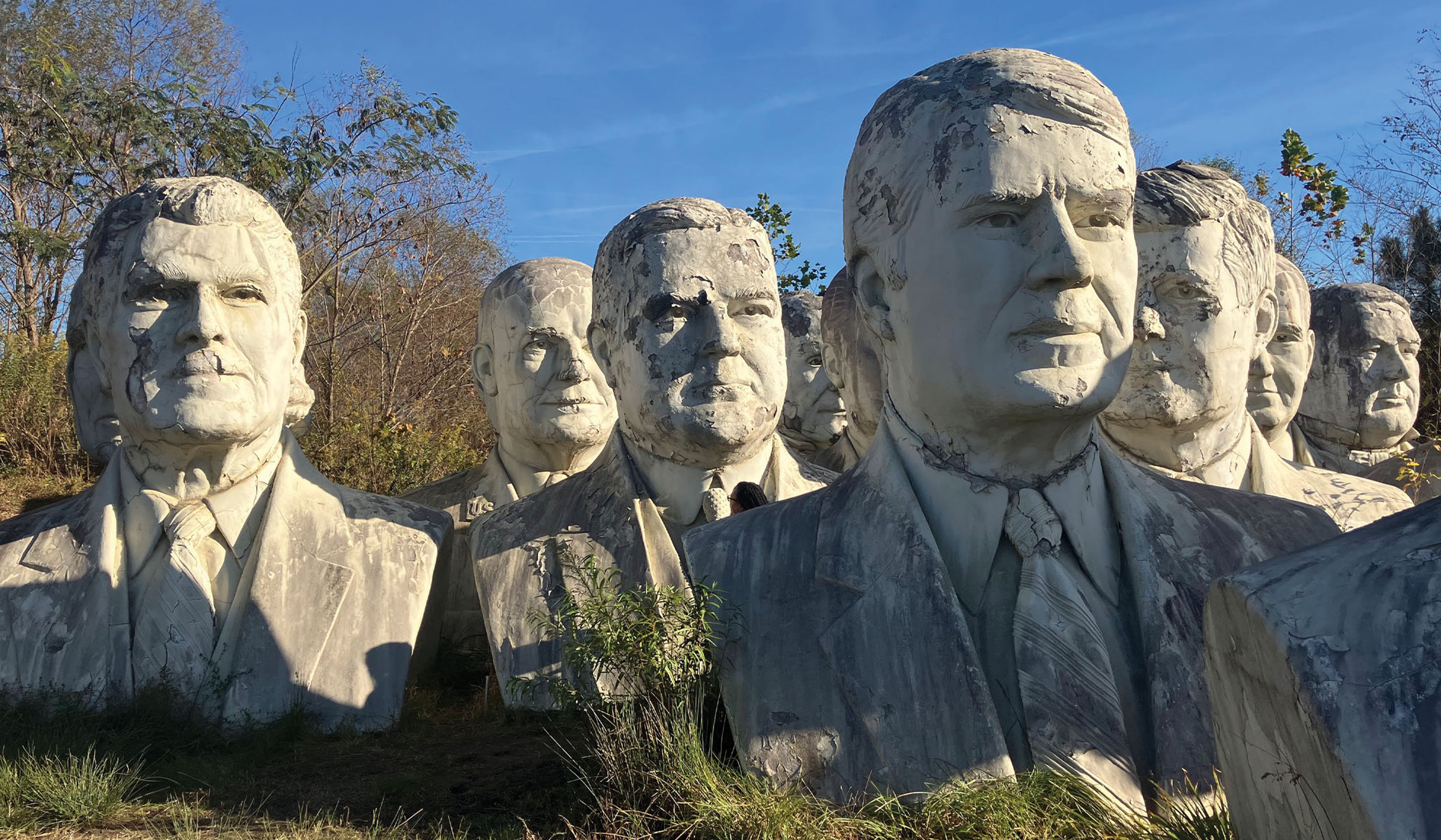
It is a truly bizarre and bewildering sight to take in, and to walk through. The massive heads are locked in an eternal forward, stoic gaze befitting the solemnity of the office their subjects held. There wasn’t much of a pattern to their placement, the aforementioned trio aside, but Jefferson’s is conspicuously backgrounded. (Hankins, a Virginia Tech fan, resents his founding of the University of Virginia.) The resemblances to their originals are obvious, and skillful, with plenty of detail on both the face and what is included of the body. Even the ties are period-accurate.
But there’s one obvious reality about the statues that only a visit can fully communicate: their decay. The years, the elements, and their transportation have all taken their toll. (To prevent further damage, touching them is forbidden.) Lincoln’s uncanny wound is not the only mark of deterioration. Washington has been shorn of some of the hair on the back of his head. Chester Arthur’s mutton chops proved too heavy to bear and dropped off. A wasp’s nest has formed in one of Nixon’s eyes. FDR has lost a bit off the top of his skull. And the “skin” of just about every statue has begun to flake or fall off, making them “look like they’ve got leprosy,” as Plashal puts it.
The statues may be shedding layers, but that decay adds a layer of eeriness to the grandeur of the heads. They inspire comparisons ranging from China’s terra-cotta army to the Easter Island moai to — as one visitor from Richmond described it to me that day — something out of Planet of the Apes. Other descriptors applied on the day of my visit: “apocalyptic,” “dystopian,” and “Soviet.”
The current condition of the statues has not lessened their appeal. Rather, it seems to have made them more interesting to visitors. “It’s cool seeing them in their decayed states,” Rodney, visiting from Virginia Beach, told me. Their unique aesthetic attracts thousands of visitors annually; more than 700 saw them the day I did. Cars in the parking lot bore license plates from Virginia and D.C., but also Tennessee, Florida, and New Jersey. I spoke with one pair visiting from New York. Famous visitors include Ozzy Osbourne and a Broadway actor who played Washington in Hamilton. In addition to tours, the heads also host nighttime photo workshops. They also appeared in the postapocalyptic TV show The Walking Dead. In their ruined condition, Plashal notes, they’re more popular than they were when they sat, perfectly preserved, in the well-maintained Presidents Park: During one peak-demand period, in the middle of the Covid pandemic, he had a tour waiting list of 17,000 people.
Some of this popularity may also arise from an unfortunate fact: The fate of the heads is uncertain. Though they are currently safe on Hankins’s property, they’re not otherwise being preserved. And they’re unlikely to stay there forever. Plashal expects tours to stop at some point in the next few years. What happens to the heads beyond that is unclear. There has been some discussion of the land’s being sold for a mixed-use development, or turned into a patriotic-themed neighborhood that makes use of the statues in some way.
Fred Schneider, a photographer who works with Plashal to run the tours, is unsure whether that’s feasible. “I don’t think you can move them,” he says, noting that the statues have sunk somewhat into the soft ground, usually even muddier than it was the day I went (hence the pile of boots, for visitors’ use). The ground may now be helping hold the statues upright, so who knows what could happen if they were transported again. Adickes himself, on the cusp of turning 98, has no plans to add Obama, Donald Trump, and Joe Biden statues, though he would like to make one more statue of Lincoln before he dies.
The fact that the statues may not last much longer ought to sadden those who enjoy both history and the tucked-away wonders of this great country. But it also helps bring the reality of history, and especially of its passage, to life. Among the presidents’ heads are great men, mediocrities, and worse; men we all remember, and men we all forget — or perhaps would like to. Each shaped America and was shaped by it. But unless they are actively remembered, it is the ultimate fate of all of them to fade away. Look on the Heads, ye Mighty, and despair.
Some may be recalled only as answers to trivia questions in contests of the sort that Schneider conducts as part of the tours. At first, I felt that I should decline to participate, for the sake of journalistic objectivity. But the grade-schooler in me who often shouted out the answer when he knew it — to say nothing of the young child my parents claim could recite all the presidents in order — eventually won out. (I won the contest for my tour group.) One of the questions asked:
There were 43 presidents represented among the statues, but only 42 heads. Why?
Grover Cleveland, I answered.
Why? Schneider prompted me further.
“Because he was, so far, the only nonconsecutive president we’ve had,” I said.












Comments