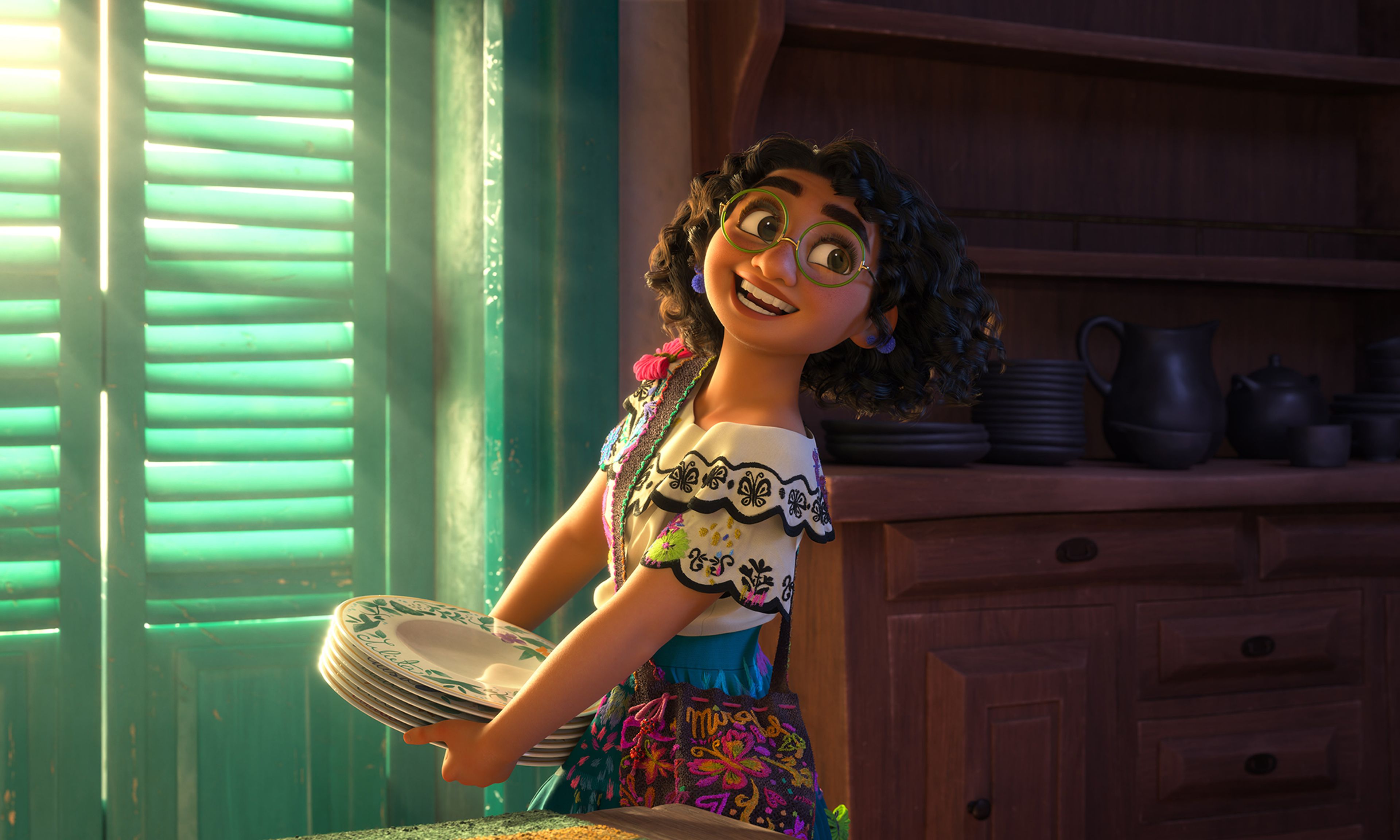
I didn’t intend to review the new Disney movie, Encanto, in this column. I watched it for the first time the way many parents watch their kids’ movies, in distracted snatches while coping with various midwinter tasks, and my immediate impression was that it was a step up from recent Disney efforts, closer to Moana in quality than to Onward or Raya and the Last Dragon, but also of a piece with the larger Disney trend I described when reviewing Raya last year: no love interest, no villain, a not-quite-successful invented mythos, good for whiling away a winter afternoon and not much more to say than that. I tossed off a one-liner on Twitter — “best Disney since Moana but also its fifth movie in a row without a meaningful love story; decadence continues” — and thought no more about it.
The culture, however, disagreed with this dismissal. My tweet stirred up angry responses — in part because I foolishly appended a link to an old column about “sex and romance at the movies,” leading to accusations that what I really wanted was a bit more Disney nudity. But it also generated thoughtful responses — defenses of what you might call the “family love story,” arguments that it makes sense, in a society so defined by divorce and single parenthood and intergenerational fracture, for stories about the quest for stronger familial bonds to displace the marriage plot.
Meanwhile the movie’s songs penetrated the culture like nothing since the “Let It Go” era (at home, our not-quite-two-year-old now croaks “We don’t talk about Bru-u-u-u-no . . .”), and thanks to repeated distracted viewings, I’ve now seen it as many times as I saw Dune.
So I give in: Let’s talk about Encanto.
The movie is set in Colombia in an indeterminate and mythic past. The central family, the Madrigals, were refugees from a civil war. Their father sacrificed himself to save their lives — an act that somehow was rewarded with what the movie calls “the miracle,” which is really three miracles combined: an eternally glowing candle tended by their abuela, the widow of the martyred patriarch; the enchanted house that she and her descendants occupy, the kind of place where the stairs carry you upward and the table sets itself; and then the magical gifts that her children and then grandchildren gain as they come of age, ranging from super-strength to the gift of prophecy to the ability to talk to animals to the power to heal wounds with your cooking.
This magical family have become the protectors of the village that’s sprung up around their enchanted casa, which is itself protected by steep mountains from whatever’s happening in the outside world. Abuela, the stern matriarch, insists that the gifts exist to serve the community, which has supplied two of her daughters with (non-magical) husbands and may do the same for one of her granddaughters as well. But she is also clearly frightened that the miracle might one day disappear — a fear that skyrockets when her granddaughter Mirabel, the movie’s heroine, is denied a supernatural gift.
It will not surprise you that despite being passed over by the magic, Mirabel has a crucial destiny to fulfill — that when cracks start appearing in the foundation of the house, and her siblings’ powers start to waver, she’s the one who goes in search of her missing uncle Bruno, the Madrigal gifted with prophecy who vanished mysteriously after years of disappointing people with his visions. And without giving away too much, we can say that the salvation of the family lies in a balance between tradition and individualism, in which lessons are learned about the dangers of clinging too tightly to rules and authority and ritual expectations, but only in order to bind the clan together with a kinder, gentler sort of familialism.
To Encanto’s boosters and fans of the new Disney style in general, I wish to concede that there’s something to this kind of drama that’s potentially as interesting as any marriage plot. However, in other ways the new movie still showcases the clear limits of the new style.
In particular, it offers an example of how when you play “let’s make up a mythology” instead of relying on the archetypes of fairy tale, you can end up with something extremely cluttered and a bit random. There’s so much magic in Encanto, of so many different kinds, yet except for Bruno’s gift of foresight none of it is particularly relevant to the actual family drama. Neither, again with a few exceptions, are most of the gifts obviously relevant to the life of the village or the valley: For all the talk of serving the community, there is no obvious danger or challenge that, say, talking to animals or shape-shifting or preternatural hearing exists to answer or resolve, nor any villain that they’re needed to defeat, because Encanto, like other recent Disney movies, has given up on villains.
The consequence is a mythos that feels fundamentally arbitrary attached to a story whose stakes are too low to justify its supernatural pyrotechnics, with individual magical powers serving as a kind of lazy character sketch for an overcrowded cast, or just grist for the next verse of a song.
But the songs, which like Moana’s soundtrack come courtesy of Lin-Manuel Miranda, are very, very good. And now that I’ve pondered Encanto for the better part of a month, I’m afraid my fundamental opinions on its cultural success are pretty boring ones: The guy who wrote Hamilton is really good at writing songs, and if you hire him to write your Disney movie’s soundtrack, it will disguise the fact that it’s hard to invent a new kind of fairy tale, because the story will fade quickly and all you’ll hear is the singing from your toddler and the chorus in your head.












Comments