Possibly the three scariest words in the English language are, “Can we talk?”
Nothing good can come of that invitation. Certainly not what seems to be indicated, which is a gentle kind of give-and-take.
“Can we talk?” almost always means, “Can you shut up and listen?” But as a rule, we tend to shy away from the bluntly honest and prefer sunny euphemisms like “engage in dialogue” and “have a good conversation” and “communicate effectively” to mask what’s really going on: You sit, you listen, end of conversation.
Not that this is always a bad thing. Sometimes life makes you the talker, sometimes life makes you the talked-at. We’ve all done our share of both. The key, as any married person will tell you, is to know when it’s time to start talking and when it’s time to shut up and listen.
It works the same in public life. Here’s a little show-business tip, for the next time you find yourself onstage, in front of a large crowd: When you’ve said something funny or striking, wait until the audience’s laughter or applause crests, and then start talking again. Don’t wait for the laughter to fade; don’t milk the last clap. Start talking again the moment their response seems just past its peak.
It’s counterintuitive, I know — your natural impulse is going to be to soak up all the adulation you can, to squeeze every last drop of that audience love — but trust me here: It’s smart audience management. You keep the speech moving. You keep moving from popular topic to popular topic. And more important, you send a clear message to your listeners that you’re in charge — that the pace and tempo of your speech are under your control — and that you’re not afraid to push them around a little. And let’s be honest: Every successful public speaker knows how important it is to make his audience sit up and beg.
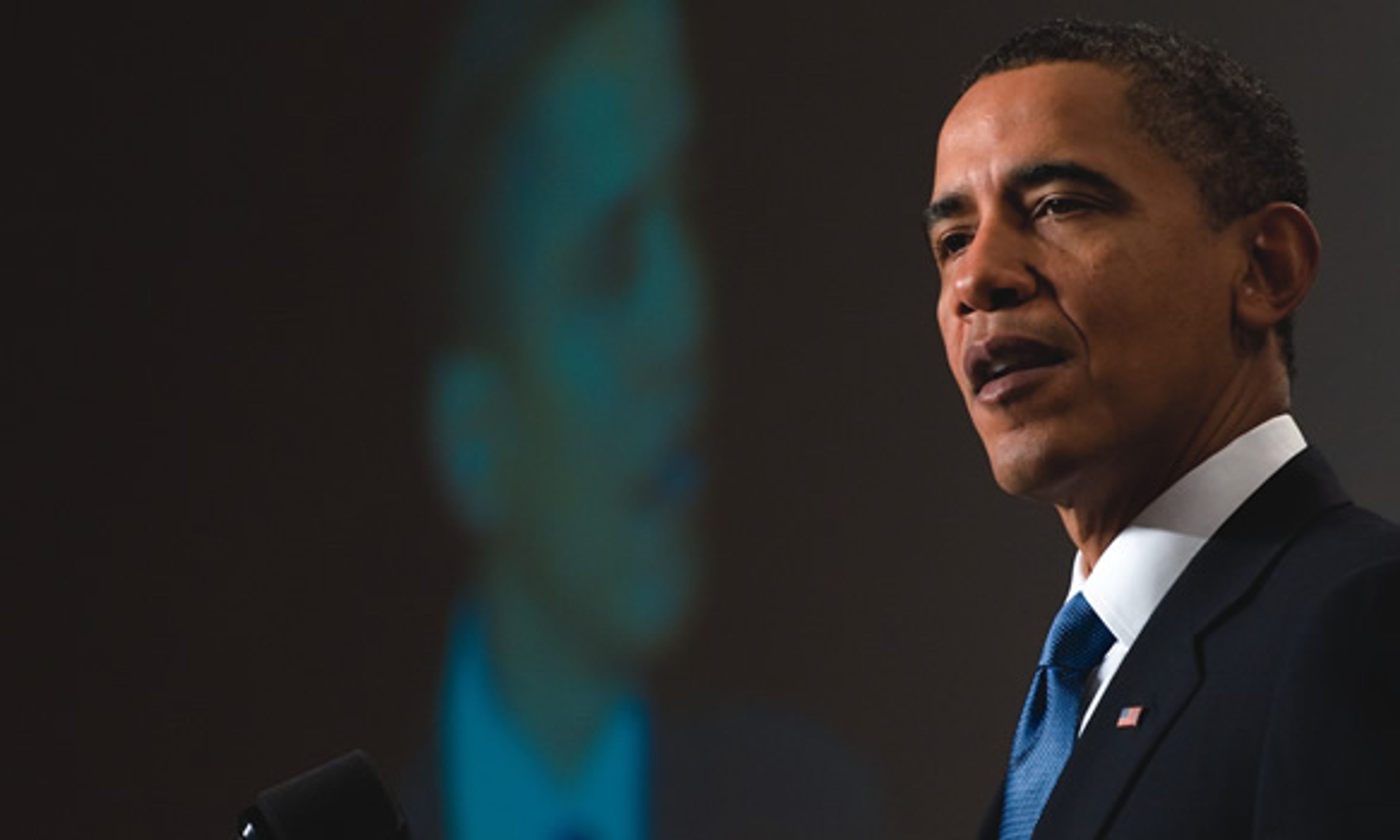
For almost two years, Barack Obama’s passionate acolytes on the hustings and in the media have been doing just that: sitting up, tongues out, tails wagging, begging for it. They’ve sat silently, drooling, as he spent the past twelve months giving interviews and speeches, “communicating” and “engaging in dialogue” and whatever other weasel words they came up with for trying to sell an increasingly skeptical public on a massive new government entitlement program with no believable method to pay for it.
He is, we all know, a remarkably eloquent man. His speeches thrill listeners; his cadences rock the house; people get chills; that sort of thing. And it’s the most boring piece of conventional wisdom to suggest that now, finally, the Left has its own version of “the Great Communicator.”
That Barack Obama, law-school teacher’s pet and professional gasbag, has convinced his fans on the left that he “communicates” well, that he’s another Reagan masterfully connecting with the deep-seated values and concerns of his audience, is all you need to know to explain the punch-drunk look on the faces of Nancy Pelosi, Harry Reid, and the rest of the Obama Rat Pack as they face the inconceivable: a president whose popularity is plummeting, and a party facing a robust thrashing in November.
Ronald Reagan wasn’t born the Great Communicator. He earned that title, over some pretty lean years, by hitting the road, making speeches, meeting people in unfashionable places, and eating disgusting banquet food. He would deliver a speech a day sometimes, to receptive audiences and not-so-receptive ones. He was cheered and booed and had good nights and bad nights — in other words, when he faced American television viewers in 1980 to run for president, he knew his audience. He had met them. In person. Where they lived, and gathered, and worshipped, and ate chicken dinners, and he knew what they cared about and didn’t care about. He knew how not to irritate them or, worse, bore them. It may seem like a trivial or superficial point, but there’s something exhausting and tedious about Barack Obama’s voice these days — he keeps talking, but he’s not hearing his audience start to shuffle out there in the dark, check their voicemail, finish their coffee, look at their watch, and head for the door. What kind of Great Communicator is that?
When unpopular, brittle Hillary Clinton decided to run for senator from New York, she didn’t go out on a speaking tour. She went out on something she called a “Listening Tour” — she hit the road, went to pancake breakfasts, sat in school auditoriums, did a whole barrel of things that were quite un–Hillary Clinton–like, all to earn her place at the podium.
We Americans prefer our politicians with a little stink on them. We like to see them eating bad barbeque and praying with people in bad suits. Political campaigns are a hazing ritual — the system is designed to weed out the snobs and the bores and to ensure that any soul who makes it through the bus rides and the town halls knows exactly what the deal is: Before you get to talk, you must shut up and listen.
Every now and then, though, someone slips through the system.
In show-business terms — and is there a better way, really, to analyze and understand American politics? — Obama made a rookie mistake. He let the applause die out. He didn’t keep the speech moving. He could have easily hopscotched along — alternating big-ticket entitlement initiatives with some smart centrist window-dressing — and ended up in a much stronger place.
Imagine, for instance, an alternative first-year plan: Obama announces a major health-care-reform initiative, garners the left-wing applause, then cleverly withdraws to allow the House and Senate to make the sausage. Meanwhile, he noisily endorses the get-tough-on-teachers stance of his secretary of education, Arne Duncan, to applause from a different part of the audience. Then, boldly, he announces a stimulus package in the form of a payroll-tax cut — something that would disproportionately benefit the working class — to baffled and stunned applause from tax-cut-loving right-wing nuts (like me) and a good piece of the tea-party crowd, all in time to circle back to health care and get his public option. He’d be looking at a first year of successes: blunting the opposition to his far-left agenda with an adroit tax cut, a giant step toward socialized medicine, and more important, the sense that the country was being led by a smart, canny, gifted politician.
Instead, this was his first year: a fat, greasy mess of a stimulus package, which has failed by any measure; political humiliation in Virginia, New Jersey, and Massachusetts; an energized and giddy opposition; a demoralized and mutinous Democratic party; and the worst possible outcome in show business: standing at the podium, alone, listening to the deafening sound that an auditorium makes when the applause dies out.
His audience once sat up in rapt attention, begging and drooling, but now sniffs at the ground, scratching itself in confusion, wondering what was so wrong about Hillary Clinton back in 2008. And the rest of us are sitting out here in the dark, in the silence, ready to stand up to the empty, exhausted suit in front of us and shout, “Hey, Obama, can we talk?”










Comments