From all of the uproar surrounding the Supreme Court’s recent decision in Citizens United v. Federal Election Commission, you would think that an activist Court had excised the Bill of Rights from the Constitution. New York senator Charles Schumer said that the Court had “predetermined the winners of next November’s election. It won’t be the Republican or the Democrats and it won’t be the American people; it will be Corporate America.” The New York Times editorialized that the Court had “thrust politics back to the robber-baron era of the 19th century.” Never one to shy away from hyperbole, MSNBC’s Keith Olbermann claimed that the Roberts Court had let Chief Justice Roger Taney — one of the great scoundrels of Supreme Court history for his decision invalidating the Missouri Compromise — “off the hook.” Citizens United, Mr. Olbermann growled, “might actually have more dire implications than Dred Scott v. Sandford.”
Olbermann’s commentary suggests that the Supreme Court willfully disregarded fundamental rights guaranteed in the Constitution. But the opposite is true. Citizens United actually protected the First Amendment right to engage in core political speech concerning federal elections, whether the speaker is an individual or a corporation. And it is doubtful that Citizens United will lead the country down the path to a second civil war, so Taney’s ignominious legacy seems safe.
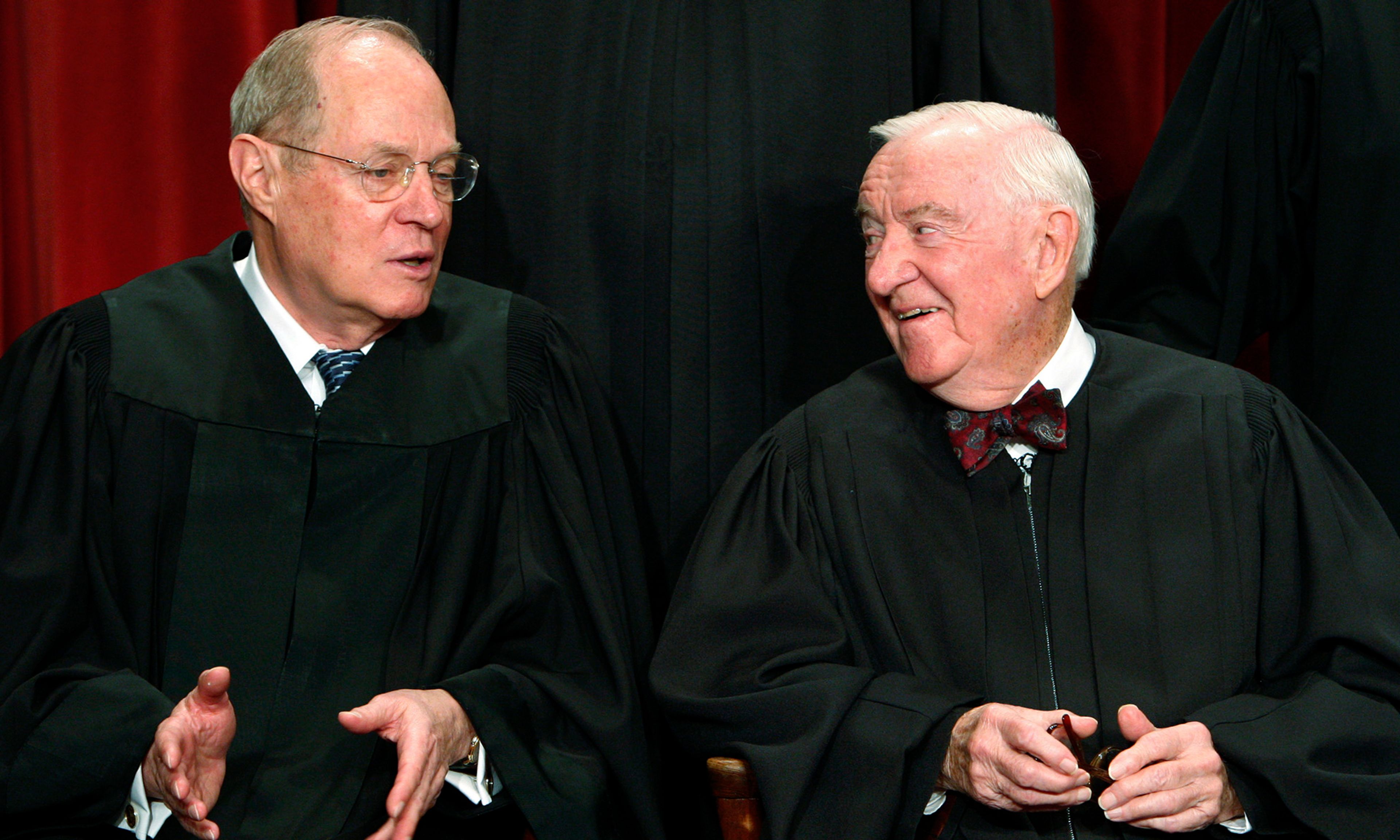
In a 5–4 decision authored by Justice Anthony M. Kennedy, the Court struck down as inconsistent with the First Amendment a federal election law that prohibits corporate and union “electioneering communications” — defined as broadcast communications within 30 days of a primary election or 60 days of a general election that clearly refer to a candidate for federal office. In so holding, the Court affirmed a longstanding principle — anathema to the Left — that “political speech does not lose First Amendment protection ‘simply because its source is a corporation.’” As Justice Kennedy reasoned: “When Government seeks to use its full power, including the criminal law, to command where a person may get his or her information or what distrusted source he or she may not hear, it uses censorship to control thought.” Such restrictions may not override “the freedom to think for ourselves.”
Outrage from liberals culminated in President Obama’s State of the Union address, during which he chided the Supreme Court for reversing “a century of law” and opening “the floodgates for special interests, including foreign corporations, to spend without limit in our elections.” Justice Samuel Alito, sitting in the audience, shook his head and mouthed the words “Not true.”
Obama’s suggestion that the Court had set aside a century of law was accompanied by complaints from several Democratic senators that Chief Justice Roberts and Justice Alito had strayed from promises made in their confirmation hearings that they would respect precedent — promises exacted in the hope of fossilizing decisions such as Roe v. Wade that are cherished by the Left. If the decision had, in fact, thrown out 100 years of settled law, those claims might have had a basis. But no less an authority than Linda Greenhouse, former Supreme Court reporter for the New York Times, dismissed the president’s criticism, noting that the century-old law prohibiting direct corporate contributions to federal candidates is still on the books and was not affected by Citizens United.
Citizens United did overturn, at least in part, a pair of more recent Supreme Court decisions, but these date only to 1990 and 2003. In Austin v. Michigan Chamber of Commerce, the Court, for the first time in its history, supported restrictions on independent corporate expenditures made in connection with elections. This 1991 decision upheld a state law prohibiting any corporation from spending funds on advertising in support of a candidate for state office. Based on that decision, in 2003, a closely divided Court upheld, in McConnell v. Federal Election Commission, the very “electioneering communications” ban challenged by Citizens United.
Neither Austin nor McConnell could claim a mantle of firmly established precedent placing it beyond re-examination by the current Court. Indeed, Justices Kennedy and Scalia dissented in both cases, arguing that the decisions were inconsistent with Supreme Court precedent affirming the First Amendment right of corporations to participate in the political process. In its 1978 decision in First National Bank of Boston v. Bellotti, the Supreme Court invalidated a Massachusetts law that prohibited corporate expenditures intended to influence any state ballot referendum not materially related to the corporation’s business interests. Bellotti unequivocally held that the discussion of public affairs, whether by an individual or a corporation, lies at the heart of the First Amendment. The Bellotti Court reasoned that the government may no more tell a business to “stick to business” than it may tell religious, charitable, or civic associations to stick to their own businesses when addressing the public. Citizens United merely realigned First Amendment law with Bellotti’s protection of the political speech of both individuals and associations of individuals in a corporation.
What of President Obama’s claim that Citizens United opens the floodgates to foreign corporate influence over federal elections? It is simply untrue. Citizens United invalidated a single provision of the Bipartisan Campaign Reform Act prohibiting independent corporate and union expenditures in connection with a federal election. It left in place the prohibition on direct corporate contributions to federal candidates. A separate, undisturbed statute prohibits foreign corporations from involving themselves in federal elections through direct contributions to or independent expenditures for or against federal candidates. The statute also forbids these foreign corporations to do indirectly what they are prohibited from doing directly. And, lest there be any doubt, Federal Election Commission regulations prohibit any foreign corporation from “directly or indirectly” participating in the decision-making process of any U.S. corporation concerning its federal-election-related activities. In short, current law, unaffected by the Citizens United decision, already prohibits a foreign corporation from seeking to influence U.S. elections, either directly or through a U.S.-based subsidiary.
More important, the Court explicitly said that it was not addressing the question of whether the government has a compelling interest in preventing foreign influence over our political process, and nothing in the decision could be read to bless such influence. The government certainly has a much stronger interest in preventing foreign influence than in preventing citizens from pooling their resources to speak through a corporation about public issues, and the corrupting influence of the former is much more apparent than that of the latter.
The irony in the Left’s outrage at Citizens United is that the decision protects some of the most powerful liberal voices. The New York Times, the Washington Post, MSNBC, and other mainstream media outlets are no less corporate in nature than Citizens United, which had sought to produce and distribute Hillary: The Movie during the 2008 primary-election cycle and been barred from doing so. Given their sheer size, one might argue that these companies pose a greater threat of distortion to federal elections than a grassroots nonprofit corporation. The reasoning that would prohibit Citizens United from distributing an anti-Hillary documentary on the eve of a primary election could also prohibit the New York Times editorial page from endorsing a candidate in a presidential election.
To date, Congress has expressly exempted the mass media’s editorializing from election-speech bans, but the First Amendment would not prevent Congress from lifting those exemptions if the critics of Citizens United had their way. It is doubtful that the same editorial boards that have criticized Citizens United would laud a decision upholding restrictions on their right to opine in the waning days of a campaign, when their endorsements might have the greatest impact. Fortunately, the Court’s decision does not leave to politicians the decision of where the line between legitimate and to draw illegitimate speech or speaker.
If there’s one truth in Washington, it is that money will find its way into an election. Though designed to lessen the influence of “special interests,” the Bipartisan Campaign Reform Act spawned well-lawyered workarounds. It gave rise to “527” organizations such as MoveOn.org and Swift Boat Veterans for Truth, which kept the spigot of special-interest funds open. In the 2004 election cycle, a mere 24 individuals contributed $142 million to such groups. And despite the prohibition of electioneering contributions from unions, labor’s money also continued to flow to campaigns through union political action committees and get-out-the-vote drives. The Service Employees International Union alone spent more than $85 million in the 2008 cycle. In a video commemorating the Obama administration’s first hundred days, its president bragged that “SEIU is on the field, it’s in the White House, it’s in the administration.”
Citizens United won’t change that. But it will guarantee that Congress does not decide which voices — big or small, rich or poor — should be favored in federal elections. It may, by its own force, streamline the morass of federal election regulation. And in a battle between more than 500 pages of federal election regulations and these ten simple words — “Congress shall make no law . . . abridging the freedom of speech” — a blow for simplicity is long overdue.











Comments